Showing posts with label Photography. Show all posts

Thursday, January 16, 2014

Frank Carpenter: World Traveler and Photographer

Over on the Facebook page for this blog I’ve been posting a series of pictures this week I’ve simply sourced as “Library of Congress”, but the source goes much deeper than that.  The pictures are wonderful depictions of world scenes beginning in the 1890s through the 1930s. I’ve featured some here.

The collection was put together by Frank and Frances Carpenter, a father-daughter team, during their world travels. The photos were used to illustrate his writings regarding travel and his world geography textbooks.

I love to snap pictures myself. Over the last five years I’ve taken approximately ten thousand photos, myself, but over his lifetime no telling how many photographs Frank Carter produced. The Library of Congress collection contains 5,400 photos in albums, 10,400 loose photos, and 7,000 glass and film negatives.
 
 
Frank Carpenter was a journalist whose assignments took him many interesting places.  Being a writing myself, I love the fact that he took his interest in travel and photography and more or less created a job for himself.

He took a trip around the world from 1888 to 1889. During that time he wrote a letter per week that was published in twelve different periodicals which led to more letter-writing travels.
Where can I get a job like that?


Not only were Frank Carpenter’s geography books used in schools for over 45 years, his writings helped to popularize cultural anthropology and geography.
Carpenter died a millionaire, but not necessarily from his writing and photography. He used his money to invest heavily in real estate in the Washington D.C. area, and at one point was then able to fund his world travels and photography “habit” on his own terms.


Frank Carpenter died in China during his third trip around the world.

Use the “like” button above in order to join the history conversation on Facebook and view more of Carpenter’s fantastic images.

Wednesday, November 14, 2012

Mixed Images...One Powerful Message

Look at this picture.  Observe it very carefully.  You can click on the pictures to isolate them and make them a little larger


Yes, you see soldiers proceeding up a street, but notice that you are actually looking at two images…..one from World War II and another from more contemporary times of the same location.
A historical mix…of sorts.

Think about the impact this could have on students of history.  Think about the connections that students could make between historical content and their surroundings.
These pictures are the work of historical expert Jo Teeuwisse from Amsterdam.  This article from the Daily Mail states she began superimposing images from different time periods of the same location after finding 300 old negatives at a flea market in her home city depicting familiar places in a very different context.

Here is a second example of her work.......


Like Miss Teeuwisse I think this process of making war scenes or any historical image have meaning by linking it to a more familiar image heightens the impact. As she states, “knowing the exact spot of some detail will etch it into your visual memory.”
Teeuwisse’s work isn’t just as simple as layering photographs, however.   She researches daily life before and during the war, interviews eye witnesses when she can and recreates certain aspects of history to gain a unique insight into that area.

Isn’t that something than any history teacher worth a grain of salt wants to do with their students?  
Of course…..part of our job description is to help students gain unique insight into the historical content we present to them.

Click through to see the pictures presented with the Daily Mail article.  Also visit the Ghosts of History Flicker page and the Facebook page here.
I’m thinking the process of superimposing images from various historical times …..The Civil War, Civil Rights and not just World War II would be a valid project for students with a little planning and guidance.

What do you think?

Saturday, May 07, 2011

Signs of the Times

I found out this morning in a roundabout way the high school I graduated from will be hiring an art teacher for grades 4, 5, and 6 for the fall. The teacher will be employed full-time and will teach darkroom photography and printmaking to elementary classes.
Yes, you read that right.


Students in upper elementary grades will be learning darkroom photography and printmaking.


First of all, I don’t have to tell you the economic climate of the United States over the last couple of years hasn’t exactly been agreeable to many in the teaching profession. Education has experienced delays with contracts, budge cutbacks, and programs have been pared down or cut out all together. Teachers have been required to take furlough days and in many instances positions have been deleted totally.


Art and music have been hit especially hard in public school systems. Unfortunately, they always seem to be the first programs to go when there are money issues.


I doubt there are very few public schools today teaching darkroom photography and printmaking to any class let alone a class of young children, and of course, one of the main reasons Woodward Academy can afford this “extra” for students is Woodward is one of the top private schools in the Atlanta area.


Still….


What a terrific opportunity to teach what may be a dying art. Bob Smith, a local photographer in my neck of the woods states, “This is interesting …I guess it’s great to expose them to the way [photography] used to be done, but in ten years, they may have to buy the chemicals themselves to do the developing. I wonder what types of film will still be sold in ten years. You have to go to professional photography shops……just to buy old 120 film that went in every camera since World War II…and they have to wait on the manufacturer to produce the next allotment.”


Think about the implications for teaching history by having a darkroom photography and printmaking class. Even our youngest students are familiar with digital cameras. Many are very savvy with the Internet, camera phones and Photoshop. They know modern photography, but by teaching older methods students can learn about the methods of Mathew Brady whose Civil War images still get history students involved directly in the war.


Students can view this image….a street scene by Nicephore Niepce, one of the earliest photographic images from 1826. The method used for this print is called Heliogrgraphy, which means ‘sun writing’. The process took eight hours of exposure time…..notice the light is on BOTH sides of the street.


This image is an iconic one showing the damage from the San Francisco Earthquake in April, 1906 by Arnold Genthe. 

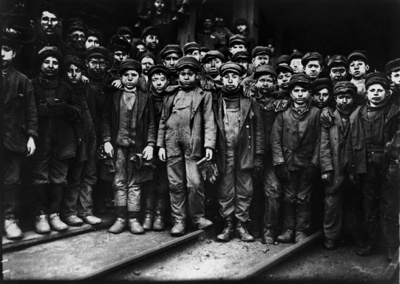
Young students can relate to this image since the age of these young boys is close to their own.  The title of the photo is “Breaker Boys”.   Lewis Hine used his photograph to change life for children all across the United States in 1910.   Breaker boys were employed in coal mines to separate the coal from slate.   Hine travelled the country taking images of child laborers.   Soonafter, a law was passed outlawing child labor.


The next image is the most famous of the four I’m featuring here.   Who hasn’t seen this haunting image of Florence Owens Thompson taken by Dorethea Lange in Oklahoma during the Great Depression in 1936?  It's called "Migrant Mother."


Photography is a powerful way to study history. Images of the past are signs of the particular times we are viewing. We can see how things looked, how people dressed, and how they wished to portray their present for future generations to see.


Historical images are great hooks to draw students in, and what better way to draw them in further than by teaching photography methods that seem to have gone by the wayside in many circles.


In today’s digital world anyone can snap an image and manipulate any way they wish and in doing so they can call themselves a photographer. Mr. Smith states, “I have a pro version of Photoshop CS4 now, and I can take a DSLR color photo and make and make it look like an old fine art black and white print from 60s. I can burn and dodge the photo just like Ansel Adams except it is digital and not like taking your hands to block out the light when the print is being exposed to the negative like Adams did.”


I have to agree.


Where is the knowledge….the craft, and does it suffer at the hands of technology?


Signs of the time, indeed.