Sunday, December 04, 2011
Static History...It Doesn't Exist
Sunday, November 13, 2011
Polking....Yes, Polking the Liberty Bell
Monday, November 07, 2011
Claudius Smith and His Band of Cowboys
Smith lived in Smith's Clove...an area of New York more than likely named for his family. The area is known for its ponds, streams and mountain gorges making up what is also referred to as the Ramapo Valley. Today the area falls under the jurisdiction of Orange County, New York and the county seat is Monroe - named for President Monroe. The area also has the distinction of being the birthplace of Velveeta cheese.
No joke.
During the American Revolution the Smith's Clove area was bisected by important trade routes. It was the perfect place for Claudius Smith to conduct guerilla warfare, but instead of helping the Patriots, Smith helped the British.
Yes, Claudius Smith was a Tory, and his actions built up quite a reputation stealing livestock and ambushing travelers on the Orange Turnpike between Canada and New York. His exploits earned him the nickname "Cowboy of the Ramapos" since he stole so many cattle. His band of men - including three of his four sons - were known as "The Cowboys."
To some, Smith was just a Robin Hood type targeting the wealthy while being generous to the poor, but it is documented he comitted acts of banditry, burglary, horse stealing and the murder of American Army major, Nathaniel Strong.
The governor of New York, George Clinton issued a warrant for his arrest. The wanted poster stated Claudius Smith was "accused of stealing money, pewter and silver plate, saddles, guns, oxen, cattle and horses." Often these items and livestock were sold to the British.
The warrant went on to state Smith ambushed John McLean, a messenger being sent to George Washington along the road and stole his dispatch, beat him and tied him to a tree by the side of the road.
The murder charge arose when Major Nathaniel Strong was found lying dead with two projectiles in his neck and head on October 6, 1778. Witnesses including Strong's wife testified that Claudius Smith and his band of Cowboys broke into Strong's home to burglarize it and ended up killing the major in the process.
Smith was eventually captured on Long Island and hung in 1779 in Goshen, New York. His last request was to remove his boots because he wanted to prove his mother wrong. She had always told him his activities would cause him to die with his boots on.
Smith's son, James, was executed at Goshen soon after his father. It is also reported that a second son named William was killed prior to his father's hanging and the youngest son was actually able to escape with other members of the band to Nova Scotia after peace was finally declared.
Most of the booty Smith and his Cowboys stole were stored in various caves throughout Smith's Clove. One cave in particular has been identified as his hide-out and is known as "Claudius Smith's Den". It's located in Harriman State Park and is pictured with this post. Legend has it that Smith's spirit guards the cave's entrance.
Claudius Smith was buried in what is now known as Presbyterian Church Park. Rumor has it that at some point in 1842 the church made some changes to the grade level in the cemetery and some graves were disturbed. Because of his rumored height (some said he was nearly seven feet tall) Smith's bones were easily identified and certain members of the town took them as their own. Apparently his skull was treated as a trophy and stored in a meat market until the new courthouse was completed. The skull was filled with cement and walled up about the main entrance to the courthouse. The town's leading blacksmith also took Smith's wrist bone as a trophy. Apparently it was passed down for years to other family members.
I'm thinking that would be an inheritance I would like to avoid. What about you?
Tuesday, August 25, 2009
Thars Gold in Them Thar Hills!
Sadly most American classrooms don’t mention gold in relation to North American history until the 1840s are discussed ….you know the drill….American River, John Sutter, Forty-Niners, San Francisco.Three American History books aimed at fourth and fifth grade and two books for high school I have at my disposal all tell the tale of the discovery of gold in California along with the large numbers of people who headed to the region to get rich.
Students examine how the gold-miner wannabees reached California. In some classrooms the situation is used to teach a bit of economics regarding the law of supply and demand and of course, Levi Strauss is always brought up regarding his contribution to the blue jean industry. Other points are also brought up. For example, the Gold Rush in California caused discrimination since so many ethnic groups ended up living close together, yet it also increased the population to the point California became a state in 1850.
The California Gold Rush a valid point in American history that should be taught. I have no problem with it per se, but what about other gold rushes?
What about other great finds of gold other than the one that occurred at Sutter’s Mill?
Poor little Conrad Reed is often shortchanged in the credit department regarding history, and I’m really not sure why. I’m mean afterall….one of the ways we interest kids in history is by pointing out that kids make history just as often as adults….and little twelve year old Conrad made history in the best way possible.
One day in 1799, while walking along the creek bed on his father’s farm in Cabarrus County, North Carolina little Conrad found a rather large rock….actually it was a nugget of gold, but no one realized it for three years while the nugget served as a door stop. At 17-pounds it was a rather large nugget, and once it was identified as gold, Conrad’s discovery ushered in the very first North American gold rush.
Yes, the very first gold rush was not in California….it was in the South.
Part of teaching the American Revolution, of course, involves introducing students to the use of Hessian soldiers by the British, but what we rarely tell students is sometimes the Hessians remained in the newly formed United States and contributed to American society in different ways. Conrad’s father, John Reed aka Johannes Reith (one suggested spelling), was one of those Hessians who stayed behind after the Patriots won independence. During the war Reed had actually abandoned his post outside of Savannah and never looked back.
While John Reed might have been an excellent farmer he was very uneducated in the gold department and allowed a jeweler to purchase the nugget for $3.50 (a whole week’s wages at that time) and only later discovered the nugget was actually worth $3,600.
Not wanting to be taken again Reed began mining gold on his property and soon after a slave by the name of Peter found a 28-pound nugget. At his death in 1845 John Reed died a very rich man.
You can visit the Reed Gold Mine site here.
American Philatelist has an interesting article here regarding gold mining in North Carolina.
Friday, January 30, 2009
From Eye of the Beholder to Presenting History Accurately
As a born and bred Southern woman with a long line of dirt poor farmers in my past, and as a teacher and writer of history charged with presenting the truth, I often find myself in the sticky conundrum of a damned if you do and damned if you don’t situation regarding historical events as well as the social/cultural ideals that still haunt and permeate my southern homeland.I’ve written here before regarding the yearly pattern of Open House at the beginning of the year when I inevitably have white parents wanting to know if I teach the truth about the Civil War, and I have just as many black parents wanting to know the same thing.
Basically they want to know if I’m going to teach their children whatever it is that they believe regardless of the truth.
Some want to make sure I teach that the issue of slavery and only the issue of slavery caused the terrible split in our country that resulted in so many lives lost and the destruction of so much property….not to mention rifts that continue even to this day.
Others want to make sure I’m someone who really knows the truth…the war was all about economic differences and that damn tariff.
Both sides have a point…both sides are right.
The Civil War was not caused by one single thing, but a list of many different things.
Some get too caught up in the romanticism of the Lost Cause moping about as if they are Ashley Wilkes while others are Big Sam or Pork (refer to Gone With the Wind if these names aren’t familiar to you) still looking for the forty acres and a mule. Those romantic types find it hard to accept and qualify the facts that slave holding was not a charitable occupation taken on by well meaning whites. It was a horrendous and nasty business that resulted in splitting families, forcible rape at times, unwanted and sometimes unaccepted bi-racial children, and a long list of other social by- products that sadly in some cases still exist today.
Not only do we wrangle over how Civil War issues are taught….we wrangle over how they are remembered as well. Some feel those in the South are wrong to erect monuments to Confederate dead….name schools and other buildings after slave owners…while many strongly advocate for their rights to remember Southern officers, officials, and leaders.
While every aspect of an event should be analyzed by students in a history class, at what point do educators move from presenting material to be analyzed in a fair and equal manner to presenting material that is compromised with personal viewpoints or too much information leaning towards one side?
At what point do we sacrifice true and honest historical remembrance for what we think we believe…for what we want to believe….for what might fit a certain modern agenda without thinking about the context of the times?
Finally, I have to ask….when we depend upon those maintaining historical sites to provide locations for students to learn about history where the history actually happened are we making sure those sites present a whole story or are we satisfied with just a story that sounds nice to make some people feel better?
During some recent research I stumbled upon a situation in Georgia during the 1840s that split the United Methodist Episcopal Church into northern and southern factions. The cause of the split was opinions regarding slavery.
The location in question is Oxford, Georgia….a place Dr. Mark Auslander discussed in his paper, Paradoxes of Blood, Law, and Slavery in a Georgia Community (2001). Oxford , as Dr. Auslander refers to it, is the birthplace of Emory University. The grounds are now the home to Oxford College and is a designated “shrine” of the Methodist Episcopal Church.
In his paper, Dr. Auslander, goes on to relate the tale of James Osgood Andrew, first president of the board of trustees of Emory College, who was at the center of the split in the Methodist Church in the 1840s. I have written more about the church split over at Georgia on My Mind in my post The Methodist Split According to Andrew.
From that particular post I relate:
We end up with a clergyman who finds he owns slaves but didn’t purchase them…yet he can’t free them because he will then be in violation of state law and subject to fines and arrest. He could sell the slaves under his ownership, but they might wind up in a worse condition with a with a master who would treat them poorly…as if being a slave wasn’t poor treatment enough. To make matters worse Bishop Andrew then becomes the focus of the split of the Methodist Church.
Bishop Andrew did lead the Southern churches in their split. Later he became the first bishop of the newly formed Methodist Episcopal Church, South. During the Civil War he resided in Alabama and retired from his post in 1866. Bishop Andrew is buried in Oxford, Georgia and is remembered as the namesake for Andrew College in Cuthbert, Georgia.
Dr. Auslander’s paper zeroes in specifically on one particular mulatto slave Andrew inherited when she was twelve years old named Kitty. Today, visitors to Oxford can visit Kitty’s gravesite located in the long segregated white cemetery where many white citizens insist Kitty is the only person of color buried in the cemetery. In fact, the memorial headstone placed there was done by an all white private foundation and is known as “Kitty’s Stone.” Per Dr. Auslander’s paper the stone was updated in the 1990s.
Dr. Auslander relates…..in the standard white version of the story, Kitty was inherited by an unwilling slaveholder….after she voluntarily refused manumission (conditional on transport to Liberia) at age nineteen in 1841 she was allowed by her benevolent owner to reside in a house that he built for her, adjacent to his own house. There, he alledgedly told her, “you may live as free as I am.” In time, the story goes, she married a free African-American man [by the name of Nathan Shell] and bore him three children before her death in the 185os.
Dr. Auslander explains that there are other tourist hotspots regarding Kitty including …the carefully restored house, in which Kitty alledgedly once lived…renovated by a predominately white local historical society. Both the home and the cemetery are often spoke of , by whites, as the most important historical sites in the county.
In white versions of the story, Kitty refused manumission when it was offered to her in 1841 and was allowed by her master, Bishop Andrew to reside in her own small cottage behind his mansion in de facto freedom. There, it is said, Kitty “looked after” local children, white and black, and treated them with warmth and respect.
Dr. Auslander further relates:
Not surprisingly, African American families in Oxford have a rather different relationship to the Kitty legend. My oldest African American informants recall hearing from the “old people” of the community that Kitty was Bishop Andrew’s coerced mistress, and that Andrew was the covert father of her children, whom he never acknowledged.
Some profess to be bored by the whole business, which they regard as a puzzling (or, at times, offensive) white obsession. Still others critique local white fascination with Kitty and with the restoration of her small house (referred to as “Kitty’s Cottage” by most local whites) as an attempt to paper over the horrors of slavery and evade the full accountability for the city’s antebellum slave-owning history.
Yet for all the manifest contrasts in white and African-American renditions of the narrative, and their strikingly different responses to spaces in which the story is memorialized, are these mythic accounts entirely distinct from one another?
In addition, many African American women and men with whom I have discussed the matter express a desire to see the matter closed, once and for all. A middle aged African American woman sighed, when the Kitty question came up, “Isn’t it time we all talked about something else? We have to get beyond all that”…An older African American man grew very quiet when the conversation briefly turned to Kitty. ….He noted softy, “Sometimes, you know, the dead just need to stay good and buried.”
Finally, Dr. Auslander discusses those in the African American community who are intensely interested in researching, uncovering and broadcasting the “true facts” of the Kitty case [stating that they] find themselves facing fundamental challenges of space and geography. Many note that whites have in effect, colonized the only places where Kitty’s story could be retold, especially her cottage and the supposed gravesite. As one African American woman remarked,”Ok, let’s say we really could prove everything about Kitty and Bishop Andrew, with DNA or whatever. Where in Oxford would we ever get to tell the truth? Put on a display? Where is there? You tell me.”
Since the 1930s, her “cottage” and grave have come to function as veritable pilgrimage sites for thousands of Georgia’s white residents, including weekly busloads of schoolchildren brought in for “educational visits” from throughout the state.
One female tour guide observed to a group of schoolchildren, “You know, Miss Kitty was loved by Mrs. Andrew as if she were her own flesh and blood. And Kitty felt the same way about the Andrew children. That’s the way it was in those days, people just took care of children your age, they could just go in and out of people’s houses like they were in their own, and be fed, and loved and looked after. That’s the way things are supposed to be. But is that how we live now?”
As one white woman noted, “Kitty’s story reminds us how families used to be, and how things still should be.” Since the late 1990s, many local white families have volunteered time, money, and effort to help restore Kitty’s former residence (a process that has so far, has not included any African American residents of the town.)
Somehow I don’t think Kitty’s Cottage is a place I would put on my list of approved field trips for my students unless I prepared them in advance to challenge the docents in their interpretation of slavery regardless of the bonds that might have and did sometimes develop between whites and blacks. I would also prepare my students to challenge statements made based on historical facts to back up so called stories no matter which side was painting the picture.
Where are the letters? Where are the diaries and journals? Where are bona fide interviews?
Most importantly……where are both sides of the issue?
Monday, September 08, 2008
Seen Here, There and Everywhere
Over at the AHA Blog (American Historical Association) reading list was published that included some interesting things—a link to a dicussion regarding the argument comparing academic resources and Wikipedia, a link to a site where you can compare the topography of Washington D.C. from 1791 to today, and for a little chuckle you can read how The Book of Secrets has made it home again to the Library of Congress
Mark Grimsley over at Blog Them Out of the Stone Age has reviewed the book
The Rifle Musket in Civil War Combat by Earl J. Hess. Grimsley states, “No kidding. If you think of yourself as a serious student of military history, this is one book you need to read—sooner rather than later.”
Via Chris Wehner at Blog 4 History I found this cool site called (formMy Year of Living Rangerously formally Volunteer in the Park). Mannie, the Ranger, works at the Antietam Battlefield site and he has posted The Sunken Road in 55mm….a recreation of The Bloody Lane, September 17, 1862.
JL Bell from Boston, 1775 is doing some great research on Declaration of Independence signer Richard Stockton comparing and contrast primary and secondary sources.
Kevin Levin over at Civil War Memory is once again writing about myth and memory and how they relate to actual events in Southern Heritage and Me. Kevin states, “No doubt, I am often perceived as an outsider whose purpose is to denigrate the people of the South and Southern Heritage. The outright attacks and/or suspicion, however, have only added to my curiosity about the blurred relationship between history and memory as well as the importance that people and certain organizations place on maintaining and defending certain views of the past.”….. “The interesting question, however, is when those modes of remembrance distort the past and serve to fuel our own contemporary values, interests, and insecurities. In other words, at what point do we leave the realm of history and enter the world of mythology and story-telling, and is it possible to achieve a healthy balance between the two? “……”It's not that I am challenging or questioning Southern heritage, it's that I am looking into or questioning one among any number of ways of remembering the past.”
As a Southerner myself I find it often difficult to write about my ancestors or other historical figures and relate their Confederate beliefs without coming myself as as supporter or making it into some romantic mythological tale. It is a fine tightrope I walk in that instance.
Finally, I posted a new entry over at The American Presidents Blog concerning Jimmy Carter and some of the challenges he had to overcome during the 1976 Presidential Campaign.
Monday, October 22, 2007
Digging For the Truth: Who Built Great Zimbabwe?
As early as the 1500s Portuguese writers passed along tales of a great stone complex located far inland on the African continent. One writer in particular, Joao de Barros, a Portuguese historian, referred to the stone complex as Axum, the fabled city of the Queen of Sheba. Other writers theorized the complex was Ophir, which is said to be the place where the Queen of Sheba acquired the gold for Solomon’s Temple. Unfortunately in the 19th century archeologists were more concerned with ignoring evidence and rewriting history to fit their own racial views.Adam Renders, an American-born German hunter and explorer found the stone remains in 1867. He found structures built with granite slabs that fit so tightly together that there was no need for mortar.
In 1871, Carl Mauch, a German geologist, hypothesized that a section of the complex other archeologist refer to as the Great Enclosure was built especially for the queen.
Many of these 19th century archeologists found it difficult to admit Africans themselves had the know how to build such an intricate set of structures. Adam Renders stated Great Zimbabwe “could never have been built by blacks”. Cecil Rhodes, the architect of British imperialism, visited the site in the 1890s where he advised Bantu chiefs that he had come to see “the ancient temple that once upon a time belonged to white men.”
Theodore Bent, who was hired by Rhodes to work the Great Zimbabwe site thought the complex had been built by “a northern race coming from Arabia…” He was referring to the Phoenicians or Egyptians.
White explorers and archeologists continued to believe and promote the dribble even when there was clear evidence that local people had inhabited the complex for some time. There were no artifacts found that would have given evidence to whites building or living at the complex. Artifacts that were found included pottery relics, bronze and copper spearheads, adzes, axes, and tools for working with gold, and they all pointed to the Bantu people.
Finally, in 1906, David Randall MacIver began to see the light. He stated the complex was “unquestionable African in every detail” describing mud dwellings belonging to a period “which is fixed by foreign imports as, in general, medieval.” His findings did not sit well with British Imperialist who basically banned further archeological study of the site for approximately
twenty-five years. Once myths take hold, however, they are hard to eradicate. In the 1960s, Ian Smith controlled a minority white government that broke away and became Southern Rhodesia. The falsification of Great Zimbabwe continued. Guidebooks were printed that showed tribal leaders bowing low to Europeans. Visitors were led to believe Great Zimbabwe was built by Europeans. Rumors continued that Great Zimbabwe was built and maintained by foreigners continued until Zimbabwe’s independence in 1980.
Radiocarbon dating in the 1960s shows The Great Zimbabwe is not ancient, but there is no evidence that is was built or inhabited by white men. An accepted view today is the complex was built by the Shona who are the ancestors of the Bantu people.
References consulted for this post include Great Zimbabwe by Peter Gazlake (1973) and The Atlas of Holy Places and Sacred Sites by C. Wilson (1996)
Wednesday, October 10, 2007
Myth Bustin' Columbus....13 Style
This past Monday was our annual remembrance of Christopher Columbus. For his name to be so recognizable most people know very little about him and there is a very likely chance that what they do know is actually false. Here are a few of the more common myths and facts regarding Christopher Columbus.1. Christopher Columbus was Spanish. Well, it would make sense since Columbus sailed under the Spanish flag, but the long term story is that Columbus was born in Genoa, Italy. However, there are many other theories that have linked Columbus to a Jewish background, the island of Corsica, and even a Viking background.
2. The main goal for the first voyage was to prove the Earth was round and not flat. This is a false statement. By 1492, most of the educated people in Europe understood the Earth was a sphere. However, there was a great debate regarding just how big the planet really was. Even Columbus had to readjust his views after completing that first voyage.
3. The crews on board the Nina, the Pinta, and the Santa Maria were filled with cut-throat criminals. While records indicate that amnesty would be granted to those who would undertake the voyage very few criminals applied for a pardon.
4. The only reason Isabella and Ferdinand of Spain agreed to fund the journey is Columbus stated he would spread Christianity to those he encountered. While there are iconic paintings of Columbus and his men landing in the New World with a priest in tow there were no clergymen on the first journey. By the second journey five priests had managed to tag along. In the picture above the priest is seen clutching the Bible behind the standard.
5. Columbus is buried in Santo Domingo. This is not necessarily so. Many records conflict this by stating his remains were moved. Maybe he is in several locations. The primary resting spot is the Cathedral of Seville in Spain. The tomb is pictured below. Santa Domingo, Genoa, and even Cuba are also mentioned in various sources.
6. Columbus discovered North America. Not quite. He was searching for a faster route to the Orient than the overland Silk Road. His theory was the Orient could be reached from Europe by sailing west. He landed in the Caribbean Islands and at no time did he ever set foot on the continent of North America. Columbus actually thought he had landed in the Orient and had no clue North or South America even existed.7. Columbus was the first man to reach the New World. This is also false. We have many sources that indicate there were plenty of visits and near visits to North and South America before Columbus such as visits by the Vikings and the Chinese explorer Zheng He. Knowledge regarding these initial visits in no way decreases the importance of the efforts of Columbus. He should be remembered because his voyages inaugurated the first permanent contact between the East and the West.
8. The Spanish monarchy had to sell the crown jewels in order to fund the journey. Actually, it is believed Queen Isabella and King Ferdinand cut a deal with the city of Palos so that the citizens there could replay a debt to the crown. The debt covered the cost of two of the ships. There was also some Italian funds that backed the trip as well.
9. I learned in high school Columbus died from syphillis. Did you? That’s not correct. While he had poor eyesight and gout Columbus did no die of syphillis. The disease was in Europe after 1492, but Columbus did not have it.
10. Columbus died in prison. This is also false. He actually died on May 20, 1506 in Valladoliad, Spain. At one time he was in chains at the end of his third voyage, but upon landing in Spain a misunderstanding was cleared up and the chains disappeared.
11. Women were never allowed on the voyages, and horses did not arrive in the New World until the conquistadors. Actually women did travel with Columbus on his third voyage. There was one woman for every ten emigrants. Horses, however reached the New World before women. They came over on the second voyage.
12. Many believe Columbus arrived with several hundered men, but that’s not true either. The
ships he used were very tiny compared to today’s standards. They were probably no bigger than a tennis court and were less than 30 feet wide. The Santa Maria had a crew of 40, the Pinta had 26, and the Nina had the smallest crew with 24 men.13. On that first voyage only the Nina and the Pinta returned triumphantly to Spain. This is fact. The Santa Mara was shipwrecked around Christmas in 1492. Thirty-nine members of her crew volunteered to stay behind at La Navidad, a fortress that was built on the northern coast of what is today the island of Haiti. Unfortunately all of these men were killed by natives. They were upset because the Spaniard s had mistreated them
Visit other Thursday Thirteens here.
Monday, October 08, 2007
Washington Slept Here
You know the old saying, “Washington slept here”, don’t you?So many places over the years have tried to cash in on the George Washington name that if he actually slept in all of the places people claim it’s a wonder we won the Revolution.
However, I’m not referring to George Washington in my title. Instead my subject matter is Washington Irving, the American author and one time U.S. ambassador to Spain. Just like his namesake it seems he has a plaque as proof he slept somewhere as well....
Last week’s wordless image was correctly identified by Grift Drift. The structure was indeed the magnificient Alhambra Palace in Spain. Washington Irving was the connecting factor between the Alhambra and our own history and literature. Irving actually resided in the Alhambra for a time while he was doing research for some of his writing including a book about Columbus. Many history scholars point to Irving’s work concerning Columbus as the basis for the very incorrect idea that the first voyage of Columbus was an attempt to prove the Earth was round. Irving is also one of the original sources for the whole "so help me God" issue I’ve written about before.
You can find out more about Washington Irving and his home named Sunnyside if you wish.
Though it may not always fit with the school system’s prescribed flow of content I generally preview American folklore with students during the second half of October using my Language Arts class to introduce Social Studies topics to students.
Halloween is the perfect time to lose ourselves in the stories of Rip Van Winkle and The Legend of Sleepy Hollow by Washington Irving.
Irving traveled greatly and it would seem he was most inspired to write about America when he was away from it for long periods of time.
Once when I wrote the term "romantic history" on the board I heard giggles, twitters, and rustlings throughout the room. I smiled and said, “Ok, what’s got everyone excited?”
One young lady volunteered, “Well, what’s so kissy-kissy about history?”
“Who said we’re going to talk about kissy-kissy?” I responded. I ended my remark by making loud kissy noises with my mouth. Several young men responded with choruses of “Ugh!” and “Gross, man!”
“Ok, first of all we are not talking about the history of love but a treatment of history.”
The boy in the front row raised his hand. “Treatment? You mean like a doctor?”
“No, I’m not speaking about a medical treatment. Ok, folks. Let’s back up a bit and let’s put our historian hats on,” I say as I mimick placing a hat on my head.
We enter a discussion regarding point of view and how we can all experience the same event but would remember it differently. We discuss the explorers and their point of view in constrast with the point of view of Native Americans. I explain to students that try as we might people who record history do not always provide all sides of an issue, and sometimes certain historians slant their treatment of history a certain way on purpose. They are not necessarily attempting to pull the wool over our eyes. Most of the time the treatment of history depends on social issues and views at the time the history was written. However, Irving’s writing helped to provide America with romantic history….a treatment that blends fiction and fact. He also borrowed ideas from European culture to arrive at something totally American.
The website HudsonValley.org states:
If there is one person in our history that more than anyone else shaped our memories and created our legends, it’s Washington Irving. America’s first successful fiction author, Irving through his writing created the myths and legends that day form the base of our literary history. Rip Van Winkle and The Legend of Sleepy Hollow are universally known to children as they grow up in our culture helping to forge the commonality we all enjoy. And in his Knickerbocker history Irving chronicled the birth of our nation, a fictitious chronicle indeed but a chronicle whose artificial facts and details to this day help shape our beliefs and our ideas of our country.
Young students simply adore the PBS series Wishbone. Part 1 of Halloween Hound: The Legend of the Creepy Collars can be found here with links to the parts of the episode.
Here is a link to an online text version of The Legend of Sleepy Hollow
Thursday, November 23, 2006
Thursday Thirteen 2, Thanksgiving Myths
![]() |
1. The Pilgrims celebrated the first Thanksgiving. There is much debate where the Pilgrims held a harvest celebration or a time of thanksgiving. They did not refer to their three day feast as Thanksgiving as we refer to it. This feast did not become a yearly event, and it was not until the 1800s that Americans began to think about a regular Thanksgiving celebration.
|
The purpose of the meme is to get to know everyone who participates a little bit better every Thursday. Visiting fellow Thirteeners is encouraged! If you participate, leave the link to your Thirteen in others comments. It’s easy, and fun! Be sure to update your Thirteen with links that are left for you, as well! I will link to everyone who participates and leaves a link to their 13 things. Trackbacks, pings, comment links accepted!
View More Thursday Thirteen Participants
Wednesday, November 22, 2006
What's All the Hubbub, Bub? All I Want Is Turkey, Family, and a Little Football
Since tomorrow is Thanksgiving I thought a list of Thanksgiving myths or misconceptions would be appropriate. Wow, there is quite a debate going on out there, and a multitude of misinformation exisits even on the debunking sites.
The first thing I did was google “Thanksgiving myths”. After I had gone through the first couple of pages of hits my head was actually reeling. There is a large amount of information, misinformation, and spin…..not to mention a large amount of copycats.
One website attempts to take on all comers and actually attempts to use primary sources to support his thoughts. Imagine that! Jeremy Bangs, a former curator at Plymouth Plantation, has posted an excellent posting which wades through many of the myth webpages zipping around the Internet. You can see his three-page work here.
Mr. Bangs states:
Surveying more than two hundred websites that “correct” our assumptions about Thanksgiving, it’s possible to sort them into groups and themes, especially since Internet sites often parrot each other. Very few present anything like the myths that most claim to combat. Almost all the corrections are themselves incorrect or banal. With heavy self-importance and pathetic political posturing, they demonstrate quite unsurprisingly that what was once taught in grade school lacked scope, subtlety, and minority insight.
One could go on. Someone should go on. To respond to all the assorted internet nonsense about Thanksgiving it is necessary to go on and on.
He then refers you to the site I have linked to above.
History News Network has some great articles up under the heading “Thanksgiving” but they appear to be a repeat since many of the comments are dated 2002 and 2003. An item under “Breaking News” caught my eye.
In an Associated Press article titled Teachers Emphasize the Indians reprinted here there is a discussion regarding how many elementary teachers are abandoning the romanticized version of Thanksgiving and settling for the more realistic version. The article discusses a teacher who attempts to get students to realize Europeans came and took possession of lands without any thought that they might already belong to someone else.
“I think that is very sad,” said Janice Shaw Crouse, a former college dean and public high school teacher and now a spokewoman for Concerned Women for America, a conservative organization. In criticisim of the teacher detailed in the article Ms. Crouse states, “He is teaching his students to hate their country. That is a very distorted view of history, a distorted view of Thanksgiving.”
Personally, I think Ms. Crouse is wrong. There is a place in our classrooms for the realistic as well as the romanticized versions of history including Thanksgiving. My students realize that when Columbus landed in the Carribbean and claimed the land in the name of the Queen of Spain it wasn’t his to claim. Does the fact that my students understand Plymoth Plantation was once a Patuxet village and the Pilgrims simply took it over mean they will hate their country? I think not. I think the knowledge helps them to understand their country better.
That being said I firmly believe a great responsibility lies with the classroom teacher to help students bridge the gap between realism and romanticism. We should provide enough background to students so they see the context of the time period. I explain to students that we are constantly uncovering new information that can be documented about historical events. Many things I learned in school has since been updated. Many things they learn today will more than likely be updated as more investigation is made.
Rick Shenkman, editor at History News Network weighs in here with Top 10 Myths About Thanksgiving.
Timothy Walch tries his hand with Thanksgiving Myths here. He states:
So what do most Americans believe happened on that first Thanksgiving Day? Most still cling to what they learned in elementary school. The Pilgrims sat down with Indians for a big meal of turkey, cornbread, cranberries and pumpkin pie. The Pilgrims dressed in black, and the Indians wore feathers and colorful beads. In fact, many Americans today still recall if they were "pilgrims" or "Indians" in their school pageants.
It's a charming story, but it's a myth. To be sure, it's a powerful one -- one that will be repeated many times this November. The fact that it's so pervasive is evidence that American myths have long lives.
So it's a good thing that Americans today are not tested on the history of that first Thanksgiving, because few of us would earn a passing grade. It seems that the historical evidence of Thanksgiving is not as compelling as the myths that cloud our memories. It's too bad that childhood images of Pilgrims and Indians aren't based on historical facts.
Here is the part of Walch’s essay that really hit home for me:
And yet there's a legacy about this holiday that threads its way from past to the present and defies both myth and historical evidence. That legacy is generosity. To be sure, Americans today may not be as religious as the Pilgrims, but most Americans do share their plenty with their family and friends on this special day. It's a holiday that brings all Americans, no matter their creed or disposition, together. And that's something worthy of our thanks.
Does it matter what they served, who served it, what they wore? I agree with Mr.Walch. We need to remember for one brief shining moment Native Americans and Europeans, though they may have been wary of one another, sat down and broke bread. They shared a meal, they interacted, they tried to understand each other. It would be a shame not to share this fact with students as well.
We can all argue, quote, and requote, until kingdom come but one thing is for sure. Just like in any historical investigation we need to look at the artifacts and the written sources. If you can’t verify it then it is simply conjecture. I’m going to post my list of 13 myths tomorrow. Anyone who wants to quibble is welcome to do so, but come armed with primary source documentation from the various writings of Willam Bradford or other involved people of the time.
Sunday, November 12, 2006
So Help Me God this 'So Help Me God' Thing Won't Go Away

One of the first posts that I published on this site that gained some notice was George, We Hardly Knew Ye. In the post I relate several myths and non-myths regarding our first president. A myth that has apparently gained mythological proportions is whether or not our first president said the words ‘so help me God’ at the end of the oath.
The saga continued as I was contacted by a reader named Casandra. Further information prompted me to post So Help Me God and nearly a month later Mythbusting 'So Help Me God'.
The great Mr. Bell over at Boston, 1775 (I love his site!) also has had some interest in this issue as well as others who participated in a discussion group at H-net.org. You can see Mr. Bell’s post here and follow his link to the discussion group.
As I previously posted back in the spring my class emailed the Library of Congress regarding their research on this issue. Very little information was obtained from the LOC which was sort of surprising. Recently I obtained a digital copy of an email from Dr. Juretta Jordan Heckscher, an official with the Library of Congress, to the aforementioned discussion group. Here it is:
To H-OIEAHC
Re: Presidential oath "so help me God" This is in reply to Barbara Clark Smith's very interesting inquiry aboutSmithsonian NMAH curators' attempts to find out when and by whom the phrase "sohelp me, God" was added the presidential oath of office prescribed by the Constitution. Reference specialists on the Library of Congress's Digital Reference Team have done some research on this topic. In particular, my colleague Kenneth Drexler reports the following information: "The question was whether or not there is primary-source evidence thatWashington said 'so help me, God' in 1789. The short answer is that I could find no evidence that he did. [Also,] according to a Washington Post article from [January 20,] 2001,'Whether Washington actually added "So help me God" to the oath is not supported by any eyewitness accounts, according to Philander D. Chase, editor of the Papers of George Washington project at the University of Virginia. "He may have said those words," Chase said.' During my research I did obtain a copy of a letter by Tobias Lear to GeorgeAugustine Washington dated May 3, 1789 in which he described the inauguration. I got the letter from Duke University. The letter makes no mention of 'so help me, God.'"
Recently a source advised me concerning an inaugural exhibit at the Mt. Vernon Estate and Gardens. George Washington’s oath of office is printed in front of the inaugural exhibit and it notes ‘So help me God’ appended to Washington’s oath. Another card with an asterisk in smaller sized print read, “Scholars debate whether Washington added these final words to the oath as set forth by the Constitution. Most modern-day Presidents include these words and think they are following in Washington’s footsteps.” My source has it on pretty good authority that someone high up in the organization insisted on the vagueness of the wording instead of correctly noting there is no proof. This same person also decided to keep the myth intact that George Washington turned down a chance to be king as well.
I guess some myths are just too hard to let go.
I believe after looking at various sources that have been provided to me I feel fairly secure in the knowledge that there is to date no proof George Washington uttered the words ‘So Help Me God.’ We can safely chalk the issue up on the myth side of the tally board…..for now that is……history has a habit of coming back and biting us in the fanny as new things are found. I won’t hold my breath, and I’m certainly not going to keep looking for a needle in haystack.
Perhaps this can be my final word on the matter.
Should I take an oath to that effect?
Tuesday, July 04, 2006
July 4, 1776, An Imagi-Holiday
As the Fourth of July approached I began to think again about myth versus fiction and how we, as educators, perpetuate the myths. Don’t get me wrong….I don’t think we intentionally do this. One reason the dividing line between myth and fiction becomes muddled is new primary sources are constantly being found which counter what we previously taught. Another reason is the structure and content of classroom resources over the last two hundred years didn’t always set things straight.The other night as we were preparing for bed I shared some ideas I had about my writing with Hubby. As we were talking I told him that I don’t think most Americans really know what they celebrate on July 4th. He off-handedly said, “What do you mean?” This launched me into a mini-history lesson which thrilled Hubby to no end….at least he’s used to it. When I was done with my recitation of trivia and facts Hubby said, “So, is July 4th just an imagi-holiday?” I liked his term so much I got up, turned the light back on, and wrote the word down so I wouldn’t forget it.
Hubby and I discussed how many of our American holidays are actually imagi-holidays or celebrations centered on what we perceive to be fact, but are really an amalgamation of myth and/or convenience. President’s Day comes to mind. Originally we celebrated Lincoln’s Birthday as well as Washington’s Birthday separately during February. Today we have combined the two dates into one as President’s Day so that we can arrange to have it on a Monday thereby giving us a three day weekend and extra time to visit all those sales at the mall. Valentine’s Day is an imagi-holiday since there are several origin stories concerning it that are trotted out every year. Halloween also has many origin stories which have resulted in folks picking and choosing which reason why they celebrate the holiday or reasons why they don’t participate. Biblical scholars agree that December 25 is an arbitrary date set for celebrating the birth of Jesus Christ which results in a mixture of fact and lore with huge amounts of faith thrown in. Due to all the non-religious aspects of the holiday it could be classified as an imagi-holiday as well.
Do we really know what we are celebrating during our independence imagi-holiday?
The records of the Continental Congress for July 4, 1776, indicate that the Committee of Five including Thomas Jefferson, John Adams, Benjamin Franklin, Roger Sherman, and Robert Livingstone presented a report to the delegates. Their report was the written document we now refer to as the Declaration of Independence. The delegates approved of the document and referred it to the printer. That’s it. That’s what happened on July 4th. We celebrate that the document was approved and sent to the printer.
The myth that has risen up over decade after decade is that the document was presented, approved, and signed by every member of the Continental Congress on July 4th. Details have been added over the years concerning the fact that by signing the document the delegates were committing treason against the king and if caught could have died a horrible tortured death. That is fact. The myth is that all of the delegates signed the document on July 4th. The document was simply sent to the printer and signed later.
John Adams and many of the delegates felt that July 2nd would be the holiday that Americans would celebrate forever more. Why? July 2nd is the day that delegates approved the resolution for independence uttered in session by Richard Henry Lee who said:
That these united colonies are, and of right ought to be free and independent states, that they are absolved from all allegiance to the British crown, and that all political connections between them and the state of Great Britain is, and ought to be, totally dissolved.
Here’s the crux of the whole matter. Richard Henry Lee’s resolution was entered in the minutes of the Continental Congress on June 7, 1776. This resolution prompted the Congress to form the Committee of Five on June 11th and have them write the Declaration of Independence which was presented on July 4th. Poor Mr. Lee! Does the average American think of him when they are setting of fireworks, eating their hot dog, or making their homemade ice cream?
In a letter to his wife, Abigal, John Adams tells her that July 2nd would be remembered as the most memorable “epoch” in the history of America.So, where did things get murky? How did Mr. Lee move to the shadows while Thomas Jefferson got all the credit with average citizens for writing the Declaration of Independence? Sounds like a very interesting journey for students to take, doesn’t it?
Is elementaryhistoryteacher calling for a change in the date for our independence celebrations? No, I’m not. What I am calling for is greater effort on the part of those who teach social studies to know their content concerning myth versus fact and share that information with students. Throw out some teasers to students, provide them with the materials, and let them discover how we decided the 4th instead of the 2nd would be our “Epoch” or Independence Day.
I think Americans can reconcile our historical facts with our historical myths and appreciate both. I believe these two forms of history are necessary for groups of people who form a nation, but if educators simply teach the front story and don’t teach the back story then we are doing a disservice to our students and to our nation.
The staff at History News Network has put together a great set of essays that provide a wealth of information about Independence Day----there are thirteen essays, one for each original colony. I wonder if that was planned. You can see their efforts here.
Sunday, April 30, 2006
So Help Me God

Today is the anniversary of the inauguration of George Washington as our first president. It has been two hundred and seventeen years since that event and folks are still attempting to find out what really happened.
What’s the big deal? Why does it matter? Well, for some folks it’s a matter of four little words…’so help me God’.
In a past post, I lamented that I often run across educators who innocently buy into historical myths either by accident or ignorance. At the end of that particular post involving George Washington I listed additional information and labeled the list “non-myths” (at least until proven otherwise).
A drop-in reader, Cassandra, emailed me with an observation from the other side of the fence. She said, “Please help students realize that the burden of proof is upon those who are making the statement, and not the other way around.” I agree…especially if we don’t want to continue teaching history myths. However, as a teacher in the classroom every day I cannot investigate every single piece of historical information to make sure there are primary sources to back it up. Sometimes we just have to trust the researcher, the textbook authors, and the teacher resource creator. However, as a classroom teacher I do have a responsibility to strive to remain current in my subject matter and not simply teach the text.
There is still quite a debate regarding George Washington and the words that he has been reported to have added to the end of his oath of office-----‘so help me God’. According to my e-mailer many different researchers have not been able to locate a bona fide primary resource to verify George Washington uttered the words “SHMG”.
My e-mailer urges me to have my students write or e-mail the Library of Congress and have the library provide us with information regarding the primary sources used to determine the notion that George Washington uttered the words in question.
This might prove to be an interesting activity. As an educator I want to make sure that I teach truths and provide as many possibilities to examine primary sources. So…I’m planning on crafting an inquiry to the Library of Congress. I doubt I involve my current group of students because other academic demands are taking up much of our time. I also feel that much of this information in its original form is too complex for nine year olds. I would much rather get my hands on the sources and put them in a more presentable form so that they can comprehend what they are looking at.
Here’s a except from Cassandra’s email to me:
On January 20, 2001 the Washington Post carried an article with the title, "Thundering On The Metroliner With George Washington's Inaugural Bible." The article explained how the same Bible that had been used at George Washington's Presidential Inauguration of April, 30 1789 was being transported from New York City to Washington D.C. for use at President-elect George W. Bush's Inauguration.
The article also described how after the Bible had "arrived on the balcony [of Federal Hall], Washington ... repeated the oath of office 'in a loud, firm voice,' [and] according to one account. 'He then added, 'So help me God,' and bent forward to kiss the Bible.'"The article continued, "[New York State Chancellor Robert R.] Livingston shouted, 'Long live George Washington, president of the United States!' and everyone went nuts. (Whether Washington actually added "So help me God" to the oath is not supported by any eyewitness accounts, according to Philander D. Chase, editor of the Papers of George Washington project at the University of Virginia. 'He may have said those words,' Chase said. After the swearing-in, Washington went inside to read his -- and the new country's -- first inaugural address in the Senate chamber."
Nobody onboard the Metroliner, at that moment, said, "Hold on, stop the train!" They should have, because Philander D. Chase had just made an historic statement that flat out challenged what educators and historians over the last 145 years have come to presume as a matter of fact.
The "account" alluded to by Philander Chase is attributed to the well-known author, Washington Irving, which never came to light until 1854. The main problem with Washington Irving's report is that Irving was six years old at the time of the inauguration, and when the inaugural scene is described it is just as if a ubiquitous author was narrating the story while standing on the second-story balcony of Federal Hall, when we know he wasn't.
Since the time of its first telling, Washington Irving's polished version of how George Washington supposedly added the words, "so help me God" to his oath of office has been repeated over and over again. It was revitalized during the 1889 Centennial Commemoration of George Washington's Inauguration, and then again in 1957 it was most notably repeated by the Nobel Prize winning historian, Douglas Southall Freeman.
Trying to overcome the idea that George Washington added the words, "So help me God," to his constitutionally prescribed presidential oath is going to require an abundant level of patience. However, if the reader takes the opportunity to visit the new Donald W. Reynolds Museum and Education Center the Mount Vernon Estate and Gardens, which is planned to open on Oct. 27, 2006, with its life-size diorama vignette showing a re-enactment of George Washington taking his presidential oath, then the visitor will be able to experience a firsthand account of George Washington taking his Inaugural Oath of Office. This way, one person at a time, we might be able to de-"mythize" at least one moment of history.
Yours truly,
Cassandra
So here’s your turn to weigh in if you have any pertinent information. I’d love to hear from you, and as soon as I get a response from the Library of Congress I will post away….so help me God!
Sunday, March 05, 2006
George, We Hardly Knew Ye!
At a conference that I recently attended I overhead two teachers talking. They were discussing a lesson for American History. I inferred they were lower elementary teachers since some of the activities they discussed usually take place in first and second grades.It was very hard to not wedge myself into their conversation. They were discussing one of our foremost American heroes…George Washington. There are many false stories out there surrounding the man that is remembered as being first in war, first in peace, and first in the hearts of our countrymen, and these two educators had bought into all of them. Yikes!
I guess the reason why their ignorance struck such a cord with me is I began the French and Indian War earlier this week as an introduction to the American Revolution. For my purposes it is not necessary to cover the entire French and Indian War. I hit the causes and the results which is kind of sad because there are several interesting tidbits concerning this time period. I would introduce more information, but we do tend to be a bit “standards” anal these days, and time is my enemy. I do feel, however, that if we teach social studies we should take the time to de “myth”isize history.
One of the first things I do is I ask the students to tell me things about George Washington. Our jot list includes: he’s on the dollar bill, he’s on the quarter, he never told a lie, he cut down a cherry tree, he had wooden teeth, he could throw a silver dollar across a river, he wore a wig, and he was our first president. I tell the kids that unfortunately history is full of myths that get handed down from generation to generation and people believe them for so long it is as if they are fact. I take a marker and draw a line through all of the myths leaving only the money facts and the first president fact on our list. They are shocked. “But my mom said….”, “But my teacher said…”
Anytime we de “myth”isize history in my classroom I make sure students realize the reasons behind the myths. We talk about revisionists (like Disney), we discuss how new information is discovered, and we discuss the motives behind changing history to leave out groups of people. I make sure students realize no one is trying to pull the wool over their eyes, especially their parents and former teachers. I certainly don’t want to break a bond of trust within the family.
I share the following with students….
George Washington’s family (on both sides) had been in the colonies for at least 2 generations. He considered himself a Virginian, however, his loyalties were with the King of Britain. He was British. He was a soldier in the British army. I tell the kids to close their gaping mouths and think for a minute. I remind students that we are talking about a time period before the United States. We look at our map again. I remind them that everyone who lived in the 13 colonies were not citizens of the United States but were citizens of British colonies and were loyal to the King.
This is very powerful for nine year olds to grasp. They hear George Washington and automatically think United States. I make sure in my lesson I remind them that George is British several times while we tackle the myths they have learned.
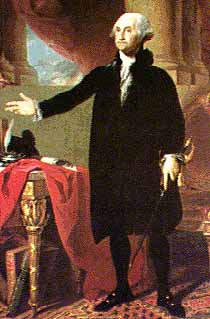
Teeth-GW did not have wooden teeth. He did have false teeth but they made from various materials------cows teeth, human teeth, and ivory. One dependable source stated he had a set of teeth that were lead and weighed as much as three pounds. These false teeth would have had springs to allow him to open and close his mouth. These would have been very uncomfortable which explains why GW is not seen with a toothy grin in any of his pictures.
A great throw-It is routinely shared with schoolchildren that George Washington once threw a silver dollar across the Potomac River. That would have been impossible since the Potomac is very wide and silver dollars would not have existed at the time the story takes place. Later Washington’s step-grandson theorized that there had been a mix-up in the story. He verified Washington had thrown a piece of slate across the Rappahannock River where he lived at Ferry Farm, his childhood home. The Rappahannock’s banks are much closer together than the Potomac’s.
Expert with an ax-You know, I saw this myth debunked a few years ago in Weekly Reader…why is it still hanging around? Mason Weems, an early biographer of Washington’s, made this story up to promote GW’s honesty. Family members have verified through the decades that the whole story is bunk.
Weird Powdered Hair-Many historians, including those that work at Mount Vernon, have verified GW did not wear a wig. He hated them. He powdered his own red/brown hair and braided it down the back to comply with the style.
Here are some non-myths (at least until they are proven otherwise):
*GW was the only president to be elected unanimously
*GW was a slave owner with 300 plus souls under his control.
*GW used slave laws to his advantage. He took his favorite cook, a male slave named Hercules, to Pennsylvania to prepare his meals. At the time Pennsylvania had a law that slaves within the colony would be free after residing in the colony for six months. GW always sent Hercules home before the end of the six month period. Eventually Hercules ran away and GW never found him.
*Upon his death GW’s will ordered his slaves freed, and he ordered that funds be set aside to help the elderly and to educate the young.
*GW, like Thomas Jefferson, is now rumored to have fathered a slave child of his own. However, many people dispute this and state that more than likely GW was unable to father children. He may have had TB earlier in his life and this may have caused him to be sterile. Some state that a Washington probably fathered the child in question, but not
George Washington.
*GW didn’t lack for children. He fathered his step-children and grandchildren. He and Martha also took in several children belonging to friends or family at various times. GW even took in the Marquis de Lafayette’s son during the French Revolution.
*The hemp plant was grown at Mount Vernon so some folks like to think GW knew something about pot. I think the plant was more than likely used for rope.
*We can thank GW for the Bible being part of the presidential inauguration ceremony and the words “So help me God” which he added himself.
*Upon her husband’s death Martha Washington burned all of her and her husband’s correspondence---only two or three letters survive.
*GW’s horses had their teeth brushed each morning. Was he planning on using them in a new set of dentures?
*It is a wonder he ever made it to serve as our first president. As a young man he suffered malaria, smallpox, pleurisy, dysentery, a near drowning in an icy river, shot at and missed by an Indian standing less than 50’ away, and had two horses shot out from underneath him
*GW survived a close call with a duel with a man named Payne---problems ended when GW offered his hand as a sign of apology and friendship*GW turned down a salary from Congress and insisted that he be paid only for his expenses. His salary would have been $500. By accepting an expense only arrangement during the 8 years of war GW was owed $447,220
Some might argue that it doesn't hurt the American public to believe their first president had superhuman throwing strength and never told a lie but we also need to understand our leaders are mortal men and women. They have the same fears, bad habits, and mortality that we do. Their greatness comes in the manner they overcome their shortcomings, the honing of their skills in leadership and delegation of duties, and their desire and constant effort at doing the right thing all the time.