Showing posts with label Videos. Show all posts

Thursday, July 16, 2009

Overcoming Mountains

So, I’ve been silent for a bit around here. Lots going on at my house….sending out graduation notices for my son, sending out 50th birthday invitations to family and friends (yes, I know….it’s hard to believe…ElementaryHistoryTeacher is married to a 50 year old man…amazing), and it seems every time I think I have a moment to post someone decides I need yet another thing to do.

Well, I’m here to tell you the old saying is true, and my family and friends seem to agree with it….When you need something done hand it off to a busy person.

Yes, I’m trying to overcome mountains of things to do, but you know me….I always have some historical thought going on in that busy brain of mine and this time is no different.

I’ve been thinking about my ancestors and all of the folks who arrived in the American colonies in the 1700s and decided to trek into the Appalachian Mountains.

During the early days of colonization in North America the Appalachian Mountains served as a barrier to expansion for the British colonies.

On the flip-side, however, and something I love to explore with students, is how the same mountain chain that hindered and challenged my ancestors also served as a hedge of protection for Native Americans.

Several factors contributed to this – the mountains formed a continual, unbroken chain with numerous confusing ridges, never-ending forests and undergrowth that can hide so many rewarding vistas – and of course, an alliance system the English formed with Native Americans kept a large number of colonists at bay until after the American Revolution.

Recently, my husband and I left Atlanta and traveled to Asheville, North Carolina for a couple of quiet days. Once again the beauty and majesty of the mountains washed over me, and I couldn’t help but think of those early settlers.

We traveled through the ridges and valleys quite well across well traveled and maintained roads – roads that did not exist when the colonists began the arduous task of entering and traversing the mountains.

I kept myself busy during the trip taking pictures and video and have placed some of the images here in the slideshow below for your enjoyment.


Well, back to the mountains I have before me today…..I have several to climb. :)

Wednesday, March 11, 2009

Great Depression in Music and Video

Today’s wordless or near wordless offering is a video regarding the Great Depression from the Thomas Brothers. If you aren’t sure who the Thomas Brothers are check out their website here and follow this link to another video clip showing how they mix history, video, and song to entertain and teach with.

Even if you can’t get the Thomas Brothers in front of students these clips are interesting enough to add to a lesson or unit of study.

Be sure to check out the video here that clearly shows how they work their magic with all age groups.


You can locate other bloggers participating in Wordless Wednesday here.

Thursday, December 06, 2007

Education Week: Digitized Video Sources Are Increasing

In a recent Education Week article titled Advent of Digital Video Triggers Shifts in School Market by Andrew Trotter( Vol.27, Issue 12, Page 10)) video is referred to as a core resource that can clarify concepts for today’s media-oriented children and draw them into their lessons. I strongly agree.

The article goes on to mention that many video providers are beginning to provide their materials online which saves them from shipping hassels plus serves the ever growing number of customers who want to view video streamed over the Internet.

One provider mentioned---Hot Chalk in partnership with NBC News---opened an an educator-friendly archive, with two-to five-minute video vignettes drawn from 70 years of archival coverage, organized by curriculum topic and augmented with extensive curriculum-planning resources. Per the article there are close to 130,000 teachers registered for a free trial that will end in January. After the first of the year the service will cost $1,999 annually per high school and $1,499 per elementary or middle school.

Last year I used United Streaming for many of my video clips. The thing I liked about the use of the videos online is digitization makes it easier for the videos to be segmented. They can be viewed from beginning to end or particular clips can be shown that meet your standard’s requirement. Often during a lesson where I was introducing new content I would alternate between a video clip, the text, and a map I might have drawn on the board to keep the flow of content moving. United Streaming along with many other video companies provide the capability to search their site based on particular state standards.

Mr. Trotter’s article goes on to state that education video sites are now including competancies and concepts to go along with the standards, lesson plans, and calendar functions.

The one thing educators have to be wary of is the type of video sources they use and the time-tested advice regarding watching a video or a clip completely through before showing it to students still applies.

A few free sources mentioned in the article are:
National Aeronautics and Space Administration
National Geographic downloadable podcasts
Videos from Wildscreen, a British charity based on Bristol.
TeacherTube is a site that provides classroom content and teacher-training resources

My articles regardings video use can be found here.
My article regarding a lesson involving Dr. King’s birthday using United Streaming can be found here.

Tuesday, November 21, 2006

Squanto: A Coincidental Life, Part 2

In part one of this post seen here I commented that I believe certain people and events are placed in our paths for very definite reasons. I like to tell students the true story behind Squanto because his story provides opportunities to look at myth versus fact as well as issues of character. For many years Squanto bounced back and forth between Europe and New England mostly through no choice of his own, however, his experience, tragic as it is, served a very real purpose. Each life lesson Squanto experienced was filed away in his toolbelt to be pulled out later when it was needed. I like to teach students they all have their own toolbelts as well.

When we last left Squanto he had finally arrived back on his home shores to discover every member of his village had been wiped out by a plague.

Historians love to banter over which type of plague raced through native villages during 1616-1619, but the important item for my use with students is Squanto was the last Patuxet left. His village had been abandoned, everything left idle as it was the day the last tribal member had succumbed to disease.

For a time Squanto resided with the Pokanokets at the invitation of Massasoit, the Grand Sachem of the Wampanoag Federation.

In 1620, however, the Mayflower arrived with men, women, and children. Their original destination had been Virginia, but a storm blew them off course. John Smith had previously explored and mapped this region and is credited with naming the area Plymouth. When a landing party finally went ashore to scope things out they found an abandoned village and decided it would be an ideal location for settlement since it was already cleared.

It was several months before the Native American known as Samoset finally walked into Plymouth and greeted the Pilgrims. It was on his third visit to Plymouth on March 22, 1621 that he brought Squanto with him. Squanto was amazed that Plymouth was located exactly where his home village had been. The Patuxet village had now become home to the Pilgrims. The Pilgrims used these initial visits with Samoset and later with Squanto to improve trade relations and to formalize a peace treaty.

Squanto decides to stay with the Pilgrims. His knowledge of the surrounding lands proved to be the saving force of the colony. Squanto showed the Pilgrims where the most fish and eels could be found as well which berries and nuts were edible. He is credited with teaching the Pilgrims the ways of the Patuxet including their practice of planting beans and corn together. The bean plant shaded the corn roots and kept the ground moist while the corn plant provided a stake for the bean plant to cling to. Squanto remembered as a boy he was instructed to place three fish inside the hill of soil where the corn and beans were planted in order to provide fertilizer for the soil. It was beneficial for Massasoit to leave Squanto with the Pilgrims because he could let the Wampanoag Federation know what the Plymouth settlers were up to.

Squanto’s information paid off for the Pilgrims because they were able to celebrate their harvest….the same one we have turned into our traditional American Thanksgiving. Massasoit along with 90 braves brought five deer. The feasting lasted for three days.

The Pilgrims greatly appreciated Squanto’s knowledge. Squanto reprised his profession of translator and guide with the settlers as he helped them on many expeditions into the countryside “to discover and view [Massachusetts] bay and trade with ye natives…partly to see the country, partly to make peace with them, and partly to procure their trucke, or barter” per Miles Standish. At one point when Squanto was away visiting a local village he was attacked by Chief Corbitant of the Mattapoinset and Pocasset tribes. Records pertaining to Miles Standish indicate many Pilgrim men set out immediately upon finding out Squanto was in distress to “rescue him if he were alive or to punish Corbitant if he had been killed.”

Naturally both the Native Americans and the English trusted Squanto. Both sides left records indicating that later on Squanto used his knowledge of living in both worlds to his advantage to gain even more power and respect. He knew his fellow natives were scared of further plague. He invented a story to tell the natives that the English had buried the plague in barrels under their storehouse. Squanto attempted to control the natives by telling them he would release the plague unless they did what he told them to.

At another point Squanto was accused of attempting to spread rumors of a conspiracy involving Massasoit. Rumors were being spread that an attack by members of the Wampanoag Federation were eminent and Massasoit was involved. The rumors had one source….Squanto. He was hauled before the English court but was found innocent probably because he “had friends at court” per the diary of Miles Standish. Massasoit demanded custody of Squanto many times since Wampanoag custom demanded Squanto’s death, but the English refused knowing what the outcome would be. This clearly violated the treaty the English had with Massasoit, but Squanto’s capabilities were invaluable to the Pilgrims.

During a foraging trip on the south ocean side of Cape Code Squanto became ill in November, 1622. Many accounts differ regarding exactly what was wrong but they all agree that Squanto began to bleed from the nose and was soon dead.

In his history, Of Plimoth Plantation Bradford states, “their interpreter and was a special instrument sent of God for their good beyond their expectation. He Squanto continued with them and was directed them how to set their corn, where to take fish, and to procure other commodities, and was also their pilot to bring them to unknown places for their profit, and never left them till he died.”

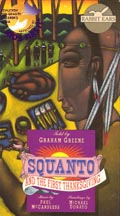
Last week before our break I showed a great video to my all of my students, even my Languages Arts kiddies. It’s a common problem in elementary schools that there are not enough videos to go around and commonly you present something students have seen over and over every year. I never have a problem with this video. It sort of mystifies because it so good, and opens the door for many avenues of discussion. The video is based on the book Squanto and the First Thanksgiving by Eric Metaxes and consists of pictures from the book with Graham Green narrating it. The music, the wonderful artwork, and the haunting voice of Mr. Green really draws students into the story. You can get more information about the video including a video clip and audio clip here. The video tells the basics. It doesn’t go into many of the extra details I have shared with you, but students learn of the odyssey Squanto goes through in an attempt to get back home. They learn how by coincidence the Pilgrims ended up where they did and settle on land that Squanto grew up on.

After the video we talked about all the bad things Squanto had gone through….how scared he must have been, how angry, how confused at being someone who had lived in both worlds, and how that knowledge caused him to be used by both worlds, and at one point even corrupted him. Many of the kids I teach have had terrible things happen to them and within their families. They see things at nine years old I didn’t know about until I was in my twenties. My point in our “after video discussion” was bad things happen to everyone…….it’s how you allow those bad things to interact with your character that makes a difference.

Every moment of our lives, the fantastic times and the horrible times, are part of a dress rehersal to be recalled during the actual performance when we are needed to do our part. Squanto is an exemplary portrait of someone who understood his role in the dual society he lived in, and he is a valuable American hero to share with students of all ages.

Sunday, November 19, 2006

Squanto: A Coincidental Life, Part 1


If you are a regular visitor here you already know that I am interested in how historical events connect and weave together to form our common human fabric. I am continually amazed at how events can have far reaching consequences….some across time…..some simply across town. What at first glance appears to be mere circumstance is instead a very carefully woven plan. I believe I know the author of that plan, but of course, that’s up to you to decide for yourself!

I love to share the story of Squanto with students because his life proves certain events and certain people are placed in our paths for reasons. We endure good times and hard times for various reasons. Sometimes we know the reasons immediately, sometimes the reasons are not made clear until later, and other times we are never aware of the far reaching effects of our actions and the people we interact with.

As we journey on through life our experiences teach us various things that we store in our toolbelt for life to be pulled out later as we need to recall the knowledge or the skill to help ourselves or others. This process can certainly be seen in Squanto’s life---that of a true American adventurer and hero.

Most elementary students are taught Squanto lived in the area where the Pilgrims first landed and he helped the Pilgrims learn how to meet their basic needs in their new homeland. While this true there is so much more to learn about this fascinating man. His life can be described as a tempest filled with grief, betrayal, as well as adventure. Squanto, of course, never wrote his own autobiography. The sources that contain information about him are few and far between and only give us snippets of his life, but a trail of events can be pieced together.

Squanto was a member of the Patuxet tribe and lived along the coast of New England near where Cape Cod is today. As Squanto became older contact with Europeans was becoming more and more common as various sea captains began to explore the coast of North America. Once the Jamestown colony was established in 1607 other entrepreneur types wanted to get in on the ground floor, and other possible sites for colonies were being investigated. English and French ships were known to fish the waters along the New England coast and they also traded with different Native American groups for furs.

It was not uncommon for some of the European sea captains to take Native Americans back to Europe with them with or without their consent. These natives were beneficial to the Europeans because they could be taught English and could inform the sea captains regarding important information regarding their homeland. The natives were a wealth of information regarding tribal and chief names, the lay of the land, which tribes were at peace and which tribes were at war. Other information could be obtained regarding crops that could be grown, the climate, rivers, and information regarding safe harbors.

According to the memoirs of Sir Ferdinando Gorges who joined the Plymouth Company in 1606, Squanto was kidnapped and taken to England in 1605 by Captain George Weymouth who was on a fact finding mission regarding resources of the Canadian and New England coast. In his own letters Weymouth writes that he decided to take a couple of natives back with him but had a hard time controlling them “for they were strong and so naked as our best hold was by their long hair.” Gorges confirms Squanto remained in England for nine years actually living with him before returning to the New World during John Smith’s 1614 voyage where Squanto would act as a guide and interpreter.

If Squanto acted as guide on any expeditions prior to 1614 there are no records to indicate it. There is a record of Squanto being a passenger on John Smith’s ship as he left England to return to the New World in March, 1614 accompanied by a second ship captained by Thomas Hunt. The purpose for the expedition was to hunt for whales and to look for gold. When it became apparent that they were not adept at catching whales and no information regarding gold was obtained Smith decided to save the voyage by fishing and trading for furs. It is believed that it was during this trip that Squanto was close enough to return to his home for a time. Smith ended up returning to England with a full cargo of fish and fur.

Captain Hunt remained in the area and it is believed Squanto acted at times as his interpreter. Their relationship, however, apparently deteriorated as Gorges relates in his report A Brief Relation of the Discovery and Plantation of New England confirms that it was at this point Hunt kidnapped Squanto along with others who were lured on board thinking they could trade beaver. Hunt travelled to Malaga, Spain and attempted to sell the Native Americans into slavery for twenty pounds each.

When local friars found out the intended slaves were Native Americans they took possession of them and attempted to instruct them in the Christian faith. Squanto lived with the friars for a year or two before returning to London with an Englishman named Sir John Slaney of Cornhill who was a very wealthy merchant. Slaney was attached to the Newfoundland Company which managed a colony at Cupper’s Cove, Newfoundland. While he resided with Slaney, Squanto improved his English and returned to North America to act as an interpreter for Slaney and Captain John Mason, governor of the Newfoundland Colony in 1617.

While in Newfoundland Squanto was recognized by Captain Thomas Dermer who was employed by Gorges and the New England Company. Dermer had sailed with John Smith on various voyages. The captain ended up returning Squanto to Gorges back in England. Gorges promptly took advantage of the situation by organizing an expedition for Dermer aided by Squanto to explore the natural resources of New England and to set up trade agreements with the local natives.

Dermer and Gorges both realized by this time the Nauset and Patuxet tribes had had enough of their tribesmen being attacked and kidnapped by Europeans. The natives had taken to attacking any ship that approached their shores. Records indicate they attacked and burned a French ship that came to close to Nauset shores. Gorges knew that having Squanto along would be beneficial.

In 1619 Squanto and Dermer explored what would one day be Plymouth harbor. It was at this time Squanto discovered his entire tribe had perished at the hands of plague since he had last been home in 1614. Squanto was now the last Patuxet. His home village was being avoided by other Native Americans in the area for fear of catching the sickness that had decimated the tribes and there were stories that evil spirits haunted the place.

For a time Squanto continued to work with Dermer but eventually decided to remain with the Pokanokets who lived where Bristol, Rhode Island is today at the invitation of Massasoit, the Grand Sachem of the Wampanoag Federation.

Part 2 of my examination of Squanto’s can be found here.

Saturday, March 18, 2006

Video Is Not a Bad Word

I find it quite appalling that some elementary schools don’t allow videos to be shown to students. How can you teach certain historical content to nine to twelve year olds and not show a video? In my previous post, Use Videos to Advance Your Curriculum I discussed another use for videos.

I usually show one to two videos per unit. Keep in mind my units last three to four weeks. After students have learned about the Boston Tea Party and Lexington and Concord I show students Johnny Tremain. Yes, I know that the book would be much better. The book is also quite different from the movie, however, the book is on a higher reading level than most of my students could manage. As a read aloud it would take too long. I generally use several picture books during the unit instead of one long novel. Before I show the video we review historical fiction. We discuss that they will see fictional characters alongside historical characters. During our post video discussion we create a chart comparing fictional events and historical events.

Here’s why I show Johnny Tremain:

Videos help students review material-The first scenes of Johnny Tremain allow me to review the social hierarchy of colonial times. Johnny is an apprentice to Ephraim Lapham, a silversmith. Students are able to review what an artisan is as well as a merchant. A merchant in the story, Johnathan Lyte is a loyalist and trades in many goods including tea. Students can see how each group related to others and how they dressed.

Videos put a human face on historical characters-Many important participants in the events students have studied are portrayed in Johnny Tremain. Johnny consults with fellow silversmith, Paul Revere, concerning a particular handle design. After damaging his hand Johnny is unable to continue his apprenticeship. He finally obtains a job with the Boston Observer where he meets up with Samuel Adams, John Hancock, and James Otis. Through these contacts he ends up passing messages to the members of the Sons of Liberty and actually becomes a participant in the Boston Tea Party.

Videos show students how events unfolded-To simply tell students how patriots obtained information about British troop movements is one thing. To see the process in action is another. Through some interaction with certain British officers Johnny is able to engage them in what seems like innocent conversation. Unknowing the British give Johnny and his friend important information about how the British will move against Lexington and Concord. Johnny is put in the important position of passing the information to the sexton at Old North Church so he’ll know how many lanterns he needs to use to warn the militia. Students then view a scene of Revere and Dawes on their midnight ride and the minutemen grabbing their muskets, kissing their families and heading out. Some darlin’ always gets excited and blurts out, “Those are minutemen aren’t they?”

Videos provide students with visuals-The final scenes of the movie relate the events of Lexington and Concord. Naturally Johnny Tremain is in the thick of things. As the British line up and face the patriots students begin to ask questions. “Why are they in straight lines? Why are they all out in the open? Why do the British wear those red coats? Why do they keep banging the drum?” I ask students to continue watching. Later the scene shifts to the long walk back to Boston for the British. There isn’t much conversation during this scene so I begin to relate new information to students. I stand below the television and point out certain things I want them to notice. I tell them about the rules for warfare that existed in Europe during the 1700s. I tell them that the drum not only keeps the rhythm of marching, but it provides directions to the different groups of soldiers.

Finally students see the patriots hiding at different places along the road taking shots at the British. We discuss why this angers the British. The patriots are not engaging them properly. I remind students that the scene they are watching is the ‘shot heard around the world’ we had just discussed the day before.

I understand why some rules exist about showing videos. I’m sure some people out there would abuse the privilege. However, videos like Johnny Tremain provide students something to connect to as they learn concepts and ideas that are foreign to them. With some students it just doesn’t click until they see events portrayed in some type of dramatical form.

Saturday, January 28, 2006

Sick? Use Videos to Advance Your Curriculum

Ok. It's Friday. Finally. And I'm breaking my own personal blog rules. I'm blogging off the subject of my blog. I'm blogging off the cuff. Totally unplanned. I guess that is the real purpose behind a blog but I tend to agonize and plan what I type out.

I guess I can forgive myself. It's been a hard week at my school. Is it a full moon? Every teacher I've seen in the hall has told me their team has had a hard week as well. I guess it's finally setting in... that long unending time period between the Christmas holidays and Spring Break. I've been too busy to notice.......plus my darlin husband gave me his coughin, sneezin, nose oozing thing and I've had it since Wednesday.

Don't know about you but in my district I am responsible for obtaining my sub whether I'm sick, if there is a death, or I just want a personal day. I should have called someone last night, but ain't it a pain to be out. Especially this time of year. Spring NCLB testing is looming and every minute is so precious. You don't want to leave "busy" work because you get stuck grading it, but you don't want to leave too much instruction, if any, for the sub. I usually go to work no matter what and "plan" my sick days, but today it was almost impossible to be a decent teacher. My kids knew it. You can't hide a thing from them. One of my sweet darlins came back to my desk, patted my shoulder and said, "Well, I guess you'll call a sub the night before from now on won't you..." So sweet, so honest------I just wanted to kill him.

My kids got to see me at my worse this morning. No makeup, school-colored sweatshirt, jeans, and barely showered. It was very apparently "elementary history teacher" didn't feel well. My kids learned early on to get on with their morning work because Mrs. "elementary history teacher isn't a morning person and she doesn't tolerate slackers first thing in the morning too well. They had seen my illness progress and were more cooperative and attentive than normal.

So....what do you do when you feel like poo, still haven't gotten observed by an administrator, and don't want to loose focus of your regular curriculum? For one thing, whether you are a first year or 31st year teacher be honest with your administrator if they come in for an observation. Tell them you are sick, not on your game, or one of your students is having a problem.

Today I opted for the video option. Oh joy, I teach three groups of American History every afternoon so it would be a fairly stress free afternoon with the exception of watching them. We are currently going over the formation of the 13 colonies. I showed students a Dear America video. I can't remember the title. It's the one set in early the early Pennsylvania colony. A young Quaker girl and her brother are kidnapped by the Lenape indians and adopted by Lenape families. The girl befriends a Lenape brave who turns out to be a an Englishman who was kidnapped as well. They fall in love but he is killed as she is rescued and returned to her family. My kids were mesmorized----even my discipline problems. I sat with them (proximity, proximity, proximty), but could cough, wheeze, and groan to my hearts desire without too much interruption.

After the video I had enough time to answer their main question. Why would the Indians kidnap white people? The main reason is that some tribes, in this case the Lenape, believed that the Great Spirit wanted them to replace their dead family members (members who had died due to the White man) with the English. This practice was carried out through the 1600s and 1700s up to and including the time of the French and Indian War and later during the western expansion.

I was sick, I looked like hell, but I managed to advance my curriculum and have a great place to pick up Monday.

Gee, hope I feel better.....