The school where I teach is separated into four different buildings that form a large square. In the center is a large grassy area with a tree. I like to gather up my students during the first week of school and we have class sitting in the grassy area. Once we are all settled I begin our discussion. I ask students to look around and notice where they are. I ask them to look at the tree, the grass, and the spots where there isn’t any grass. I ask them to notice if the ground is completely flat or do they notice it rising or falling in certain areas. I tell them that as historians they need to be aware of the lay of the land. They need to be able to make observations for anything that can be used as a frame of reference or a landmark of sorts when exploring a historical site. Anything can be a clue regarding how the land was once used or who lived there.
I show students a picture of a pile of rocks. “What could this be trying to tell us?”
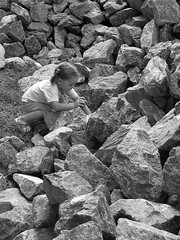
I get all sorts of crazy answers. Sometimes a student will mention that the pile of rocks could be a grave. We discuss that possibility for a moment and then I tell them that sometimes it just takes standing back a bit to get a better view of what we are looking at.
I then show them a picture taken from the air. I hear several ohs and ahs.
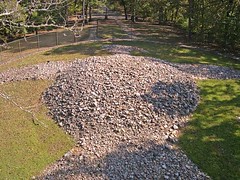
I quickly tell students they are looking at Rock Eagle----an Indian rock formation located in Georgia. I let them know we will be discussing this more in depth in a couple of days.
I show students a picture of a deep gully. I pass it around for them to observe. We discuss possible causes for the gully…erosion, earthquake, mother nature, God….
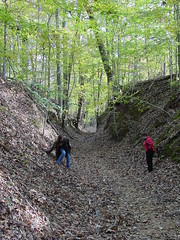
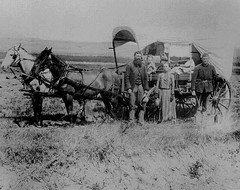
”How about man?” I ask as I show them the next picture. What if hundreds of these wagons made their way up a trail over fifty years or so? I identify the gully as part of the Natchez Trace that runs between Nashville and Natchez.
Finally I show students a picture of a trench. What happened here? Some try to be cute and guess that more wagons caused the trench. Someone thinks we’re looking at a creek bank or an early Grand Canyon.
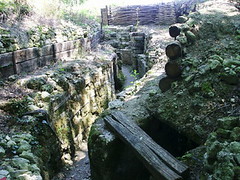
We discuss it at length and then I show students this…..
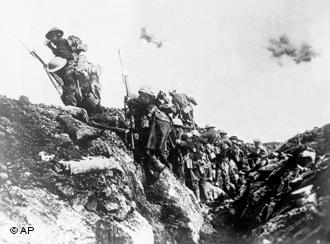
I explain that trenches are sometimes man-made. The first picture tells us this as we observe rocks and wood placed on the sides of the trench. I give them a quick explanation of the trench warfare that took place during World War I.
I end our discussion by telling students that history is everywhere around them if they will take the time to examine, to wonder, to question what they see. A pile of rocks could be just that, but if I know a little history I might guess that the pile of rocks might be a burial spot if I already know that Native Americans in my area were doing that hundreds of years ago. If I knew a little history I might realize the pile of rocks could be part of a much larger design that could be seen from the air.
Knowing my location and the history of the area might help me identify what I am looking at. I tell students that later in the year we will discuss the settlement of the frontier and I’ll be telling them about the Natchez Trace. If I know this from my studies of history when I see a location with a gully like this it might help me to identify it. If I’m in Belgium and come across a maze of trenches in the ground I could arrive at the idea that they must be World War I trenches because I know from my history class that the war was fought in trenches.
By this time I have several wiggle worms so we get up and walk down to the recess field. I gather everyone in a group and I tell them that historians never know what they are standing on unless they truly observe their surroundings. We identify together that we are standing on the recess field, and then I ask, “Is that all we’re standing on?”
I tell students to follow me and we go to the edge of the playground. We are standing on the edge of a hill. Down below us we see a flat overgrown area. Sticking out of the hill in various places we see all sorts of debris. Rocks, long pieces of rebar, broken signs, glass, wires, bricks, and assorted hunks of concrete litter the hillside. We regroup and I tell the class that the area where they play did not look like it did many years ago. I ask them to come up with some ideas about what happened. Some are silly, some are average, and some are pretty good guesses. Finally, I tell them the story. Many loads of dirt were hauled in to build up their playground, but before the dirt was dumped the town brought in remnants of a section of town. You see the town where our school is located experienced an explosion and some of the trash ended up as filler for our playground. Some of the kids nod their heads in agreement and state their grandmother or grandfather had told them about the explosion while other students are amazed.
So….before we trudge back to the classroom I summarize and close with, “What did we learn today?” I get several responses.
“Things aren’t always as they appear to be.”
“You never know what you are looking at.”
“Every piece of ground has a history if you’ll just look at it and listen.”
“Our recess field is a dump.” Yep, there’s always a true blue smartie in every group.

 I’ve taken enough time from my project today to get the 26th edition of the Georgia Carnival up and running for viewing pleasure. This edition marks the one year anniversary for one of the few state-focused carnivals in the blogosphere. You can find it over at Georgia on My Mind. You’ll find lots of views regarding the results of the Iowa caucus, a primary calendar, and a great post on making resolutions among many other great submissions. Do you know what a Brasstown Baldbuster is? Well, head on over to Georgia’s carnival and find out!
