School starts in my district tomorrow, and every teacher I know has said the same thing. “Wow, that was a short summer!” Yep, I have to agree. It was a short summer, but like it or not the first day is here and by the end of next week summer will just be a hazy memory in our rear view mirrors.
Here are a few previous posts I’ve published here at History Is Elementary that deal with the nuts and bolts of getting ready for a new year…..things on my desk, various forms, and procedures, and one situation where I pulled a solution out of my a……out of thin air when I needed it most.
A Teacher's Throne
Tools of the Trade: Class Syllabus
Tools of the Trade: Classroom Syllabus, Part 2
Keeping a Notebook Elementaryhistoryteacher Style
Classroom Notebooks Revisted
Tools of the Trade: Study Guide
Name Calling
Tools of the Trade: Lack of Progress Letter
Enjoy! …..and HAVE A GREAT YEAR!!!!!!!!!!!!!!!!!!!!!!!!!

Showing posts with label Beginning of the Year. Show all posts
Showing posts with label Beginning of the Year. Show all posts
Wednesday, August 05, 2009

Sunday, October 05, 2008
Sunday Snippets
The Education Carnival is up for your reading pleasure over at Matthew Needleman’s site….Creating Lifelong Learners while the History Carnival made its appearance over at American Presidents. I’m a bit late with these links….Take pity on a recooping woman. :)
Last week my good blog friend Polski3 alerted me that this site may be loading s-l-o-w-l-y when you try to access it. I’ve noticed the site being a bit slow for me as well.
I’m sorry. It’s not my intention.
I visited WebSiteOptimization.com and allowed their system to analyze my site. I found my images and exterior scripts might be slowing things down, so I’m planning on spending this week trying some changes. I’d love to convert to the layout style for Blogger….this template is written for Classic Blogger. I’ll see what works and what doesn’t. If you stop by and things look a little strange...well, now you will know why.
Finally, the particular lesson referenced below is one I wish I had thought of first……
Back in September of 2005, on the first day of school, Martha Cothren, a social studies teacher at Robinson High School in Little Rock, did something not to be forgotten. On the first day of school, with the permission of the school superintendent, the principal, and the building supervisor, she removed all of the desks out of her classroom. When the first period kids entered the room they discovered that there were no desks. Looking around, confused, they asked, “Ms. Cothren, where’re our desks?”
She replied, “You can’t have a desk until you tell me what you have done to earn the right to sit at a desk.”
They thought, “Well, maybe it’s our grades.”
“No,” she said.
Maybe it’s our behavior.
She told them, “No, it’s not even your behavior.”
And so, they came and went, the first period, second period, third period. Still no desks in the classroom. By early afternoon television news crews had started gathering in Ms. Cothren’s classroom to report about this crazy teacher who had taken all of the desks out of her room.
The final period of the day came and as the puzzled students found seats on the floor of the deskless classroom. Martha Cothren said, “Throughout the day no one has been able to tell me just what he/she has done to earn the right to sit at the desks that are ordinarily found in the classroom. Now I’m going to tell you.”
Want to know the reason…..head here to learn more about a gutsy move by a gutsy teacher to help her students understand what the right to an education is all about.
Last week my good blog friend Polski3 alerted me that this site may be loading s-l-o-w-l-y when you try to access it. I’ve noticed the site being a bit slow for me as well.
I’m sorry. It’s not my intention.
I visited WebSiteOptimization.com and allowed their system to analyze my site. I found my images and exterior scripts might be slowing things down, so I’m planning on spending this week trying some changes. I’d love to convert to the layout style for Blogger….this template is written for Classic Blogger. I’ll see what works and what doesn’t. If you stop by and things look a little strange...well, now you will know why.
Finally, the particular lesson referenced below is one I wish I had thought of first……
Back in September of 2005, on the first day of school, Martha Cothren, a social studies teacher at Robinson High School in Little Rock, did something not to be forgotten. On the first day of school, with the permission of the school superintendent, the principal, and the building supervisor, she removed all of the desks out of her classroom. When the first period kids entered the room they discovered that there were no desks. Looking around, confused, they asked, “Ms. Cothren, where’re our desks?”
She replied, “You can’t have a desk until you tell me what you have done to earn the right to sit at a desk.”
They thought, “Well, maybe it’s our grades.”
“No,” she said.
Maybe it’s our behavior.
She told them, “No, it’s not even your behavior.”
And so, they came and went, the first period, second period, third period. Still no desks in the classroom. By early afternoon television news crews had started gathering in Ms. Cothren’s classroom to report about this crazy teacher who had taken all of the desks out of her room.
The final period of the day came and as the puzzled students found seats on the floor of the deskless classroom. Martha Cothren said, “Throughout the day no one has been able to tell me just what he/she has done to earn the right to sit at the desks that are ordinarily found in the classroom. Now I’m going to tell you.”
Want to know the reason…..head here to learn more about a gutsy move by a gutsy teacher to help her students understand what the right to an education is all about.
Monday, August 04, 2008
What's Your Message?
My dear husband forwarded this video to me earlier today, and I instantly felt it was so very important to share with those of you who visit here.
We all have a message……through our daily interactions with co-workers, parents and students, through our interaction with strangers each day, as we visit with friends, and as we parent and conduct our family life.
How our message is s delivered makes or break how it is perceived by others. If we all thought a little more about our message and could discover the best mode of delivery it would probably be a much different world.
What do you think?
We all have a message……through our daily interactions with co-workers, parents and students, through our interaction with strangers each day, as we visit with friends, and as we parent and conduct our family life.
How our message is s delivered makes or break how it is perceived by others. If we all thought a little more about our message and could discover the best mode of delivery it would probably be a much different world.
What do you think?
Monday, August 21, 2006
Keeping a Notebook: Elementaryhistoryteacher Style

This morning in my second period history class it felt like we were finally getting down to the business of class. We tackled Chapter One, Lesson Two by reading text and taking notes on the important parts. This lesson dealt with natural resources (renewable, nonrenewable, and flow) as well as other resources such as human and capital resources. The lesson gives students an opportunity to develop a flow chart involving the production of peanut butter by lifting ideas from the text as well as brainstorming a list of resources and classifying them into the various categories. The lesson ends with a discussion regarding scarcity and opportunity costs.
This is the time of the year when I teach the features of the textbook and attempt to persuade students to look for the definition of various vocabulary words in context. Why go to the back of the book when you don’t have to? The flipping back and forth can really confuse some students who struggle in their reading. We discover that the text gives us hints about the definition of a word such as the word “is” following a vocabulary word. Students are learning that “is” is a hint that a definition may follow. They get real excited trying to beat each other out in finding the definitions first. This year our brand new text provides the vocabulary words highlighted in yellow and a main idea is written at the beginning of each major section. We are including the main ideas in our notes.
Notes? Yes, Elementaryhistoryteacher requires her students to take notes. Once upon a time when I was an aspiring student teacher I sat at the knee of a master. She modeled for me a wonderful method for students to use in keeping a notebook. This method worked for her, and it has served me well for several years. Many of my former students who are now in highschooler who come back to visit tell me they have relied on my method for various classess if the teacher doesn’t have any notebook requirements.
It would appear that my current group of students are making a smooth induction into the Elementaryhistoryteacher’s ever growing notebook-notetaking procedure club. It is a fairly simple procedure especially for my fourth graders considering they have arrived at my door with their third grade mentalities still intact.
This method begins and ends with a two pocket, three prong folder. It can’t be any other type. We put out a supply list early in May and again in August but I still have a few who two weeks into the school year don’t have the proper folder. I usually purchase a hundred or so folders with my classroom money to have on hand. This year they went fast. As of today they are all gone. Rather than wait on certain students to finally purchase what I require I simply tell them to pick a color and for Heaven’s sake let’s get on with it!
Once everyone has folder we label it on the outside cover in this way------“Social Studies” and the student’s name. Students are then asked to take one sheet of notebook paper and lay it on their desk. I ask them to lay their left hand down on the desk by it. I tell them they will always be writing on the correct side of the paper if they check to make sure the holes are on the same side as their left arm. It’s amazing how many kids don’t even think about the side of the paper they are using. This simple reminder seems to help. I ask students to place at the top of their paper “Social Studies Notebook” in the center. The next line states, “Table of Contents” while the third line is for the name of the particular unit. In our case it is “America’s Land”.
Students then receive a lesson in how to open a three prong folder and how to place paper in it. The majority really have no clue. I visit each table group and model for students with one folder. I tell students their table of contents should always be the first thing they see when they open their folder.
I then pass out their study guides. These are very simple documents that I present more for parents than for students to use. At the top is information involving the name of the unit, the text pages that will be used, the standards the unit covers, information regarding absences from class, the unit test date, as well as unit vocabulary and lesson questions. My school system follows the Max Thompson/Learning Focused method of creating lesson plans so each unit has an enduring understanding/essential question and each lesson has a key question that students should be familiar with and should be able to answer in order to demonstrate mastery.
I ask students to lay their study guides on their desk face up and place a small number 1 in the upper right hand corner similar to a page number. I then ask students to return to their table of contents and next to the red line place a number one and list by it “Study Guide”. We then open up the prongs, place the Study Guide inside, and close the prongs up. Someone always quips, “Gee, it’s like a little book.” They are exactly right. Students are making a mini-book or portfolio, as if were, regarding the particular unit of study.
As we progress through the unit we add notes and activities as we go always adding a new page number and making an addition to the table of contents. Students who have been absent learn to compare their table of contents to the one I keep in the classroom to see what was done while they were gone.
This morning as we began a new lesson I had students open their books and have one new fresh sheet of paper on their desks along with their pencil. I wrote on my classroom table of contents “3. Notes: Our Nation’s Resources” and requested that students add to their own table of contents. At the top of their fresh sheet of paper students were asked to place a page number 3 in the upper-right hand corner and title the paper “Notes: Our Nation’s Resources”. We then were ready to begin reading and transferring important information to paper.
Once the notes are complete I remind students to choose two colored pencils and color code their notes by underlining the main ideas in one color and underlining the vocabulary words in another. In this way important information jumps of the page and parent helpers can locating information more easily.
Asssignments such as crossword puzzles or other activities are entered on the table of contents by title such as “Crossword-Landforms” or “Flowchart-How Peanut Butter is Made”.
The front pocket of the folder holds graded tests, etc. Students are asked to keep tests to use to study with for nine week comprehensive benchmark exams as well as to use in preparation for the state test at the end of the year. The back pocket holds twenty to thirty pieces of fresh paper.
Notebooks are graded at the end of each unit. Students trade folders and check off the table of contents compared to the items in the prongs. They made note of any problems with the folder by noting them on the table of contents. I have found that students who are having difficulty benefit from grading other notebooks. We generally end up with 10-12 items per unit in notebooks so items end up counting around 10 points each. It makes it very easy for students to assess a grade. Once graded, students remove the papers from the prongs, staple the mini-book together with the table of contents on top and store the papers in their back pocket. Students are asked to keep graded notebooks during each nine week period. They can take them home to store or to do whatever they want to with them as long as I don’t know. I explain to kids that I have a real problem with them throwing away all of their hard work so if they do wish to throw their notebooks away they should do it at home.
So what’s the big deal? Why does Elementaryhistoryteacher make her young charges go through a note-taking, note-keeping process such as this? Yes, certain students resist me, but they come along in the end. Yes, certain students are mentally/physically unable to handle these tasks. We adjust where needed according to IEPs. In a future post I will take a look at the research that backs up the use of note-taking and summarizing in the classroom.
Saturday, August 05, 2006
A New Year Has Begun
Yesterday was the first day of school for parents, teachers, and students in my school district. It seemed from the many discussions at our Open House Thursday night that students have become bored, parents were tired of trying to entertain their children, and most teachers would be happy with just another week to feel fully prepared.
The school year is here, however, whether we want it or not.
I can't believe I haven't posted in almost a week. Since Monday I have been in meetings, and have frantically attempted to clean and arrange my classroom for the best learning environment I can. My team has worked well together attempting to shuffle resources around so they are in the proper room.
A colleage of mine, our music teacher, told me Thursday he felt like a gerbil on one of those exercise wheels. Spinning, spinning, spinning, and not really getting anywhere. I have to agree with him. By the time I had gotten home after Open House Thursday night I had been at school for a total of thirteen hours( just that one day). I couldn't even put together a coherent sentence I was so tired.
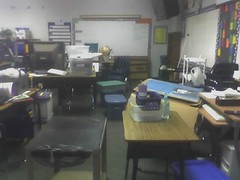
This is a view of my room from the hallway door as I began to put my room back together.
This is the same view minutes before parents and students arrived for Open House.
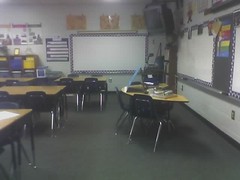
This view is also from the hallway door, but it looks towards the back of my classroom where I have a very extensive classroom library for students. I have over 500 books that I have brought from home as my children tired of them or that I have bought myself.
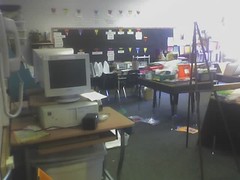
Here is the same view after I worked my tail off. I placed all three of my computers along the wall to make more space to move above the room.
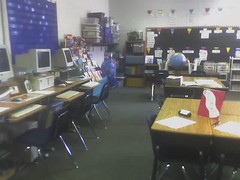
This view is looking towards the hallway door and is taken from behind my desk. All of my individual units are packed within the plastic tubs you see. The binder that holds my lesson plans, extra copies that didin't get used the last time I taught the unit, accompanying teacher resource books, tradebooks, etc. all fit nicely in the tubs. Each tub is labeled with the unit name such as "Civil War/Reconstruction", "Native American Regions", or "American Revolution". Some units are so large I use two or three tubs to hold everything.
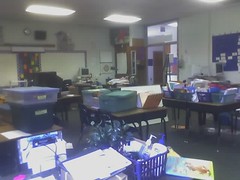
Here is the after picture.
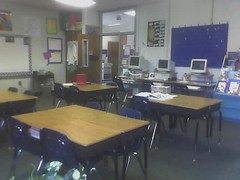
The teachers on my hall were all making these cute little hallway displays to welcome new students and place student names outside their doors. Elementaryhistoryteacher is not into cute little cutesies. I admire them, but just don't seem to do them myself.
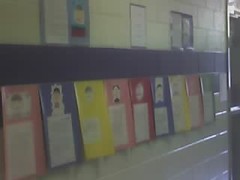
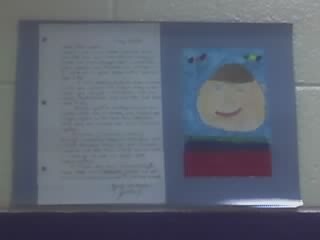
The last year I taught fifth grade my teaching partner from across the hall had the language arts students write letters to teachers who had impacted their elementary years. Several chose me and this colleage took the letters and the student's self-portraits and laminated them onto construction paper. The group of students presented these to me the last few days of school. I treasure them and make it a tradition to haul them out from the protective case stacked on top of my classroom closet and display them for Open House. Occaisionly one of the students show up with a younger brother or sister and they are surprised to see their work on the wall. I place a caption with them that states "Elementaryhistoryteacher is kid-tested and board approved!". It fills up the wall along with my new homeroom list.
The mother of this particular student who wrote me a letter teaches in the lower grades at my school. I told her she needed to come to my end of the campus to see her child's work. She said she would and advised that her young man has just gotten his learner's permit. Wow! I'm old.
Yesterday morning another colleage of mine who works with our special education students brought her son in before taking him to the middle school to start his eighth grade year. I gave him a good squeeze and realized he could now see the top of my head with gray hairs scattered here and there. I didn't have my glasses on and had to stand on tip-toe to see the shadow that stretched along his upper lip. My new view confirmed it for me. It was no shadow, but the faint beginnings of a mustache.
It was the perfect beginning for a new year. Brand new students making the transformation from third graders to fourth graders, and a reminder that time marches on for former students after they have left me.
The school year is here, however, whether we want it or not.
I can't believe I haven't posted in almost a week. Since Monday I have been in meetings, and have frantically attempted to clean and arrange my classroom for the best learning environment I can. My team has worked well together attempting to shuffle resources around so they are in the proper room.
A colleage of mine, our music teacher, told me Thursday he felt like a gerbil on one of those exercise wheels. Spinning, spinning, spinning, and not really getting anywhere. I have to agree with him. By the time I had gotten home after Open House Thursday night I had been at school for a total of thirteen hours( just that one day). I couldn't even put together a coherent sentence I was so tired.
This is a view of my room from the hallway door as I began to put my room back together.
This is the same view minutes before parents and students arrived for Open House.
This view is also from the hallway door, but it looks towards the back of my classroom where I have a very extensive classroom library for students. I have over 500 books that I have brought from home as my children tired of them or that I have bought myself.
Here is the same view after I worked my tail off. I placed all three of my computers along the wall to make more space to move above the room.
This view is looking towards the hallway door and is taken from behind my desk. All of my individual units are packed within the plastic tubs you see. The binder that holds my lesson plans, extra copies that didin't get used the last time I taught the unit, accompanying teacher resource books, tradebooks, etc. all fit nicely in the tubs. Each tub is labeled with the unit name such as "Civil War/Reconstruction", "Native American Regions", or "American Revolution". Some units are so large I use two or three tubs to hold everything.
Here is the after picture.
The teachers on my hall were all making these cute little hallway displays to welcome new students and place student names outside their doors. Elementaryhistoryteacher is not into cute little cutesies. I admire them, but just don't seem to do them myself.
The last year I taught fifth grade my teaching partner from across the hall had the language arts students write letters to teachers who had impacted their elementary years. Several chose me and this colleage took the letters and the student's self-portraits and laminated them onto construction paper. The group of students presented these to me the last few days of school. I treasure them and make it a tradition to haul them out from the protective case stacked on top of my classroom closet and display them for Open House. Occaisionly one of the students show up with a younger brother or sister and they are surprised to see their work on the wall. I place a caption with them that states "Elementaryhistoryteacher is kid-tested and board approved!". It fills up the wall along with my new homeroom list.
The mother of this particular student who wrote me a letter teaches in the lower grades at my school. I told her she needed to come to my end of the campus to see her child's work. She said she would and advised that her young man has just gotten his learner's permit. Wow! I'm old.
Yesterday morning another colleage of mine who works with our special education students brought her son in before taking him to the middle school to start his eighth grade year. I gave him a good squeeze and realized he could now see the top of my head with gray hairs scattered here and there. I didn't have my glasses on and had to stand on tip-toe to see the shadow that stretched along his upper lip. My new view confirmed it for me. It was no shadow, but the faint beginnings of a mustache.
It was the perfect beginning for a new year. Brand new students making the transformation from third graders to fourth graders, and a reminder that time marches on for former students after they have left me.
Monday, July 31, 2006
A Time to Reflect, Set New Goals, and Combat Time
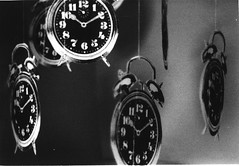
I sat in a faculty meeting from eight this morning until three-thirty this afternoon with a break for lunch. It was great to see everyone and catch up. Upon the adjournment of our meeting the school year clock began ticking. Precious time has already been wasted lolly-gagging around.
Tick, tick, tick! The parents will be milling about my room at four-thirty on Wednesday. How much homework do you give? Where can I find my son’s bus assignment? Are these the fourth grade textbooks? Where will my daughter sit? She needs to be in the front.
Tick, tick, tick! Busses will begin arriving at seven-twenty on Friday morning. Yes, FRIDAY! There is a simple mission for Friday. Get them off the bus, get them to the classroom, get them fed, get them back on the bus, and finally….get them home safely.
The beginning of the school year means many new things. Students have new teachers, new classrooms, and new clothes. Teachers experience an ever changing curriculum, new students, and new colleagues and sometimes new administrators as well.
A new school year is a chance for a new beginning, to change direction if necessary, and to set new goals.
Ever the history teacher I understand that I can’t know where I’m going if I don’t know where I have been, so I’m going to take the beginning of this school year as an opportunity to look back at some of my previous posts.
My personal top ten…so far….here at History is Elementary are listed below in no particular ranking order. Click on over and read at will....:)
1. Content Delivery: The Thirteen Colonies-a real conversation between myself and my students where I use a “questioning” technique to link an important vocabulary word from one unit to another.
2. George, We Hardly Knew Ye-my thoughts concerning de”myth”isizing history using George Washington as a focus.
3. Different Strokes for Different Folks-Differentiation, anyone?
4. Samuel Adams Isn't Just a Beer-My attempt to help students connect today’s world to an important citizen of the 18th century.
5. A Sticky Easter Memory-a personal memory involving a hot April day, a mixture of gum, chocolate, and Easter eggs, and a funeral. Yes, your eyes aren't failing you.....a funeral.
6. The Star Spangled Banner-Why It Should Be Our Anthem-My opinion and I’m sticking to it.
7. Saying Goodbye to Students-Three hundred and eight goodbyes so far...and going strong!
8. It's Important to Know Your Frontier-Just as it says….
10. Sex in the Classroom-NOT just as it says….
Michael, over at American Presidents invited me to post about presidents on his site last March. I’ve not managed to post there as much as I would like but here are my top five American Presidents posts listed below in no particular ranking order.
Can an Obscure President Become a Lesson in Character? I asked a family member to give me the name of the most obscure president he could think of. He came up with Chester A. Authur. I discovered ole' Chester was pretty interesting.
A Tale of Four Favorite Sons-I enjoyed writing this post. The Election of 1824 is a prime example to show students how the sectionalism began to to divide the nation.
Millard Fillmore Was a Know-Nothing-Vocabulary words can mean different things when used in different contexts
Exploring Campaign Slogans-My 11th grade American History teacher taught me about every U.S. election and the administrations of each President. He always included the campaign slogans, and I found them very entertaining.
So Who Was Our First President?-Some purists argue that George Washington was our 15th president!
So, one of the things that effective teachers and students do as they reflect on what they have accomplished is they set new goals to strive for, and I’m no different.
I hope to continue crafting posts that are entertaining, informative, and worth the time to read. I hope I begin to reach more of those elementary and middle school teachers who don’t blog but would enjoy reading posts about my adventures in the classroom. I hope to actually begin submitting various sections of my writing to other writing venues including magazines and professional journals.
I hope for now……but “time” will remain my enemy. Maybe over the next few months “time” and I can follow in the steps of history and make a compromise.
History is full of those, you know.
Wednesday, July 26, 2006
Welcome To My Mess
It’s that time of year…..put away the suntan lotion, the dog-earred novel, and all of the trip memorabilia. Accept the fact that blogging may have to decrease to two or three posts per week instead of the daily Summer post. Move all of the Summer things to-do to the upcoming Fall Break to-do list. Hang up the flip-flops and try to find more presentable teaching shoes. Try not to have any regrets about wasted time and all of the things you wanted to do over the break but didn’t get to.
It’s time to focus on the classroom to make it presentable for Open House and the first day of school. As you can see I have many, many things to do. Over the last two days I’ve opened every tub (I should have stock in Rubbermaid), and weeded out and thrown away things I haven’t touched in at least two years. I’ve dusted, cleaned out my fridge (there was a container of yogurt in there with a date of 2005), and reorganized my classroom library.
This picture (below) is taken standing in my classroom door looking towards the back of my room. I need to reorganize my word wall. I usually use words for writing on the wall and post social studies/history vocabulary on a chart. Since I am going to teach language arts to both classes of social studies I'm playing with the idea of posting all the words together since students will be writing reflections at least every other day to sort out and make connections with the content. What do you think?
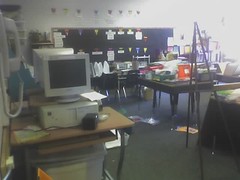
This picture (below) is also taken standing in the doorway looking straight ahead. I love the fact that I have two whiteboards. They really come in handy for things I'm required to post all of the time as well as for things I need to write during a lesson. This is the side of the room where everything, yes everything was when I came to school last week. I've spread it all out so I can have space to work and I use the desktops to sort things.
This is the view (below) from the back of the room at my desk looking towards the doorway. Students will be sitting in groups of four. A set of textbooks is already waiting in each desk for students. I hold the book facing me and place a tiny number on the top close to the spine along with the first two letters of my last name. I begin with 1 and move on to 2, 3, 4, etc. I do this on each type of textbook-----math, science, grammar, reading, and social studies. One desk has all of the 1's, another the 2's, etc. This helps students keep up with their books so much better because they know all of their books should be the same number. I have forms with the school system number already written in along with the matching number of mine so on the first day of school all I have to say is "What number to do you have?" and enter the student's name. I keep a master copy of these forms with the school system number on it so I don't have to reinvent the wheel unless we have new books. A great veteran teacher friend of mine showed me this trick when I moved down to fourth grade. It also makes taking up books at the end of the year a snap.
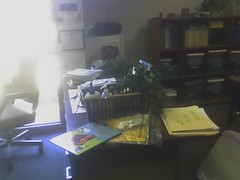
Finally a shot of my desk. I laid everything flat and put small things in a basket back in May because I knew they would move everything to clean the carpets.
I'm worried I won't get things done before Open House. We have to be at school Monday, July 31st for an all day meeting....no time to work in the rooms. I'll have all day Tuesday and Wednesday morning to work. However, Wednesday afternoon parents will be milling about my room. It's almost like having them searching through your underwear drawer. I know it a necessary evil, but I'm sure many judgements are made on that first visit. Yikes! I hate to spend my last two free days...tomorrow and Friday at school, but I may need to.
It’s time to focus on the classroom to make it presentable for Open House and the first day of school. As you can see I have many, many things to do. Over the last two days I’ve opened every tub (I should have stock in Rubbermaid), and weeded out and thrown away things I haven’t touched in at least two years. I’ve dusted, cleaned out my fridge (there was a container of yogurt in there with a date of 2005), and reorganized my classroom library.
This picture (below) is taken standing in my classroom door looking towards the back of my room. I need to reorganize my word wall. I usually use words for writing on the wall and post social studies/history vocabulary on a chart. Since I am going to teach language arts to both classes of social studies I'm playing with the idea of posting all the words together since students will be writing reflections at least every other day to sort out and make connections with the content. What do you think?
This picture (below) is also taken standing in the doorway looking straight ahead. I love the fact that I have two whiteboards. They really come in handy for things I'm required to post all of the time as well as for things I need to write during a lesson. This is the side of the room where everything, yes everything was when I came to school last week. I've spread it all out so I can have space to work and I use the desktops to sort things.
This is the view (below) from the back of the room at my desk looking towards the doorway. Students will be sitting in groups of four. A set of textbooks is already waiting in each desk for students. I hold the book facing me and place a tiny number on the top close to the spine along with the first two letters of my last name. I begin with 1 and move on to 2, 3, 4, etc. I do this on each type of textbook-----math, science, grammar, reading, and social studies. One desk has all of the 1's, another the 2's, etc. This helps students keep up with their books so much better because they know all of their books should be the same number. I have forms with the school system number already written in along with the matching number of mine so on the first day of school all I have to say is "What number to do you have?" and enter the student's name. I keep a master copy of these forms with the school system number on it so I don't have to reinvent the wheel unless we have new books. A great veteran teacher friend of mine showed me this trick when I moved down to fourth grade. It also makes taking up books at the end of the year a snap.
Finally a shot of my desk. I laid everything flat and put small things in a basket back in May because I knew they would move everything to clean the carpets.
I'm worried I won't get things done before Open House. We have to be at school Monday, July 31st for an all day meeting....no time to work in the rooms. I'll have all day Tuesday and Wednesday morning to work. However, Wednesday afternoon parents will be milling about my room. It's almost like having them searching through your underwear drawer. I know it a necessary evil, but I'm sure many judgements are made on that first visit. Yikes! I hate to spend my last two free days...tomorrow and Friday at school, but I may need to.
Tuesday, July 25, 2006
A Few Quiet Mornings Left
It’s a quiet morning here except for the sound of the washing machine and the steady stream of “fair and balanced news” coming from the Middle East emitting from my bedroom television.
Both kidlets plus one friend are still asleep, and hubby left for his business an hour ago. I have a few, very few, precious mornings like this left before I am required to report to my campus for preplanning.
Students report to school next Friday, August 4th, for their first day of school. Yikes! This means my preplanning begins next Monday. Double yikes!
My classroom is a wreck. Every cabinet, bookshelf, desk, table, chartstand, and chair will have to return to its appropriate spot as everything was shoved to one side back in June for carpet cleaning. This was a good thing since two of my precious ones took to throwing up on my carpet last year. I have avoided the spots ever since.
My school was the recipient of an e-rate grant this summer so our televisions have been upgraded, a telephone system has been installed, a new bell system, and we now have cameras in our hallways and out side our building. Fantastic! However, my television was moved from one corner to the opposite one. I’m hoping the wiring is still there to use the tv as a computer monitor when I need to do a power point or show some other kind of image.
I guess I need to corral my school’s computer guru and pinpoint him regarding some of my personal issues. I want to make sure that I can still show clips of videos from United Streaming so that the picture is the right size and the sound comes through. I want to use a classroom blog with my writing students so they can use the comment feature to peer analyze and critique. Our filters are so strong any type of web journal simply won’t come through without the guru approving the URL.
Our Leadership meeting was yesterday. It was nice to get back with everyone and I had much love and support from my colleagues due to my recent loss.
I still have scads of thank-yous to write. Mother would kill me if she knew I still had not gotten to this. She was always very prompt as a fine Southern lady should be. I still have a few to do from my world of blog, and I will.
Now that it is time to become a teacher again I will start my ever expanding “TO DO LIST” and all of those people who need to be thanked will be entered upon the list along with things like “finish regions power point”, “copy units for Connie”, “complete team agenda for meeting”, etc.
One of the best feelings in the world is to cross an item off your “TO DO LIST” and make it a “TA-DAH!”…..something finished….something accomplished…..something earned.
I want to get back to normal, but normal has changed. I’m still in the “TO DO” stage with all that has occurred, and that’s ok.
It’s going to take some time to get normal to feel right again and turn all of this around from a “TO DO” to a “TA-DAH”, but I will do it….in time.
Both kidlets plus one friend are still asleep, and hubby left for his business an hour ago. I have a few, very few, precious mornings like this left before I am required to report to my campus for preplanning.
Students report to school next Friday, August 4th, for their first day of school. Yikes! This means my preplanning begins next Monday. Double yikes!
My classroom is a wreck. Every cabinet, bookshelf, desk, table, chartstand, and chair will have to return to its appropriate spot as everything was shoved to one side back in June for carpet cleaning. This was a good thing since two of my precious ones took to throwing up on my carpet last year. I have avoided the spots ever since.
My school was the recipient of an e-rate grant this summer so our televisions have been upgraded, a telephone system has been installed, a new bell system, and we now have cameras in our hallways and out side our building. Fantastic! However, my television was moved from one corner to the opposite one. I’m hoping the wiring is still there to use the tv as a computer monitor when I need to do a power point or show some other kind of image.
I guess I need to corral my school’s computer guru and pinpoint him regarding some of my personal issues. I want to make sure that I can still show clips of videos from United Streaming so that the picture is the right size and the sound comes through. I want to use a classroom blog with my writing students so they can use the comment feature to peer analyze and critique. Our filters are so strong any type of web journal simply won’t come through without the guru approving the URL.
Our Leadership meeting was yesterday. It was nice to get back with everyone and I had much love and support from my colleagues due to my recent loss.
I still have scads of thank-yous to write. Mother would kill me if she knew I still had not gotten to this. She was always very prompt as a fine Southern lady should be. I still have a few to do from my world of blog, and I will.
Now that it is time to become a teacher again I will start my ever expanding “TO DO LIST” and all of those people who need to be thanked will be entered upon the list along with things like “finish regions power point”, “copy units for Connie”, “complete team agenda for meeting”, etc.
One of the best feelings in the world is to cross an item off your “TO DO LIST” and make it a “TA-DAH!”…..something finished….something accomplished…..something earned.
I want to get back to normal, but normal has changed. I’m still in the “TO DO” stage with all that has occurred, and that’s ok.
It’s going to take some time to get normal to feel right again and turn all of this around from a “TO DO” to a “TA-DAH”, but I will do it….in time.
Friday, June 30, 2006
Historians Observe Their Surroundings
The school where I teach is separated into four different buildings that form a large square. In the center is a large grassy area with a tree. I like to gather up my students during the first week of school and we have class sitting in the grassy area. Once we are all settled I begin our discussion. I ask students to look around and notice where they are. I ask them to look at the tree, the grass, and the spots where there isn’t any grass. I ask them to notice if the ground is completely flat or do they notice it rising or falling in certain areas. I tell them that as historians they need to be aware of the lay of the land. They need to be able to make observations for anything that can be used as a frame of reference or a landmark of sorts when exploring a historical site. Anything can be a clue regarding how the land was once used or who lived there.
I show students a picture of a pile of rocks. “What could this be trying to tell us?”
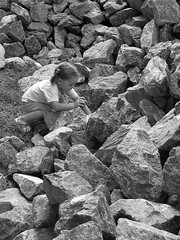
I get all sorts of crazy answers. Sometimes a student will mention that the pile of rocks could be a grave. We discuss that possibility for a moment and then I tell them that sometimes it just takes standing back a bit to get a better view of what we are looking at.
I then show them a picture taken from the air. I hear several ohs and ahs.
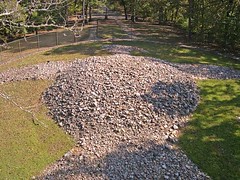
I quickly tell students they are looking at Rock Eagle----an Indian rock formation located in Georgia. I let them know we will be discussing this more in depth in a couple of days.
I show students a picture of a deep gully. I pass it around for them to observe. We discuss possible causes for the gully…erosion, earthquake, mother nature, God….
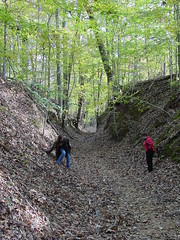
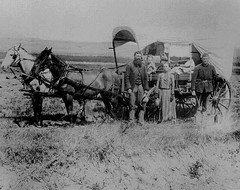
”How about man?” I ask as I show them the next picture. What if hundreds of these wagons made their way up a trail over fifty years or so? I identify the gully as part of the Natchez Trace that runs between Nashville and Natchez.
Finally I show students a picture of a trench. What happened here? Some try to be cute and guess that more wagons caused the trench. Someone thinks we’re looking at a creek bank or an early Grand Canyon.
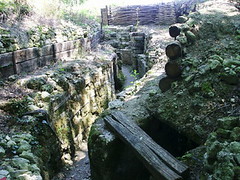
We discuss it at length and then I show students this…..
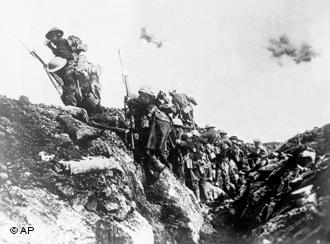
I explain that trenches are sometimes man-made. The first picture tells us this as we observe rocks and wood placed on the sides of the trench. I give them a quick explanation of the trench warfare that took place during World War I.
I end our discussion by telling students that history is everywhere around them if they will take the time to examine, to wonder, to question what they see. A pile of rocks could be just that, but if I know a little history I might guess that the pile of rocks might be a burial spot if I already know that Native Americans in my area were doing that hundreds of years ago. If I knew a little history I might realize the pile of rocks could be part of a much larger design that could be seen from the air.
Knowing my location and the history of the area might help me identify what I am looking at. I tell students that later in the year we will discuss the settlement of the frontier and I’ll be telling them about the Natchez Trace. If I know this from my studies of history when I see a location with a gully like this it might help me to identify it. If I’m in Belgium and come across a maze of trenches in the ground I could arrive at the idea that they must be World War I trenches because I know from my history class that the war was fought in trenches.
By this time I have several wiggle worms so we get up and walk down to the recess field. I gather everyone in a group and I tell them that historians never know what they are standing on unless they truly observe their surroundings. We identify together that we are standing on the recess field, and then I ask, “Is that all we’re standing on?”
I tell students to follow me and we go to the edge of the playground. We are standing on the edge of a hill. Down below us we see a flat overgrown area. Sticking out of the hill in various places we see all sorts of debris. Rocks, long pieces of rebar, broken signs, glass, wires, bricks, and assorted hunks of concrete litter the hillside. We regroup and I tell the class that the area where they play did not look like it did many years ago. I ask them to come up with some ideas about what happened. Some are silly, some are average, and some are pretty good guesses. Finally, I tell them the story. Many loads of dirt were hauled in to build up their playground, but before the dirt was dumped the town brought in remnants of a section of town. You see the town where our school is located experienced an explosion and some of the trash ended up as filler for our playground. Some of the kids nod their heads in agreement and state their grandmother or grandfather had told them about the explosion while other students are amazed.
So….before we trudge back to the classroom I summarize and close with, “What did we learn today?” I get several responses.
“Things aren’t always as they appear to be.”
“You never know what you are looking at.”
“Every piece of ground has a history if you’ll just look at it and listen.”
“Our recess field is a dump.” Yep, there’s always a true blue smartie in every group.
I show students a picture of a pile of rocks. “What could this be trying to tell us?”
I get all sorts of crazy answers. Sometimes a student will mention that the pile of rocks could be a grave. We discuss that possibility for a moment and then I tell them that sometimes it just takes standing back a bit to get a better view of what we are looking at.
I then show them a picture taken from the air. I hear several ohs and ahs.
I quickly tell students they are looking at Rock Eagle----an Indian rock formation located in Georgia. I let them know we will be discussing this more in depth in a couple of days.
I show students a picture of a deep gully. I pass it around for them to observe. We discuss possible causes for the gully…erosion, earthquake, mother nature, God….
”How about man?” I ask as I show them the next picture. What if hundreds of these wagons made their way up a trail over fifty years or so? I identify the gully as part of the Natchez Trace that runs between Nashville and Natchez.
Finally I show students a picture of a trench. What happened here? Some try to be cute and guess that more wagons caused the trench. Someone thinks we’re looking at a creek bank or an early Grand Canyon.
We discuss it at length and then I show students this…..
I explain that trenches are sometimes man-made. The first picture tells us this as we observe rocks and wood placed on the sides of the trench. I give them a quick explanation of the trench warfare that took place during World War I.
I end our discussion by telling students that history is everywhere around them if they will take the time to examine, to wonder, to question what they see. A pile of rocks could be just that, but if I know a little history I might guess that the pile of rocks might be a burial spot if I already know that Native Americans in my area were doing that hundreds of years ago. If I knew a little history I might realize the pile of rocks could be part of a much larger design that could be seen from the air.
Knowing my location and the history of the area might help me identify what I am looking at. I tell students that later in the year we will discuss the settlement of the frontier and I’ll be telling them about the Natchez Trace. If I know this from my studies of history when I see a location with a gully like this it might help me to identify it. If I’m in Belgium and come across a maze of trenches in the ground I could arrive at the idea that they must be World War I trenches because I know from my history class that the war was fought in trenches.
By this time I have several wiggle worms so we get up and walk down to the recess field. I gather everyone in a group and I tell them that historians never know what they are standing on unless they truly observe their surroundings. We identify together that we are standing on the recess field, and then I ask, “Is that all we’re standing on?”
I tell students to follow me and we go to the edge of the playground. We are standing on the edge of a hill. Down below us we see a flat overgrown area. Sticking out of the hill in various places we see all sorts of debris. Rocks, long pieces of rebar, broken signs, glass, wires, bricks, and assorted hunks of concrete litter the hillside. We regroup and I tell the class that the area where they play did not look like it did many years ago. I ask them to come up with some ideas about what happened. Some are silly, some are average, and some are pretty good guesses. Finally, I tell them the story. Many loads of dirt were hauled in to build up their playground, but before the dirt was dumped the town brought in remnants of a section of town. You see the town where our school is located experienced an explosion and some of the trash ended up as filler for our playground. Some of the kids nod their heads in agreement and state their grandmother or grandfather had told them about the explosion while other students are amazed.
So….before we trudge back to the classroom I summarize and close with, “What did we learn today?” I get several responses.
“Things aren’t always as they appear to be.”
“You never know what you are looking at.”
“Every piece of ground has a history if you’ll just look at it and listen.”
“Our recess field is a dump.” Yep, there’s always a true blue smartie in every group.
Subscribe to:
Posts (Atom)