Showing posts with label Historical Paintings. Show all posts

Saturday, July 04, 2009

Childe Hassam's Flag Series....Appropriate for the Fourth

This, of course is a painting by the artist known as Childe Hassam, an American Impressionist artist best known for his series of flag paintings. I’ve used this painting before as an image here at History Is Elementary in my Fourth of July postings because it is aptly titled “Fourth of July”. (By the way…the link takes you to a list of several Fourth of July postings that appeared here in the past.)

Here are some of the other paintings in the series…a series of thirty paintings…and more information regarding this interesting artist.


Hassam became interested in expressing his patriotism for the United States during the days leading up to our involvement in World War I. Patriotic paintings were used to counter the isolationist point of view expressed by President Woodrow Wilson and others prior to 1917. In fact, at one point Hassam wanted to go to Europe and paint scenes from the battlefront, but the U.S. government would not approve the trip. At one point he was arrested for sketching naval maneuvers along a river…..

Many of the flag pictures were donated for the war effort. Hassam accepted Liberty Bonds for payment regarding one of the paintings. Hassam’s goal was for the entire series to be sold as a war memorial, however the paintings were eventually sold individually after several group exhibitions.

More of the paintings can be seen at this link.

One of Hassam's best known works in the flag series, Avenue in the Rain, remains part of the White House collection. I've posted it over at American Presidents Blog here.

Happy Fourth!......and fly those flags, please.

Friday, December 07, 2007

An Ending or a Preview

Last week I shared with you an unfinished painting for my wordless image. It was begun by Benjamin West (pictured left) who was born in Pennsylvania in 1738. His most formal lesson as a boy regarding painting was at the hand of local Native Americans who taught him how to mix paint using clay and bear grease. By 1763 he had traveled to England where he became one of the leaders of the Royal Academy even though he had no formal art training and couldn’t spell very well either. Once in England West began to work on several commissioned works at the request of King George III. Though West left the colonies before the American Revolution he did have strong connections there. He had been named for Benjamin Franklin, was a great friend of his, and had painted a portrait of him.

I usually end my American Revolution unit by showing students the unfinished work of West, and I tell them the purpose of the painting was to memorialize the signing of the Treaty of Paris (1783). I ask students to think for few minutes and based on what they have learned write a few sentences in their notebooks regarding why they think the painting is unfinished.

It’s so easy to present content to students regarding a war and tie it all up in a nice little bow by telling them Cornwallis surrendered at Yorktown, the British sailed home, the Treaty of Paris was signed, and then BAM…..we move on to the formation of American government.

It just wasn’t that simple.

Generally the British were not that happy with the surrender, and anti-American sentiment was high. True, British citizens were tired of war, but they didn’t like loosing either. Negotiations for the treaty went on for sometime. Benjamin Franklin and his group of negotiators held firm regarding the independence of America and that the British nation should formally recognize it. Some historians have stated that the actions of the American negotiators are the greatest triumph to date of American diplomacy. However, it must be noted that the treaty was only a stop gap measure and many problems remained between the two nations until the signing of the Jay Treaty or Treaty of London in 1794.

In the painting from left to right we see John Jay, John Adams, Benjamin Franklin, Henry Laurens, and William Temple Franklin, the grandson of Benjamin Franklin. Yes, I’m aware that he resembles George Washington in the painting. My students usually pick up on this as well. Of course we know that Washington was not part of the negotiations. He was busy doing other things.


The team of Jay, Adams, and Franklin did the majority of the negotiations. Henry Laurens, former president of the Continental Congress, was one of the Peace Commissioners, but he didn’t sign the primary treaty. He did serve an important purpose involving a second agreement that involved the Netherlands and Spain. Laurens (picture at left) who hailed from South Carolina was a major planter and slave holder. Ironically his former business partner in the slave trade, Richard Oswald, was the leader of the British delegation. Laurens’ son, John, was an aide-de-camp for George Washington and was known for several brave exploits during the American Revolution. He also petitioned for the inclusion of slaves into the Continental force in return for their freedom. Georgia’s Laurens County is named for John Laurens. I have detailed bits of his life over at Georgia on My Mind.


The unfinished section of the painting was for the British delegation, but they refused to sit for Mr. West. Their disdain and outright hatred for the Americans kept them from consenting to become immortalized for all time. Many of my students connect to the many disagreements they have with their friends and realize the British really knew how to hold a grudge. Their refusal to sit for the painting is a powerful symbol for students, and serves as a preview for problems ahead that eventually lead to the War of 1812.

By presenting this painting to students I provide a few details regarding peace negotions and press upon the fact that a peace treaty doesn’t mean that all issues are resolved. Some are ongoing and eventually lead to another war.

Thursday, July 26, 2007

A Painter for Several Units

This is American Gothic, one of the most recognizable and parodied images in American culture. It was painted in 1930 by Grant Wood. Even though my young students know nothing about Mr. Wood or the artistic style of Regionalism they immediately tell me they’ve seen the painting before when I flash it up on my television monitor. It’s not surprising because it seems everyone has done their own portrayal of the painting in some way or another…just do a Google search using the key words "American Gothic". In fact, I posted Georgia’s version of the painting this very week.

My wordless image for this week is called Calendulas. Wood painted it in 1929, and it is very different from his other works. Many of the readers who visited my Wordless puzzle brought up Van Gogh. They did this for good reason. The style of Calendulas is reminiscent of Van Gogh’s Sunflowers. Click over to Sunflowers and then back to Calendulas (the first link in this paragraph). Notice how similar the two works are. There is a thick application of paint on the flowers themselves. Notice how the vase in Calendulas seems to tilt forward---this is due to the horizontal stripes. The illusion of a round vase is achieved through the curved blue stripes on the vase, and the horizontal table edge provides depth to the painting. When I’m pretending to be a Language Arts teacher I like to show students Calendulas and Sunflowers together. Then I ask students to make a two-column chart to compare and contrast the two paintings. We spend some time working on the charts to word and reword ideas that eventually wind up in a written essay.

Wood was born in Amamosa, Iowa. His first forays into art include creating scenery for his for his high school plays and drawings for the year book. Later he studied at an art institute and visited Europe several times. He even organized his own Paris artshow. He was a well travelled person and very cosmopolitan, however, once he finally settled back in Iowa for good he was often seen in overalls. He was a member of a group of artist referred to as Regionalist and was part of the American Scene Movement in the 1930s. During a time of great nationalism in the United States he looked to America’s past and supported rural life. His paintings that were completed during the Depression seem vastly different to the start realities of the time----they were filled with cultivated fields while top soil was blowing away in the Dust Bowl.

Once the United States entered World War I, Wood joined the Army and travelled to Washington D.C. where he designed camouflage for U.S. artillery. I previously wrote about the use of camouflage in World War I here. Later, after the war, Wood returned to his Iowa roots and took up residence in a carriage house with no address. He promptly made one up. His reason for returning home was simple. He said, “I realized that all the really good ideas I’d ever had come to me while milking a cow, so I went back to Iowa.” His body of work is great and doesn’t always include paintings. He has worked in many mediums including stained glass. A corn-themed chandelier Wood designed hangs in an Iowa hotel and the image on the Iowa state quarter is a Wood creation.

Grant’s work can be used all year long at various points of an American History class. George Washington and the various myths that surround him can be a great time to show students Wood’s Parson Weem’s Fable. When students are introduced to Henry Wadsworth Longfellow’s The Midnight Ride of Paul Revere Wood's painting of the same name helps to draw students into the event. Finally, the Birthplace of Herbert Hoover (my favorite Wood painting) is a very interesting view of a presidential birthplace.

In a statement that accompanied his final painting Wood remarked, “In making these paintings as you may have guessed I had in mind something I hoped to convey to a fairly wide audience in America---the picture of a country rich in the arts of peace; a homey lovable nation worth any sacrifice necessary to its preservation.”

What do you think of this statement?

Does this America still exist?

Tuesday, July 03, 2007

Happy Fourth of July!


If you have stopped by for Wordless Wednesday please scroll down to the next post.....


The artist of the above painting is Childe Hassam. He’s famous for a series of twenty-two flag paintings begun in 1916. Hassam was inspired by a preparedness parade he witnessed for World War I on Fifth Avenue in New York.

Isn’t it lovely?

…and just in case you need a little patriotic reading here are some of my more patriotic or government related posts. Happy Fourth!

George, We Hardly Knew Ye

The Star Spangled Banner---Why It Should Be Our Anthem

July 4, 1776---An Imagi-Holiday

Being About the Business of the People

Changing the Constitution

9/11 Lessons Learned

Shazaam! Thar Be Pirates!

Lady Liberty and Her Boys

The Town That Forgot the Fourth of July

Sunday, March 11, 2007

Monroe Crossing the Delaware

Monroe crossing the Delaware.

That sounds strange, doesn’t it? The name of the famous painting should be correctly termed Washington Crossing the Delaware. I misnamed it on purpose to bring another president to the forefront because President James Monroe is also depicted in this famous painting.

Do you see him? The boat is rather crowded, isn’t it? You might notice several different figures of interest. Can you pick out the man of Scottish descent? What about the African Prince Whipple? Can you find the two frontiersmen? The two farmers? What about the man who looks very feminine? No, this isn’t going to be a replay of The Davinci Code…..but, you’ve got to admit the man with the red shirt does look feminine, or at least many art scholars seem to think so.

Continue on over to American Presidents where I have posted the remainder of the story.

Sunday, February 04, 2007

Art Critics? We Don't Need No Stinking Art Critics!

This American icon has been reproduced, reconfigured, and the scene reinacted numerous times since it first appeared in its original form at the Philadelphia Centennial Exposition in 1876 to celebrate the 100th anniversary of the beginning of the American Revolution. This painting, The Spirit of ’76, is one of the most recognized images of the American Revolution; however, most art critics have held it in disdain since it first appeared. Apparently people decided they wouldn’t listen since more images were sold and passed along than the number of people who actually filed past it at the Exposition.

Archibald MacNeal Willard first named his work of art Yankee Doodle. Word has it that he was asked to change the name once the painting went on display in Philadelphia because the name was already taken by a deranged citizen as a nickname. Willard complied and opted for The Spirit of ’76.

Willard began his art career early on as a graffiti artist in his hometown. Later he fought for the North in the Civil War where he met up with J.F. Ryder, a famous photographer and entrepreneur who sold some of Willard’s work and encouraged him to paint something for the Centennial.

Willard worked on the painting over three years and we know that at least four versions exist. Apparently Williard improved on each copy as time went on. The U.S. State Department owns one of them. The final copy that went on display in Philadelphia depicted Willard’s father as the middle character while the smaller drummer boy was the son of General John Devereux.

Once the painting was done Ryder displayed it in the window of his studio. He knew the image would resonate with visitors to the Centennial when huge crowds gathered in front of his studio to see Willard’s work.

The Spirit of ’76 was displayed at Memorial Hall during the Philadelphia Exposition. Ryder sold chromolithographs of the image to promote the exhibit. More copies of the image were sold for months as the painting went on a national tour and visited several U.S. cities.

It just goes to show you that when something speaks to the American people it speaks loud and clear…..even the passage of time does not serve as a barrier.

Sunday, January 07, 2007

An Internet Challenge...Your Help Is Needed


So, I’m wondering…..I’m wondering how powerful the Internet can be. I’m wondering if it’s possible through the power of the Internet to locate the whereabouts of a historic painting that could be worth well over a million dollars. I’m wondering if the power of blogging and emails could locate a painting that has not been documented or seen since 1976.

This all started when I was attempting to come up with an idea for a post at American Presidents. I try to post there at least every eight to ten days. As I was looking through the official White House site I stumbled upon the official White House Christmas card and an idea for a post was born. I posted Have You Received Your White House Christmas Card? While I was looking at different cards I came across the Nixon card for 1971 and was simply awestruck by it.

The image for the 1971 cards was different. It was a colonial design showing what appreared to be George Washington with a White House under construction. I’d never seen a painting like it, so I quickly researched it and decided to post the image as my Wordless Wednesday and asked commenters to guess about the picture. Then I would later post about the image and how it was used for an official Christmas card. You can see my postings here where I explain more about this unique painting.

Firefly over at Bioluminescence left a comment that really intrigued me. She found an article from the year 2,000 which explained how the White House and others were attempting to locate the original painting for this image.

It all started in 1930 when the Pennsylvania Railroad, the largest company in the United States until World War I, commissioned the artist, N.C. Wyeth, to complete a series of images for a poster series titled “Building the Nation”. There were supposed to be twelve images but only four were ever known to be completed. Pennsylvania Railroad later became Penn Central and in 1976 was taken over by Conrail.

The White House would love to know the whereabouts of the painting as it is a rare image of George Washington with a scaffolded White House. Wyeth is the only known artist to have painted the White House under construction. Estimates state the painting could be worth well over $1 million dollars.

Posters of the image do exist, however, the original painting the posters were taken from has been lost. The last time the painting was documented was in an Appendix dated 1976 for the Pennsylvania Railroad listing items that were to be turned over to Conrail. The painting was listed as having minor surface damage.

Perhaps someone took the painting home, not realizing what they had, or perhaps it was given as a present at a retirement dinner. While some believe the painting is gone I don’t think so. It’s in an office closet underneath things someone thinks is a bunch of junk. It’s under someone’s bed with all of “Granddad’s stuff” he had when he worked for the railroad. Maybe it’s hanging unceremoniously in someone’s attic.

I need your help to get the word out. Copy this post and put it in an email and send to as many people as you can and ask them to do the same. Place a post on your blog or website. Perhaps one of your readers knows someone who worked for Pennsylvania Railroad or Conrail and knows several other people who did as well. Wouldn’t it be fantastic to tell people you helped to locate a painting that had historical significance plus it was worth over $1 million dollars?

Will YOU join in with this national scavenger hunt?

Information can be obtained through this blog and emails can be sent to historyiselementary@yahoo.com. I am preparing an email to send to everyone I know. If you would like me to send you a copy of the email so that you can simply forward it without reinventing the wheel please contact me and I will be happy to send it to you.

Thursday, December 21, 2006

A Painting With a Dual Purpose


Post Update: Firefly has uncovered a very interesting article regarding the whereabouts of the original painting for this week's Wordless Wednesday. I have emailed appropriate curators at the White House and the museums mentioned in the article and hope to hear back from them soon. This is getting interesting....Please read the entire post and make sure you view the comments as well.

Congrats to A.M. Whittaker and Firefly who placed the proper information in the comments section first.

The painting I featured in this week’s Wordless Wednesday seen here was created by American artist, N.C. Wyeth. It was first commissioned in 1930 for the Pennsylvania Railroad where it was used as a patriotic poster. Unfortunately I was unable to discover if any of the poster images survive or where the original painting is today. I have emailed the Wyeth homeplace and studio to see what they can tell me.

The painting does depict President Washington and White House architect, James Hoban inspecting the uncompleted White House in 1798. The site of the White House was chosen by Washington and city planner, Pierre L’Enfant, which we recognize today as 1600 Pennsylvania Avenue. Though Washington never lived in the mansion he did oversee the construction. Wikipedia advises Mr. Hoban resided on the grounds of the White House during construction with his wife, ten children, and nine slaves in a red brick house.

The second purpose for Wyeth’s image came about in 1971, some twenty-six years after Wyeth’s tragic death in a train crossing accident. President Nixon along with his wife, Pat, choose Wyeth’s image for their official White House Christmas Card.

As I researched White House Christmas Cards for my recent post at American Presidents I was struck by the 1971 card and how different the image was compared to other cards. I loved the big, billowy clouds and just the overall painting style made me pause and take notice. Compare this image to other N.C. Wyeth images seen here and here. He had quite a career doing illustrations for children's book and magazines such as Scribners.

Tanya Nichols over at Crafty Girls mentioned in the comments she would come back and print the picture out for her children. This is a great idea. Children need to view art as something to interpret and every painting has more than one meaning.

Inferencing is one of the reading skills I struggle with every year to teach my fourth graders. All of you who commented on my Wordless Wednesday this week did just that…..even if you did it comically….you were inferencing and it is a powerful tool for learning. There is a fantastic N.C. Wyeth painting called The Giant here. It is a great learning tool for kids to experience the “whole” picture. Sometimes you can set your printer to black and white or outline and print a famous painting out for kids to color. They love this.

You can learn more about N.C. Wyeth here.

I'm pleased that some of you seem to be enjoying this little diversion. I had thought about chucking the whole thing, but it would seem it is serving a learning purpose....for ALL of us. :)

Wednesday, December 20, 2006

Wordless Wednesday....Sort of....What Can You Tell Me About This?

Telling me the painting is set in Washington D.C. and the year is 1798 won't cut it.:)

Update: Shhhhhh! I know this is Wordless Wednesday, but the Education Carnival is in town. Hurry on over to The Median Sib before the lines get too long.

Update 12-20-06: The explanation for this week's Wordless Wednesday is posted here.

Friday, December 01, 2006

Mary Turner Sargent


I’ve joined several bloggers out and about who participate in Wordless Wednesdays. My first post was yesterday and can be found here.

I’ll continue posting a historical image on Wednesdays and will follow up with an explanation regarding the historical significance of the image by Friday.

This week’s image is a famous paining by John Singleton Copley of Mary Turner Sargent. A much larger and clearer image of the portrait can be found here. The painting was completed shortly after Mrs. Sargent’s marriage to Daniel Sargent of Boston who hailed from a very wealthy family of merchants and ship owners. Daniel Sargent was a Federalist and served in the Massachusetts legislature for a time and as a state senator. He was also a first captain in the Boston Light Infantry.

Mrs. Sargent was born in Salem, Massachusetts, where many of America’s first millionaires lived. She was born in what is now the House of the Seven Gables made famous by Nathaniel Hawthorne’s 1851 novel by the same name. Per the House of Seven Gables website no papers of [Mrs. Sargent’s] have been found, but the recent discovery of the letter books kept by her niece, Judith Sargent Murray, are revealing important information. In these letter books---in which Judith made copies of her correspondence to family and friends---the letters to or about Mary describe her as a woman of integrity, selflessness, and compassion.

Can you imagine sitting six hours at time for fifteen or sixteen times in order to have a painting completed? There is some evidence that this is exactly what Mrs. Sargent did per one of her sons.

Click on over and examine the larger version of the painting. What do you see?

Many of my commenters yesterday mentioned Mary Sargent’s very long neck. It does look rather strange, but in the larger image you see that she clearly has something tied around her neck. Even with that knowledge her neck is still long. Perhaps she appears to be quite tall and straight because of her undergarments. During this time period women of wealth were taught from a young age about posture. Of course, they wore whale boned corsets so they had no choice at standing up straight. They also had no choice at breathing as well!

We can see from Mrs. Sargent’s posture and placement of her hands that she was a wealthy, refined lady of social standing. Copley used copies of backgrounds from English paintings as well as the positioning of the subject and objects within the painting to give them an English feeling. In the larger version you can see that there is actually cascading water to the left of the painting. One of Mary Sargent’s hands is in the water and you can see she is holding a shell. Remember the famous painting called The Birth of Venus by Botticelli seen here.The shell Mrs. Sargent holds points to Venus who is a symbol of love and beauty while the water represents purity.

Copley may have been chosen to paint Mary Sargent’s image because he had quite a list of clients on both sides of the Atlantic and was well known in wealthy circles. Copley was very skilled at recreating the trappings of wealth in his paintings such as the clothing, the furniture, and of course the lace. Look at Mary Sargent’s arms. Even on-line the lace looks like you could reach out and touch it.

Mary Sargent eventually lost her life to water on the brain. One of her sons was Henry Sargent who became famous for his portraits while another son, Lucius Manlius Sargent was a writer and historian. I knew there was a reason why I was drawn to this family….

At the outbreak of war between the colonies and England, Copley had a decision to make. Should he see the war out in the colonies or the “mother country”? Either way he would alienate half of his customer base. After he was encouraged to study painting in London at the Royal Academy Copley chose to return to England. He never returned to the colonies, but we are left with little treasures like the painting of Mary Turner Sargent.

Thursday, November 23, 2006

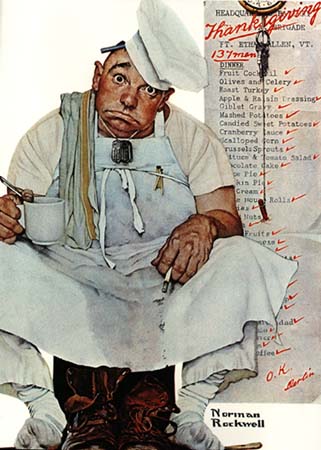
Happy Thanksgiving!


DON'T FORGET TO KISS THE COOK.......