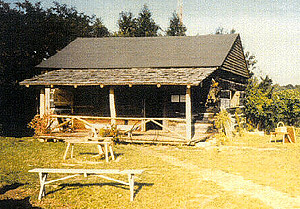
The Pilgrims set foot on Plymouth Rock in November, 1620.
Can you imagine moving to a “New World”?
Can you imagine moving anywhere for that matter right before the rush of the Christmas season?
I can’t.
Maybe it’s just a woman thing, but I know what would have been on my mind had I been on the Mayflower. I would be thinking.......Here it is nearly the first of December, I have no home, and Christmas is just around the corner. I have shopping to do, the decorations need to be up (hope I remembered where I packed them), and then I have all the cooking to do. How am I going to fit 30 various parties, dinners, and gatherings into four weeks? When are the greeting cards going to get addressed? And.....how does one ship gifts back home from the “New World”?
By December, 1620 many of the Pilgrims were sick with scurvy and many more were suffering from wild coughing fits They hardly felt like celebrating, but the fact of the matter is any Pilgrims well enough spent their first December 25th in the New World by sending out scouting parties, building their first structures, and all of the other necessary tasks to build “New Plymouth”
The Pilgrims didn’t ignore Christmas because they had bigger fish to fry like securing shelter and gathering food. It was much more than that.
They didn’t celebrate Christmas….
…..at all.
Not a Christmas carol, a Christmas tree, or a Christmas meal. Nothing. Not even Santa.
The Grinch would have loved New Plymouth.
The Pilgrims were a very no nonsense, no frills type of people. If the Bible didn’t direct it, they didn’t do it. This means they didn’t buy into any additions made to Christianity especially church traditions.
Since Christmas was not mentioned in the Bible the Pilgrims ignored the holiday. They disapproved of the way their fellow Englishmen celebrated the day with parties, feasting, drinking, and bawdy behavior in some instances.
One year after the Pilgrims arrived in the New World on December 25, 1621, Governor William Bradford discovered a few recent arrivals to New Plymouth didn’t want to work on what the Pilgrims considered just another day. He made a notation in Of Plymouth Plantation:
“On the day called Christmas Day, the Governor called [the settlers] out to work as was usual. However, the most of this new company excused themselves and said it went against their consciences to work on that day. So the Governor told them that if they made it [a] matter of conscience he would spare them till they were better informed; so he led away the rest and left them.”
When the working party returned they found the men who had a conscience decided not only to refrain from working in recognition of the day they also decided to play games and shockingly they were having ……..FUN. The governor ordered them to stop making an exhibition in the streets for all to see. The men were told if they wanted to act like that to go to the privacy of their homes.
The Puritans who differed from the Pilgrims regarding the Anglican Church merely wanted to change certain practices of the church while the Pilgrims totally separated themselves from it, however they were on the same page regarding celebrating Christmas. They knew there was absolutely no Biblical proof regarding December as the birth month for Christ, and they knew history. They realized Christmas had roots in the pagan winter solstice festivals like the Roman Saturnalia. The argued the early Roman Catholic Church had taken a pagan holiday and merged it with Christian beliefs.
In the book The Battle for Christmas, Stephen Nissenbaum sums it up this way:
“The Puritan knew what subsequent generations would forget; that when the Church, more than a millennium earlier, had placed Christmas Day in late December, the decision was part of what amounted to a compromise, and a compromise for which the church paid a high price. Late-December festivities were deeply rooted in popular culture, both in observance of the winter solstice and in celebration of the one brief period period of leisure and plenty in the agricultural year. In return for ensuring massive observance of the anniversary of the Savior’s birth by assigning it to this resonant date, the Church for its part tacitly agreed to allow the holiday to be celebrated more or less the way it had always been. From the beginning, the Church’s hold over Christmas was (and remains still) rather tenuous. There were always.people for whom Christmas was a time of pious devotion rather than carnival, but such people were always in the minority. It may not be going too far to say that Christmas has always been an extremely difficult day to Christianize. Little wonder that the Puritans were willing to save themselves the trouble.”
For sure – the Puritans didn’t trouble themselves. They just outlawed the holiday.
In fact, by Christmas, 1659 the Five-Shilling Anti-Christmas Law was enacted by the General Court of Massachusetts. The law stated:
Whosoever shall be found observing any such day as Christmas, or the like, either by forebearing labor, feasting, or any other way upon such account as aforesaid, every such person so offending shall pay for each offense five shillings as a fine to the country.
Boston actually outlawed the celebration of Christmas from 1659 to 1681.
Even after the law was set aside in 1681, New Englanders were slow to accept Christmas. The customs of gift giving and parties and even decorations were considered to be pagan customs. My research indicates even as late as 1870 Boston schools held classes on Christmas Day.
It’s interesting to note that today we still have the Christmas tug-of-war. The church is still fighing the masses over the Christmas issue. Christians fuss and fume because it seems everyone celebrates the holiday even if they don’t actually believe in the reason for the season. Folks are in it for the parties, the drinking, the gifts, the decorations, the food, the general falderal whether they believe in the divinity of Christ or not.
Heck, even Christians enjoy the falderal. I do.
I’m just glad I can celebrate how I wish, believe what I want to, and I don’t have to pay fine while doing it.
Showing posts with label Early Colonization. Show all posts
Thursday, December 09, 2010
Thursday, January 28, 2010
13 Facts About the Laws of Burgos, 1512-1513
1. Like many such proclamations and treaties the title…..Laws of Burgos…is based on a location. The document was formerly published in Burgos, Spain in 1512.2. The laws were the first code of conduct governing how Native Americans should be treated in the Americas by Spanish foreigners in America.
3. At first the laws only included the island of Hispanola, but later Puerto Rico and Jamaica was included.
4. The laws addressed the mistreatment of natives and called for their conversion to Catholicism.
5. The laws were rarely enforced making the Laws of Burgos of little value.
6. The laws called for encomiendas…..a labor system where a Spanish citizen was granted a certain number of natives they became responsible for. Basically in exchange for religious instruction the receiver of the encomienda could exact tribute from the Natives including labor, gold or other products.
7. The laws were written due to the reports of Domingo de Mendoza, the cardinal archbishop of Seville regarding abuse of the American Indians.
8. The Laws of Burgos consists of 35 laws.
9. One of the laws regarding teaching the Native Americans about Christianity mandated they would be taught the Ten Commandments, the Seven Deadly Sins, and the Articles of Faith, however, the 14th law stated the Natives had the right to perform their sacred dances.
10. The 2nd law is rather interesting…..”The Indians will leave their land voluntarily to come to the ecomiendas so that they shall not suffer from being removed by force.”
11. The 13th law involved gold….”Indians in an ecomienda must search for gold for five months a year and at the end of the five months are allowed to rest for 40 days.
12. The ecomienda system was not new to some of the Natives….the former Incan Empire had a similar system in their culture. Conquistadors and soldiers were not the only ones who maintained ecomiendas. Women and even some notable Native Americans maintained them including Montezuma’s daughters.
13. The sad thing is the Laws of Burgos did nothing to actually help Native Americans. It was just a first in a long series of empty gestures that took place over and over and over.
You can see the actual wording of the Laws of Burgos here.
Other bloggers participate in Thursday 13….you can find them here.
Labels:
Early Colonization,
Spain,
Thursday Thirteen
Thursday, November 19, 2009
Who the Heck Is Thorfinn Karlsefni?
Quick!
Dig down deep into that creaky file cabinet in your mind and pull out the folder labeled “Vikings” and name a few of the more famous ones for me.
I’ll wait.
No, not the football team. There should be another folder there for the OTHER Vikings. You know, the Norsemen who were explorers, warriors, merchants, and pirates.
There you go. That’s it. Wow, that folder hasn’t seen the light of day in…..well, just blow the dust off it and open it up.
So, what have you got?
Leif Ericsson….son of Erik the Red
Canute (Knut or Cnut) Sweynsson….better known as Canute the Great….King of England, etc.
Those are usually the top three names I get. Most of the time folks just give me Erik and Leif.
What about Thorfinn Karlsefni?
Yep, you are so very right. Who in the heck is Thorfinn Karlsefni?
Well….here goes….
1. Thorfinn was a Norse merchant who followed Leif Ericsson’s route seven years later.…around 1010 AD…to North America.
2. While on a trading trip to Greenland Thorfinn met and married Gudrid Thorbjarnardottir, the widow of Erik the Red’s son, Thorvald. (Believe me, I’m glad I don’t have to type these names every day.)
3. Snorri, the son of Thorfinn and his wife is thought to be the first European baby born in North American.
4. The location of Snorri’s birth it thought to be Buzzards Bay, Massachusetts. Other locations given include Long Island Sound, the Bay of Fundy, or L'Anse aux Meadows
5. Three years after arriving in North America, Thorfinn and his men abandoned the settlement they created and went to Greenland first…..then Norway and finally settled in Iceland, his childhood home.
6 Why was the North American settlement abandoned? Perhaps distance was the key. Some scholars theorize that Vinland was to the Vikings like India was to Alexander the Great…..it was beyond the Viking’s ability to impose their will. Others argue that climate change was the culprit.
7. You can find a statue of Thorfinn Karlsefni in Philadelphia, Pennsylvania....pictured here with my post.
8. Thorfinn grew up in Iceland and can count Aud the Deepminded, a queen from the British Isles and Ugarval, King of Ireland in his lineage though I have found no verifiable reference to Ugarval.
9. Archeology supports the long-held theory that it was Thorfinn who began the tradition of telling the Viking sagas that were passed down from generation to generation.
10. Sagas recount for most of our knowledge regarding Viking history, but it is important to remember we must separate Viking fantasy from Viking fact. Archeology lends credence to the sagas. Sagas that include Thorfinn explain he left North America after a clash with Native Americans.
11. One of the sagas tells the story of Freydis and Thorvald…a married couple that accompanied Thorfinn and his wife to the New World. When attacked by Native Americans the saga states that the Viking men ran off leaving a pregnant Freydis to scream after them, “Why do you flee from such pitiful wretches, brave men like you? If I had weapons, I am sure I could fight better than any of you.” At this point Freydid picks up a sword and exposes her breast to indicate she is a woman and frightens off her attackers. There are other versions of this particular saga…..
12.Once he settled in Iceland the records indicate Thorfinn never returned to North America.
13. Archeologist discovered a turf mansion believed to belong to Thorfinn in Iceland.
An online article regarding Thorfinn and the archaeology that proves some of the sagas concerning him can be found at Smithsonian Magazine online.
Other bloggers participate in Thursday Thirteen. You can learn more about the meme or find links to other participants here
Labels:
Early Colonization,
Explorers,
Thursday Thirteen,
Vikings
Tuesday, October 21, 2008
Jamestown Had a Sister?!?!?
When I teach the English colonies I tend to follow the same format teachers do all across the United States. Before discussing the original 13 colonies we hit on major firsts for all the heavy-hitting players—Spain’s first settlements, the first settlements for France, and then we begin discussing Roanoke and Jamestown.
What I don’t normally share with students is information regarding Jamestown’s little sister….Popham.
In 1607, thirteen years prior to the Pilgrims landing at Plymouth, Englishmen on behalf of the Virginia Company formed a colony on the shores of New England at the mouth of the Kennebec River. At that time, the mouth of the Kennebec River, near Phippsburg, was not in the state of Maine as it is today but in territory the English identified as Northern Virginia. The colony was short-lived….a little over a year passed before it was abandoned in the fall of 1608.
So why don’t we remember the Popham Colony today?
When studets learn that the Pilgrims founded the FIRST New England colony in 1620, are we merely foisting a lie onto our students?
Hardly.
The reason why the Popham Colony faded in our historical memory has to do with the success, or in this case the lack of success of the colony.
Several important lessons regarding the process of colonization can be learned from the Popham experience, however. The colony did not fail because of massive starvation, sickness, or even Native American troubles though there were those problems to some degree. The Popham Colony failed mainly due to family changes within the ranks of the colony’s leadership.
On May 31, 1607, 100 to 120 colonists left Plymouth in two ships. Their mission was to trade items—precious metals, spices, and furs—and to show that they could build English ships from the natural resources in the area. The expedition leader, George Popham sailed on the ship Gift of God. Good old George received the honor of being the leader of the colony because his uncle was a Virginia Company financial backer, Sir John Popham, who just happened to be Lord Chief Justice of England. George Popham’s second in command, Gilbert Raleigh, was the half nephew of Sir Walter Raleigh. The remaining colonists were mainly soldiers, artisans, farmers, and traders.
Much of what we know about the Popham Colony today resides in a primary document—a diary authored by Robert Davis—the captain of the second ship, the Mary and John, to make the voyage.
Immediately upon landing the colonists built a settlement they named Fort Saint George. We know how the fort was designed because one of the colonists, John Hunt, drew a map. It showed a star-shaped fort with ditches and ramparts. The grounds included a storehouse and chapel plus fifteen additional structures. The fort also had nine guns. The map has a notable history in and of itself as it ended up in the Spanish archives where it was located in 1888. Espionage was hot and heavy during the race to see who could colonize North America first. The map had been passed to King Philip III of Spain in 1608 by the Spanish ambassador, Pedro de Zuniga.
By now you are probably wondering what caused the Popham Colony to fail…..Well, it’s true—the Maine winters were a little too much for them. Any support system the colonists had developed with Native Americans eventually deteriorated which led to the realization that any profitable trade the colonists and financial backers hoped for never materialized.
Half of the colonists returned to England in December, 1607.
George Popham died in 1608 leaving Raleigh Gilbert in command. Apparently Gilbert didn’t have what it took to lead a fledgling colony plus he soon learned he had inherited his family’s estate, so he returned to England. The remaining colonists would not stay without Gilbert and made plans to leave with him.
…and what about the dream to construct ships from the Maine forests? In this the Popham Colony was somewhat successful. Led by their shipwright, Digby, they constructed a 30-ton pinnace they christened Virginia---the first English ship built in Maine and probably in all of North America.
Some of the colonists returned to England along with Raleigh Gilbert on the Mary and John while others sailed aboard the pinnace, Virginia.
So, the Pilgrims weren’t the first New Englanders….they were merely the first New Englanders who stayed.
.....and anyway...Popham Beach doesn’t have the same ring to it as Plymouth Rock, does it?
This website explains how people today are attempting to recreate the Virginia.
The exact site of the Popham Colony was lost until its rediscovery in 1994. Much of this historical location is now part of Maine's Popham Beach State Park.
Here are some interesting links regarding Popham Colony: This site discusses the archeology at the Popham site, the Archaeology Channel shares some information, and there is an informative article here.
What I don’t normally share with students is information regarding Jamestown’s little sister….Popham.
In 1607, thirteen years prior to the Pilgrims landing at Plymouth, Englishmen on behalf of the Virginia Company formed a colony on the shores of New England at the mouth of the Kennebec River. At that time, the mouth of the Kennebec River, near Phippsburg, was not in the state of Maine as it is today but in territory the English identified as Northern Virginia. The colony was short-lived….a little over a year passed before it was abandoned in the fall of 1608.
So why don’t we remember the Popham Colony today?
When studets learn that the Pilgrims founded the FIRST New England colony in 1620, are we merely foisting a lie onto our students?
Hardly.
The reason why the Popham Colony faded in our historical memory has to do with the success, or in this case the lack of success of the colony.
Several important lessons regarding the process of colonization can be learned from the Popham experience, however. The colony did not fail because of massive starvation, sickness, or even Native American troubles though there were those problems to some degree. The Popham Colony failed mainly due to family changes within the ranks of the colony’s leadership.
On May 31, 1607, 100 to 120 colonists left Plymouth in two ships. Their mission was to trade items—precious metals, spices, and furs—and to show that they could build English ships from the natural resources in the area. The expedition leader, George Popham sailed on the ship Gift of God. Good old George received the honor of being the leader of the colony because his uncle was a Virginia Company financial backer, Sir John Popham, who just happened to be Lord Chief Justice of England. George Popham’s second in command, Gilbert Raleigh, was the half nephew of Sir Walter Raleigh. The remaining colonists were mainly soldiers, artisans, farmers, and traders.
Much of what we know about the Popham Colony today resides in a primary document—a diary authored by Robert Davis—the captain of the second ship, the Mary and John, to make the voyage.
Immediately upon landing the colonists built a settlement they named Fort Saint George. We know how the fort was designed because one of the colonists, John Hunt, drew a map. It showed a star-shaped fort with ditches and ramparts. The grounds included a storehouse and chapel plus fifteen additional structures. The fort also had nine guns. The map has a notable history in and of itself as it ended up in the Spanish archives where it was located in 1888. Espionage was hot and heavy during the race to see who could colonize North America first. The map had been passed to King Philip III of Spain in 1608 by the Spanish ambassador, Pedro de Zuniga.
By now you are probably wondering what caused the Popham Colony to fail…..Well, it’s true—the Maine winters were a little too much for them. Any support system the colonists had developed with Native Americans eventually deteriorated which led to the realization that any profitable trade the colonists and financial backers hoped for never materialized.
Half of the colonists returned to England in December, 1607.
George Popham died in 1608 leaving Raleigh Gilbert in command. Apparently Gilbert didn’t have what it took to lead a fledgling colony plus he soon learned he had inherited his family’s estate, so he returned to England. The remaining colonists would not stay without Gilbert and made plans to leave with him.
…and what about the dream to construct ships from the Maine forests? In this the Popham Colony was somewhat successful. Led by their shipwright, Digby, they constructed a 30-ton pinnace they christened Virginia---the first English ship built in Maine and probably in all of North America.
Some of the colonists returned to England along with Raleigh Gilbert on the Mary and John while others sailed aboard the pinnace, Virginia.
So, the Pilgrims weren’t the first New Englanders….they were merely the first New Englanders who stayed.
.....and anyway...Popham Beach doesn’t have the same ring to it as Plymouth Rock, does it?
This website explains how people today are attempting to recreate the Virginia.
The exact site of the Popham Colony was lost until its rediscovery in 1994. Much of this historical location is now part of Maine's Popham Beach State Park.
Here are some interesting links regarding Popham Colony: This site discusses the archeology at the Popham site, the Archaeology Channel shares some information, and there is an informative article here.
Thursday, June 21, 2007
Just Another Indentured Servant?
During most of the time I lived in Virginia Beach, Virginia many moons ago I was either hugely pregnant or I was toting a baby around. The ongoing situation was not very condusive to sightseeing in and around my temporary home while Dear Hubby was in the Navy.There I was in a veritable hotbed of history---one location even bore my maiden name---and I, historical freak that I am, was stymied by motherhood.
Now before you get the wrong idea let me state Dear Son was welcomed with open arms and ample lap. I simply look back on those two years spent in and around the sights of Virginia Beach, Norfolk, and Jamestown, and can’t believe I allowed so many historical gems to slip through my fingers.
I did manage to make it to Williamsburg, but another place I toured was the Adam Thoroughgood House the subject of my wordless entry this week.
Frumteacher
correctly identified the location while The Tour Marm finally linked the house and my hints to a news story concerning the height of Americans. When I heard the story I began to wonder how it could be used with students. Then I remembered my visit to the Thoroughgood house. I was the tourist that asked the stupid question regarding how small the furniture in the house was. I think my question was, “Did ya’ll cut this stuff down? It looks like doll furniture?”It did. I’m only slightly over five feet and I towered over the table and chairs. The docent informed us that during the early colonial period people were much shorter and the furniture would have been normal to people living in the 17th Century.
Now let’s take a look at the news story from Good Morning America yesterday.
A study completed by the University of Munich and Princeton University found the U.S. had the shortest population in the industrialized world and the reason may have to do with way people live.
From the Daily Kent Stater back in March:
In the United States, the current average height of an adult man is 5 feet, 9 inches, and for an adult woman, it is 5 feet, 3 inches, according to the Centers for Disease Control and Prevention.
In the Netherlands, though, men average 6 feet tall while the average woman is 5 feet, 7 inches, according to the Leiden University Medical Centre in the Netherlands.
What’s that you say? So what? Well…….
What if I shared pictures of colonial furniture from the 17th century and discussed why things appear so low to the ground?
What if I then shared the news story?
This could possibly be an interesting way to pose an ongoing mystery for students to work on for several weeks. Why were early colonists so short? How did Americans get the distinction of being the tallest? All year long we could refer back to the story and analyze new information in relation to the growing height of Americans. Finally….how did America loose their title? Again, another mystery would be posed.
Ok….if that doesn’t float your instructional boat Adam Thoroughgood is a great early colonist for students to learn about. Many of my students tend to think about indentured servants as no better than slaves themselves. Thoroughgood’s story was common of many young men in England during the late 1600s and early 1700s. Since he was the seventh son of an Anglican vicar he was not the first born son and had no hope of an inheritance even though his family was very prominent in Kings Lyn, Norfolk, England, so at age 18 he sailed for the colonies as an indentured servant.
Once he worked his contract he was able to own land and he became very involved by serving in the House of Burgesses, Governor’s Council, and Justice of the Court. Records indicate he was also a captain in the milita. After Virginia became a royal colony many places were renamed or named for the first time. Thoroughgood is given credit for naming New Norfolk County (later the city of Norfolk) in 1624 after his home in England.
Thoroughgood increased his land holdings when he returned to England and persuaded 105 new colonists to sail back to Virginia with him. For his trouble he received 5,000 acreas and his actions insured George Washingon would be born as one of the new colonists was Augustine Warner, Washington’s early ancestor. The ancestor of George Mason, another important Patriot, was also in that colonist group.
Thoroughgood died at an early age (36). The Adam Thoroughgood House…though it bears his name…was not a place where he ever lived. It is believed it belonged to his son. Unfortunately Thoroughgood’s grave along with others from the time period is now submerged in the water and mud of the Lynnhaven River. Some unconfirmed stories state swimmers in the early 1800s could still feel the tombstones with their toes.
The house itself is a symbol of upward mobility in early American society and shows how architecture did change over time. While there were some alterations to the structure during restoration in 1957 the brick is a common building material used in Virginia at the time the house was built. The chimney on the north side is set within the wall in order to warm the house again north winds while the chimney on the south end of the house is on the exterior.
So, I'm going to print out those articles about Americans getting shorter and I'm going to head to the basement and stuff the copies in my Early Colonization unit book. You never know....they might come in handy.
Labels:
Early Colonization,
Virginia,
Wordless Wednesday
Monday, June 12, 2006
It's Important to Know Your Frontier
I’ve been busy this past week working on power points to go with my history units. So far I have completed power points for the War of 1812 and the Louisiana Purchase combined with the Lewis and Clark expedition.
The third power point I’m just now finishing up will have images to go along with my lesson regarding Daniel Boone, the Wilderness Road, and the settlement of Kentucky and Tennessee.

I have found this can be a tricky area for teachers who are history novices because the word frontier can mean different things depending on the time period that is being covered. Several years ago a colleague of mine once remarked, “You know, EHT, I don’t know as much as you do about history so I feel fairly safe with the content as long as I stay in the text page by page.”
I saw her point. I would have to do the same thing if I suddenly found myself teaching math. Staying with the text can get you into trouble, though, and here’s why.
Generally a unit of study regarding the formation of our government is taught after the American Revolution followed by the settlement of the frontier.
My colleague came to me one day and said, “Who picked out this text? It’s useless.”
“Why?” I asked.
“Well, I started looking at the lesson about the frontier and it doesn’t have any information about sod houses, the prairie, or the early railroads. What are we going to do?” my colleague wailed.
Gently I told her she was thinking about the wrong frontier.
Even as I did my research this week I came up with many different time periods when I googled frontier. I can see how people could easily get confused.
The frontier in early America changed every few years as settlers became crowded and moved to the outer regions. Folks were moving across the Appalachian Mountains before and during the French and Indian War. That was the first frontier, and it existed several years before the settlement of the Great Plains that brought us tales of buffalo, sod-busters, and cowboys.
What can also add to the confusion not only at the elementary level but can confuse upper level students as well, is we tend to touch on settlement across the Appalachian Mountains as we begin the French and Indian War and we touch on it some more at the conclusion of the war with the Proclamation of 1763 issued by King George III which stated colonists could not settle the lands west of
the Appalachian Mountains. The British intended to hold this area for the Native Americans but also meant to move the boundary line westward as white settlement forced it to move.
We then jump headlong into the American Revolution forgetting about the settlers we’ve left dangling out there across the mountains. After the conclusion of the Revolution and a discussion about the formation of our government we then expect the students to turn their attention back to these settlers who crossed the Appalachians.
This situation is definitely one where I feel a teacher needs to depart from the text program and discuss the back county (deep inland settlements towards the mountains) as well as the crossing of the Appalachian Mountains during and at the end of the American Revolution. In this way it remains in context with events such as the Wilderness Road which Daniel Boone was establishing as early as 1775 , the Treaty of Fort Stanwix (1768), and Sycamore Shoals (1775) which began settlement in what would become Kentucky.
In February, after we completed our examination of U.S. government, I asked my students to tell me what they thought of when I said the word frontier. I wrote the word on the board to give them a visual. Some of the responses were buffalo, cowboys, trains, prairie, and covered wagons.
Clearly there is some confusion regarding the word frontier. People tend to think about the Wild West in connection to the frontier because it was the last frontier Americans settled here in the contiguous United States.
I usually make my point by drawing an outline map of the United States on the board. I add in the Appalachian Mountains and, I sketch in where the Mississippi River would be. I ask students, “Where did the Europeans begin to settle first?”
“Along the coast,” they decide.
“And then what?” I prod.
Students proceed to tell me that the settlers eventually crowded up in the first settlements and, they began to move inland. We had already learned a vocabulary term for the inland area and I remind students that their text called this area the backcountry. I share with them further that the word frontier can also describe this land. The land at the edge and beyond a settlement is known as frontier.
As we ended our discussion about the term frontier one of my young men raised his hand. When I called on him he stated, “I know what the final frontier is.”
I fell for this hook, line, and sinker, “Really, what is it?”
My young man reeled me in, “Space…that’s the final frontier.”
Clearly this sweetie watches a lot of Star Trek.
Remember that you can subscribe to this blog and receive my updated posts in your email box by submitting your email address in the Feed Blitz box at the top of this page or use the Bloglines button to the right. Thanks in advance for your comments!
The third power point I’m just now finishing up will have images to go along with my lesson regarding Daniel Boone, the Wilderness Road, and the settlement of Kentucky and Tennessee.

I have found this can be a tricky area for teachers who are history novices because the word frontier can mean different things depending on the time period that is being covered. Several years ago a colleague of mine once remarked, “You know, EHT, I don’t know as much as you do about history so I feel fairly safe with the content as long as I stay in the text page by page.”
I saw her point. I would have to do the same thing if I suddenly found myself teaching math. Staying with the text can get you into trouble, though, and here’s why.
Generally a unit of study regarding the formation of our government is taught after the American Revolution followed by the settlement of the frontier.
My colleague came to me one day and said, “Who picked out this text? It’s useless.”
“Why?” I asked.
“Well, I started looking at the lesson about the frontier and it doesn’t have any information about sod houses, the prairie, or the early railroads. What are we going to do?” my colleague wailed.
Gently I told her she was thinking about the wrong frontier.
Even as I did my research this week I came up with many different time periods when I googled frontier. I can see how people could easily get confused.
The frontier in early America changed every few years as settlers became crowded and moved to the outer regions. Folks were moving across the Appalachian Mountains before and during the French and Indian War. That was the first frontier, and it existed several years before the settlement of the Great Plains that brought us tales of buffalo, sod-busters, and cowboys.
What can also add to the confusion not only at the elementary level but can confuse upper level students as well, is we tend to touch on settlement across the Appalachian Mountains as we begin the French and Indian War and we touch on it some more at the conclusion of the war with the Proclamation of 1763 issued by King George III which stated colonists could not settle the lands west of
the Appalachian Mountains. The British intended to hold this area for the Native Americans but also meant to move the boundary line westward as white settlement forced it to move.
We then jump headlong into the American Revolution forgetting about the settlers we’ve left dangling out there across the mountains. After the conclusion of the Revolution and a discussion about the formation of our government we then expect the students to turn their attention back to these settlers who crossed the Appalachians.
This situation is definitely one where I feel a teacher needs to depart from the text program and discuss the back county (deep inland settlements towards the mountains) as well as the crossing of the Appalachian Mountains during and at the end of the American Revolution. In this way it remains in context with events such as the Wilderness Road which Daniel Boone was establishing as early as 1775 , the Treaty of Fort Stanwix (1768), and Sycamore Shoals (1775) which began settlement in what would become Kentucky.
In February, after we completed our examination of U.S. government, I asked my students to tell me what they thought of when I said the word frontier. I wrote the word on the board to give them a visual. Some of the responses were buffalo, cowboys, trains, prairie, and covered wagons.
Clearly there is some confusion regarding the word frontier. People tend to think about the Wild West in connection to the frontier because it was the last frontier Americans settled here in the contiguous United States.
I usually make my point by drawing an outline map of the United States on the board. I add in the Appalachian Mountains and, I sketch in where the Mississippi River would be. I ask students, “Where did the Europeans begin to settle first?”
“Along the coast,” they decide.
“And then what?” I prod.
Students proceed to tell me that the settlers eventually crowded up in the first settlements and, they began to move inland. We had already learned a vocabulary term for the inland area and I remind students that their text called this area the backcountry. I share with them further that the word frontier can also describe this land. The land at the edge and beyond a settlement is known as frontier.
As we ended our discussion about the term frontier one of my young men raised his hand. When I called on him he stated, “I know what the final frontier is.”
I fell for this hook, line, and sinker, “Really, what is it?”
My young man reeled me in, “Space…that’s the final frontier.”
Clearly this sweetie watches a lot of Star Trek.
Remember that you can subscribe to this blog and receive my updated posts in your email box by submitting your email address in the Feed Blitz box at the top of this page or use the Bloglines button to the right. Thanks in advance for your comments!
Labels:
colonies,
Early Colonization,
frontier,
Kentucky,
Tennessee
Subscribe to:
Posts (Atom)