Showing posts with label US Congress. Show all posts

Tuesday, September 21, 2010

A Little Desk History....

There are many types of desks. Messy ones, clean ones, ones to work at and ones just for show. There are fancy desks referred to as secretaries, computer desks, executive desks and roll top desks. Ernest Hemmingway and Winston Churchill preferred a stand-up desk. United States presidents have used the Resolute Desk, and then there is Thomas Jefferson’s lap desk.

Of course, students have desks as well. They generally have gum stuck underneath or inside them, and the tops are adorned with identifying tags left behind by precious owners extolling what they hate or who they love.

The desk I featured in my Wordless Wednesday is a U.S. Senate desk, and they have quite a history.

The desks date back to 1819 when 48 desks were commissioned following the destruction of the previous desks by the British during the War of 1812. There are only four of the original desks…..two are in private collections, one desk is in the Senate collection and another was housed at Beauvoir, Jefferson Davis’ plantation. It was destroyed by Hurricane Katrina. It is hard to determine which desks are original or were commissioned later.

Some of the desks are distinguishable by their trapezoid shape. This enabled the desks to be arranged in a semi-circle. Today, the desks are arranged according to political party. In the 1950s, Senator Wayne Morse switched parties from Republican to Democrat. He actually placed his desk in the middle between each party compromising the normal arrangement.

The Cherokee Strip is an area of the Senate chamber that when used compromises the original arrangement. The area gets its name from an section of Oklahoma that was part of a dispute between the United States and the Cherokees dating back to the Kansas Nebraska Act in 1854. Today the section of the Senate chamber is used when one party has a significant majority and desks are included on the side of the other party.

Just like the desks belonging to my fourth and fifth graders some of the Senate desks contain graffiti. The earliest names and dates go back to the early 1900s and unfortunately, some of the names like Daniel Webster are deemed forgeries. It is not known if some of the desks contain the words, “For a good time call…..”


One desk drawer has more than just a signature, however. Desk number 86 has a notation that reads, “Spoke 24 hours, 18 minutes from this desk in 1957….Senator Strom Thurmond (SC) in opposition to the Civil Rights Act.” Back then Senator Thurmond had to rely on his own voice to be heard, but today, each desk is equipped with an amplification box and a microphone…

Today Senators choose their desk based on seniority except for the Daniel Webster desk which the senior senator from New Hampshire uses. Jefferson Davis’ desk is used by the senior senator from Mississippi, and the Henry Clay desk is used by the senior senator from Kentucky.

When Senators leave the Senate they have to leave their desk behind, but can tote their chair with them New chairs are made to replace them.


During each legislative session the Senate pages are responsible for making sure each desk is equipped with items that will be needed such as the Congressional Record, Executive Calendar, Calendar of Business, the day’s legislation, any legislative notices or bulletins and just like my students……two pencils.

It’s a wonder the Jefferson Davis’ desk is still intact. During the Civil War soldiers camped out in the Senate chamber. They identified the desk Jefferson Davis, the president of the Confederacy, had used and began to tear it apart. One of the Capital employees stopped them.

If a senator happens to pass away during a legislative session his or her desk is draped in black crepe and flowers are placed on the desk. The flag at the U.S. Capital is flown at half staff. In past years actual funerals were held in the Senate chambers, but that hasn’t happened since 1959.

The best desk of all is the candy desk. Ever since 1965 when George Murphy began to keep a supply of candy in his desk The candy desk currently sits on the back row of the Republican side.


Hmmm…..seating arrangements, two pencil requirements, candy, desks defaced with graffiti……it would seem the Senate isn’t too different from fourth or fifth grade….

Friday, June 18, 2010

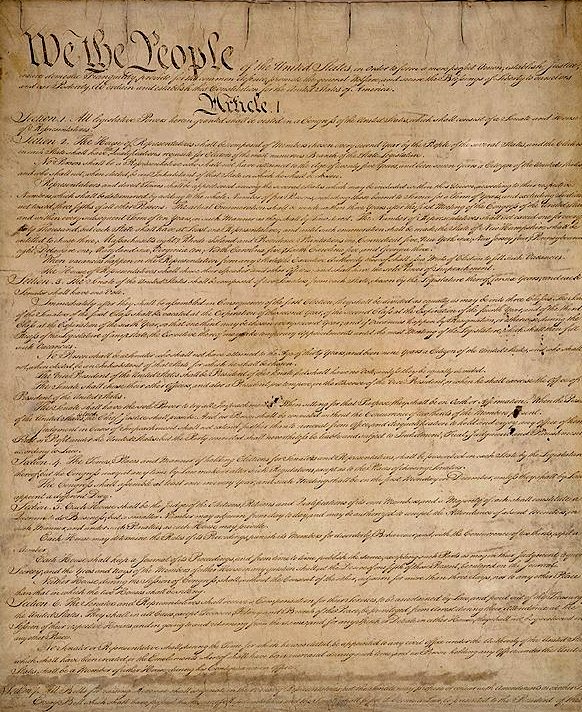
The Constitution: A Living Breathing Document

This post first appeared here at History Is Elementary in June, 2006. I’m currently attending a seminar on educational law, so it seems appropriate to re-run this today.

Enjoy.

Earlier this month we sidestepped another effort to amend our Constitution. That’s not surprising since there have been approximately 10,000 proposed amendments since 1789. Most of them never got out committee while some amendments, the Equal Rights Amendment, for example, gained great notoriety but expired while waiting on ratification.

If it’s possible to love a document then Elementaryhistoryteacher absolutely adores the United States Constitution. My American identity rests in the stability and continuity of the United States Constitution. I really get into teaching my government unit even though some of the more intricate workings of our government I’m required to cover in fourth grade are a bit too lofty for the students to grasp. However, I try. I lay seeds that I hope will sprout later.

I teach students that our Constitution was the first of its kind for a recognized nation. It is so important that it has been copied many times by other fledgling democracies. We spiral back in our content to recall events we studied earlier in the year that began a chain ending with the Constitutional Convention. We remember the Iroquois League, the Mayflower Compact, and the Fundamental Orders. I remind students the colonist were Europeans---men who had governmental roots based in monarchies---men whose ancestors were the majority yet lived at the pleasure of a few leaders or in most cases one decision maker. We remember the Declaration of Independence whose author had the audacity to give a divine monarch his comeuppance. The beauty of it, I tell students, is that our plan of government works. It worked during times of crisis like the Civil War, Watergate, and during the presidential election of 1876 when the voting results were disputed in three states.

We discuss the events during the actual Constitutional Convention including the various compromises, and we learn about the three branches of government. We discuss ratification. At this point I usually depart from my colleagues because I feel it is important to teach students how our Constitution provides for amendments, but they should understand that any effort to change one of our most previous documents should be approached soberly and gingerly.

We discuss the first ten amendments known as the Bill of Rights because they concern our individual rights and were necessary in order to obtain ratification of the document. Future amendments are not usually discussed at my grade level unless the time period is taught when the amendments were added. There is nothing wrong with this in my eyes but teachers are loosing a fantastic opportunity to give the amendment process the proper examination it requires. Teachers are usually required to teach citizenship responsibilities to contrast with the Bill of Rights. Lessons are presented that indicate certain rights citizens have contrasting activities citizens should engage in to keep the Republic healthy such as voting and educating ourselves regarding important issues. While we are teaching citizen responsibilities we should also focus on the appropriateness of amending the Constitution.

The originality of our government is that it gives something very precious to ‘we the people’---not entitlement programs, porkbelly special projects, or low interest student/home loans---but freedom. Citizens are given freedom of choice, freedom of action, and freedom to live as we wish as long as our freedom does not interfere with the freedom of someone else.

It should be remembered that the Constitution doesn’t hand rights over to us; our plan of government only guarantees them. The philosophy that many of our Forefathers operated under taught that citizens are born with certain rights and liberties. The Constitution simply secures these rights for the populace.

The framers of the Constitution were highly suspicious of government. They had just gotten rid of what they considered to be tyrannical control. They were all about protecting individual rights not restricting liberty. Amendments to the Constitution involving personal liberty should always grant liberty not take it away.

Whether I agree with the premise or not, a proposed Constitutional amendment should never be used to serve as a smokescreen for Congress in anticipation of midterm elections. Our nation faces major problems with illegal immigration and the war in Iraq, yet proposed amendments regarding flag burning and same-sex marriage have been discussed repeatedly. This has been a poor use of the amendment process and is a poor use of emotional issues to detour voters from the real issues at hand.

Some Americans are going to engage in behaviors that others will have a problem with . Does this mean we are going to propose amendments for what some perceive to be bad choices and bad behavior? If this is allowed I'm afraid we will be opening doors that will be very hard to close in the future.

Wednesday, June 28, 2006

Senator McCain Weighs In

In this post titled, “We Need to Stop This…Now”, Sen. John McCain apparently agrees with me concerning the inability of Congress to be about the business of the people. He states:

I'm afraid it's because at times we value our incumbency more than our principles.

Follow the above link at Porkbusters where Mr. McCain is a guest blogger. It is refreshing to see a politician put himself in a position where citizens can tell him what they think.

Others Weigh In...Now It's Your Turn

In a recent editorial titled Congress's Real Crimes, Gloria Borger (U.S.News and World Report) states:

So here we are, at the start of summer, with Capitol Hill in a frenzy, talking up a storm as it readies to leave for a long break. Goodness knows, your members of Congress deserve their rest, given all they’ve accomplished: Social Security reform. Immigration reform. Lobbying reform. Healthcare reform.

Oops. Wrong list.

Ms. Borger and I, it seems, are like minded as you can see by visiting my recent posts Changing the Constitution and Being About the Business of the People.

I wonder what would happen if we had an election and absolutely no one showed up to vote? Would they get the message then?

In the same online issue, David Gergen also pens his views regarding Congress in a thoughtful essay about leadership here. Here are a few excerpts:

The grim truth is that the political leadership of the country, especially in Washington, is almost dysfunctional in grappling with the big issues bearing down on us. From energy to education, climate change to healthcare, budget deficits to trade deficits, progress is perilously slow. And time is definitely not on our side.

Reading further:

What this means for America is that if we wish to remain great, we must improve--dramatically--the way we compete. We all know this starts with K-12 education, and we have made progress, but it has been shamefully slow and uneven.

…and towards the end:

Ultimately, these are questions that test our national will. If America is not to slip from great to good, we need civic leadership across the country to light fires and rally energies

I guess after reading the opinion of others and contemplating my own thoughts my biggest concern right now with the direction our country is going in is we aren’t heading in any direction. We have made no major gains in any of our problem areas and more and more I believe Congress is our problem. I’m tired of the fighting…the partisan politics…shooting down great ideas because your party didn’t come up with it. It has to stop.

Serving as a legislator should not be a life-long career choice. Maybe we need some fresh blood….folks who don’t understand the saying, “this is the way we’ve always done it.”

I’d be interested in knowing what you think.

Tuesday, June 27, 2006

Being About the Business of the People

I appreciate your comments to my recent post here about the U.S. Constitution and my objections to amending it to correct issues of morality. However, one comment that was made deserves some elaboration on my part especially in light of recent events here in Georgia.

One person who commented agreed with me that altering the Constitution is a big deal but that times have changed and we need to change with the times. True, very true. However, let’s remember what the main purpose of the U.S. Constitution is. It is our plan of government. We have three branches that work independently and dependently at the same time hence the term checks and balances. The Constitution lays out the responsibilities for each branch and provides the game plan for what can be done and what can’t. The U.S. Constitution also details the relationship between the states and the Federal government. It tells us that matters that are not covered in the Constitution falls under the authorization of the states.

Currently a few amendments to the U.S. Constitution involve changes regarding the procedures of the Federal government, however, most of the amendments secure our individual liberties. The only time we have had an amendment that restricted liberty it was repealed later. The 18th amendment dealt with Prohibition. The purpose of the amendment was flawed, it failed miserably, and was repealed by the 21st amendment.

This brings me to the news from today. This morning I was awoken with a news story concerning yet another U.S. Congressman who is pushing for an amendment to ban flag burning. I was also reminded by my newsman that the State of Georgia would be arguing their case before the Georgia Supreme Court regarding a reversal of a gay marriage amendment. Sometime ago Georgia citizens voted overwhelmingly (76%) to approve a state amendment that would ban gay marriage and civil unions. The key word to the dispute is “and”. Some months later a judge overturned the vote because the ballot question presented to voters dealt with more than one issue. It is true that for over a century Georgia has had a statute where ballot questions can only deal with one issue. State attorneys argue that the two issues, gay marriage and civil unions are really one and the same.

So here’s the crux of my point….the major issue I keep hearing about amendments based on issues of morality is people are angry at judges who legislate from the bench. If our U.S. Congress and our state legislatures would sincerely be about the business of the people these situations would not occur. Many of the members of legislatures across our great country are attorneys. Why then can’t they legislate appropriately so that we don’t have crazy loopholes and mistakes that cause these types of debacles? Think about the thousands of dollars that are being wasted because the Georgia General Assembly did not follow procedure or overlooked it. There are too many people involved in the legislation process for there to be haphazard and sloppy legislation.

Perhaps our lawmakers should make the problems of “we the people” their main concern instead of taking great ideas that will solve problems and whittle away at them and water them down so much they don’t even resemble the original legislation by the time they are done. Why do they do this? Could it be that legislators are so involved in pleasing every special interest group they are hindered from being about the business of the people. Could it be continued efforts to be re-elected also hinders them from doing what “we the people” elect them to do?

What do you think?

Remember that you can subscribe to this blog and receive my updated posts by email when you submit your address in the Feed Blitz box at the top of this page or if you read several blogs you can click on the Bloglines button to the right. Thanks in advance for your comments!

Friday, June 23, 2006

Changing the Constitution

Earlier this month we sidestepped another effort to amend our Constitution. That’s not surprising since there have been approximately 10,000 proposed amendments since 1789. Most of them never got out committee while some amendments, the Equal Rights Amendment, for example, gained great notoriety but expired while waiting on ratification.

If it’s possible to love a document then Elementaryhistoryteacher absolutely adores the United States Constitution. My American identity rests in the stability and continuity of the United States Constitution. I really get into teaching my government unit even though some of the more intricate workings of our government I’m required to cover in fourth grade are a bit too lofty for the students to grasp. However, I try. I lay seeds that I hope will sprout later.

I teach students that our Constitution was the first of its kind for a recognized nation. It is so important that it has been copied many times by other fledgling democracies. We spiral back in our content to recall events we studied earlier in the year that began a chain ending with the Constitutional Convention. We remember the Iroquois League, the Mayflower Compact, and the Fundamental Orders. I remind students the colonist were Europeans---men who had governmental roots based in monarchies---men whose ancestors were the majority yet lived at the pleasure of a few leaders or in most cases one decision maker. We remember the Declaration of Independence whose author had the audacity to give a divine monarch his comeuppance. The beauty of it, I tell students, is that our plan of government works. It worked during times of crisis like the Civil War, Watergate, and during the presidential election of 1876 when the voting results were disputed in three states.

We discuss the events during the actual Constitutional Convention including the various compromises, and we learn about the three branches of government. We discuss ratification. At this point I usually depart from my colleagues because I feel it is important to teach students how our Constitution provides for amendments, but they should understand that any effort to change one of our most previous documents should be approached soberly and gingerly.

We discuss the first ten amendments known as the Bill of Rights because they concern our individual rights and were necessary in order to obtain ratification of the document. Future amendments are not usually discussed at my grade level unless the time period is taught when the amendments were added. There is nothing wrong with this in my eyes but teachers are loosing a fantastic opportunity to give the amendment process the proper examination it requires. Teachers are usually required to teach citizenship responsibilities to contrast with the Bill of Rights. Lessons are presented that indicate certain rights citizens have contrasting activities citizens should engage in to keep the Republic healthy such as voting and educating ourselves regarding important issues. While we are teaching citizen responsibilities we should also focus on the appropriateness of amending the Constitution.

The originality of our government is that it gives something very precious to ‘we the people’---not entitlement programs, porkbelly special projects, or low interest student/home loans---but freedom. Citizens are given freedom of choice, freedom of action, and freedom to live as we wish as long as our freedom does not interfere with the freedom of someone else.

It should be remembered that the Constitution doesn’t hand rights over to us; our plan of government only guarantees them. The philosophy that many of our Forefathers operated under taught that citizens are born with certain rights and liberties. The Constitution simply secures these rights for the populace.

The framers of the Constitution were highly suspicious of government. They had just gotten rid of what they considered to be tyrannical control. They were all about protecting individual rights not restricting liberty. Amendments to the Constitution involving personal liberty should always grant liberty not take it away.

Whether I agree with the premise or not, a proposed Constitutional amendment should never be used to serve as a smokescreen for Congress in anticipation of midterm elections. Our nation faces major problems with illegal immigration and the war in Iraq, yet proposed amendments regarding flag burning and same-sex marriage have been discussed repeatedly. This has been a poor use of the amendment process and is a poor use of emotional issues to detour voters from the real issues at hand.

Some Americans are going to engage in behaviors that others will have a problem with . Does this mean we are going to propose amendments for what some perceive to be bad choices and bad behavior? If this is allowed I'm afraid we will be opening doors that will be very hard to close in the future.

Remember that you can subscribe to this blog and receive my updated posts by email when you submit your address in the Feed Blitz box at the top of this page or if you read several blogs you can click on the Bloglines button to the right. Thanks in advance for your comments!