Showing posts with label Reading. Show all posts

Thursday, April 16, 2009

The Gift

Back during another lifetime in the 1970s you would have found me on Friday night sitting in front of our family television….the one where the knob had fallen off and we had to resort to using needle-nosed pliers to change it…patiently waiting for my favorite television show to air. There I was – gazing up at the screen – watching a parade of commercials and happily munching on taco-flavored Doritos – then I would hear the theme song I can sing to this day and even if you won’t admit it, you can as well.

Here’s the story…of a lovely lady…who was bringing up three very lovely girls…All of them had hair of gold like their mother’s…the youngest one in curls.

Here’s the story…of a man named Brady…who was busy with three boys of his own…They were four men…living all together…yes, they were all alone.

I loved the Brady Bunch. They were different. They were not a cookie-cutter version of my very average family. Not everyone was related by blood, not everyone got along all the time, but there was a lot of love and acceptance. Take two families with former tragedy and throw in a dash of Alice and presto! An Instant American family I would have loved to be a part of.

Look around your classroom or neighborhood. We have more families with steps and halves and live-ins than ever before, and if you are like me you have often side-stepped an important facet of American History….our family history.

It’s easy to ignore these days, isn’t it?

We have students who have their fair share of tragedy….parents on drugs, in jail, molestations, mental illness, a different uncle in the house every week or so, physical violence…a plethora of mixed families that make the Brady Bunch-type family impossible to achieve, so I can understand why educators might be leery of asking children to examine their families, to answer the question why their families are important, and to decide how their family fits into the American quilt even with all the baggage that sometimes accompanies family life these days.

But, how can we ask students to connect to a bunch of folks discussed in the study of history that they’ve never heard of and will never meet unless they can connect to how they fit in….how their family fits into our society no matter the baggage and no matter the circumstances?

A brand new book has dropped into my lap that I think would serve as a great reminder that families come in all shapes and forms. A family doesn’t necessary have to be a group of people all related by biology….they have to have things in common and those things bind us together in love.

The book I’m talking about is called The Gift. Its author and illustrator, Karen Craft, just happens to be my dear sister. In The Gift she tells the true story of Baby Boy who came to live with a family who wanted a little boy very much. The book covers numerous themes from family love, overcoming tragedy, and even an honest look at what makes the concept of family what it is and to be more precise what makes the concept of a mother….a mother.

As the first page of the book states, “A Mama isn’t just someone that gives birth to you. She’s someone that sits with you when you’re sick, and doesn’t mind. She’s the one who bakes you cookies late into the night, when you forgot to tell her earlier. She will clap louder than anyone at your piano recital. She reads your favorite book to you over and over. And over. She really listens to you when you need to talk and when you’re scared she makes you feel safe. She teaches you to be polite and chew with your mouth closed. She’s the last person you see when she kisses you good night, and the first person you want to see in the morning. You know in your heart that she’s your Mother, you Mom, your Mama. She’s your gift and you are hers. Sometimes biology just isn’t so important after all.”

The Gift is a great book to open the door to discuss adoption with students of all ages, to discuss blended families, to discuss losing a family member, and to discuss how non-family members….our friends and neighbors….are important parts of our families as well.

Children will love the story details regarding Da, Mama, Sister Dear, and Baby Girl. The story even has its own version of Alice in the guise of Nanni-K who in reality happens to be my dear niece.

It is a great resource for your classroom library, a media center, or a home library. Students, young and old, will love The Gift as a read aloud as they make Mother’s Day cards and presents, and the book lends itself well to small group reading activities for older students.

Karen Craft’s illustrations are brought to life even in more exact detail by artist Meghan Branscomb from Mornin’ Glory Studios. As you can see from the story illustrations I’ve scattered through this post they are exceptional and make the story even more entertaining. I’m already thinking about making a few slides of the illustrations in enlarged detail to show to students as the book is read.

It’s a great book to purchase for your child or another child you know. With Mother’s Day around the corner it is also a perfect gift for your mother, mothers you know young and old, and even those motherly-types you have in your life. I have a few of those….and I know you do too.

Visit Karen Craft's website, Just Sharing a Story , to purchase your copy of The Gift.

Tuesday, June 03, 2008

The New Catch-22: The Social Studies Version

In a post titled The New Catch-22: Science and Literature, the Science Goddess over at What It's Like on the Inside wrote about a problem that plagues content area teachers. She says:

It goes without saying, I'm sure, that I have a particular bias about including science as part of a well-rounded education. It is not enrichment. It should not be an add-on to the curriculum, or something taught as filler when the teacher finds some time. I also believe that science becomes even more important in high-poverty areas because it provides students with background experiences as the basis for literacy. It is the concrete which allows teachers to tie on abstract words and symbols. It forms the foundation for students to make personal connections and have something to write about.

As I commented at her site if we took out the word “science” and included the words “social studies” then she has hit the nail right on the head for me and my thoughts on the issue. For example, I’ve lifted the following sentence from the Science Goddess’ post and inserted my curriculum area: Experiences in [social studies] build literacy (vocabulary in traditional settings does not). But students have to have the basic skills in reading and writing in order to support other learning.

Yes, this is a catch-22 since so many students come to us unprepared. The Science Goddess and I both realize that more and more emphasis is being placed on reading instruction in the early grades which in turn cuts the time for science and social studies instruction. She surmises the cry of the gung-ho literacy types in her post by saying: "Make them practice reading all day, if necessary, because more instruction is the same as better instruction." I guess it’s just the knee-jerk reaction, but it goes against research, and it goes against the success I’ve had in my social studies classroom regarding literacy improvement. Many of my students who do come to me unprepared improve their literacy rate by at least two grade levels.

I’m just wondering if I already knew I should be teaching literacy along with my content, and the Science Goddess knows she should be teaching literacy along with her content then why don’t we see more of it. I certainly don’t as I visit other content area classrooms. I see content, I see assessment, yet I also see poor retention and performance.

Literacy instruction in the content areas is THE KEY to building comprehension and retention of the material we teach. Let me repeat this because it is SO VERY IMPORTANT….if you teach science or your teach social studies and you aren’t teaching your students how to access the content….how to digest the information…..you are not providing all of the information you can to your students. If you aren’t well versed in many, many reading strategies please use your time over the summer to develop reading strategies that you can use beginning the first day of school.

In my fourth grade history courses I use many reading strategies; however, I would venture to say I use the text-marking strategy the most. I model the strategy for students more often at the beginning of the year, and as we go along I slack off more and more as many more students choose to use the strategy on their own.

In the beginning the trick is to get the students to understand this is not busy work, and it should not be just one more thing they have to do. Once they see the benefit they buy into it. Early on I use a process where students read a passage and then provide a retell immediately on tape or by writing a summary about what they have read. After we have practiced the strategy a few times I have students complete more summaries.

I always conference with each student individually for a few minutes and ask them what they think about the strategy. What do they find easy? What do they find difficult? What benefits do they see from using the strategy? Most understand that the process makes them think about their reading more indepth since they have to summarize it at the end. It’s here where they buy into the strategy, and basically after this they are willing to try any strategy I show them throughout the year. I try to include a reading strategy with each and every content lesson I teach.

From time to time I copy a page from the social studies text and hand them out for students to practice with the text-marking strategy. Depending upon the standards we are focusing on students learn to mark main idea, cause and effect, geographic descriptors, etc. Students might mark features of the text including captions, headings, or sub-headings or important points regarding an event.

When copies of the text cannot be made I have provided strips of colorful Post-It notes or marking tape that does not harm the textbooks.

I have found that over time students begin to internalize the process and begin to create their own way of marking text with their own shot-cuts---personal abbreviations and symbols. They make the strategy their own.

My team began using the text-marking strategy after attending a reading conference several years ago. We were concerned with our student’s level of comprehension and mandated student testing was looming before us. Since students could write in their test booklets this seemed like one strategy students could use all year long and transfer into the testing period as well. Over the years many students have chosen to utilize the strategy and stated the process makes it easier to keep track of the details and facts in a strict pass/fail situation when nerves are already on edge. Since they have practiced the process all year it comes very natural for them.

It’s so very easy for all of us in the content areas to moan and groan that “they are taking our time away from us” and we can continue to complain that students aren’t prepared as they reach the lower and upper middle grades OR we can roll up our sleeves and provide more opportunities for students to have more varied literacy experiences and more practice with various reading strategies, so they will not be “left behind.”

Tuesday, January 30, 2007

Let Them Read a Book!

Recently I posted about Dr. King and a lesson involving a video from my classroom prior to his special day.

Elizabeth from More From Elizabeth was one of the commenters to my post. She stated she “learned about Dr. King by reading a book” and wanted to know “what happened to books.” She also commented that she “would have been insulted” if she had been shown an animated video past the first grade.

That was the main point of my post……Students had seen the same animated video year after year. I elected not to do that and showed students two video clips that consisted of reinactments as well as real footage from Dr. King’s life.

It’s taken me a few days to respond, but I wanted to let Elizabeth know that books are alive and well in my classroom. Georgia fourth graders are required to read at least one million words or twenty-five grade level appropriate books in one year. We require every fourth grader to have a media center book with them at all times. During their reading class students read in small groups with a teacher, they read independently, they listen to books, they read Accelerated Reader books and take computerized assessments that give students feedback on how well they are comprehending what they read. Students reread familiar books to each other to build fluency as well.

Yes, Elizabeth, reading is alive and well in my classroom. Before the holidays my homeroom was retested to check comprehension through Dibels and two other assessments our system requires. The results indicated that all but two students had moved up one entire level from their ranking at the beginning of the year. The other two had also made gains, but had not increased an entire level. I have students currently reading at the upper third grade level all the way though an eighth grade level.

I’m not surprised about our results with the amount of reading students complete during each school day. Besides the types of reading I mentioned above students are also reading their Social Studies and Science textbooks (though school administrators would rather choke to death than to let anyone know we really use them). My students read supplemental items I add to my Social Studies program to bring in extra content, read through power points I’ve made for each Social Studies lesson, the vocabulary presented through Social Studies and Science are very advanced, and I haven’t even touched on the reading of literature students complete in Language Arts.

We read. We read all day. Please understand that many of the students I teach have never left their small town. We have a major mall fifteen minutes away, but many of my students have never been inside it. Their families purchase everything they need from the local Walmart. Atlanta is twenty-five minutes away, but it could be a million miles away for some. Many of my students have never been to any of the Atlanta museums, have never been to Turner field to see a live Braves game, never been on a plane, and think the only shows that come on television are Jerry Springer and American Idol. Most of my students ask to take my books bought with my own money home because they don’t have books of their own. The only magazines many see are People or TV Guide. Many have never been on a vacation and those that have often don’t venture beyond choices like Dollywood, Gatlinburg, or Georgia’s idea of Mecca….Panama City Beach. Not that those places are bad….I’ve been to all three, but they are somewhat limited in broadening one’s idea of culture.

With the advent of testing heavy in the inferencing department many students need images. They aren’t required to simply recall or locate information. Students are now required to evaluate data and then make generalizations in order to arrive at an answer. In order to do this they need reference points to build prior knowledge. Sources like United Streaming are a God-send. Today’s youngster finds it difficult to imagine a classroom where their African American friends weren’t welcome. In classrooms where today’s students know their rights it seems very foreign to them that certain people were excluded from various aspects of society simply because of skin color. Short film clips that show footage of the riots, firehoses, sit-ins, and marches build images in the minds of students. These images serve as anchors that students grab onto as they manipulate new unfamilar material.

Yes, I could have read a cute read aloud to students about Dr. King and showed students the pictures. I could have gone out and bought a class set of a chapter book concerning the life and times of Dr. King and spent several days reading it and analyzing the events with students, but let’s think outside the box for a moment....

What if by showing the video clips I gave students a scaffold….knowledge they could stand on to get them to the next place? What if the next place was the media center where they were motivated to look for a book independently concerning Dr. King? What if Dr. King’s image was clearer in their mind as they read because they had seen the video images of Dr. King preaching, being interviewed on television, and making his “I Have a Dream” speech?

What if in the days following my video presentation every biography of Dr. King had been checked out of our media center by a fourth grader?

I don’t need to wonder…..that’s what happened.

Thursday, December 14, 2006

The Good and Bad...A Week Before Christmas Break

The Bad…..they’re dropping like flies. Some sort of stomach ailment is traveling around giving bad tummies, fevers, and headaches. I wrote so many passes to the office this morning I was afraid somebody would think I was trying to empty my room. I’ve been on the fringes of the travelin’ crud myself, but since it’s a near impossibility to secure a sub I’m trudging on……

The Good…presents! So far I’ve amassed lots of sweet homemade cards, hugs, a mini-snowglobe and bear figurine from the dollar store, raspberry vanilla and cherry blossom products from Bath and Body Works, a bag of fruit, and a nice watch. One gift was particularly unusual…..I received a battery operated pencil sharpener in the shape of a monster. You put your pencil in his mouth to sharpen it. When you’re done he burps. The young man that gave it to me said, “I gave it to you because you have a good sense of humor.” Another student spoke up and said, “Yeah, you’d get it….you’d think it was funny.” I did get it. I did think it was funny. What my gift giver didn’t realize is the best gift he gave me was telling me he thinks I have a good sense of humor. My students understand me. After the thirtieth burp, however, I don’t know if my sense of humor will still be intact.

The Bad…tempers are short. Kids who have tolerated each other suddenly have had enough and are telling each other off right and left. This leads to shoving desks, shoving chairs and shoving each other. Name calling is high on the activity list, and being in a state of constant alert for everyone’s safety is a little exhausting.

The Good…I have earned a new reputation among students, especially the boys, as a tolerable linebacker. Earlier this week one of my young men became a bit too aggressive during a friendly game of football. He didn’t like the way a play had gone and pushed another boy rather hard two or three times. I began walking towards them telling the first boy to stop several times. The boy being pushed puts his hands up and backed away, but the pusher kept after him. I basically ended up tackling the pusher from behind and held him in a restraint hold to get him to calm down. Once things calmed down one of the boys hollered, “Nice tackle, Elementaryhistoryteacher! Ya wanna play?” The news must have gotten around because several students in other grades mentioned hearing about my “tackle”. I won’t hold my breath….I don’t think the Atlanta Falcons will be calling anytime soon.

The Bad…coordinating a pizza order for 100 students for our non-party, movie watching event on Friday, sweating out the delivery of our presents we ordered for students on-line, end of term paperwork, grading, coordinating exams when students are absent from school more than they are in, and adding the extra load of completing 96 certificates for students throughout the entire school who had exemplary behavior during September, October, and November. These were awarded at our PTSO meeting Tuesday night. They took me three days to complete. How do I get roped into these things?

The Good…Our reading teachers have determined our fourth grade has risen an entire level in reading scores since the beginning of the year. Approximately 90 of 100 fourth graders have 10 Accelerated Reader points or more. This is fantastic since none of our students had 10 points during the first term…..our reading teachers pushed the program, motivated the kids, and they surpassed our wildest dreams. In 9 weeks many of my homeroom students have amassed 20, 30, and even 40 points. Most important of all we have noticed that fluency is increasing and comprehension is improving. What a Christmas present!

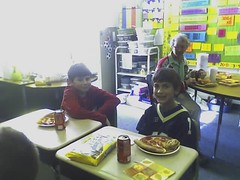
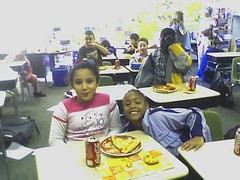
The two highest students are in my homeroom. One has 69 points while the other has 70. These points for students represent many minutes of independent reading. Today we recognized the top three in each homeroom with pizza. It was nice to have this small group for a special lunch in one the classrooms with us to acknowledge their hard work. Here is a couple of pictures of our top students.

ARParty1

The young man on the left is my "pencil sharpener guy".

ARparty

S0….it’s finally here. The final day before break, and I haven’t even started my shopping yet.

The Carnival of Education---Edition 97 is up over at the Education Wonks. Go see the best and brightest in the edublogosphere!