Showing posts with label Thanksgiving. Show all posts

Tuesday, November 25, 2008

Thanksgiving Diversions

Thanksgiving is on the brain the week….who is going where, the assignments for who brings what dish, the grocery list, catching up on housework and keeping in mind those Christmas decorations need to be ready to go up the day after the feast. Then there is the cooking….cooking….cooking.

If you need a break from the preparations or if you merely need a diversion from all the family love during this time of thanksgiving check out the Plimouth Plantation website. One interesting feature of the website is the list of ongoing blogs that you can link to.

You can follow As the Wetu Turns which is a daily chronicle of daily life in the Wampanoag Indigenous program, or follow My So-Called Pilgrim Life….a chronicle of daily life in the 1627 English village at Plimouth Plantation from both a modern and historical perspective.

Even though it’s not been updated since June, 2008 Mayflower II-Captain's Blog is still a great read. Captain Peter Arenstam chronicles the events surrounding the Mayflower II 50th anniversary celebrations. You can find out what it takes to keep a 17th-century ship afloat.

Finally, The Embroiderer's Story is detailing the story of the Colonial Wardrobe and Textiles Department in their quest to recreate a 17th-century embroidered jacket.

Wednesday, November 21, 2007

Happy Thanksgiving!


I’m on a self-imposed posting holiday until Friday. I will be spending time with family and friends.

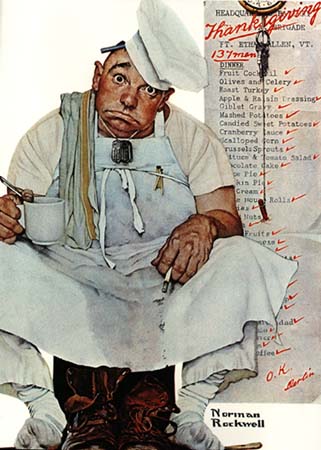
The painting I’ve presented here is by Norman Rockwell and was inspired along with three other paintings by Franklin Delano Roosevelt’s Four Freedom’s speech.

The four paintings (you can see them here) were published in the Saturday Evening Post on February 20th, February 27th, March 6th, and March 13th in 1943.

The paintings raised over $130,000,000 in war bond sales when they toured around the country by the U.S. Department of the Treasury.

If you are looking for Thanksgiving reading here are the titles of some of my former postings:

13 Thanksgiving Myths

What's All the Hubbub, Bub? All I Want Is Turkey, Family, and a Little Football

Squanto: A Coincidental Life, Part 1

Squanto: A Coincidental Life, Part 2

Monday, November 19, 2007

Taking the Time to Give Thanks

We have this wonderful opportunity at church each month for every Sunday school department to get together for a lesson, and of course, being Baptists the process involves food. We call it Breakfast Sunday.

Various folks volunteer or are volunteered to provide the lesson. This month’s lesson was given by one my most favorite volunteers as he generally provokes me to think. We even had a craft with our lesson which is evident by my picture with this post. We wrote things we were thankful for on feathers and then glued them to the turkey's body. It was nice to come home and place my Thankful Turkey on the fridge. Since my kids are 22 and 14 I haven’t had refrigerator art in some time.:) It’s supposed to be a turkey…..don’t make fun of it, please.

Our teacher’s lesson plan had an opening salvo that depended on everyone connecting to their prior knowledge of the Pilgrims, of course. Being an avid history reader, history reseacher, and history teacher I usually try…..try….to remain silent when historical topics come up because folks-in-the-know can really be boorish people, and I really hate to beat people over the head with what I might know. Truth be told as many can testify once I get started I can’t shut up and then basically I embarrass myself. My children can quote chapter and verse on this….

Our esteemed teacher for the morning asked the question regarding what the Pilgrims had to be thankful for. Why did the Pilgrims give thanks with a great feast? There were several good answers thrown out between bites of biscuits slathered with gravy, but when one particular answer was uttered I couldn’t stand it any longer, and I prayed I could give a statement that would not become a treatise on the Pilgrim’s experience. Praise be! I did ok. My comment was short and to the point, but be warned….I might not be with this post. :)

The answer that prompted me to action was a comment concerning how the Pilgrims gave thanks for their journey across the sea by giving a Thanksgiving dinner.

No, that’s not so.

It is so very easy to speed the story along and think the Pilgrims were unhappy in England, procured a ship named The Mayflower, and sailed for the New World. It’s also very easy to recall the Pilgrims arrived, landed at Plimouth (Old English spelling) Rock in 1620, and the annual holiday was begun upon landing.

There’s so much more to the story…..

The Pilgrims did have a hard time worshipping the way they wanted to in England. Back in the day there was only one church in England and one way of worship. If you didn’t agree you could be made to feel very uncomfortable and ran the risk of being charged with treason since the monarchy was the official head of the Church of England. The Church of England would not have appreciated the blending of traditional and contemporary worship styles that so many churches in my area enjoy today.

So, the Pilgrims did not set off for the New World, but went to Holland where they remained for several years. When they couldn’t obtain the necessary papers to leave their home country they resorted to any means necessary including bribery to book passage. Two attempts to leave England were thwarted and several ended up in jail for a time. Eventually it was only a small group of 150 or so that ended up in Holland. They were happy for awhile, but eventually there were problems. In his History of Plimoth Plantation William Bradford advised the Pilgrims began to have many “discouragements” in Leiden, the Dutch city where they had settled. They were still a small group, and others had been unable to follow them. Many of the older membes of the group had difficulty in obtaining a job, and money was running out rather quickly. The Pilgrim children were being “drawn away by evil examples into extravagance and dangerous courses” as well. In order to keep their own culture intact they knew they must go somewhere where they could be “unto themselves.”

In September, 1620 the Pilgrims set out for the New World. Procuring the right paperwork and obtaining needed investors was not easy. The investors, of course, were looking for a profit and over the many months would express their displeasure at the lack of progress the Pilgrims would make in the New World. Their original destination was not as far north as present day Massachusetts, but an area north of the Virginia colony where colonists had already set up the settlement of Jamestown (1607). The climate had been tested and they had a fairly good idea where they wanted to settle. A terrible storm ended up blowing the Mayflower off course and this is how they came to land at Plimouth in November, 1620.

Plimouth was not an ideal place for a colony and the timing of the Pilgrim’s landing was not ideal either. By December, many of the Pilgrims were sick with scurvy and other ailments. Snow had begun to fall and needed crops had not been planted. What resulted was a period of time the Pilgrims described as the Starving Time. The name makes sense because that is what many of the Pilgrims did. During the first winter approximately half of the Pilgrims died.

The survivors along with their Native American friend, Squanto, eventually developed the settlement we refer to as Plimoth and by November 1621, after their first harvest, they did indeed have much to be thankful for.

Looking towards our own Thanksgiving, what do you have to be thankful for?

Sunday, November 26, 2006

Dragging Things Out


I guess we are the only family in the United States actually smoking a turkey today. You’d think we’re tired of turkey after Thanksgiving, but Hubby Dear received a dandy bird from a client and well…..we have to eat, you know. We usually drag holidays out as long as we can.

Sometimes dragging something out is great and other times well….sometimes things can go on too long. Cinderella over at World of Royalty linked to two newspaper stories regarding the American Mohegan tribe and a request to meet with monarch of Britan dating back to the 1730s. Read the whole story story here and here.

This is most interesting. Everytime I visit Cinderella I find something wonderful.

Friday, November 24, 2006

November Remembrance, Part One

Is it possible to love someone through another’s memory? To love and admire someone you never met, someone you will never be able to meet, someone who at the moment of their passing caused an incredible upheaval of grief and gouged an enormous chasm of longing for things that can never be, someone who a large number of people still speak of with reverence, awe, and thankfulness?

I believe it is possible.

I know it is possible.

I know it because I participate in this kind of love and admiration everyday for two vastly different Americans who left this Earth almost a year to the day from one another. My admiration for these two inviduals stems from my mother who shared her memories of them with me during my formative years where they became entertwined and linked indelibly in the murkiness where actual memory and grafted memories blend.

NovemberRemembrance

I was six months old on Saturday, November 24, 1962. Naturally I have no real memories of this day. What I know comes from Sister Dear who was six at the time. We had just celebrated Thanksgiving the previous Thursday. More than likely my parents had driven my sister and I to their shared hometown to visit with my Dad’s folks and then my Mom’s. Little did anyone know it would be the last time my Mom saw her mother alive. Sister Dear recollects the phone ringing that Saturday afternoon and nothing ever being the same again. She tells me now that Mother began wailing and flung herself across her bed. Sister Dear remembers simply standing and staring at Mother as she became a grieving, heaving mass of pain. When she remembers that moment she sees a collage of images of mother mixed with the piney hardwood floor of our hallway, the old radio that had been mothers as a teen now used as a phone table in the hallway, and how time seemed to stand still. Sister Dear was watching Mother’s agony as she had been told her mother had been found dead of a heart attack at the age of 62.

It was sudden. It was cruel. It was not what anyone would have expected. In writing that my Mother has left behind she states Nanny was tall and slender with broad shoulders. She had beautiful skin and dark, thick, course hair. She was a great cook and seamstress----most of the clothes my mother wore were handmade by my grandmother. She was always a cheerful person---smiling, laughing, and always hid any problems she might have---plus she always wanted to do something to help people who were less fortunate than herself.

Sister Dear speaks of our “Nanny” by describing her simply as FUN. She remembers having great times with Nanny. In every picture I have ever seen of my grandmother she is wearing a June Cleaver type dress…..shirtwaist, short sleeves, and full skirt. Sister Dear tells that Nanny would place her in the hem of her skirt and swing her back and forth. That had to be fun. Sister Dear tells of waking on warm mornings and gazing up on the wall where a picture hung of a little boy and a little girl. They were about to cross a bridge and an angel was hovering at their shoulders. She has told me this picture actually scared her. We were told as children that the boy and girl were on their way to Heaven. I remember the framed print too…….it scared me as well. Sister Dear has told me she would lie in bed the longest time and try NOT to feel sorry for the kids, but it was hard. As an adult I now understand the significance of that print. My grandmother had bore tragedy upon tragedy as young woman. Her first husband had been shot to death in front of her, and she had lost three children….one to sickness, one got ahold of some medicine that had been left out, and a baby boy had been born dead. The print that scared my sister and I so probably gave comfort to our grandmother and might have been the reason it hung in the spare bedroom.

Once up Sister Dear would walk into the front room and find a big bowl of blueberries on the floor between the screen door and door jam. She’d sit on the gritty floor and munch away. It always seemed, Sister Dear says, that Nanny would just know she was up and awake. She’d turn from her chores in the garden and give a hearty good mornin’ wave, and Sister Dear's day of fun would begin by building a playhouse out of tongue and groove planks and a cardtable Nanny would provide for her. I’ve always been told Nanny loved working with plants and apparently she could get anything to grow anywhere. Sister Dear remembers Nanny always smelled deliciously of outside, sunshine, and fresh turned earth. Things could be done at Nanny’s house that could not be done at home. Nanny always allowed Sister Dear to make mud pies on the porch not with water, but with real honest to goodness buttermilk.

Sister Dear remembers Daddy holding her as they stood in front of the casket set up in the front room of my grandparent’s home, and she remembers the funeral which took place at the one room wooden church with the obligatory outhouse in the back plopped in the piney woods where three generations of my mother’s family scratched the dirt. The land for the church had at one time been part of the family farm, but my great grandfather had donated it to the church folk. Nanny was laid to rest in dirt that was home to her. Sister Dear remembers a long service, our distraught mother who we now know had been given something to keep her calm and quiet, and the long row of our grandfather’s half-sisters who were actually more in line with our mother’s age than our grandfather’s. Each dear aunt took her turn holding Sister Dear in her lap….first Dee, then Blanche, then Claudine, then Nelle, and Elizabeth and then back to Nelle, then Claudine, then Blanche, and then Dee where the whole process started over again.

Mother grieved. Years later Mother spoke of grieving hard. She often said the knowledge that she had to take care of Sister Dear and I got her through, but there were days she didn’t know if she could make it. Our grandfather grieved hard as well. Sister Dear remembers his home being fun. I remember it as dark and dusty shrine much like the Haversham bedroom in Great Expectations. Many things were left exactly like they were the day Nanny left us even down to her pin cushion which always hung on a nail in the hallway with the pins in it just like they were the last time Nanny used it. As I grew older it remained hanging on its nail fading in color with the dust eventually caking over it until it was practically rotten.

The remainder of this post can be found at American Presidents Blog here.

Thursday, November 23, 2006

Happy Thanksgiving!


DON'T FORGET TO KISS THE COOK.......

Thursday Thirteen 2, Thanksgiving Myths

Thirteen Things about THANKSGIVING MYTHS

1. The Pilgrims celebrated the first Thanksgiving. There is much debate where the Pilgrims held a harvest celebration or a time of thanksgiving. They did not refer to their three day feast as Thanksgiving as we refer to it. This feast did not become a yearly event, and it was not until the 1800s that Americans began to think about a regular Thanksgiving celebration.

2. Since it was a harvest celebration God was left out. The Pilgrims were a very religious group. To think they didn’t pray or include God in their celebration would be denying who they were.

3. Pilgrims……Puritans, they were all the same. The Pilgrims were Seperatists who disagreed with the Church of England. They preferred to leave England and settled in Holland before sailing for “Northern Virginia”……..actually present-day Massachusetts. The Puritans came over later and began settling in the area of present-day Boston.

4. Pilgrims wore dark clothing and per many of the paintings and school pageants where the feast is portrayed Native Americans wore feather headresses. In probate records from the time period we find inhabitants of Plymouth owned cloaks of red and clothing of various hues. The large buckles we are so fond of using to recreate Pilgrim clothing did not come into use until the late 1600s. Wampanoags would not have worn headresses in the manner of Plains Indians. They also did not live in teepees.

5. The Pilgrims were the only group to have a time of thanksgiving. Records indicate many different European groups in North America had times of thanksgiving including the Spanish in present-day Texas and in St. Augustine during the 1500s. The settlers at Berkeley Plantation, Virginia also make a claim of having an earlier thanksgiving celebration. Ultimately various Native Americans of North America must have the distinction of a harvest celebration and/or time of thanksgiving as they had done so for thousands of years as part of their culture.

6. They ate turkey. While we are certain through various records of the time they ate deer we are not certain about turkey. Records indicate fowl was served, but historians continue to debate the turkey issue. It is certain that many of the dishes we consider traditional today were not served at the Pilgrim’s feast.

7. The Pilgrims lived in log cabins. Many of the images that have been created over the years show Pilgrims living in log type cabins. This is incorrect. For many months the Pilgrims continued to use The Mayflower as a home. Slowly, wooden, clapboard building were fashioned to house the Pilgrims and their possessions.

8. The Pilgrims prepared the food and invited the Wampanoags. Like any pot-luck everyone participated. The Pilgrims would have prepared some of the food and Massasoit, along with 90 of his braves brought several deer.

9. After three days of feasting there must have been tons of dishes to wash. My students are usually delighted to find out that the early Pilgrims would have had no plates and there wasn’t a single fork at Plymoth Plantation. They ate with their hands.

10. The term “Pilgrims” was not in use until the 1870s. William Bradford states “They knew they were Pilgrims.” in his Of Plimoth Plantation. He was there. He should know.

11. William Bradford issued a Thanksgiving Proclamation in 1623. Jeremy D. Bangs gives a great debunking to this misconception here.

12. The Pilgrims were grave robbers. Written first-hand accounts of people who were there indicate they found graves, examined them, but left things intact. They did find buried corn and carried some of it away with them.

13. Celebrating Thanksgiving is a slap in the face to Native Americans and should not be done. True, after Massasoit died things began to get increasingly tense between the Wampanoags and all European settlers in the area including the Pilgrims. King Philip’s War is proof of that. Perhaps we could look at Thanksgiving as the time that once was…..the time when there was a promise of doing things in a more congenial manner. Thanksgiving should not be looked upon as a celebration of domination or a time of mourning……it serves as an important lesson that Europeans and Native Americans were not always at odds. They could cooperate and live together. There are lessons to be learned from the breakdown of relations.


Links to other Thursday Thirteens!1. (leave your link in comments, I’ll add you here!)

Get the Thursday Thirteen code here!

The purpose of the meme is to get to know everyone who participates a little bit better every Thursday. Visiting fellow Thirteeners is encouraged! If you participate, leave the link to your Thirteen in others comments. It’s easy, and fun! Be sure to update your Thirteen with links that are left for you, as well! I will link to everyone who participates and leaves a link to their 13 things. Trackbacks, pings, comment links accepted!


Wednesday, November 22, 2006

What's All the Hubbub, Bub? All I Want Is Turkey, Family, and a Little Football

Tomorrow is Thursday and folks who participate in the Thursday Thirteen meme will be posting their list for the week. I posted my first list last week. I decided to join the meme because it looked interesting and I thought it might be a great way to attract people to this site who are not involved in education. I decided that I could incorporate history and educational issues into my list each week.

Since tomorrow is Thanksgiving I thought a list of Thanksgiving myths or misconceptions would be appropriate. Wow, there is quite a debate going on out there, and a multitude of misinformation exisits even on the debunking sites.

The first thing I did was google “Thanksgiving myths”. After I had gone through the first couple of pages of hits my head was actually reeling. There is a large amount of information, misinformation, and spin…..not to mention a large amount of copycats.

One website attempts to take on all comers and actually attempts to use primary sources to support his thoughts. Imagine that! Jeremy Bangs, a former curator at Plymouth Plantation, has posted an excellent posting which wades through many of the myth webpages zipping around the Internet. You can see his three-page work here.

Mr. Bangs states:

Surveying more than two hundred websites that “correct” our assumptions about Thanksgiving, it’s possible to sort them into groups and themes, especially since Internet sites often parrot each other. Very few present anything like the myths that most claim to combat. Almost all the corrections are themselves incorrect or banal. With heavy self-importance and pathetic political posturing, they demonstrate quite unsurprisingly that what was once taught in grade school lacked scope, subtlety, and minority insight.

One could go on. Someone should go on. To respond to all the assorted internet nonsense about Thanksgiving it is necessary to go on and on.

He then refers you to the site I have linked to above.

History News Network has some great articles up under the heading “Thanksgiving” but they appear to be a repeat since many of the comments are dated 2002 and 2003. An item under “Breaking News” caught my eye.

In an Associated Press article titled Teachers Emphasize the Indians reprinted here there is a discussion regarding how many elementary teachers are abandoning the romanticized version of Thanksgiving and settling for the more realistic version. The article discusses a teacher who attempts to get students to realize Europeans came and took possession of lands without any thought that they might already belong to someone else.

“I think that is very sad,” said Janice Shaw Crouse, a former college dean and public high school teacher and now a spokewoman for Concerned Women for America, a conservative organization. In criticisim of the teacher detailed in the article Ms. Crouse states, “He is teaching his students to hate their country. That is a very distorted view of history, a distorted view of Thanksgiving.”

Personally, I think Ms. Crouse is wrong. There is a place in our classrooms for the realistic as well as the romanticized versions of history including Thanksgiving. My students realize that when Columbus landed in the Carribbean and claimed the land in the name of the Queen of Spain it wasn’t his to claim. Does the fact that my students understand Plymoth Plantation was once a Patuxet village and the Pilgrims simply took it over mean they will hate their country? I think not. I think the knowledge helps them to understand their country better.

That being said I firmly believe a great responsibility lies with the classroom teacher to help students bridge the gap between realism and romanticism. We should provide enough background to students so they see the context of the time period. I explain to students that we are constantly uncovering new information that can be documented about historical events. Many things I learned in school has since been updated. Many things they learn today will more than likely be updated as more investigation is made.

Rick Shenkman, editor at History News Network weighs in here with Top 10 Myths About Thanksgiving.

Timothy Walch tries his hand with Thanksgiving Myths here. He states:

So what do most Americans believe happened on that first Thanksgiving Day? Most still cling to what they learned in elementary school. The Pilgrims sat down with Indians for a big meal of turkey, cornbread, cranberries and pumpkin pie. The Pilgrims dressed in black, and the Indians wore feathers and colorful beads. In fact, many Americans today still recall if they were "pilgrims" or "Indians" in their school pageants.

It's a charming story, but it's a myth. To be sure, it's a powerful one -- one that will be repeated many times this November. The fact that it's so pervasive is evidence that American myths have long lives.

So it's a good thing that Americans today are not tested on the history of that first Thanksgiving, because few of us would earn a passing grade. It seems that the historical evidence of Thanksgiving is not as compelling as the myths that cloud our memories. It's too bad that childhood images of Pilgrims and Indians aren't based on historical facts.

Here is the part of Walch’s essay that really hit home for me:

And yet there's a legacy about this holiday that threads its way from past to the present and defies both myth and historical evidence. That legacy is generosity. To be sure, Americans today may not be as religious as the Pilgrims, but most Americans do share their plenty with their family and friends on this special day. It's a holiday that brings all Americans, no matter their creed or disposition, together. And that's something worthy of our thanks.

Does it matter what they served, who served it, what they wore? I agree with Mr.Walch. We need to remember for one brief shining moment Native Americans and Europeans, though they may have been wary of one another, sat down and broke bread. They shared a meal, they interacted, they tried to understand each other. It would be a shame not to share this fact with students as well.

We can all argue, quote, and requote, until kingdom come but one thing is for sure. Just like in any historical investigation we need to look at the artifacts and the written sources. If you can’t verify it then it is simply conjecture. I’m going to post my list of 13 myths tomorrow. Anyone who wants to quibble is welcome to do so, but come armed with primary source documentation from the various writings of Willam Bradford or other involved people of the time.

Tuesday, November 21, 2006

Squanto: A Coincidental Life, Part 2

In part one of this post seen here I commented that I believe certain people and events are placed in our paths for very definite reasons. I like to tell students the true story behind Squanto because his story provides opportunities to look at myth versus fact as well as issues of character. For many years Squanto bounced back and forth between Europe and New England mostly through no choice of his own, however, his experience, tragic as it is, served a very real purpose. Each life lesson Squanto experienced was filed away in his toolbelt to be pulled out later when it was needed. I like to teach students they all have their own toolbelts as well.

When we last left Squanto he had finally arrived back on his home shores to discover every member of his village had been wiped out by a plague.

Historians love to banter over which type of plague raced through native villages during 1616-1619, but the important item for my use with students is Squanto was the last Patuxet left. His village had been abandoned, everything left idle as it was the day the last tribal member had succumbed to disease.

For a time Squanto resided with the Pokanokets at the invitation of Massasoit, the Grand Sachem of the Wampanoag Federation.

In 1620, however, the Mayflower arrived with men, women, and children. Their original destination had been Virginia, but a storm blew them off course. John Smith had previously explored and mapped this region and is credited with naming the area Plymouth. When a landing party finally went ashore to scope things out they found an abandoned village and decided it would be an ideal location for settlement since it was already cleared.

It was several months before the Native American known as Samoset finally walked into Plymouth and greeted the Pilgrims. It was on his third visit to Plymouth on March 22, 1621 that he brought Squanto with him. Squanto was amazed that Plymouth was located exactly where his home village had been. The Patuxet village had now become home to the Pilgrims. The Pilgrims used these initial visits with Samoset and later with Squanto to improve trade relations and to formalize a peace treaty.

Squanto decides to stay with the Pilgrims. His knowledge of the surrounding lands proved to be the saving force of the colony. Squanto showed the Pilgrims where the most fish and eels could be found as well which berries and nuts were edible. He is credited with teaching the Pilgrims the ways of the Patuxet including their practice of planting beans and corn together. The bean plant shaded the corn roots and kept the ground moist while the corn plant provided a stake for the bean plant to cling to. Squanto remembered as a boy he was instructed to place three fish inside the hill of soil where the corn and beans were planted in order to provide fertilizer for the soil. It was beneficial for Massasoit to leave Squanto with the Pilgrims because he could let the Wampanoag Federation know what the Plymouth settlers were up to.

Squanto’s information paid off for the Pilgrims because they were able to celebrate their harvest….the same one we have turned into our traditional American Thanksgiving. Massasoit along with 90 braves brought five deer. The feasting lasted for three days.

The Pilgrims greatly appreciated Squanto’s knowledge. Squanto reprised his profession of translator and guide with the settlers as he helped them on many expeditions into the countryside “to discover and view [Massachusetts] bay and trade with ye natives…partly to see the country, partly to make peace with them, and partly to procure their trucke, or barter” per Miles Standish. At one point when Squanto was away visiting a local village he was attacked by Chief Corbitant of the Mattapoinset and Pocasset tribes. Records pertaining to Miles Standish indicate many Pilgrim men set out immediately upon finding out Squanto was in distress to “rescue him if he were alive or to punish Corbitant if he had been killed.”

Naturally both the Native Americans and the English trusted Squanto. Both sides left records indicating that later on Squanto used his knowledge of living in both worlds to his advantage to gain even more power and respect. He knew his fellow natives were scared of further plague. He invented a story to tell the natives that the English had buried the plague in barrels under their storehouse. Squanto attempted to control the natives by telling them he would release the plague unless they did what he told them to.

At another point Squanto was accused of attempting to spread rumors of a conspiracy involving Massasoit. Rumors were being spread that an attack by members of the Wampanoag Federation were eminent and Massasoit was involved. The rumors had one source….Squanto. He was hauled before the English court but was found innocent probably because he “had friends at court” per the diary of Miles Standish. Massasoit demanded custody of Squanto many times since Wampanoag custom demanded Squanto’s death, but the English refused knowing what the outcome would be. This clearly violated the treaty the English had with Massasoit, but Squanto’s capabilities were invaluable to the Pilgrims.

During a foraging trip on the south ocean side of Cape Code Squanto became ill in November, 1622. Many accounts differ regarding exactly what was wrong but they all agree that Squanto began to bleed from the nose and was soon dead.

In his history, Of Plimoth Plantation Bradford states, “their interpreter and was a special instrument sent of God for their good beyond their expectation. He Squanto continued with them and was directed them how to set their corn, where to take fish, and to procure other commodities, and was also their pilot to bring them to unknown places for their profit, and never left them till he died.”

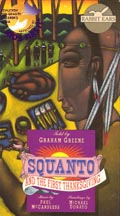
Last week before our break I showed a great video to my all of my students, even my Languages Arts kiddies. It’s a common problem in elementary schools that there are not enough videos to go around and commonly you present something students have seen over and over every year. I never have a problem with this video. It sort of mystifies because it so good, and opens the door for many avenues of discussion. The video is based on the book Squanto and the First Thanksgiving by Eric Metaxes and consists of pictures from the book with Graham Green narrating it. The music, the wonderful artwork, and the haunting voice of Mr. Green really draws students into the story. You can get more information about the video including a video clip and audio clip here. The video tells the basics. It doesn’t go into many of the extra details I have shared with you, but students learn of the odyssey Squanto goes through in an attempt to get back home. They learn how by coincidence the Pilgrims ended up where they did and settle on land that Squanto grew up on.

After the video we talked about all the bad things Squanto had gone through….how scared he must have been, how angry, how confused at being someone who had lived in both worlds, and how that knowledge caused him to be used by both worlds, and at one point even corrupted him. Many of the kids I teach have had terrible things happen to them and within their families. They see things at nine years old I didn’t know about until I was in my twenties. My point in our “after video discussion” was bad things happen to everyone…….it’s how you allow those bad things to interact with your character that makes a difference.

Every moment of our lives, the fantastic times and the horrible times, are part of a dress rehersal to be recalled during the actual performance when we are needed to do our part. Squanto is an exemplary portrait of someone who understood his role in the dual society he lived in, and he is a valuable American hero to share with students of all ages.

Sunday, November 19, 2006

Squanto: A Coincidental Life, Part 1


If you are a regular visitor here you already know that I am interested in how historical events connect and weave together to form our common human fabric. I am continually amazed at how events can have far reaching consequences….some across time…..some simply across town. What at first glance appears to be mere circumstance is instead a very carefully woven plan. I believe I know the author of that plan, but of course, that’s up to you to decide for yourself!

I love to share the story of Squanto with students because his life proves certain events and certain people are placed in our paths for reasons. We endure good times and hard times for various reasons. Sometimes we know the reasons immediately, sometimes the reasons are not made clear until later, and other times we are never aware of the far reaching effects of our actions and the people we interact with.

As we journey on through life our experiences teach us various things that we store in our toolbelt for life to be pulled out later as we need to recall the knowledge or the skill to help ourselves or others. This process can certainly be seen in Squanto’s life---that of a true American adventurer and hero.

Most elementary students are taught Squanto lived in the area where the Pilgrims first landed and he helped the Pilgrims learn how to meet their basic needs in their new homeland. While this true there is so much more to learn about this fascinating man. His life can be described as a tempest filled with grief, betrayal, as well as adventure. Squanto, of course, never wrote his own autobiography. The sources that contain information about him are few and far between and only give us snippets of his life, but a trail of events can be pieced together.

Squanto was a member of the Patuxet tribe and lived along the coast of New England near where Cape Cod is today. As Squanto became older contact with Europeans was becoming more and more common as various sea captains began to explore the coast of North America. Once the Jamestown colony was established in 1607 other entrepreneur types wanted to get in on the ground floor, and other possible sites for colonies were being investigated. English and French ships were known to fish the waters along the New England coast and they also traded with different Native American groups for furs.

It was not uncommon for some of the European sea captains to take Native Americans back to Europe with them with or without their consent. These natives were beneficial to the Europeans because they could be taught English and could inform the sea captains regarding important information regarding their homeland. The natives were a wealth of information regarding tribal and chief names, the lay of the land, which tribes were at peace and which tribes were at war. Other information could be obtained regarding crops that could be grown, the climate, rivers, and information regarding safe harbors.

According to the memoirs of Sir Ferdinando Gorges who joined the Plymouth Company in 1606, Squanto was kidnapped and taken to England in 1605 by Captain George Weymouth who was on a fact finding mission regarding resources of the Canadian and New England coast. In his own letters Weymouth writes that he decided to take a couple of natives back with him but had a hard time controlling them “for they were strong and so naked as our best hold was by their long hair.” Gorges confirms Squanto remained in England for nine years actually living with him before returning to the New World during John Smith’s 1614 voyage where Squanto would act as a guide and interpreter.

If Squanto acted as guide on any expeditions prior to 1614 there are no records to indicate it. There is a record of Squanto being a passenger on John Smith’s ship as he left England to return to the New World in March, 1614 accompanied by a second ship captained by Thomas Hunt. The purpose for the expedition was to hunt for whales and to look for gold. When it became apparent that they were not adept at catching whales and no information regarding gold was obtained Smith decided to save the voyage by fishing and trading for furs. It is believed that it was during this trip that Squanto was close enough to return to his home for a time. Smith ended up returning to England with a full cargo of fish and fur.

Captain Hunt remained in the area and it is believed Squanto acted at times as his interpreter. Their relationship, however, apparently deteriorated as Gorges relates in his report A Brief Relation of the Discovery and Plantation of New England confirms that it was at this point Hunt kidnapped Squanto along with others who were lured on board thinking they could trade beaver. Hunt travelled to Malaga, Spain and attempted to sell the Native Americans into slavery for twenty pounds each.

When local friars found out the intended slaves were Native Americans they took possession of them and attempted to instruct them in the Christian faith. Squanto lived with the friars for a year or two before returning to London with an Englishman named Sir John Slaney of Cornhill who was a very wealthy merchant. Slaney was attached to the Newfoundland Company which managed a colony at Cupper’s Cove, Newfoundland. While he resided with Slaney, Squanto improved his English and returned to North America to act as an interpreter for Slaney and Captain John Mason, governor of the Newfoundland Colony in 1617.

While in Newfoundland Squanto was recognized by Captain Thomas Dermer who was employed by Gorges and the New England Company. Dermer had sailed with John Smith on various voyages. The captain ended up returning Squanto to Gorges back in England. Gorges promptly took advantage of the situation by organizing an expedition for Dermer aided by Squanto to explore the natural resources of New England and to set up trade agreements with the local natives.

Dermer and Gorges both realized by this time the Nauset and Patuxet tribes had had enough of their tribesmen being attacked and kidnapped by Europeans. The natives had taken to attacking any ship that approached their shores. Records indicate they attacked and burned a French ship that came to close to Nauset shores. Gorges knew that having Squanto along would be beneficial.

In 1619 Squanto and Dermer explored what would one day be Plymouth harbor. It was at this time Squanto discovered his entire tribe had perished at the hands of plague since he had last been home in 1614. Squanto was now the last Patuxet. His home village was being avoided by other Native Americans in the area for fear of catching the sickness that had decimated the tribes and there were stories that evil spirits haunted the place.

For a time Squanto continued to work with Dermer but eventually decided to remain with the Pokanokets who lived where Bristol, Rhode Island is today at the invitation of Massasoit, the Grand Sachem of the Wampanoag Federation.

Part 2 of my examination of Squanto’s can be found here.