Showing posts with label frontier. Show all posts

Friday, March 23, 2007

Daniel Boone Was a Man...Yes, a Big Man!

Yes, the Tour Marm finally came up with the right answer for my Wordless image. Go check out her history puzzles here. My Wordless Wednesday this week referred to the nickname members of the Shawnees gave larger-than-life Daniel Boone.

My young historians will soon be leaving our studies of American government behind, and now the settlement of the West looms before us….Now don’t be confused. I’m not speaking of the sweeping vistas of Monument Valley as seen in John Wayne westerns-----I’m referring to our "first" west that I wrote about back in June titled
It's Important to Know Your Frontier.

Yes, Daniel Boone is a larger-than-life figure. There are as many myths and incorrect stories about his exploits as there are true ones. I could go on and on and on but here are five interesting facts about Boone that aren’t commonly known.

1. Daniel Boone was born into a family of Quakers---his father had come to the colonies from England in 1713 and settled in Pennsylvania. Later the Boone family left the Quakers and relocated to the Yadkin River Valley of North Carolina. It seems that Mr. Boone’s children kept marrying outside their faith and sometimes a child would be on the way before the actual marriage ceremony.

2. As some of us older types remember in the Daniel Boone series on television he was married to Rebecca and did have a daughter named Jemima, but what many historians now agree on is Jemima was actually fathered by Daniel’s brother Ned. Boone knew this but brought Jemima up as his own along with the many other children he and Rebecca had together. It seems that the relationship started between Rebecca and the brother after Boone was thought to be dead on one of his lengthy trips in the wilderness.

3. Boone was captured by Native American groups several times. Once when he was captured by the Shawnees he was made to run the gauntlet and having survived he was adopted into the tribe to replace a fallen warrior. He was given the name sheltowee, or Big Turtle because he carried a large pack and moved very slow. Boone stayed with the Shawnees for such a long time before escaping that his family went back to North Carolina thinking he was dead. His fellow frontiersmen hesitated to trust him after his “sojourn” with the Indians and for his troubles Boone had to undergo a failed courtmartial proceeding.

4. Boone wasn’t just a hunter, trapper, guide, and adventurer. He saw military action in the French and Indian War, the American Revolution, and many other Indian conflicts such as Dunmore’s War. In his lifetime he was a tavern owner, surveyor, land speculator, legislator, horse trader, and slave owner.

5. Boone spent his final years living in Missouri. He moved there in 1799 when it was still part of Spanish Louisiana. There he was appointed as “judge and jury” as well as military leader of the Femme Osage district.

Boone is known to have said, “I can’t say as ever I was lost, but I was bewildered once for three days.”

Yep, he was brave, he was fearless and as tough as a might oak tree!

Monday, June 12, 2006

It's Important to Know Your Frontier

I’ve been busy this past week working on power points to go with my history units. So far I have completed power points for the War of 1812 and the Louisiana Purchase combined with the Lewis and Clark expedition.

The third power point I’m just now finishing up will have images to go along with my lesson regarding Daniel Boone, the Wilderness Road, and the settlement of Kentucky and Tennessee.

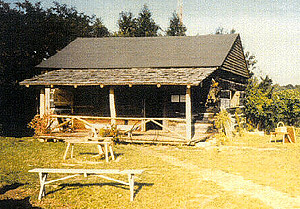
cabin

I have found this can be a tricky area for teachers who are history novices because the word frontier can mean different things depending on the time period that is being covered. Several years ago a colleague of mine once remarked, “You know, EHT, I don’t know as much as you do about history so I feel fairly safe with the content as long as I stay in the text page by page.”

I saw her point. I would have to do the same thing if I suddenly found myself teaching math. Staying with the text can get you into trouble, though, and here’s why.

Generally a unit of study regarding the formation of our government is taught after the American Revolution followed by the settlement of the frontier.

My colleague came to me one day and said, “Who picked out this text? It’s useless.”

“Why?” I asked.

“Well, I started looking at the lesson about the frontier and it doesn’t have any information about sod houses, the prairie, or the early railroads. What are we going to do?” my colleague wailed.

Gently I told her she was thinking about the wrong frontier.

Even as I did my research this week I came up with many different time periods when I googled frontier. I can see how people could easily get confused.

The frontier in early America changed every few years as settlers became crowded and moved to the outer regions. Folks were moving across the Appalachian Mountains before and during the French and Indian War. That was the first frontier, and it existed several years before the settlement of the Great Plains that brought us tales of buffalo, sod-busters, and cowboys.

What can also add to the confusion not only at the elementary level but can confuse upper level students as well, is we tend to touch on settlement across the Appalachian Mountains as we begin the French and Indian War and we touch on it some more at the conclusion of the war with the Proclamation of 1763 issued by King George III which stated colonists could not settle the lands west of
the Appalachian Mountains. The British intended to hold this area for the Native Americans but also meant to move the boundary line westward as white settlement forced it to move.

We then jump headlong into the American Revolution forgetting about the settlers we’ve left dangling out there across the mountains. After the conclusion of the Revolution and a discussion about the formation of our government we then expect the students to turn their attention back to these settlers who crossed the Appalachians.

This situation is definitely one where I feel a teacher needs to depart from the text program and discuss the back county (deep inland settlements towards the mountains) as well as the crossing of the Appalachian Mountains during and at the end of the American Revolution. In this way it remains in context with events such as the Wilderness Road which Daniel Boone was establishing as early as 1775 , the Treaty of Fort Stanwix (1768), and Sycamore Shoals (1775) which began settlement in what would become Kentucky.

In February, after we completed our examination of U.S. government, I asked my students to tell me what they thought of when I said the word frontier. I wrote the word on the board to give them a visual. Some of the responses were buffalo, cowboys, trains, prairie, and covered wagons.

Clearly there is some confusion regarding the word frontier. People tend to think about the Wild West in connection to the frontier because it was the last frontier Americans settled here in the contiguous United States.

I usually make my point by drawing an outline map of the United States on the board. I add in the Appalachian Mountains and, I sketch in where the Mississippi River would be. I ask students, “Where did the Europeans begin to settle first?”

“Along the coast,” they decide.

“And then what?” I prod.

Students proceed to tell me that the settlers eventually crowded up in the first settlements and, they began to move inland. We had already learned a vocabulary term for the inland area and I remind students that their text called this area the backcountry. I share with them further that the word frontier can also describe this land. The land at the edge and beyond a settlement is known as frontier.

As we ended our discussion about the term frontier one of my young men raised his hand. When I called on him he stated, “I know what the final frontier is.”

I fell for this hook, line, and sinker, “Really, what is it?”

My young man reeled me in, “Space…that’s the final frontier.”

Clearly this sweetie watches a lot of Star Trek.


Remember that you can subscribe to this blog and receive my updated posts in your email box by submitting your email address in the Feed Blitz box at the top of this page or use the Bloglines button to the right. Thanks in advance for your comments!