Without a question…..without a doubt history and time are inexplicably intertwined. You can’t have one without the other. During my 49 years riding around on this planet there have been events that serve as turning points in my life – meetings, births, marriages, deaths, reunions, actions that show strength and truthfulness and those that scream weakness and betrayal. Yes, we all have those moments in life….during our time here……embedded in each of our personal histories.
Collectively, historical events have their impact as well. We all have those, “Where were you?” moments such as JFK’s assassination, the Apollo Moon Landing, the Challenger Explosion, the Oklahoma Bombing, and of course…….the tragedy of September 11th, a date that needs no year to identify it because it was that terrible, that horrible, that defining in the psyche of each and every American who experienced it.
Last night was another one of those defining moments in our collective history. While it can be argued the death of Osama bin Laden is actually the closing act to the tragedy of September 11th it is yet another of those events which define our lives.
September 11th changed our lives in so many ways all in an instant just as last night changed it as well. Some of the changes are short term such as the elation, the relief, and the renewed anger as we remember what his policies and philosophy led others to do in the name of religion….of all things. Other changes will be long term. It would be interesting to be a fly on the wall fifty or even one hundred years from now to see how September 11th and the death of bin Laden is treated in history classrooms.
Will the whole series of events be taught in a entire instructional unit lasting several days? Then again, it might just become a mere mention before launching into an even more important event….though now we can’t even fathom that. The worse thing that could happen is if future historians and educators decide the whole thing was much ado about nothing.
I doubt that will happen since these events did occur during the age of technology and instant news, and not just news of the collective kind but personal news. We all have Facebook pages, blogs, pictures on line, the ability to interact with newspapers and other columns leaving our comments to express our thoughts and feelings.
Yes, within the last decade our lives have been changed in an instant. Last night’s news made of all of us recall those events of September 11th – where we were, what we were doing and how we came to be where we were last night.
Over the last few years I’ve re-posted my September 11th story because it’s that important personally for me to remember. I’m re-posting it again below, and I ask you to remember and reflect how you came to where you were at when you heard the news last night……
However, this time I will use the young’s man real first name because he finally got the chance to read my recollection of that tragic day not too long ago, and gave me permission to use it.
September 11, 2001 began like any other September school day; however, it was abnormally quiet since Tyler’s seat was uncharacteristically empty. He had not missed a day of school since we had started around the first of August.
Tyler was my assigned rambunctious, outspoken, almost uncontrollable young man for the year. There is always at least one. He was a handsome ten year old who adored baseball, adored going to church, and was very in touch with his feelings. While his brain usually moved ahead of his feet by about ten steps he never intentionally meant to interrupt me for the five thousandth time in one class period, never meant to cause me frustration, and he never meant to get on my nerves. Tyler simply had no clue that a one-to-one ongoing conversation between a teacher and himself was not the proper procedure in a classroom with 24 other students.
He blurted out constantly attempting to finish my sentences, anticipate my questions, and interrupted his classmates every time the notion slapped him in the head. He also had a problem many young men do…..he couldn’t sit still. His parents had long since solved the energy problem by making sure Tyler was signed up for every sport that came along. Unfortunately we don’t run bases in my classroom.
After the second week of getting used to Tyler’s energy level he and I conferenced and we worked out a management plan for mysanity. He and I developed hand signals so that he would know when I had had my limit of interruptions. He honestly didn’t realize what he was doing. Sometimes kids have to be taught social limits regarding space and conversation limits. We worked out a plan where Tyler could stand at his seat every so often to ease any discomfort as he sat. I arranged for his seat to be towards the back of the group so he wouldn’t interfere with another student. Tyler seemed grateful for the strategies as he commented, “Gee, maybe this will work. Lord knows you were ready to strangle me yesterday.”
Tyler was right. So on that September morning his seat screamed at me in the quiet as the class proceeded through their morning work.
We were about to transition into Social Studies when Tyler suddenly burst through the door out of breath speaking as fast and as loud as he possibly could. “Oh my gosh, Mrs. Cooper, a plane crashed in New York City and the whole place is on fire.”
It was very confusing to say the least. I mean where had he suddenly come from? The classroom had gone from very orderly and quiet to some town crier bursting through the door screaming New York City was on fire. My mind was attempting to process all of this. Where had Tyler been? Why was he just now coming to me? What had he been doing? What is this about a plane?
Huh?
I grabbed Tyler by the shoulders. “Darlin’, what are you talking about?”
Tyler was still trying to speak between deep breaths. “I don’t…..know. The man…..said a plane……had crashed…….in New York.”
“What man?” I quizzed.
“The man…..on the radio,” Tyler gulped.
The room was totally disrupted by now with students watching my question and answer session with Tyler their heads bobbing back and forth like they were watching a tennis match.
“Back up, Tyler,” I lobbed, “Where have you been?”
Tyler fired back, “The dentist. By the way, Dr. C. says hello.” Dr. C. is a local dentist and I had taught his son a couple of years before. He was always sending my students back to school with a “Hey, how ya’ doing?” message.
I countered impatiently with, “Yes, yes, hey to Dr. C.” I waved my hand to the air. “Tyler, tell me what’s going on?”
I was getting exasperated. The rhythm of my class had been disrupted, precious instructional minutes were being lost, and I still didn’t know what was going on.
Finally, Tyler served up, “On the way over here from Dr. C’s office the guy on the radio said the World Tower or something has been hit by a plane.”
“The World Trade Center, is that what you mean?” I struck back.
“Yeah, I think so.”
I walked over to the television, hit the on button and switched the channel to CNN……the only twenty-four hour news channel our school could get at the time. The image hit me like a ton of bricks.
“Oh my gosh, Tyler. You’re right.” I said as I backed up from the screen. The room got very still and we listened to the announcer. It was still early enough that both towers were still standing. The announcer was still getting information in his earpiece so he could explain what was going on.
I offhandedly began telling students that many years before a small plane had hit the Empire State Building and the same thing had probably happened again. I told them that, but I wasn’t so sure.
I stepped into the hallway and got the attention of my teaching partner. I lovely woman who was still trying to figure this Southern gal out considering she grew up in New York. Her eyes immediately filled up with tears as she pulled her door behind her and mouthed the words, “Those bastards!” to me.
“What do you mean?” I asked.
“I guarantee you this is the same group who tried to take the towers down before.” We exchanged a few more words before she stepped back in her room to turn on her television as Tyler came to my classroom door.
“Mrs. Cooper,” he said. “The tower just fell.”
“Don’t be silly,” I told him as I reentered my room. A few of the girls had heard me and were agreeing with Tyler.
I looked at the screen and there was nothing there but one tower and smoke. It simply did not register with me the building were gone. The announcer was speaking about planes, large planes had done this. My mind screamed. Jetliners, how could two jetliners hit the towers on the same day?
Another student asked, “Mrs. Cooper, what’s the pentagram?”
A bossy little girl shot back at him, “Pentagon, pentagon.”
I didn’t take my eyes from the television as I said, “Ummm, it’s a building in Washington D.C. where all the branches of the armed forces have their offices including the Secretary of Defense. Why?”
“The guy on television said a plane crashed into it. It’s on fire too.”
I closed my eyes. I could not deny something was going on. We had to be under attack, but from who? I wanted to curl up into a ball and cry. I wanted to get my purse and go get my kids. I wanted my husband. I wanted my mother and father. I couldn’t. I was the teacher. I was the adult in charge. I couldn’t let them see me upset. I had to turn off the television and get on with our day.
I walked over to the set at the same time my vice principal came into my room. She smiled and motioned to the television and said, “Turn it off.”
“I know,” I said. “I was about to.” We both knew this wasn’t the same thing as our first walk on the Moon or MLK’s funeral. Our students didn’t need to see anymore unfolding events. Luckily they didn’t see any bodies falling from the sky and they had not yet begun to show footage of the plane flying into the tower and the resulting explosion. It was bad enough they witnessed the fall of the building.
Some of the children, being children, went right back to what they were doing. Tyler walked over to me and said, “Mrs. Cooper, we need to pray for those people. There are people who died this morning. It’s so sad.”
“Yes, Tyler. It’s so sad. Tyler, you know I can’t ask you to pray.”
“I know, but I don’t think you’ll stop me. Will you?”
“No, I won’t. Do what you need to do.”
Tyler walked around the room to every student saying, “C’mon guys. We need to pray for those people. Let’s hold hands and get in a circle.”
Every boy and girl stood up, formed a circle and grabbed each other’s hands. No one argued about holding a girls hand or a boy’s hand. Boys didn’t balk at holding each other’s hands. They just did it. Once they were all were in place each one turned and looked my way as if to say, “C’mon!” I was sitting alone at a student’s desk confused and needing information so terribly. At this point all I knew was someone had an undetermined number of American planes, some were missing, some had crashed horribly, and my husband who works in the air freight industry had his office very near the Atlanta airport.
As the kids looked at me two students broke ranks and opened up a place for me. They just stood there looking at me. I just sat there looking at them. Finally, I got up and joined them in their prayer circle. I looked across the circle to Tyler and nodded at him. He began his very heartfelt, innocent prayer for the people in the buildings, the people in the planes, the people on the ground, our president and other government leaders and as he ended each child went around the circle and said something squeezing the next person’s hand as they were through. Finally, the prayers ended up at Tyler again and he finalized the prayer.
I don’t remember what we did that day. I don’t remember what I taught, or if I taught. An hour later the exodus started. Child after child was called for check-out until I only had three or four left.
Finally, the last student was on a bus and I was on my way home. Hubby had contacted me earlier in the afternoon to tell me he was ok and had gone to get both our kids. They were all at home waiting for me.
The ride home was so eerie. The message boards over the normally backed-up Atlanta interstates flashed the words NATIONAL EMERGENCY. The most surreal thing was there was no traffic on the streets or in the sky. The skies around Atlanta’s busy airport are always filled with planes. You can always look up and find at least one in any direction you gaze. Not that afternoon. It was so quiet. It was four p.m. before I really knew what had happened and saw the same footage that everyone else had seen over and over all afternoon.
I learned many things that day. I learned that my country was as vulnerable as any other. I learned that your life can change direction in one single instant. I learned that citizens can put politics aside and come together in one voice when they realize they have a common enemy. I learned the frantic fear of wondering where your family is and realized we would need an emergency game plan. I learned that people hate me just because I was born an American.
The most important thing I learned, however, was from a ten year old young man and his fellow classmates who did what they felt in their hearts and lived up to their convictions no matter the consequence.
Showing posts with label terrorism. Show all posts
Monday, May 02, 2011
Tuesday, September 11, 2007
Wordless 39: 9/11 Six Years Past
No guessing games this week....only remembrance.
Related Posts: 9/11: Lessons Learned
Have We Always Had Terrorism or Is It Something New?
Shazaam, Thar' Be Pirates!
See other wordless images here.
Related Posts: 9/11: Lessons Learned
Have We Always Had Terrorism or Is It Something New?
Shazaam, Thar' Be Pirates!
See other wordless images here.
Monday, September 11, 2006
Simple Remembrances

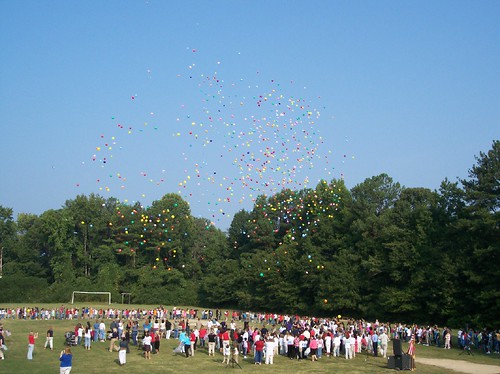
We had a short ceremony and balloon release this morning to remember the victims of 9/11 at my school. I was so proud of our students…..there were no major problems. Every child behaved in a manner you would hope. A local radio station was there so some of my students were lucky enough to be interviewed.
One young man walked over to me following his fifteen minutes of fame and said, “Don’t worry, Elementaryhistoryteacher, I didn’t say nuthin’ I wasn’t ‘posed to.”
Like I was worried……
As the balloons were released we continued to watch them as they danced and swirled on their journey up through the air. Once the balloons were very high in the sky some of my students remarked how they looked like stars.
Apparently some of the kids in grade K had been discussing among themselves how the victims were in Heaven. Somebody asked what would happen to the balloons. One wee one correctly stated that the people in Heaven would have fun popping the balloons. We were sending them a gift……
I love the simplicity of children.

In case you haven’t had enough images today this link here will take you to a slide show from USA Today.
Sunday, September 10, 2006
9-11....Lessons Learned
Though I wasn’t assigned a victim of 9/11 to post about from the 2996 Project, I decided that I would post my personal story of that day and dedicate it to those who lost their lives.September 11, 2001 began like any other September school day; however, it was abnormally quiet since T.’s seat was uncharacteristically empty. He had not missed a day of school since we hard started around the first of August.
T. was my assigned rambunctious, outspoken, almost uncontrollable young man for the year. There is always at least one. He was a handsome ten year old who adored baseball, adored going to church, and was very in touch with his feelings. While his brain usually moved ahead of his feet by about ten steps he never intentionally meant to interrupt me for the five thousandth time in one class period, never meant to cause me frustration, and he never meant to get on my nerves. T. simply had no clue that a one-to-one ongoing conversation between a teacher and himself was not the proper procedure in a classroom with 24 other students.
He blurted out constantly attempting to finish my sentences, anticipate my questions, and interrupted his classmates everytime the notion slapped him in the head. He also had a problem many young men do…..he couldn’t sit still. His parents had long since solved the energy problem by making sure T. was signed up for every sport that came along. Unfortunately we don’t run bases in my classroom.
After the second week of getting used to T.’s energy level he and conferenced and we worked out a management plan for Elementaryhistoryteacher’s sanity. He and I developed hand signals so that he would know when I had had my limit of interruptions. He honestly didn’t realize what he was doing. Sometimes kids have to be taught social limits regarding space and conversation limits. We worked out a plan where T. could stand at this seat every so often to ease any discomfort as he sat. I arranged for his seat to be towards the back of the group so he wouldn’t interfere with another student. T. seemed grateful for the strategies as he commented, “Gee, maybe this will work. Lord knows you were ready to strangle me yesterday.”
T. was right. So on that September morning his seat screamed at me in the quiet as the class proceeded through their morning work.
We were about to transition into Social Studies when T. suddenly burst through the door out of breath speaking as fast and as loud as he possibly could. “Oh my gosh, Elementaryhistoryteacher, a plane crashed in New York City and the whole place is on fire.”
It was very confusing to say the least. I mean where had he suddenly come from? The classroom had gone from very orderly and quiet to some town crier bursting through the door screaming New York City was on fire. My mind was attempting to process all of this. Where had T. been? Why was he just now coming to me? What had he been doing? What is this about a plane? Huh?
I grabbed T. by the shoulders. “Darlin’, what are you talking about?”
T. was still trying to speak between deep breaths. “I don’t…..know. The man…..said a plane……had crashed…….in New York.”
“What man?” I quizzed.
“The man…..on the radio,” T. gulped.
The room was totally disrupted by now with students watching my question and answer session with T. their heads bobbing back and forth like they were watching a tennis match.
“Back up, T.,” I lobbed, “Where have you been?”
T fired back, “The dentist. By the way, Dr. C. says hello.” Dr. C. is a local dentist and I had taught his son a couple of years before. He was always sending my students back to school with a “Hey, how ya’ doing?” message.
I countered impatiently with, “Yes, yes, hey to Dr. C.” I waved my hand to the air. “T., tell me what’s going on?”
I was getting exasperated. The rhythm of my class had been disrupted, precious instructional minutes were being lost, and I still didn’t know what was going on.
Finally, T. served up, “On the way over here from Dr. C’s office the guy on the radio said the World Tower or something has been hit by a plane.”
“The World Trade Center, is that what you mean?” I struck back.
“Yeah, I think so.”
I walked over to the television, hit the on button and switched the channel to CNN……the only twenty-four hour new channel our school could get at the time. The image hit me like a ton of bricks.
“Oh my gosh, T. You’re right.” I said as I backed up from the screen. The room got very still and we listened to the announcer. It was still early enough that both towers were still standing. The announcer was still getting information in his earpiece so he could explain what what was going on.
I offhandedly began telling students that many years before a small plane had hit the Empire State Building and the same thing had probably happened again. I told them that, but I wasn’t so sure.
I stepped into the hallway and got the attention of my teaching partner. I lovely woman who was still trying to figure this Southern gal out considering she grew up in New York. Her eyes immediately filled up with tears as she pulled her door behind her and mouthed the words, “Those bastards!” to me.
“What do you mean?” I asked.
“I guarantee you this is the same group who tried to take the towers down before.” We exchanged a few more words before she stepped back in her room to turn on her television as T. came to my classroom door.
“Elementaryhistoryteacher,” he said. “The tower just fell.”
“Don’t be silly,” I told him as I reentered my room. A few of the girls had heard me and were agreeing with T.
I looked at the screen and there was nothing there but one tower and smoke. It simply did not register with me the building were gone. The announcer was speaking about planes, large planes had done this. My mind screamed. Jetliners, how could two jetliners hit the towers on the same day?
Another student asked, “Elementaryhistoryteacher, what’s the pentagram?”
A bossy little girl shot back at him, “Pentagon, pentagon.”
I didn’t take my eyes from the television as I said, “Ummm, it’s a building in Washington D.C. where all the branches of the armed forces have their offices including the Secretary of Defense. Why?”
“The guy on television said a plane crashed into it. It’s on fire too.”
I closed my eyes. I could not deny something was going on. We had to be under attack, but from who? I wanted to curl up into a ball and cry. I wanted to get my purse and go get my kids. I wanted my husband. I wanted my mother and father. I couldn’t. I was the teacher. I was the adult in charge. I couldn’t let them see me upset. I had to turn off the television and get on with our day.
I walked over to the set at the same time my vice principal came into my room. She smiled and motioned to the television and said, “Turn it off.”
“I know,” I said. “I was about to.” We both knew this wasn’t the same thing as our first walk on the Moon or MLK’s funeral. Our students didn’t need to see anymore unfolding events. Luckily they didn’t see any bodies falling from the sky and they had not yet begun to show footage of the plane flying into the tower and the resulting explosion. It was bad enough they witnessed the fall of the building.
Some of the children, being children, went right back to what they were doing. T. walked over to me and said, “Elementaryhistoryteacher, we need to pray for those people. There are people who died this morning. It’s so sad.”
“Yes, T. It’s so sad. T, you know I can’t ask you to pray.”
“I know, but I don’t think you’ll stop me. Will you?”
“No, I won’t. Do what you need to do.”
T. walked around the room to every student saying, “C’mon guys. We need to pray for those people. Let’s hold hands and get in a circle.”
Every boy and girl stood up, formed a circle and grabbed each others hands. No one argued about holding a girls hand or a boy’s hand. Boys didn’t balk at holding each other’s hands. They just did it. Once they were all were in place each one turned and looked my way as if to say, “C’mon!”. I was sitting alone at a student’s desk confused, and needing information so terribly. At this point all I knew was someone had an undetermined number of American planes, some were missing, some had crashed horribly, and my husband who works in the air freight industry had his office very near the Atlanta airport.
As the kids looked at me two students broke ranks and opened up a place for me. They just stood there looking at me. I just sat there looking at them. Finally, I got up and joined them in their prayer circle. I looked across the circle to T. and nodded at him. He began his very heartfelt, innocent prayer for the people in the buildings, the people in the planes, the people on the ground, our president and other government leaders and as he ended each child went around the circle and said something squeezing the next person’s hand as they were through. Finally, the prayers ended up at T. again and he finalized the prayer.
I don’t remember what we did that day. I don’t remember what I taught, or if I taught. An hour later the exodus started. Child after child was called for check-out until I only had three or four left.
Finally, the last student was on a bus and I was on my way home. Hubby had contacted me earlier in the afternoon to tell me he was ok and had gone to get both our kids. They were all at home waiting for me.
The ride home was so eerie. The message boards over the normally backed-up Atlanta interstates flashed the words NATIONAL EMERGENCY. The most surreal thing was there was no traffic on the streets or in the sky. The skies around Atlanta’s busy airport are always filled with planes. You can always look up and find at least one in any direction you gaze. Not that afternoon. It was so quiet. It was four p.m. before I really knew what had happened and saw the same footage that everyone else had seen over and over all afternoon.
I learned many things that day. I learned that my country was as vulnerable as any other. I learned that your life can change direction in one single instant. I learned that citizens can put politics aside and come together in one voice when they realize they have a common enemy. I learned the frantic fear of wondering where your family is and realized we would need an emergency game plan. I learned that people hate me just because I was born an American.
The most important thing I learned, however, was from a ten year old young man and his fellow classmates who did what they felt in their hearts and lived up to their convictions no matter the consequence.
Saturday, September 09, 2006
Have We Always Had Terrorism Or Is It Something New?
During our class changes I stand at my door herding one group out and the next group in. This is the time for hellos and goodbyes, and last minute reminders. I frantically repeat over and over, “Don’t forget to take your notebook home. You’ll need your notes to complete the homework.”This is also the time I hear things like “I forgot my homework”, “Can I go to the bathroom?”, “So and so called me a so and so”, and the ever popular “I don’t feel so good. Can I go call my Mom?” At least twice a week someone approaches me with blood dribbling down their chin grinning ear to ear as they display a tooth in their outstretched hand. Three or four drop all of their books in the hallway as they negotiate around each other. The sound is deafening. Someone inevitably decides its time to clean out their desk at class change and must be shooed along.
It is a hectic time.
I can’t help but think, “Head 'em up! Move ‘em out! Rawhide!” as we play fruit basket turnover. Somehow, someway we manage to move every fourth grader to a different place in three to four minutes. Students settle down again by writing their assignments in their agenda books and are required to read through their notes until we are ready to begin the day’s lesson.
Sometime in early September, in anticipation of the eleventh, I attempt to honor those brave souls who perished that day by putting historical events in context for my wee ones. In an attempt to show students that history is linear and events can be connected over time I like to answer the inevitable question I’m asked every year around the 9/11 anniversary……”Elementaryhistoryteacher, have we always had terrorism or is it something new?” Every year it’s the same….new kids, same questions.
I show the students a short power point I’ve put together that shows images from 9/11------ones that are appropriate for nine year olds to see. I tell them the story from my point of view that day because these students have no real memory of that day. Each year my groups are further removed from the shock, pain, and fear of that terrible day as time marches on.
Students begin peppering me with questions. Why? How? Why didn’t we…? Why can’t we….? and finally What is terrorism and how did it get started?
We use several different dictionaries to arrive at a definition and we discuss what it is not as well as what it is.
I then hand out a list of various terroristic acts against the United States since its earliest days through 2000. We read through them together.
Here’s what the students see:
October, 2000: A suicide bomber attacked the USS Cole in Yemen killing 17 American soldiers and wounding 39
August, 1998: The U.S. embassies in Nairobi, Kenya and Dar es Salaam, Tanzania were bombed killing 224 and wounding many others.
June, 1996: 19 Americans and approximately 500 people were injured when a bomb was placed at the U.S. barracks in Dhahran, Saudia Arabia
November, 1995: A bomb at U.S. military headquarters in Riyadh, Saudi Arabia, kills five U.S. service personnel
April, 1995: the Oklahoma City bombings at the Murrah Federal Building killed 168 and injured more than 500
February, 1993: Terrorist bombers strike the World Trade Center, killing six people and injuring more than 1,000 others
December, 1988: The bombing of Pan Am 103 over Lockerbie, Scotland kills 270 people, mostly Americans.
September, 1986: Twenty people are killed after security forces storm a Pan Am plane taken by hijackers at the Karachi Airport.
June, 1985: Robert Dean Stethem, a U.S. serviceman was killed and his body thrown to the tarmac at the airport in Beruit, Lebanon when Shiite Muslims hijacked a TWA jet carrying mostly Americans. Thirty nine others were held hostage 17 days before being released.
September, 1984: The U.S. embassy in Beruit, Lebanon was bombed killing 16 and injuring the ambassador.
October, 1983: The bombing of the U.S. Marine barracks in Beiruit, Lebanon kills 241
April, 1983: A car bomb at the U.S. Embassy in Beiruit, Lebanon kills 17
Students take a look at the timeline. I ask them to work together and underline repeated words and phrases. After calling time I write the repeated words on the board as they call them out to me---------------Americans, embassy, airplane, airport, Beiruit, Lebanon, bomb, hijacked
Nine out of eleven situations occurred on federal owned properties, ten out of eleven involved bombs, and two of the eleven actually occurred in the United States.
“What do you think is going on?” I ask students, “What is causing all of this to happen?”
“Well, it seems like someone doesn’t like the United States?”
“All of these things are happening to us.”
“Yeah, all of those events are within the last twenty years or so.”
“Good observations,” I say, “but let’s take a look at this.”
I direct students’ attention to the television screen where I’ve popped up a few power point slides. I read off each one as I snap through them briefly explaining the sitution the slide details.
December, 1941: U.S. military instalations at Pearl Harbor were attacked by the Japanese…2400 deaths. This led to the U.S. involvement in World War II.
September, 1901: President McKinley was assassinated at the Pan-American Exposition in Buffalo by a member of the Anarchist movement
September 16, 1920: Wall Street was bombed by another member of the Anarchist movement when a wagon loaded with dynamite was parked in front of the Morgan Bank.
1865 through the 20th century: The Ku Klux Klan terrorizes Southern citizens, black and white alike.
“So, what is your observation now? Is terrorism just something from recent times?” I ask.
“Terrorism has been going on for a long time.”
“Elementaryhistoryteacher, isn’t Pearl Harbor different? It started a war.”
“Hmmmmm, your right, but after 9/11 many people compared Pearl Harbor to the World Trade Center bombing,” I explain before continuing, “Japan’s a country. What country attacked us on 9/11?”
I’m met with blank stares. I wait. Finally a hand goes up.
“Wasn’t it Osamma Bin Laden?”
“Al-Quaida?” someone else adds.
I back the slides up to the ones concerning McKinley and the Wall Street bombing. I ask, “Was the group of anarchists a country?”
“No, they were just a group of people.”
I show students another set of slides and again briefly explain the situtations:
Xenophon, an ancient Greet historian instructed his students regarding the use of psychological warfare against enemy populations.
Roman emperors constantly employed the use of terror to maintain power and order across their empire.
Biblical history tells us about the Zealots who would attack Roman and Greek officials in broad daylight to express their displeasure at being dominated by those cultures.
The Spanish Inquisition and the French Revolutionaries employed terrorism to justify their agendas in the name of God and freedom.
From 1865 to 1905 anarchists not only threatened the United States but Europe and Russia as well.
In 1914 an anarchist assassinated the Archduke Franz Ferdinand leading all of Europe and eventually the United States into World War I.
“So, what do you think now?” I ask.
The conversation continues and eventually students arrive at the fact that terrorism has been around along time, and the United States hasn’t always been the target.
I show them one last slide. It depicts the Sons of Liberty throwing chests of tea into Boston Harbor. I briefly talk about the events and explain to students that they will be learning more about it in January. We discuss the fact that the tea is private property belonging to some merchant back in Britain or in Boston. We discuss the reasoning behind the action the Sons of Liberty take.
Students learn that the British considered the Boston Tea Party a terroristic act. No one was killed but private property was destroyed to make a political point against a government. The dividing line between a terroristic act and a freedom fighter is a fine line depending on whose side you’re on.
We all came to a consensus that terrorism confuses us. None of my young charges understand how anyone could use terror to prove a point.
“It doesn’t solve anything,” as one student stated.
I agree. My whole purpose for going through this episode with students was not to provide them with an opportunity to empathize with the terrorist who mean to harm the United States. I’m not a “let’s get in touch with our feelings” type of teacher.
My goal is to show them that historical events aren’t always cut and dry. You can’t look at one list of events and decide how things are. You need to dig, you need to get the whole story, you need to analyze points of view, you need to see that cause and effect do play a role in history. Events are connected whether we want them to be or not. I ended the lesson by reminding them that their education is the key for them to be a good citizen. They should always dig for more and not trust what they see on television, in a newspaper, or even what they hear from a teacher. They should always gather the information on their own and arrive at their own interpretation.
As far as solving the whole terrorism question I believe the solution is as convoluted as solving the education quagmire. There are no easy answers, and there is not a one-size-fits-all solution. While I feel strongly that more violence breeds even more I am glad we took some type of action and rid the Middle East of the Taliban and Saddam Hussein. However, we do need to understand that while the terrorists are an enemy they are not our only enemy. Our other enemy is the American extremes…..those of us who over analyze and would prefer no action against the terrorist feeling that the United States has gotten what she deserves, and those of us who are so uninvolved we don’t participate in the American experiment at all.
Tuesday, September 05, 2006
Honoring the Victims of 9/11
This is absolutely amazing……here is a link to the complete list of people who were lost on 9-11 along with the name of the blogger who has agreed to remember the person with a post honoring their lives.I like the idea of remembering their lives and not their murders.
This project is called 2,996 and as of August 28th all the names were assigned.
What a great way to honor these people!
Shazaam, Thar' Be Pirates!
During my middle and high school days re-runs of Gomer Pyle, U.M.C, used to come on television at least once a day in the afternoon or early evening on Channel 17, WTBS. I would usually have the television on during my homework time (don’t tell my students) and Gomer, Andy Griffith, Bud and Kitten from Father Knows Best and, of course, the Beaver could be heard in the background as I rewrote my American History notes (compulsive behavior), struggled through Algebra problems, or quizzed myself concerning biology terms.Gomer Pyle was the best. Sargent Carter was a scream and Lou Ann Poovey was the perfect girl for Gomer. Just the name alone was priceless. If I remember correctly Gomer broke the news to Andy Griffith concerning his enlistment into the Marines by walking into Andy’s office singing the Marine Battle Anthem at the top of his lungs while he marched around the jail.
In the same Gomerish corny style I begin a lesson in the same way.
I usually wait until everyone is “kind of” settled (today’s classrooms are rarely entirely silent), and I walk out into the hall, compose myself, and walk back into the room singing much like my friend Gomer Pyle used to:
From the Halls of Montezuma,
To the shores of Tripoli;
We fight our country’s battles
In the air, on land and sea;
First to fight for right and freedom
And to keep our honor clean;
We are proud to claim the title
Of United States Marine.
While I sing and march around the room at the top of my lungs I try hard not to look at the kids because they look hilarious. Some are embarrassed for me and for themselves, some smile, and some laugh.
Our flag’s unfurled to every breeze
From dawn to setting sun;
We have fought in ev’ry clime and place
Where we could take a gun
In the snow of far-off Northern lands
And in sunny tropic scenes;
You will find us always on the job—
The United States Marines.
By the end of the second stanza studens are getting into it with me as I point to the television screen which can double as my computer monitor. They begin to sing along with the lyrics I have posted there.
Here’s health to you and to our Corps
Which we are proud to serve
In many a strife we’ve fought for life
And never lost our nerve;
If the Army and the Navy
Ever look on Heaven’s scenes;
They will find the streets are guarded
By United States Marines.
We all have a glorious finish and students cajole me into singing again from the beginning. We do!
After things calm down I pose the following questions:
What do pirates, Gomer Pyle, a coastal region of Africa, and the United States have in common?
What American war followed the American Revolution?
While you are thinking (I’m giving you sufficient wait time) I’ll go on…
To get students in the correct mind set I ask them, “What is the war we are currently fighting?”
Even at nine years old students are fairly savy about what is going on in the world. Many tell me we are fighting a war with Iraq, and I tell them kind of but not really. Others mention terrorism…a smattering of them even say the television catch-phrase “war on terror”….others add the word “terrorism”. I tell these smartees they win my bingo award for the day.
I then ask, “When did terrorism start?”
We have a lively discussion where students determine the definition of terrorism and we decide that based on the definition terrorism has been around for a long time. I tell students as the year goes on we are going to to have many examples of terrorism and they need to attempt to identify examples of it as we discuss the settlement of our country.
Do you know the answers to my questions yet? Pirates, Gomer Pyle aka the Marines, a coastal region of Africa, and the United States all have the Barbary Coast Wars in common. Following the American Revolution our country was involved in the Barbary Coast Wars. Both of the Barbary wars were seperated by the War of 1812. Terrorism played a huge part in these conflicts.
We begin our look at the Barbary Coast War by looking at the map. I ask students to find Algiers, Morocco, Tunis, and Tripoli. In 1800, these areas often acted independently but were controlled by a larger government called the Ottoman Empire. Gangs of thugs and pirates controlled these areas with an iron hand.
This area of the Mediterranean had been problematic to the British and French for some time. In fact, these self-proclaimed privateers had been in business since the times of the Crusades. These nefarious characters were immortalized in literature such as Daniel Dafoe’s Robinson Crusoe and Cervantes of Don Quixote fame had been taken hostage himself in Algiers for a time.
Through numerous diplomatic efforts and ransom British ships had maintained safe passage through the Barbary Coast. American ships had enjoyed the safety net of British diplomacy until our ties were severed with them at the end of the American Revolution.
Suddenly, American ships were fair game to the Barbary Coast pirates. It would appear that Congress anticipated problems because they allocated monies in 1784 for the payment of tribute to pirates. Think about that for moment and it kind of makes your stomach turn. We were just going to give in? An actual plan to be taken advantage of….
In similar fashion to today events there were politicians who vehemently spoke out against paying tribute to pirates to keep from having American ships, crews, and freight taken. When Thomas Jefferson was ambassodor to France he spoke out stating that the payment of ransom would only lead to more attacks. George Washington is known to have sided with Jefferson as well. In fact, in a letter to Ezra Stiles, the president of Yale University, Jefferson wrote: “it will be more easy to raise ships as a means to fight these pirates into reason, than money to bribe them.” Unfortunately Congress at the time was more concerned with domestic matters and did not deal with the problem head-on.
Jefferson finally got his chance to make a difference when he was inaugurated in 1801. Almost immediately the Barbary state of Tripoli demanded $225,000. When Jefferson refused to pay tribute the Pasha of Tripoli declared war against the United States though there were no formal declarations. Actually the Pasha’s statement of war was to have the U.S. consolate’s flag pole cut down.
The United States never actually declared war on the Barbary States but the did authorize the President to sieze all vessels and goods of the Pasha of Tripoli “and also to cause to be done all such other acts of precaution or hostility as the state of war will justify.”
This conflict is a who’s who of American ship names. The group of frigates that were sent to the Mediterranean included ships with names like Intrepid, Philadelphia, Constitution, Constellation, Chesapeake, Argus, and Syren.
Highlights of the Barbary conflict include the 1803 blockade of Barbary ports and hit and run raids against Barbary cities headed up by Commodore Edward Preble. It was at this time the USS Philadelphia ran aground and her crew and captain were taken captive. A group of sailors led by Lieutinant Stephen Decatur, Jr. managed get to the ship and set it on fire. The thought was a burned out hull would not be a bargaining chip for the pirates.
Finally, Tripoli was attacked outright on July 14, 1804. At one point Captain Richard Somers and the crew of the USS Intrepid entered the harbor at Tripoli packed from top to bottom with explosives. An accident or enemy fire ignited the explosives with all hands lost.
The actual lyrics “from the shores of Tripoli” come from the Battle of Derna where Americans attacked over land with the assistance of Arab, Greek, and Berber mercenaries.
A treaty ended the first go round with the Barbary pirates in June, 1805. Unfortunately the capture of the city of Derna was not used as a bargaining chip and many felt the treaty was too flimsy. Afterall, we agreed to exchange prisoners with the Barbary States but we also gave them $60,000. I know, it didn’t make sense to my students as well. Seems like the argument regarding ransom versus tribute started way back then.
Soon we had other problems on the high seas as America became embroiled in conflicts between Britain and France which ultimately led to the War of 1812. Naturally the Barbary States did not hesitate to take advantage of the US while their attentions were diverted elsewhere. American began paying tribute/ransom once again.
After the War of 1812, American sailors led by Stephen Decatur, Jr. and William Bainbridge began to use pirate tactics themselves. It worked during the American Revolution to fight like Native Americans, didn’t it? During our attacks hundreds of prisoners were taken and in order to secure their release the pirates had to agree the United States was released from tribute obligations in perpetuity and secured a payment of $10,000 in reparations for damages.
Things were not finally over until a nine hour bombardment by the British weakened Algiers which eventually became a French colony in 1830. Tunis fell to the French in 1881 while Tunis became an Italian colony in 1835. Europe maintained a strong hold over the Barbary States well into the Twentieth Century.
Gee…history is amazing. All of this led to Gomer Pyle.
Well……..surprise, surprise, surprise!
Subscribe to:
Posts (Atom)