Showing posts with label Georgia. Show all posts

Tuesday, January 22, 2013

Let's Hear It for Local History

Over the last couple of years I’ve immersed myself into a personal local history project involving researching and writing about the history of my home…..Douglas County, Georgia. 

What started as a weekly column here at Douglasville Patch morphed into a blog called Every Now and Then located here. 
I’ve learned several interesting things along the way, met some great people, and kept myself rather busy meeting a self-imposed Monday deadline each and every week……something I’m trying to get back to doing around here at History Is Elementary as well.

One of the things I’ve tried to do in many of my postings is to connect local history to the larger picture of what was happening in Georgia  and in the United States at the same time.
For example, recently I wrote about a couple who moved to Douglasville, Georgia in 1887.  Now in and of itself that’s NOT so remarkable, but the fact that the couple was from Chicago, Illinois caught my interest. Later as I began to get more involved in the research I saw how far reaching the story of C.C. and Helen Wilmans Post happened to be.

Both were journalists.  He could be termed a muckraker actively writing during the reform movement of the late 1800s. I had mentioned him in a post here at History Is Elementary a few months ago.  
His wife, however, got caught up as the self-described founder of “mental science” hawking her “lessons” and books discussing how upon receipt of a fee she could cure patients of various ailments.....a process she described as an "absent cure."

While his wife was busy receiving thousands of dollars a year for her “services”, C.C. Post had become not only heavily involved with local politics in Douglasville, Georgia he also became very involved with third party politics in Georgia via the Farmers Alliance which grew into the Populist Party.  He was known not only on the local stage, but on the state and national stage as well.
The Posts are an interesting study regarding the time period and how folks reacted to them. 

You can access  their story at the following links
Part One…..A Little Background on Mr. and Mrs. Post

Part Three….Mr. Post and Third Party Politics

My local blog has its very own Facebook page where readers can stay advised regarding updates.  You are more than welcome to “like” the page here.

Monday, April 05, 2010

It's THE Week for Golf in Georgia

Augusta, Georgia is front and center this week as the golf infamous and elite arrive to play the much heralded course at August National.

President Eisenhower loved August National…..this post relates a little about his experiences there, and there are a couple of links at the end to other posts I’ve written concerning the course.

David Eisenhower became a member of the August National Club in 1948. Prior to becoming president he managed to visit the course five different times.

Ike loved golf. Estimations go as high as 800 regarding the number of rounds of golf Eisenhower played during his eight years in office visiting various courses. Some of those rounds were played during the 29 visits he made to Augusta National. a Golf Digest article advises President Eisenhower loved golf so much he installed a putting green on the south lawn of the White House and during inclement weather he hit long irons into a net in the basement.

With the help of donations from club members a cabin was built for Eisenhower on the grounds of Augusta National in 1953 for a cost of $70,000. However, your idea of a cabin, my idea of a cabin, and Augusta National’s idea of cabin are totally different things. The Eisenhower cabin is a house as seen in the image here. The cabin was built to the specifications of the Secret Service and has an entire lower floor where agents resided when Eisenhower visited Augusta. The cabin served as the first real home President Eisenhower had known since graduating form West Point in 1915 and entering the army. When the President wasn’t visiting the cabin, it was used by other club members.

Accommodations were also made for the President to complete his business affairs----the business of the nation---in an office that was provided for him over the club’s pro shop. In fact, it has been reported that the “Eisenhower Doctrine,” where America announced it would use force in the Middle East, was announced within a fairway wood of the first tee. Today Eisenhower’s own cracker barrel sits in the Augusta National Pro Shop. The wood used for the barrel was once part of the White House roof.

Sadly it was impossible for President Eisenhower to attend a Masters Tournament while he was president. It would have been too disruptive. However, he would usually show up on the following Monday to play a round with the winner. The same Golf Digest article I referenced above states Arnold Palmer remembered Ike as “a regular guy on the golf course and a regular guy period.”

Palmer also remembered Ike was a fierce competitor who fought for a $1 nassau bet as if he were hitting a beach in France. “When somebody conceded him a putt,” Palmer recalls, “there was no discussion. He picked up his ball and moved on fast.”

At least once during the coverage for the Masters Tournament you will hear a reporter mention the Eisenhower Pine. The tree in question is a Loblolly Pine that stands 65 feet tall and is estimated to be at least 100 years old. It is located on the 17th hole, and is 210 yards from the Master’s tee.

The tree and Eisenhower had quite a contentious relationship. The pine had a bad habit of getting in the President’s way. At a 1956 club meeting Eisenhower addressed the members in attendance and suggested the tree should be cut down. The Augusta National Club website advises that club president, Clifford Roberts, adjourned the meeting immediately instead of offending the President by rejecting his request outright. Citing Roberts Rules the club president ruled the President of the United States out of order.

Some of the changes to the Augusta National property President Eisenhower proposed were more positive, however. At one point Eisenhower mentioned he had found a perfect place to build a dam in order to form a fish pond. Today the dam is exactly where the President suggested, and the pond is referred to as Ike’s Pond.

One of the best stories concerning President Eisenhower at Augusta National is the time when the press corps was allowed to follow him on a full round of the course. At Rae’s Creek Ike hit two balls into the water. The President of the United States immediately stripped of his shoes and went after the errant golf balls. The reporters had a very rare moment on their hands, unfortunately I have yet to find a photograph of this moment online.

This article first appeared at American Presidents Blog in April, 2008

Over at Georgia on My Mind I discuss Ike’s special church pew in Augusta and at History Is Elementary I discuss the history of the land where Augusta National is today.

Friday, January 30, 2009

From Eye of the Beholder to Presenting History Accurately

As a born and bred Southern woman with a long line of dirt poor farmers in my past, and as a teacher and writer of history charged with presenting the truth, I often find myself in the sticky conundrum of a damned if you do and damned if you don’t situation regarding historical events as well as the social/cultural ideals that still haunt and permeate my southern homeland.

I’ve written here before regarding the yearly pattern of Open House at the beginning of the year when I inevitably have white parents wanting to know if I teach the truth about the Civil War, and I have just as many black parents wanting to know the same thing.

Basically they want to know if I’m going to teach their children whatever it is that they believe regardless of the truth.

Some want to make sure I teach that the issue of slavery and only the issue of slavery caused the terrible split in our country that resulted in so many lives lost and the destruction of so much property….not to mention rifts that continue even to this day.

Others want to make sure I’m someone who really knows the truth…the war was all about economic differences and that damn tariff.

Both sides have a point…both sides are right.


The Civil War was not caused by one single thing, but a list of many different things.

Some get too caught up in the romanticism of the Lost Cause moping about as if they are Ashley Wilkes while others are Big Sam or Pork (refer to Gone With the Wind if these names aren’t familiar to you) still looking for the forty acres and a mule. Those romantic types find it hard to accept and qualify the facts that slave holding was not a charitable occupation taken on by well meaning whites. It was a horrendous and nasty business that resulted in splitting families, forcible rape at times, unwanted and sometimes unaccepted bi-racial children, and a long list of other social by- products that sadly in some cases still exist today.

Not only do we wrangle over how Civil War issues are taught….we wrangle over how they are remembered as well. Some feel those in the South are wrong to erect monuments to Confederate dead….name schools and other buildings after slave owners…while many strongly advocate for their rights to remember Southern officers, officials, and leaders.

While every aspect of an event should be analyzed by students in a history class, at what point do educators move from presenting material to be analyzed in a fair and equal manner to presenting material that is compromised with personal viewpoints or too much information leaning towards one side?

At what point do we sacrifice true and honest historical remembrance for what we think we believe…for what we want to believe….for what might fit a certain modern agenda without thinking about the context of the times?

Finally, I have to ask….when we depend upon those maintaining historical sites to provide locations for students to learn about history where the history actually happened are we making sure those sites present a whole story or are we satisfied with just a story that sounds nice to make some people feel better?

During some recent research I stumbled upon a situation in Georgia during the 1840s that split the United Methodist Episcopal Church into northern and southern factions. The cause of the split was opinions regarding slavery.

The location in question is Oxford, Georgia….a place Dr. Mark Auslander discussed in his paper, Paradoxes of Blood, Law, and Slavery in a Georgia Community (2001). Oxford , as Dr. Auslander refers to it, is the birthplace of Emory University. The grounds are now the home to Oxford College and is a designated “shrine” of the Methodist Episcopal Church.

In his paper, Dr. Auslander, goes on to relate the tale of James Osgood Andrew, first president of the board of trustees of Emory College, who was at the center of the split in the Methodist Church in the 1840s. I have written more about the church split over at Georgia on My Mind in my post The Methodist Split According to Andrew.

From that particular post I relate:

We end up with a clergyman who finds he owns slaves but didn’t purchase them…yet he can’t free them because he will then be in violation of state law and subject to fines and arrest. He could sell the slaves under his ownership, but they might wind up in a worse condition with a with a master who would treat them poorly…as if being a slave wasn’t poor treatment enough. To make matters worse Bishop Andrew then becomes the focus of the split of the Methodist Church.

Bishop Andrew did lead the Southern churches in their split. Later he became the first bishop of the newly formed Methodist Episcopal Church, South. During the Civil War he resided in Alabama and retired from his post in 1866. Bishop Andrew is buried in Oxford, Georgia and is remembered as the namesake for Andrew College in Cuthbert, Georgia.

Dr. Auslander’s paper zeroes in specifically on one particular mulatto slave Andrew inherited when she was twelve years old named Kitty. Today, visitors to Oxford can visit Kitty’s gravesite located in the long segregated white cemetery where many white citizens insist Kitty is the only person of color buried in the cemetery. In fact, the memorial headstone placed there was done by an all white private foundation and is known as “Kitty’s Stone.” Per Dr. Auslander’s paper the stone was updated in the 1990s.

Dr. Auslander relates…..in the standard white version of the story, Kitty was inherited by an unwilling slaveholder….after she voluntarily refused manumission (conditional on transport to Liberia) at age nineteen in 1841 she was allowed by her benevolent owner to reside in a house that he built for her, adjacent to his own house. There, he alledgedly told her, “you may live as free as I am.” In time, the story goes, she married a free African-American man [by the name of Nathan Shell] and bore him three children before her death in the 185os.

Dr. Auslander explains that there are other tourist hotspots regarding Kitty including …the carefully restored house, in which Kitty alledgedly once lived…renovated by a predominately white local historical society. Both the home and the cemetery are often spoke of , by whites, as the most important historical sites in the county.

In white versions of the story, Kitty refused manumission when it was offered to her in 1841 and was allowed by her master, Bishop Andrew to reside in her own small cottage behind his mansion in de facto freedom. There, it is said, Kitty “looked after” local children, white and black, and treated them with warmth and respect.

Dr. Auslander further relates:

Not surprisingly, African American families in Oxford have a rather different relationship to the Kitty legend. My oldest African American informants recall hearing from the “old people” of the community that Kitty was Bishop Andrew’s coerced mistress, and that Andrew was the covert father of her children, whom he never acknowledged.

Some profess to be bored by the whole business, which they regard as a puzzling (or, at times, offensive) white obsession. Still others critique local white fascination with Kitty and with the restoration of her small house (referred to as “Kitty’s Cottage” by most local whites) as an attempt to paper over the horrors of slavery and evade the full accountability for the city’s antebellum slave-owning history.

Yet for all the manifest contrasts in white and African-American renditions of the narrative, and their strikingly different responses to spaces in which the story is memorialized, are these mythic accounts entirely distinct from one another?

In addition, many African American women and men with whom I have discussed the matter express a desire to see the matter closed, once and for all. A middle aged African American woman sighed, when the Kitty question came up, “Isn’t it time we all talked about something else? We have to get beyond all that”…An older African American man grew very quiet when the conversation briefly turned to Kitty. ….He noted softy, “Sometimes, you know, the dead just need to stay good and buried.”


Finally, Dr. Auslander discusses those in the African American community who are intensely interested in researching, uncovering and broadcasting the “true facts” of the Kitty case [stating that they] find themselves facing fundamental challenges of space and geography. Many note that whites have in effect, colonized the only places where Kitty’s story could be retold, especially her cottage and the supposed gravesite. As one African American woman remarked,”Ok, let’s say we really could prove everything about Kitty and Bishop Andrew, with DNA or whatever. Where in Oxford would we ever get to tell the truth? Put on a display? Where is there? You tell me.”

Since the 1930s, her “cottage” and grave have come to function as veritable pilgrimage sites for thousands of Georgia’s white residents, including weekly busloads of schoolchildren brought in for “educational visits” from throughout the state.

One female tour guide observed to a group of schoolchildren, “You know, Miss Kitty was loved by Mrs. Andrew as if she were her own flesh and blood. And Kitty felt the same way about the Andrew children. That’s the way it was in those days, people just took care of children your age, they could just go in and out of people’s houses like they were in their own, and be fed, and loved and looked after. That’s the way things are supposed to be. But is that how we live now?”

As one white woman noted, “Kitty’s story reminds us how families used to be, and how things still should be.” Since the late 1990s, many local white families have volunteered time, money, and effort to help restore Kitty’s former residence (a process that has so far, has not included any African American residents of the town.)


Somehow I don’t think Kitty’s Cottage is a place I would put on my list of approved field trips for my students unless I prepared them in advance to challenge the docents in their interpretation of slavery regardless of the bonds that might have and did sometimes develop between whites and blacks. I would also prepare my students to challenge statements made based on historical facts to back up so called stories no matter which side was painting the picture.

Where are the letters? Where are the diaries and journals? Where are bona fide interviews?

Most importantly……where are both sides of the issue?

Sunday, May 11, 2008

Carny Time in Georgia

The Mother’s Day edition of the Georgia Carnival is up and running over at Georgia on My Mind. This carnival isn’t just for Georgians. Post include church growth, a post regarding the effects of not vaccinating children, a video regarding wine choices with bar-b-que including the word “quaffable”, captioned movies for the hearing impaired, and many other interesting posts from fantastic blogs.

Head on over, but watch for falling trees and other storm debris. Our Mother’s Day this year found the Atlanta area enduring another round of tornados, straight-line winds, and the oft repeated phrase, “It sounded just like a freight train.”

My family is ok, but many of my fellow Georgians are not. It was a bumpy morning around here from 2 a.m. until 5 a.m.

So, go to the carnival with me and let’s take our minds off storms and cleaning up. Good reads can always do the trick!

Friday, April 18, 2008

Past, Present, Future: Augusta National

This past weekend it was all about the Masters Tournament around here. I love to watch it, and my husband loves to live through it making each swing and putt with his favorite players. Since he wasn’t in attendance for this year’s action, I forgave him for pulling his Blackberry out to check the tournament results as we exited our church sanctuary following Sunday night’s service. Shhhh….dont’ tell! :)

You have to admit… golf is a game with great history, and the Masters Tournament has a history that can stand alone. It is said that when Georgia’s own favorite son, Bobby Jones, came across the piece of land that would become August National Club he said, “Perfect! And to think this ground has been lying here all these years waiting for someone to come along and lay a golf course upon it.”

Well, the land hadn’t just been laying there. Believe it or not it had a history before August National. Prior to Jones and his partners acquiring the land, it had served as an indigo plantation owned by Dennis Redmond. The building that serves as the Augusta National Clubhouse was built in 1854 to serve as the Redmond home, and is believed to be the first home in the South to be built of concrete. The walls are 18 inches thick, but following the Charleston earthquake in the late 1800s a few cracks were noted. The current clubhouse has had a few major additions, however, since the plantation days.

In 1857, the property was purchased by Belgian Baron Louis Mathieu Edouard Berckmans. Whew! That’s a mouthful, isn’t it? Berckmans’ hobby was horticulture while his son, Prosper Julius Alphonse, dabbled in horticulture, but he was also an agronomist. Father and son began Fruitland Nurseries covering 365 acres. They imported many trees and plants from countries all over the world. This explains why there are so many varieties of trees and flowering plants on the property today. In fact, the row of 61 magnolias that line Magnolia Lane were planted prior to the Civil War. Many of the pine trees that spot the course are over 150 years old. The Masters Tournament is known for the beautiful azaleas that blanket the course which Prosper is credited with making them an extremely popular addition to gardens in the South.

While there are many aspects of the Augusta National course that have their own little stories to tell I’m going to focus today on two aspects of the course that involve the presidency of the United States----the Eisenhower cabin and the Eisenhower Pine. So, pack up your belongings and join me over at American Presidents where I’ll explain the rest of the story…..

Saturday, April 05, 2008

Digging Holes

I used to love to dig holes in my yard. Didn’t you? I made forts, playhouses, roads…..I lived in my imagination back then, and it is one major difference I often see between my childhood and many of the children I teach. They don't use their imaginations enough. They want every activity they engage in "told" to them or pre-prepared for them.

The boys described in the article referred to below are thankfully using their imaginations. In the process they have become associates of the imaginary Indiana Jones and the real Leakey family.

LAWRENCEVILLE, GA. - What began as a project to build an imaginary fort turned into an archeological dig for a trio of Dacula middle schoolers. A couple of weeks ago, Austin Bannister, 12, and Tyler Moore, 13, were digging a makeshift barracks in a wooded nature preserve in their neighborhood when they encountered some rusted metal. They began to dig, enlisting Tyler's twin brother, Austin, to help, and soon they discovered……

Head on over to the article recently published in the Gwinnett Daily News.

Saturday, March 15, 2008

Fridays Aren't So Wonderful Lately

Don’t we all simply live to get to Friday? Fridays just have a different sort of feeling to them. They are normally that little bend in the racetrack where you can catch your breath for moment, look back on a week accomplished, and begin to plan for the week ahead.

Around here though, the last two Fridays have been knee deep in tornado terror. As a native Georgian tornados and stories of tornados have been a part of my life since birth, but lately……

Last Friday night I was posting something over at my Georgia site while there was a nice little rain coming down. It was already dark and I was waiting on my husband to get home. News reports had mentioned rain and had mentioned the possibility of wind but no mention of tornados. As I was working with my laptop the lights suddenly went out…..pitchblack except for the light of the laptop which had switched over to battery.

I kept working as the power went on and off, on and off, on and off, on and off, several times in succession. The rain had stopped, and it was very quite and still. Five minutes later the storm sirens went off. I didn’t get scared until the sirens went off. I think that sound is more scary than the wind and the rain, quite frankly. It was so confusing to hear the siren because there was nothing going on outside.

There I was computer in hand, no warnings from my television, no warnings when I checked the local tv sites…..nothing but quiet. I thought maybe I should go to the basement, but there I was in the dark with no flashlight, and I’d probably kill myself just trying to get down there navigating the maze I’ve created with “important stuff” I keep telling myself I need to store.

Come to find out while it was so quiet and the power kept going on and off a tornado was overhead and was traveling to its dismise just a few miles away. In fact the storm had hit a grocery store and some houses about 5 miles away from me and had done quite a bit of damage.

Witnesses there said the sirens didn’t go off until ten minutes after the storm had hit. What’s the point? Later in the week the National Weather Service confirmed a touchdown of an EF1 tornado with winds of 110 mph. The track of the storm was seven miles long and approximately 100 yards wide. The touchdown was at Hampton Mill Road, and the track continued northeast through the grocery store across Chapel Hill Road through Brookmont, and finally disappating at Vulcan Drive near Groover Lake in Lithia Springs. Since I’m near Vulcan Drive I know that all of that time it was so quiet the storm was moving overhead.

Scary.

That brings me to last night when the city of Atlanta made history. A tornado hit the city for the first time that we know of. The damage pictures are absolutely amazing. Fellow Georgia blogger Spacey G from Mostly Media shares her own video from last night.

Details from Atlanta’s oldest local news channel, WSB-TV, can be found here along with a slideshow of images taken by media types, and a slideshow of images uploaded by everyday folks. A paper from Kentucky has a few daytime images of highrises as well as the many condo buildings (converted factories) that dot the downtown area.

It is amazing to see Atlanta landmarks like the Equitable Building and the Peachtree Plaza with windows blown out. Also, as much as many Georgians complain about the craziness that can go on with Atlanta government and politics it seems the city did a great job last night handling a situation that could have resulted in utter chaos. I’m sure we’ll hear somebody complaining in the days to come though.

As I am writing this today another wave of storms are racing across the state and fatalities are reported in Polk County, Georgia. For a time they were mentioning my father’s community of Macedonia near Canton, so I have been in prayer for folks I know and love as well as folks I don’t know.

Springtime in Georgia….it appears it will be a bumpy ride this year.

….note for you grammar-type folks--- tornadoes and tornados are both accepted as proper plural forms….just in case you wondered. :)

UPDATE: A little while after I posted this we had another storm come through with hail the size of golf balls. The storm went over us, but as it moved on towards Atlanta a local television tower camera got an image of it. It's rare to get an image of a tornado in Georgia. See my update over at Georgia on My Mind titled Well, Hail!

Monday, March 10, 2008

Sins of the Fathers

There’s no easy way around it….this post may disturb you. While I have no family stories regarding an ancestor who took part in a lynching or even viewed a lynching it doesn’t mean they didn’t. It doesn’t mean they did either.

However, as a Southerner I can’t help but be shocked at what my fellow Southerners did in years past. The act of lynching, mob mentality, the celebratory nature of the events, and the braggadocios behavior that followed have haunted and will continue to haunt the South for many more years to come.

When I conducted a casual search for information regarding the word “lynching” I discovered that many people link the word back to Charles Lynch who was a jurist in Virgina during the American Revolution. Mr. Lynch was in charge of punishing Loyalist supporters. I haven’t found any scholarly sources verifying this bit of history, so don’t take my word for it, but it is interesting. If anyone knows of any scholarly sources please send them my way. :)

Apparently Mr. Lynch’s extralegal sentences---whipping, property seizure, coerced pledges of allegiance, and conscription into the military---were accepted by Virginia lawmakers and “Lynch’s Law”, “Judge Lynch”, and “Lynching” became synonymous for punishment outside the law.

Of course when the word “lynching” is used today we automatically reflect on the horrific acts across the South though there have been lynchings in every state of the Union but four. Much like floggings, disembowelments, and the decapitations that took place in merry old England lynchings drew a crowd…..a crowd of some of the most powerful and prominent members of a community.

This macabre practice by Southern ancestors gets even stranger when you realize they were proud enough to have their pictures taken with the evidence of their crimes, and even stranger still to realize many of the photographs were reproduced on postcards so they could send them to friends and family members. Sadly, many of these murders were committed against innocent men and women as a result of trumped up charges.

Many of the postcard images have been collected by James Allen. You can see them online at his site called Without Sanctuary. (Warning-----extremely graphic site)

Over at Georgia on My Mind I posted about the lynching of Leo Frank, a Jewish man who was lynched by mob in Cobb County, Georgia in 1915. The picture with this post is some of the crowd celebrating the lynching in the town square at Marietta, Georgia. Recently a historical marker was placed at the lynching site and some of Georgia’s famous sons were there to remember and condemn the horrific events of that day including former governor Roy Barnes…..seems one of his great-grandfathers was a participant in the events that day.

Ever hear of the song Strange Fruit sung by Billie Holliday? The song actually describes the displayed bodies resulting from lynch mob violence. The lyrics go like this:

Southern trees bear a strange fruit
Blood on the leaves and blood at the root
Black bodies swinging in the Southern breeze
Strange fruit hanging from the poplar trees
Pastoral scene of the gallant South
The bulging eyes and the twisted mouth
Scent of magnolia sweet and fresh
Then the sudden smell of burning flesh
Here is a fruit for the crows to pluck
For the rain to gather, for the wind to suck
For the sun to rot, for a tree to drop
Here is a strange and bitter crop.

This site advises Strange Fruit was a controversial song. It was a struggle for Ms. Holiday to incorporate into her nightclub act, but she wanted to include it as her “personal protest” song.

Here is Billie Holiday singing Strange Fruit:


May we never forget……How on earth could we?

Friday, January 25, 2008

Today in History: First Trancontinental Phone Call

What are the three words Alexander Graham Bell uttered to Mr. Watson at the beginning of the first transcontinental phone call on January 25, 1915?

If you are thinking “Mr. Watson, come here” you are wrong.

Head on over to my post at Georgia on My Mind to find out what the three words were and how this call is part of Georgia’s history.

Saturday, January 19, 2008

Out and About in the Blogosphere

A nice lazy, snowed in Saturday…..a good time was had by all. I sat in my chair and did all sorts of “webby things” on the computer. Dear Hubby watched movie after movie on his new high-definition surround sound television and made us Jambalaya for dinner. Tomorrow it will be football, football, and more football. Dear Daughter and friend created the wonderful snowman you see in the picture here.

Isn’t Frosty great? Not bad for two teenage girls who have only had real snow in their yards three or four times since birth.

You folks above the Mason-Dixon Line like to poke fun of us Southern types when we get ice and snow. Yes, we all run to the store when ice is in the forecast. Yes, schools shut down and folks stay home from church. Heck, ten people from our church called today to let us know church had been cancelled.

Apparently Jesus doesn’t drive too well in the snow and neither do Georgians. We just don’t get enough practice. It is a real safety issue in these parts when black ice forms on the roads. You can read more about the snowy south here, here, and 943 closings and delays in the Atlanta area are being reported.

I received a nice email this week from my friend, Mrs. Mecomber, who authors the great blog New York Traveler. Her kids are finalists in a video contest and they need our votes. Head on over to her post that tells you specifically how to vote. I always loved the Swedish Chef character!

The Georgia Carnival is up over at Georgia Politics Unfiltered…..great postings and great blogs to explore!

Dolce Belezza provided 13 Books Which Have Won an Award in 2007 and I’m so glad she did. There’s three or four listed I have on my list to check out.

I was most impressed with Dr. Pezz and his lesson plan that included showing his students the video Star Wars and Mythology produced by the History Channel. The good doctor states I think the kids will be excited to see how the patterns, structures, and archetypes used in Greek/Roman and Norse mythology are still being used in modern storytelling.

I love this! When the movie O Brother, Where Art Thou? came out many of my young students were very excited about it. I took advantage of the teachable moment that presented itself and we had a short talk about the time period presented in the movie as well as the connection to The Iliad and The Odyssey. It’s never too early to begin showing students connections between literature of the past and entertainment of the present and future.

Have a great rest of the weekend!

Tuesday, January 15, 2008

A Couple of Links to Share

When I begin to teach my unit on the Age of Exploration I’m moving students from a purely North American focus (Native American tribes prior to 1500 A.D.) to one that includes Europe and Africa. Some of my posts regarding exploration can be seen here.

We spend a few days in the beginning discussing the status of the world at the time and going back a bit in time to discuss the rise of African kingdoms and their role in trade networks. One of the kingdoms we discuss is the Kingdom of Aksum as discussed here. Invariably a question regarding the Queen of Sheba will come up. I provide some links regarding her factual or mythical existence (you get to choose) over at Got Bible.

I have a rather large collection of blogs authored by fellow Georgians over at Georgia on My Mind. They cover a wide range of topics from history and religion to local or national politics. There are craft blogs, photo blogs, and even a few “here’s what I did today” blogs. Recently I discovered one that I want to share here with you. It’s a wonderful source for lovers of history.

The name of the blog is Mary Zelda. The description on the blog states it is a story of a rural southern family as recollected by a child who wasn’t even born for the first 37 years and related in the voice of Mary, who was there. The blog also describes itself as a fictive account from the first half of the 20th century illustrated by actual photos….and I love this part….characters and events in this story are real. Conversations are remembered or imagined.

Quite simply Mary Zelda is a wonderful and creative way to catalog and remember family history. I’m most impressed and see all sorts of ways it could be used in a classroom covering the early 20th century. Please go check her out!

If you have come by expecting my wordless image to be up I’m going to try really hard to be a good girl in ‘08 and not post it until after midnight on Tuesdays or wait until Wednesday morning.

Friday, November 16, 2007

FDR's Unfinished Portrait

I’ve wanted to write about President Franklin D. Roosevelt’s last days for sometime, and this week seemed appropriate. I had once again reached a point where I was uncertain about my wordless image and what I would post, and I had to look through my research in an attempt to pull something from my….from my…..well, let’s say from my notebook. :)

Time ran out and I had to think quickly on my feet. This can occur when you have a necessary but boring vocabulary quiz planned and you find out the superintendent of schools will be in your room along with other visiting dignitaries in twenty minutes to see something “stimulating.” Luckily my dilemma wasn’t that serious and I’m awfully glad I spent some time during the summer to research various topics. What’s that old Boy Scout motto? Be prepared!

In my wordless image readers were given the assignment to provide me with information about the image, and just like my classroom students they didn’t disappoint me. Readers came up with some wonderful bits of knowledge regarding FDR, and some were so brave to leave a comment indicating they didin’t know anything about the image….well, I’m impressed with their honesty.

In my classroom I appreciate and students learn to appreciate mistakes and the “not knowing” because we are then given a precious gift….the opportunity to learn something.

What a gift to give yourself, eh?

In the responses commentors provided information such as FDR was our 32nd president, he served more than two terms (four actually), led us through the Depression with programs like the CCC, instituted Social Security, and led us through World War II. Roosevelt went to Harvard, had polio, married his cousin, and at one time was Assistant Secretary to the Navy. A couple of Georgia participants reminded us that he had a huge impact on Georgia. I’ve written about his impact before as well some family connections here and here.

The unfinished painting of President Roosevelt was by Elizabeth Shoumatoff, and it represents the last moments of his life since he suffered from a cerebral hemorrage on April 12, 1945 while the President sat for the picture at Warm Springs, Georgia.

Tuesday, November 13, 2007

Shhhhh.....This Blog Is In Prayer

I’m in prayer today, and I hope if you have a notion you are too. However, it didn’t take my Governor to prompt me to prayer. I’ve been praying since early in the summer for a change in our weather pattern and so have many others.

I guess there are those who would be shocked to discover I have prayed in my classroom (gasp!), prayed in the hallways, and even placed my hands over that all important state test before it’s sent in for scoring. I have been known to stand beside a student while he or she is working and place my hand on their shoulder while I say a prayer. Prayer should be a constant activity…..a daily conversation with God.

My daily conversation with God, however, is a silent one. Most students never know I say prayers in the classroom and I certainly wouldn’t gather students and direct them to pray. However, I have given them the opportunity at their suggestion….one such occasion was 9/11 when a student wanted to say a prayer for the people in the towers. The student organized it, made sure everyone knew they didn’t have to join in, he led it, and I silently prayed with them. Sometimes public prayer is necessary.

Gov. Sonny Perdue’s call for prayer has once again placed our state in the forefront for those who like to write off Southerners as simple country bumpkins. You know….those “There they go again…..” types.

Religion is a part of the South and deeply embedded into our culture no matter how many critics want to ridicule it or even deny it. If your family has been in the South for over five generations and have more or less followed the Baptist, Methodist, or just the Christian faith in general there’s a good chance you have a long line of pastors in your family like I do.

It’s hard to shake that kind of dust from your shoes.

I guess some high-falutin’ educated folks manage to educate themselves right out religion even if they have deep Southern roots. I too have been faced to separate fact and faith. It’s a choice they make and I support their choice, however, I hold three pieces of paper that tell me I’m highly educated as well…. yet for me and my house I choose prayer and all that goes along with it.

News stories regarding the Governor’s request can be found here, here, and here.

This post also appears at Georgia on My Mind and Got Bible?

Thursday, November 01, 2007

You Know You're In Georgia When...

These truisms were lifted from a great book by William Schemmel called You Know You're In Georgia When...

You know you are in Georgia when…

1.You visit tumbling waters.

2. Introductions begin with “What would you like to drink?” The proper answer is sweet iced tea. It’s the wine of the South.

3. You find yourself located in the carpet capital of the world.

4. Grits is groceries. We eat them for breakfast, lunch, and dinner.

5. Hushpuppies are for eating not for wearing.

6. You find yourself at America’s oldest state park in the nation…. Indian Springs State Park

7. You attend Octoberfest in an alpine village.

8. You see Stonehenge.

9. You savor Swamp Gravy.

10. UGA is a DAMN GOOD DOG (and don’t forget that Ramblin' Wreck)

11. There’s a Waffle House on every corner.

12. You need a phrase book to understand the natives. Examples: “That dog don’t hunt”; “All vine and no taters”; “That’s so good you’ll slap your granny”; “Shootin’ the Hootch”; and my personal favorite “I’m fixin’ to”. Not sure what these mean? Check out the Urban Dictionary or ask me in comments.

13. You hear funeral announcements or the county hospital report on the radio. You have to go pretty far outside of Atlanta to hear this now, but it still exists. How else would you know who to go “a visitin’” after church on Sunday?

Catch more Thursday Thirteens for your reading pleasure.

Saturday, October 27, 2007

Weekend Reading Assignment

It looks like it’s going to be a great fall day around here. My house had three days of rain…not the drenching kind we really need but more of the “fits and starts” kind of rain. I’m thankful for any, however.

Dear Son is home from school (laundry for me), Dear Daughter is busy with her social life (driving for me), Dear Hubby is at church participating in a work day (I get to control the TV remote), and me……

I have a deadline to meet with a paper that MUST be written and what am I doing? I’m preparing a blog entry instead. If you’ve spent any time around here I think it’s fairly clear that I like to write, however, I have to be interested in my topic. The topic of my paper is merely a summary of an eight week course….it should be fairly simply for me to do, but I’m sooooo disinterested. The assignment is a pointless rehash of things I’ve already said. I’ve thought of several ways I could structure the assignment, but unfortunately I’m not the teacher this time and as a student apparently I have no control….

Too often we see kids in the classrooom who are disinterested. They do everything they possibly can to avoid starting an assignment. Often this is due to a lack of knowledge or skills, but more often than not it is simply because the assignment doesn’t challenge or motivate the student. I think the solution is flexibility. Sometimes when I have a child who is avoiding an assignment I sit with him or her and we take a look at the particular standard and narrow down what it is the student should know or be able to do. From there I ask the student to come up at least two ways they could prove to me “they know” or “can do”. Once that is done I take a look at the choices…sometimes we have to tweak it a bit or two….and then I ask the student to choose one of their solutions and get on with it.

A little power and some choice will go a long way sometimes.

Just a thought…..

My first link for this weekend’s reading assignment is a happy one. Sometime ago I posted a lengthy recap of the Genarlow Wilson saga. Yesterday I watched on televison as he was finally released from prison and walked into the arms of his mother and sister. Yes, this young man made a poor choice, but poor legislation by the Georgia General Assembly (even though their intention was good) is at the heart of this matter. Georgia blogger, GriftDrift has the best recap of all issues concerning Wilson’s odyssey.

Speaking of my homeland the Georgia Carnival which I normally host here was hosted this week by Rusty at Radical Georgia Moderate. He did a great job and don’t hestiate to wind your way through a Georgia Carnival thinking it’s all about Georgia and won’t be interesting. There are many postings about other subjects; however, Rusty’s recap of our water woes is a most excellent round up of what might end up being a war with Alabama and Florida.

Did you know that two cabinet members were killed in an explosion in the early 1840s? I wrote about it earlier this week over at American Presidents.

I was also infected with the 10-20-30 virus, but I’m better now.

If this doesn’t give you enough to read the Education Carnival is a must see, and an article regarding America's oldest natural history museum begs for more research regarding the various collections it still holds.

As for me…..I still have that dang paper to write. :(

Monday, September 10, 2007

More Questions Regarding Good Old TR

Can a plunger be used as an educational prop?

What happened when President Theodore Roosevelt invited Booker T. Washington to dine with him?

How did President Roosevelt ever combat and reconcile his deep Southern roots?

What do I share with students when they ask me about celebrating their Confederate heritage?

The answer to these questions can be found in my post Theodore Roosevelt: The Plunger.

Thursday, August 30, 2007

13 Things About the New Hindu Temple in Lilburn, Georgia

What in the world is that?

That’s the question I remember asking when my mother and I passed the construction of the Hindu Temple in Clayton County, Georgia. I was home from college and didn’t know about the construction. Suddenly it felt like I was in a foreign country. I found the building so intriguing.

My wordless image this week was of course is an image of the new Hindu Temple in Lilburn, Georgia, a suburb of Atlanta. The massive structure is being dedicated this weekend. Teachergirl correctly identified my image.

1. The dedication is set to coincide with the 100th year anniversary of the Bochasanwasi Shri Akshar Purushottarn Swarninarayan Sanstha sect of Hindusim. The sect was established in 1907 by guru Shastriji Maharaj.

2. The opening of the temple has drawn thousands of people to the Atlanta area for the festivities which included a parade of elaborate floats and cultural dancers.

3. The swami arrived via private plane that touched down at the Peachtree Dekalb Airport and arrived at the temple in a Rolls Royce covered with flowers. He was met by the mayor of Lilburn, Jack Bolton, who presented the swami with the key to the city. The swami in turn gave a blessing for the city.

4. Officials for the sect state the temple will be a location for devotees to meet for religious and social gatherings.

5. The temple is 30,535 square feet of carved marble, and has been compared to a wedding cake and evokes thoughts of the Taj Mahal in India. There is no metalwork or concrete in the entire structure.

6. The temple is one of the larges Hindu Temples in the United States including the ones in Houston and in Chicago. It is also larger than another temple in the Atlanta suburbs that makes its home in Riverdale, Georgia.

7. The structure cost 19 million dollars and is the result of 1.3 million hours of volunteer consutruction. Many volunteers in the U.S. and in India put their personal lives on hold in order to volunteer to help with the construction.

8. The temple was constructed in sections of carved marble and took over two years to piece together.

9. The marble came from Italy and one source stated it was the same type of Marble Michelangelo used in much of his work. The sandstone used in the temple is from Turkey. Both the marble and sandstone made their way to Rajaskthan in western India where artisans carved the intricate designs and patterns. Some pieces are the size of Volkswagen beetles while others are as small as tiny flowers.

10. Each piece was numbered and put together much like a huge jigsaw puzzle. Hindu scripture provides the necessary lengths, widths, and heights of temples. Yogesh Patel, the designer of the temple, states it should last for 1,000 years.

11. Temple members will not know how to act once they begin their worship in the new temple. They had been meeting in a skating rink. The new temple will conduct prayer five times a day rather than twice, and it should draw worshippers throughout the southeast.

12. Naturally the temple dwarfs anything in the area including the homes within the Dickens Trail neighborhood which backs up to the temple property. Folks are being very accepting even though there has been much commotion in the neighborhood within the last few days or so. Dedication rituals include constant chanting and praying that has been broadcast over loud speakers which could be annoying. They have been chanting non-stop from early morning until dark three weekends in a row. Neighbors, however, are grateful for what is NOT on the property such as another strip mall, gas station, stripclub, or yet another Walmart. Also during the building process many of the members of the congregation have reached out to the surrounding neighbors including a delivery of candy at Christmas.

13. Public tours will begin September 1st, and I hope to be able to visit this massive structure. I’ll have to remember a few rules, however, so I don’t commit a faux paux. No hats, shorts, or tank tops can be worn in the temple. There is no smoking or drinking…not that I do that anyway. Cellphones should be placed on vibrate. There is no photography inside the mandir and shoes must be removed before entering the building.

It would seem that tours do have to be arranged through BAPS officials. Additional information can be obtained through the BAPS website.

Are you thirteening yet? Join here.

This thirteen was reblogged almost entirely from local newspapers and news reports. The photos are courtesy of 11 Alive News.

Tuesday, June 05, 2007

Jackson's Marriage and a Forgotten Settlement in Georgia

One area I wanted to explore while I was in Mississippi was the 553 Loop that leaves Highway 61, runs adjacent to the old Natchez Trace, and circles back around to rejoin Highway 61 again. The area is known as Church Hill and is home to the historic Maryland Settlement. There are several former plantation homes that are now private residences. They aren’t available for tours, but can be seen from the road. Visits can be made to Christ Episcopal Church which dates from 1857. One of my tour brochures I collected on our trip advises this area is one of the most beautiful and compact plantation tours in the South and is approximately four miles from Springfield Plantation.

Springfield Plantation has many things to boast about, but one of the most important things is it is the location of a presidential marriage…….a marriage complete with unending devotion and scandal. Click on over to American Presidents Blog for my complete post titled Jackson's Marriage at Springfield Plantation.

I’ve also updated Georgia On My Mind with a new post titled Changing Pockets. It concerns a rare geological formation and a former settlement turned ghost valley in the North Georgia Mountains.

Saturday, November 25, 2006

Damn Good Dog!


I just love UGA, the University of Georgia mascot. I love him even more when we beat Georgia Tech in the annual rivalry game.

In case you aren't aware UGA is tussling with the mascot of the Georgia Tech Yellow Jackets. He won!

Damn fine game!

Tuesday, August 15, 2006

Strange Georgia...


Ok, here’s a challenge for you…….What does Thomas Paine, the center of the universe for the Cherokee Nation, and the Rosicrucians have in common?

C’mon, take a wild guess, I’ll wait……..

It’s ok, I’m still here…….take your time.

Yes, I know it’s intriguing…….what could it be?

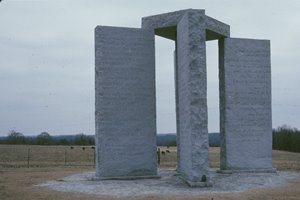
If your answer was the Georgia Guidestones you would be correct.

Georgia Guidestones? Yep,Georgia Guidestones! Some folks refer to them as the American Stonehenge including Yoko Ono. She loves them and thinks everyone should see them.

The Georgia Guidestones are located just outside the small town of Elberton, Georgia, the granite capital of Georgia. What better place for a mysterious man to appear suddenly one day and arrange to have a monument erected based on, according to him, the principals Thomas Paine expressed in The Age of Reason.

Elberton, Georgia is also very close to Al-yeh-li-A lo-He which is the center of the universe according to Cherokee legend. In fact, major Cherokee trails radiated from the Elberton area and major ceremonies were performed there annually.

Sounds fairly interesting until you actually read the ten guiding principals etched on the stones. Then it becomes strange. The first one calls for a world population of no more than 500,000, 000. That means that the majority of the Earth’s population would need to perish in order to reach a harmonious balance. Many call these principals the ten commandments of the New World Order or that they are the guiding principals of the Anti-Christ. Another tie-in with the Cherokee Nation’s center of the universe is a legend that states the “new age” will begin from Al-ye-li-A lo-He.

Others state the whole thing is a stunt by the city fathers of Elberton to boost tourism.

Review the evolution of the guide stones here.

Here are some other links for the stones here, here, and here.

Google the words “Georgia Guide Stones” and there are many, many links to sites that are interesting in a strange sort of way as you click each one. Careful though......don't get sucked in!

Gee, only in Georgia……