Showing posts with label constitution. Show all posts

Friday, June 18, 2010

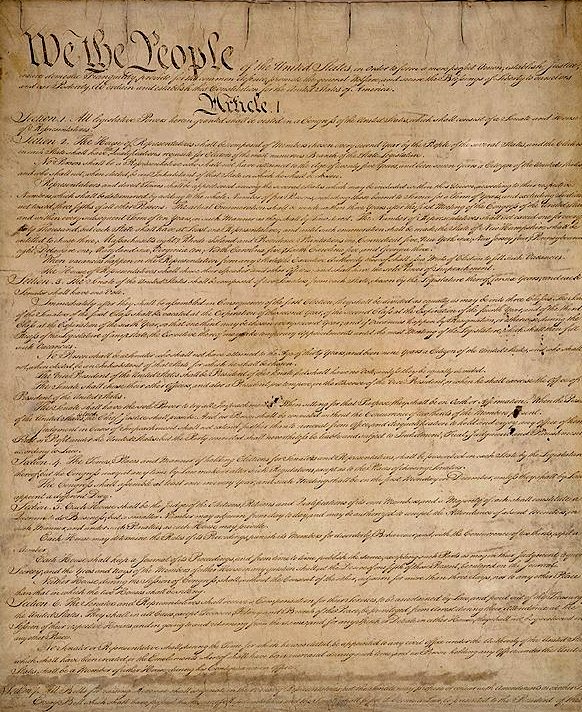
The Constitution: A Living Breathing Document

This post first appeared here at History Is Elementary in June, 2006. I’m currently attending a seminar on educational law, so it seems appropriate to re-run this today.

Enjoy.

Earlier this month we sidestepped another effort to amend our Constitution. That’s not surprising since there have been approximately 10,000 proposed amendments since 1789. Most of them never got out committee while some amendments, the Equal Rights Amendment, for example, gained great notoriety but expired while waiting on ratification.

If it’s possible to love a document then Elementaryhistoryteacher absolutely adores the United States Constitution. My American identity rests in the stability and continuity of the United States Constitution. I really get into teaching my government unit even though some of the more intricate workings of our government I’m required to cover in fourth grade are a bit too lofty for the students to grasp. However, I try. I lay seeds that I hope will sprout later.

I teach students that our Constitution was the first of its kind for a recognized nation. It is so important that it has been copied many times by other fledgling democracies. We spiral back in our content to recall events we studied earlier in the year that began a chain ending with the Constitutional Convention. We remember the Iroquois League, the Mayflower Compact, and the Fundamental Orders. I remind students the colonist were Europeans---men who had governmental roots based in monarchies---men whose ancestors were the majority yet lived at the pleasure of a few leaders or in most cases one decision maker. We remember the Declaration of Independence whose author had the audacity to give a divine monarch his comeuppance. The beauty of it, I tell students, is that our plan of government works. It worked during times of crisis like the Civil War, Watergate, and during the presidential election of 1876 when the voting results were disputed in three states.

We discuss the events during the actual Constitutional Convention including the various compromises, and we learn about the three branches of government. We discuss ratification. At this point I usually depart from my colleagues because I feel it is important to teach students how our Constitution provides for amendments, but they should understand that any effort to change one of our most previous documents should be approached soberly and gingerly.

We discuss the first ten amendments known as the Bill of Rights because they concern our individual rights and were necessary in order to obtain ratification of the document. Future amendments are not usually discussed at my grade level unless the time period is taught when the amendments were added. There is nothing wrong with this in my eyes but teachers are loosing a fantastic opportunity to give the amendment process the proper examination it requires. Teachers are usually required to teach citizenship responsibilities to contrast with the Bill of Rights. Lessons are presented that indicate certain rights citizens have contrasting activities citizens should engage in to keep the Republic healthy such as voting and educating ourselves regarding important issues. While we are teaching citizen responsibilities we should also focus on the appropriateness of amending the Constitution.

The originality of our government is that it gives something very precious to ‘we the people’---not entitlement programs, porkbelly special projects, or low interest student/home loans---but freedom. Citizens are given freedom of choice, freedom of action, and freedom to live as we wish as long as our freedom does not interfere with the freedom of someone else.

It should be remembered that the Constitution doesn’t hand rights over to us; our plan of government only guarantees them. The philosophy that many of our Forefathers operated under taught that citizens are born with certain rights and liberties. The Constitution simply secures these rights for the populace.

The framers of the Constitution were highly suspicious of government. They had just gotten rid of what they considered to be tyrannical control. They were all about protecting individual rights not restricting liberty. Amendments to the Constitution involving personal liberty should always grant liberty not take it away.

Whether I agree with the premise or not, a proposed Constitutional amendment should never be used to serve as a smokescreen for Congress in anticipation of midterm elections. Our nation faces major problems with illegal immigration and the war in Iraq, yet proposed amendments regarding flag burning and same-sex marriage have been discussed repeatedly. This has been a poor use of the amendment process and is a poor use of emotional issues to detour voters from the real issues at hand.

Some Americans are going to engage in behaviors that others will have a problem with . Does this mean we are going to propose amendments for what some perceive to be bad choices and bad behavior? If this is allowed I'm afraid we will be opening doors that will be very hard to close in the future.

Thursday, February 04, 2010

13 Quick Facts Regarding "The Federalist"

At some point during your high school government class or college Political Science course you had to read The Federalist. Jacob Cooke in the forward section for the collection of essays writes….the authoritative exposition of the Constitution [and] occupies an unrivaled place in our national political literature.

1. There are actually 85 articles regarding the ratification of the United States Constitution. They were originally published with the titles "The Federalist, No. 1”, The Federalist, No. 2”, etc.

2. Originally only 84 essays were written – not 85. The extra essay came about when the 31st essay was split. The 29th essay was also moved to follow the 34th to make the sequence logical.

3. The set of essays are the go-to source when interpreting the Constitution. By 1788, two volumes containing the essays were published with the title “The Federalist”. While many collections of the papers now carry the title The Federalist Papers, it is a misnomer.

4. The articles capture the motivation and philosophy regarding our version of government.

5. While most of the articles were written by Alexander Hamilton they were also penned by James Madison and John Jay. John Jay is always listed as an author, and he should be, but compared to Hamilton and Madison his contribution was very limited.

6. However, originally the authorship was a closely held secret. The pseudonym “Publius” was used.

7. Hamilton tried to list others to help – Gouverneur Morris, who declined to help and William Duer, who unfortunately did not meet Hamilton’s exact writing standards. Later his essays were added under the name “Philo-Publius”.

9. By 1792, the secret was out regarding authorship when a French edition of the essays identified Hamilton, Madison, and Jay.

10. Once the Constitution was proposed for ratification by the Federalist convention there were many articles and letters to the editor of the papers that published them opposing “Publius”.

11. The series of articles appeared in three newspapers – the Independent Journal, the New York Packet, and the Daily Advertiser.

12. Hamilton and Madison both claimed to have written several of the essays – 18 through 20, 49 through 58, and 62 and 63. Today after computer-based analysis of word choice patterns indicate Madison wrote all of the disputed essays.

13. The purpose of The Federalist was to focus on New York voters – to sway them to choose delegates to the ratification convention that would support the Constitution. Unfortunately, New York took the side of the Anti-Federalists – so in actuality The Federalist failed, and citizens in states like Delaware, Maryland, New Jersey and Georgia never saw them prior to ratification.

You can view an online version of The Federalist (the McLean version) here.

Other bloggers participate in Thursday 13….you can find them here.

Wednesday, September 23, 2009

Parallel

Out of all the historical content I have shared with students over the years the content that I find most satisfying to share with them is the information and activities I present regarding how our government came to be and how it works.

As citizens we are all about our rights….in fact, these days it seems we all overdose a little about what government should be doing for us. We often forget that an important aspect of being a citizen of the United States involves not just having a laundry list of rights….that list includes responsibilities as well.

YES! There are things that WE….we the people are supposed to do in order for our government to work right.

One of our primary responsibilities as a citizen is not just to know our rights, but to know how our government works….not how we think it works, not how politicians tell us it works, not how the media wants us to perceive how it works, but really KNOW how it works.

A few years ago I was required to not only teach a few social studies classes I was also slated to teach two science classes. It was a change of pace, and I really ended up enjoying overseeing units regarding sound, small machines, and space. I infused each unit with lots of hands-on opportunities including plenty of chances for movement. One of the lessons that I loved the most was where students actually took the job of a planet or other heavenly body and formed a human universe. Anyone visiting our back parking lot that day would have seen total chaos as a group of students whirled around another student in the middle of the group as he moved his arms to mimic radiating the light of the sun out towards Earth and beyond. Every planet-person revolved around the sun and every planet had a moon or moons revolving around it as well while some students observed the action. Then of course, we had fruit basket turn over as some students came out of the mix to observe or changed jobs to get a different perspective.

We created a parallel universe….a model….so students could experience a little part of it.

My handy on-line dictionary tells me that the word parallel can mean anything having the same direction, course, nature, or tendency….it can be something identical or similar in nature.
I have come to find that parallels in content delivery are key to provide those hands-on opportunities that students need to experience content and to develop a true grasp of the concepts we are attempting to teach.

So, I’ve often thought how wonderful it would be if I could develop a parallel-type government project to help students grasp American government, but how to do it? How to manage it?… and basically as the adult in the room…..how to control it?

Well, great things come to those who wait. I’ve come across a wonderful little book titled Parallel.

Parallel.

Of course, I’m looking for a parallel activity, so what else would it be????

Parallel is a book written by an author from my neck of the woods by the name of RaeMichael. It is a book of fiction regarding a group of college students who are handed an extra credit project by their political science professor.

The group decides to set up a parallel government of the United States using the U.S. Constitution as their guide. Imagine that!

As the project….named the “New” United States of America….begins the first order of business for “Congress” is to pass a resolution to Reaffirm the Superiority of the Constitution requiring all laws and resolutions must be reconciled with the U.S. Constitution prior to consideration. Other actions of the “New” United States of America include holding politicians accountable for the promises they make, and campaign reform and the lobby process are also addressed.

I’m excited about the book because I can see the value of using it with upper elementary, middle, and high school students to interject another source into a teaching unit for government. I can see myself using the fictional book as a read aloud to serve as a springboard to ask students to set up a similar experiment…..allowing students to set up their own living, breathing, working “new” American government. Parallel provides opportunities for analysis and great pro/con discussions regarding such innovations in government as banning all lawyers from political service….yes, I know….a highly controversial subject.

The preview blurb on the back of the book advises the parallel government project was meant to be small….a small manageable version…[it] seemed the right thing to do. But what they didn’t understand was, government is never small nor manageable, and is often not the right thing to do.

Rightly so….government is meant to do some things while it is also meant to stay out of other areas. This book takes an honest look at all aspects of government, and I recommend it highly.

You can visit the author’s website and purchase the book here.

Thursday, September 17, 2009

Happy Constitution Day!

On this day in 1787 the United States Constitution was signed, however it was not until 2004 that an official observance was recognized by Congress. Prior to 2004 the day was celebrated as Citizenship Day.

The law which officially recognizes today as Constitution Day provides that any U.S. public school receiving federal funds must set aside a portion of classroom instruction specifically for teaching the history of the Constitution.

Here are some fun facts regarding the Constitution:

1. The U.S. Constitution Center advises our Constitution is the shortest and the oldest Constitution in the world.

2. The Constitution located at the National Archives in Washington D.C. was hand written by Jacob Shallus. He was an assistant clerk to the Pennsylvania General Assembly and was paid $30 for his touble.

3. Our Constitution was NOT the first plan of government for the United States. The Articles of Confederation failed miserably and necessitated the meeting of the Constitutional Convention to form a new plan.

4. Most people refer to the influence of John Locke when discussing the formation of our Constitution, but Monesquieu’s influence should not be overlooked. He discussed the need for balanced forces pushing against each other referencing Polybius, a 2nd century BC philosopher who discussed checks and balances.

5. Over 10,000 constitutional amendments have been introduced in Congress since 1789….only 27 have actually gone through the entire amendment process.

The U.S. Constitution is one of my most favorite topics to teach about….Since 2006, I’ve written about it several times here at History is Elementary. You can see those postings here.

Saturday, October 11, 2008

Eating Up the Bread of Our Children

Most dictionaries define pork as a government project or appropriation that yields jobs or benefits to a specific locale and patronage opportunities to its political representative.

A great article over at Harper's Magazine advises “pork-barreling as a legislative epithet is a pre—Civil War coinage that referred to the custom of handing out salt pork to slaves, who would crowd around the barrels that held it, and indeed, members of Congress have raided the federal treasury for home-district boondoggles ever since the earliest days of the republic.” John Ferejohn’s book, Pork Barrel Politics: Rivers and Harbors Legislation, 1947-1968 confirms this explanation.

To qualify specifically as pork legislation must meet seven criteria per the Citizens Against Government Waste and the Congressional Porkbusters Coalition. They are:

*the legislation must be requested by only one chamber of Congress;
*cannot be specifically authorized;
*cannot be competitively awarded;
*has not been requested by the President
*greatly exceeds the President’s budget request or the previous year’s funding;
*serves only a local or special interest.

The earliest form of pork barrel spending would be the Bonus Bill of 1817. It was introduced by John C. Calhoun and it involved highway construction linking the East and South with the western frontier. Part of the controversy was the source of the funds….an earnings bonus from the Second Bank of the United States. The proposed bill was eventually vetoed by President James Madison.

Calhoun actually justified his pork-barrel spending as many Congressmen do today. He used the Constitution to bolster his argument citing Article 1, Section 9, Clause 7 which Calhoun argued actually gives Congress the power to spend by stating, “No money shall be drawn from the Treasury but by consequence of Appropriations made by Law.”

Years later President Grover Cleveland would also use the Constitution to support his nickname as the “king of the veto” because he rejected hundreds of congressional spending bills during his two terms. He continually stated he could find no support in the Constitution for the appropriations.

Over at the site for Citizens Against Government Waste they have a well-documented discussion regarding the history of pork-barrel spending. I’ve included some of it here:

Washington insiders have espoused this “power of the purse” to validate Congress’s mushrooming appetite for pork. Sen. Larry Craig (R-Idaho) and Rep. Mike Simpson (R-Idaho) have argued eliminating earmarks would equate to an unconstitutional delegation of spending discretion to the executive branch. Sen. Harry Reid (D-Nev.) said that earmarking has been going on “since we were a country.” A spokeswoman for lobbying from Cassidy and Associates said, “Earmarking has been going on since the time of George Washington.”

The First Congress rejected a bill to loan money to a glass manufacturer after several members challenged the constitutionality of the proposal. In a debate during the Second Congress over a bill to pay a bounty to New England cod fishermen, Rep. Hugh Williamson of South Carolina argued that it was unconstitutional to gratify one part of the Union by oppressing the other…destroy this barrier,-and it is not a few fishermen that will enter, but all manner of persons; people of every trade and occupation may enter in at the breach, until they have eaten up the bread of our children.

Thomas Jefferson made a similar prediction in a letter to James Madison dated March 6, 1796, challenging Madison’s proposition for improvements to roads used in a system of national mail delivery. Jefferson wrote:

Have you considered all the consequences of your proposition respecting post roads? I view it as a source of boundless patronage to the executive, jobbing to members of Congress and their friends, and a bottomless abyss of public money. You will begin by only appropriating the surplus of the post office revenues; but the other revenues will soon be called into their aid, and it will be a scene of eternal scramble among the members, who can get the most money wasted in their State; and they will always get most who are meanest.”

Madison, the Father of the Constitution, actually vetoed the public works bill stating the clause “to provide for the common defense and general welfare” did not grant Congress additional powers not enumerated in Article 1, Section 8.

It would be hard to imagine a more convoluted, inaccurate, and self-serving interpretation of the Constitution and U.S. history. The Founding Fathers deemed that Congress could only spend money in pursuant to those powers specifically enumerated in the Constitution. The 10th Amendment leaves all other responsibilities to the states.

…and like many things dealing with the U.S. Constitution the debate regarding what constitutes appropriate appropriations will continue.

Wednesday, March 26, 2008

America: a Great Nation

The U.S. Constitution outlines three branches of government….the Executive, the Legislative, and the Judicial. Checks and balances are employed to make sure no one branch has total and complete power.

What are your thoughts on how our three branches makes America a great nation?

Note: The three branches shown in the photo were created by my daughter for a project she is working on for her AP Government class. It’s amazing what some twigs from the yard, an old silk flower arrangement, and a printer can create.

You can view other wordless images here.

Wednesday, March 21, 2007

Thursday Thirteen: Week 17 Constitution Convention Facts

My students have been learning about the formation of the government and thankfully they seem interested. You know they are interested when they don’t want class to stop for lunch. So, in keeping with my current classroom theme here are 13 facts about the Constitutional Convention.

1. The U.S. Constitution was written in the same Pensylania State House where the Declaration of Independence was signed and where Georgia Washington received his commission as Commander of the Continental Army. Now called Independence Hall, the building still stands today on Independence Mall in Philadelphia, directly across from the National Constitution Center.

2. Written in 1787, the Constitution was signed on September 17th, but it wasn’t until 1788 that it was ratified by the necessary nine states.

3. The U.S. Constitutuion was prepared in secret, behind locked doors that were guarded by sentries.

4. Some of the original framers and many delegates in the state ratifying conventions were very troubled that the original Constitution lacked a description of individual rights. In 1791, Americans added a list of rights to the Constitution. The first ten amendments became known as The Bill of Rights.

5. Of the 55 delegates attending the Constitutional Convention, 39 signed and 3 delegates dissented. Two of America’s “founding father’s” didn’t sign the Constitution. Thomas Jefferson was representing his country in France and John Adams was doing the same in Great Britain.

6. Established on November 26, 1789, the first national “Thanksgiving Day” was originally created by George Washington as a way of “giving thanks” for the Constitution.

7. Of the written national constitutions [in the world], the U.S. Constitution is the oldest and shortest.

8. At 81, Benjamin Franklin of Pennsylvania was the oldest delegate at the Constitutional Convention and at 26, Jonathon Dayton of New Jersey was the youngest.

9. The original Constitution is on display at the National Archives in Washington, D.C.. When the Japanese bombed Pearl Harbor, it was moved to Fort Knox for safekeeping.

10. More than 11, 000 amendments have been introduced in Congress. Thirty-three have gone to the states to be ratified and only twenty-seven have received the necessary approval from the states to actually become amendments to the Constitution.

11. Rhode Island was the only state [from the original 13] that refused to send delegates. Dominated by men wedded to paper currency, low taxes, and popular government, Rhode Island’s leaders refused to participate in what they saw as a conspiracy to overthrow the established government.

12. Patrick Henry of “give me liberty or give me death” fame also refused to go. The great orator said, “I smell a rat!” He firmly believed that state governments could protect personal liberties best.

13. George Washington reluctantly attended the Convention. He was suffering from rheumatism, despondent over the loss of a brother, absorbed in the management of Mount Vernon, and doubted the convention would accomplish very much or that many men of stature would attend. He delayed accepting the convention for many months, yet He was the one who was elected president of the convention. As such Washington did not particpate in any of the debate during the months the convention met.

Various websites provide this information far better than I can. Statements 1-10 can be found here. Statements 11, 12, and 13 can be found here.

Would you like some information on the men who were delegates from your state? If you live in one of the 13 original states you can find your delegates here.


Sunday, December 10, 2006

Ummmm.....I Believe Your Myths and Traditions Are Showing


I hadn’t planned on writing about this issue until I had the fourth person mention it to me. It was at that point I decided I couldn’t remain silent any longer. Now at the outset let me remind you that I have made it no secret here that I am a Christian, and I am fairly conservative. I believe in many American traditions and love our heritage of liberty laden documents like the Declaration of Independence and the United States Constitution.
However, the comments made in my presence this past week by several people reinforced to me what I already know. What many Americans think are fact and law are sometimes at best only tradition and myth. Now there’s nothing really wrong with this. Every culture needs its traditions and myths, but when tradition and myth intrude on the legal rights of others then tradition and myth can be a dangerous thing. So what started this discourse? Last week Dennis Prager, talk show host, author and on-line columnist, published this column seen here, and the next day his follow up can be seen here regarding the brand new Congressman from Minnesota, Keith Ellison.

This week I heard from American citizens that it was a law that all members of Congress must swear an oath on the Christian Bible. I heard someone say only Christians should be members of Congress because the United States is a Christian nation. I heard someone say, when confronted with the truth about the legalities, that law doesn’t matter and that if a member of Congress doesn’t want to swear to the Christian God by placing his hand on a Christian Bible then he shouldn’t be allowed to serve the people who elected him.

How Puritan! How close-minded! So, is this what we have made of ourselves with tradition and myth? Is it “our” way or the highway?

In the early days before the thirteen colonies were even completely organized a man by the name of Roger Williams dissented from the Puritan way of life. He spoke out and stated he thought the Puritan tradition of allowing religion to dictate government policy and procedures wrong. He felt the treatment of Native Americans was wrong. He was banished from the Puritan colony and eventually founded a settlement at Providence where a government was set up that clearly seperated church and state and called for equal rights for all who lived there.

Thomas Hooker, a pastor, was a Puritan dissenter as well. He disputed Puritan views that stated only those of the Puritan version of faith could vote within the colony. Hooker felt any man should have the right to vote, and after banishment went on to found the colony of Connecticut. The Fundamental Orders, Connecticut’s plan of government, is thought to be the world’s first constitution of its kind. All men were given the right to participate in government.

I review these situations in our history because they are important. The ideas that these two people took with them as they were banished from the Puritan way of life became some of the most important aspects of the government of the United States….freedom of religion, seperation of church and state, and the right to comment and dissent.

Poor Mr. Prager, though. He has been cussed out, villified, and has been threatened. We need to remember he has a right to express his opinion and there is a way to disagree without name calling and threats. I admire Mr. Prager and have enjoyed listening to him in the past. I will probably listen to him in the future, but I feel strongly he is wrong in this case simply because the Constitution does not support his views.

The oath of office that members of Congress recite is not written specifically in the Constitution. The only oath of office that is prescribed word-for-word is the oath for president. Members of the first Congress in 1789 took it upon themselves to create an oath as one of their first acts as a lawmaking body. The oath, a mere fourteen words, said, “I do solemnly swear (or affirm) that I will support the Constitution of the United States of America.”

Why so short? Why so simple? The answer is simple…..The Constitution states members of Congress and other officials “shall be bound by Oath or Affirmation to support this Constitution.” That’s it. This oath was changed a bit during the Civil War over time as members of Congress were concerned a traitor might take a seat in Congress. The added text came to be known as the Test Oath as it was a test of loyalty. Eventually members of Congress had to recite this revised oath as well as sign a copy. Even when the test oath text was removed, in 1884, it became a tradition for members of Congress to sign their name in a book that is filled with names of people who have served in Congress and have taken the oath. Mr. Ellison and other new members of Congress will be signing that book very soon.

In Prager’s first column he states, “When all elected officials take their oaths of office with their hands on the very same book, they all affirm that some unifying value system underlies American civilization.” Huh? I don’t get it. First of all they don’t’ and haven’t in the past said the oath with their hand on the same book. Second, they don’t state they will support a value system. They only state they will uphold the Constition as they serve “we the people”. The Constitution is not a value system…..it is a plan for our government….it details how the government will operate.

Mr. Prager states many Jews, non-believers, Mormans, etc. have placed their hands on a Bible, but he doesn’t give any specific names of people. I am wary of blanket statements, and quiet frankly I’d be suspect of any person who placed their hand on the Bible when it isn’t their sacred text. To force someone or intimidate them to do that is an act no better than the early explorers who slashed the throats of Native Americans simply because they wouldn’t pray to God and convert from their wicked ways.

Many say, and I can agree, the whole thing is a moot point anyway. All new members stand together in a group, raise their hands, and repeat words that have been part of an oath crafted by the First Congress in 1789. There are no hands placed on any book of any kind. Later during the photo-op there is an opportunity for a new member of Congress to be surrounded by friends, family, and the book of their choice if the mood strikes.

Prager goes on, however, and says, “So why are we allowing Keith Ellison to do what no other member of Congress has ever done----choose his most revered book for this oath?” Gee, maybe because that’s the tradition……others have done this with no problem. Case in point……Debbie Wasserman Schultz of Florida refused the Christian Bible when she was sworn in as a U.S. Representative. A Hebrew Bible could not immediately be found, but one was eventually borrowed from another representative.

Eugene Volokh, in a National Review article seen here takes issue with Prager’s statement, “for all of American history, Jews elected to public office have taken their oath on the Bible, even though they do not believe in the New Testament.” Volokh continues, “…it is clear [Prager] is wrong. Linda Lingle, Governor of Hawaii, took the oath of office on a Torah in 2001….[and] Madeleine Kunin, a Jewish immigrant and Governor of Vermont [used family owned prayer books].” (Mr. Volokh also explores the mutliculturalism aspect of Mr. Prager’s argument in the last link given as well).

Prager continues, “…I nor tens of millions of other Americans will watch in silence as the Bible is replaced with another religious text for the first time since George Washington brought a Bible to his swearing-in.” First of George Washington was being sworn as the president of the United States. This is the only office that the Constitution specifically calls for and prescribes an oath of office. I have researched and have been provided with a waterfall of information regarding Washington and his oath of office and my sources explain to me that the Bible Washington used was not one he brought. It was an after thought and one had to be procured.

In fact, there have been presidents who were sworn with no Bible at all such as Theodore Roosevelt. Rutherford B. Hayes had no Bible at his private ceremony. He only pulled it out for the public. Franklin Pierce did not swear but used the affirmation choice, as did Herbert Hoover, a Quaker. Lyndon Johnson was sworn in for his first term using only a missal, a book containing the prayers and rites used by a priest in celebrating Mass.

In the follow up column Prager states, “Clearly, many Americans, including some conservatives and libertarians, have no problem with the idea that for the first time in American history, a person elected to Congress has rejected the Bible for another religious text when taking his oath of office.” In another statement he says, “America is interested in only one book, the Bible.”

I’m sorry….I must have missed the memo that made Christianity the official religion of the nation. What about the Constitution’s provision that states “no religious test shall ever be required as qualification to any office or public trust under the United States….” It would seem that the framers of the Constitution solved this issue a long time ago. The Constitution goes on to state, “The Senators and Representatives…[and other state and federal officials] shall be bound by oath or affirmation, to support this Constitution, but no religious test shall ever be required.”

In the second column Prager states, “My belief that the Bible should be present at any oath (or affirmation) of office has nothing whatsoever to do with the religion of the office holder.” This really scares me. Is this what we are about? I don’t care what religion you are. I don’t care if you don’t worship this way. Swear to my book, my way, or it’s the highway. Mr. Prager says the solultion is very simple….Mr. Ellison should bring both books, the Bible and the Koran, to the ceremony. In this way he will be sending the “right” message. In fact I believe that is really what is at the crux of Mr. Prager’s shorts being in a tangled knot….

Mr. Prager seems to think since he will have already been sworn in Mr. Ellison will bring his Koran to make a point to the American people. He says, “…the use of the Koran has absolutely nothing to do with taking an oath on the book he holds sacred. It is used entirely to send a message to the American people. So all the arguments that he must be able to swear on the book he holds sacred are moot. He will have already been sworn in.” If this is the case then all of the books members bring to the photo-op are moot and are simply “messages” being sent to the American people. I disagree with the whole “message” reasoning, however, when have we ever denied free speech? If Mr. Ellisons’ message can’t be delivered then no one’s message should be delivered.

I tell my nine year old students everyday they have a responsibility to themselves to not believe everything they see, hear, and read until they have have checked things out themselves and have used the facts to arrive at their own conclusions. It is easy to make blanket statements, it is easy to allow tradition and myth to cloud our collective national conscience, and it is easy to sit back and allow things to happen. This situation has probably educated many, many people who were under wrong impressions. This situation has probably opened the door for some to reconsider their thoughts and opinions. This situation shows that our country is indeed a wonder place where all are invited to participate in government, and all are free to worship in any manner they choose.

BTW...I’m a finalist for a Weblog Award. Vote for me here. Thanks!

Wednesday, June 28, 2006

Others Weigh In...Now It's Your Turn

In a recent editorial titled Congress's Real Crimes, Gloria Borger (U.S.News and World Report) states:

So here we are, at the start of summer, with Capitol Hill in a frenzy, talking up a storm as it readies to leave for a long break. Goodness knows, your members of Congress deserve their rest, given all they’ve accomplished: Social Security reform. Immigration reform. Lobbying reform. Healthcare reform.

Oops. Wrong list.

Ms. Borger and I, it seems, are like minded as you can see by visiting my recent posts Changing the Constitution and Being About the Business of the People.

I wonder what would happen if we had an election and absolutely no one showed up to vote? Would they get the message then?

In the same online issue, David Gergen also pens his views regarding Congress in a thoughtful essay about leadership here. Here are a few excerpts:

The grim truth is that the political leadership of the country, especially in Washington, is almost dysfunctional in grappling with the big issues bearing down on us. From energy to education, climate change to healthcare, budget deficits to trade deficits, progress is perilously slow. And time is definitely not on our side.

Reading further:

What this means for America is that if we wish to remain great, we must improve--dramatically--the way we compete. We all know this starts with K-12 education, and we have made progress, but it has been shamefully slow and uneven.

…and towards the end:

Ultimately, these are questions that test our national will. If America is not to slip from great to good, we need civic leadership across the country to light fires and rally energies

I guess after reading the opinion of others and contemplating my own thoughts my biggest concern right now with the direction our country is going in is we aren’t heading in any direction. We have made no major gains in any of our problem areas and more and more I believe Congress is our problem. I’m tired of the fighting…the partisan politics…shooting down great ideas because your party didn’t come up with it. It has to stop.

Serving as a legislator should not be a life-long career choice. Maybe we need some fresh blood….folks who don’t understand the saying, “this is the way we’ve always done it.”

I’d be interested in knowing what you think.

Tuesday, June 27, 2006

Being About the Business of the People

I appreciate your comments to my recent post here about the U.S. Constitution and my objections to amending it to correct issues of morality. However, one comment that was made deserves some elaboration on my part especially in light of recent events here in Georgia.

One person who commented agreed with me that altering the Constitution is a big deal but that times have changed and we need to change with the times. True, very true. However, let’s remember what the main purpose of the U.S. Constitution is. It is our plan of government. We have three branches that work independently and dependently at the same time hence the term checks and balances. The Constitution lays out the responsibilities for each branch and provides the game plan for what can be done and what can’t. The U.S. Constitution also details the relationship between the states and the Federal government. It tells us that matters that are not covered in the Constitution falls under the authorization of the states.

Currently a few amendments to the U.S. Constitution involve changes regarding the procedures of the Federal government, however, most of the amendments secure our individual liberties. The only time we have had an amendment that restricted liberty it was repealed later. The 18th amendment dealt with Prohibition. The purpose of the amendment was flawed, it failed miserably, and was repealed by the 21st amendment.

This brings me to the news from today. This morning I was awoken with a news story concerning yet another U.S. Congressman who is pushing for an amendment to ban flag burning. I was also reminded by my newsman that the State of Georgia would be arguing their case before the Georgia Supreme Court regarding a reversal of a gay marriage amendment. Sometime ago Georgia citizens voted overwhelmingly (76%) to approve a state amendment that would ban gay marriage and civil unions. The key word to the dispute is “and”. Some months later a judge overturned the vote because the ballot question presented to voters dealt with more than one issue. It is true that for over a century Georgia has had a statute where ballot questions can only deal with one issue. State attorneys argue that the two issues, gay marriage and civil unions are really one and the same.

So here’s the crux of my point….the major issue I keep hearing about amendments based on issues of morality is people are angry at judges who legislate from the bench. If our U.S. Congress and our state legislatures would sincerely be about the business of the people these situations would not occur. Many of the members of legislatures across our great country are attorneys. Why then can’t they legislate appropriately so that we don’t have crazy loopholes and mistakes that cause these types of debacles? Think about the thousands of dollars that are being wasted because the Georgia General Assembly did not follow procedure or overlooked it. There are too many people involved in the legislation process for there to be haphazard and sloppy legislation.

Perhaps our lawmakers should make the problems of “we the people” their main concern instead of taking great ideas that will solve problems and whittle away at them and water them down so much they don’t even resemble the original legislation by the time they are done. Why do they do this? Could it be that legislators are so involved in pleasing every special interest group they are hindered from being about the business of the people. Could it be continued efforts to be re-elected also hinders them from doing what “we the people” elect them to do?

What do you think?

Remember that you can subscribe to this blog and receive my updated posts by email when you submit your address in the Feed Blitz box at the top of this page or if you read several blogs you can click on the Bloglines button to the right. Thanks in advance for your comments!

Friday, June 23, 2006

Changing the Constitution

Earlier this month we sidestepped another effort to amend our Constitution. That’s not surprising since there have been approximately 10,000 proposed amendments since 1789. Most of them never got out committee while some amendments, the Equal Rights Amendment, for example, gained great notoriety but expired while waiting on ratification.

If it’s possible to love a document then Elementaryhistoryteacher absolutely adores the United States Constitution. My American identity rests in the stability and continuity of the United States Constitution. I really get into teaching my government unit even though some of the more intricate workings of our government I’m required to cover in fourth grade are a bit too lofty for the students to grasp. However, I try. I lay seeds that I hope will sprout later.

I teach students that our Constitution was the first of its kind for a recognized nation. It is so important that it has been copied many times by other fledgling democracies. We spiral back in our content to recall events we studied earlier in the year that began a chain ending with the Constitutional Convention. We remember the Iroquois League, the Mayflower Compact, and the Fundamental Orders. I remind students the colonist were Europeans---men who had governmental roots based in monarchies---men whose ancestors were the majority yet lived at the pleasure of a few leaders or in most cases one decision maker. We remember the Declaration of Independence whose author had the audacity to give a divine monarch his comeuppance. The beauty of it, I tell students, is that our plan of government works. It worked during times of crisis like the Civil War, Watergate, and during the presidential election of 1876 when the voting results were disputed in three states.

We discuss the events during the actual Constitutional Convention including the various compromises, and we learn about the three branches of government. We discuss ratification. At this point I usually depart from my colleagues because I feel it is important to teach students how our Constitution provides for amendments, but they should understand that any effort to change one of our most previous documents should be approached soberly and gingerly.

We discuss the first ten amendments known as the Bill of Rights because they concern our individual rights and were necessary in order to obtain ratification of the document. Future amendments are not usually discussed at my grade level unless the time period is taught when the amendments were added. There is nothing wrong with this in my eyes but teachers are loosing a fantastic opportunity to give the amendment process the proper examination it requires. Teachers are usually required to teach citizenship responsibilities to contrast with the Bill of Rights. Lessons are presented that indicate certain rights citizens have contrasting activities citizens should engage in to keep the Republic healthy such as voting and educating ourselves regarding important issues. While we are teaching citizen responsibilities we should also focus on the appropriateness of amending the Constitution.

The originality of our government is that it gives something very precious to ‘we the people’---not entitlement programs, porkbelly special projects, or low interest student/home loans---but freedom. Citizens are given freedom of choice, freedom of action, and freedom to live as we wish as long as our freedom does not interfere with the freedom of someone else.

It should be remembered that the Constitution doesn’t hand rights over to us; our plan of government only guarantees them. The philosophy that many of our Forefathers operated under taught that citizens are born with certain rights and liberties. The Constitution simply secures these rights for the populace.

The framers of the Constitution were highly suspicious of government. They had just gotten rid of what they considered to be tyrannical control. They were all about protecting individual rights not restricting liberty. Amendments to the Constitution involving personal liberty should always grant liberty not take it away.

Whether I agree with the premise or not, a proposed Constitutional amendment should never be used to serve as a smokescreen for Congress in anticipation of midterm elections. Our nation faces major problems with illegal immigration and the war in Iraq, yet proposed amendments regarding flag burning and same-sex marriage have been discussed repeatedly. This has been a poor use of the amendment process and is a poor use of emotional issues to detour voters from the real issues at hand.

Some Americans are going to engage in behaviors that others will have a problem with . Does this mean we are going to propose amendments for what some perceive to be bad choices and bad behavior? If this is allowed I'm afraid we will be opening doors that will be very hard to close in the future.

Remember that you can subscribe to this blog and receive my updated posts by email when you submit your address in the Feed Blitz box at the top of this page or if you read several blogs you can click on the Bloglines button to the right. Thanks in advance for your comments!