Thursday, July 07, 2011

Identifying Andrew Jackson's Property

Over the Fourth of July holiday I was fortunate enough to make a stop at Andrew Jackson’s home, Hermitage, in Nashville, Tennessee.

Unfortunately, President Jackson was out, but he had left behind all sorts of interesting things for me to look at.
I thought I’d post them for a quick little game.  Don’t worry though…the answers are right here.
Go on and take a look and then at the bottom of the post you will find my link to more pictures from Jackson’s lovely home.

Okay…what’s this?

It looks like carved ivory, doesn’t it?   It carried something both men and women used during Jackson’s time.     Yes, this little crab-shaped item has a little box in it that carried snuff.   You could slip it in your pocket.   I can just imagine the conversations it would start when Jackson brought it out during a meeting.
Okay….what about this????     Forgive my fat fingers and the not-too-focused image.   I never promised you that I was an expert at photography.


I had no idea what this was.  I just admired the lovely green color.   
It’s a cup plate.
Now don’t confuse this with a saucer….they are two totally different things. 
 
Cup plates were used in the 18th and early 19th centuries.   In those days tea was served in cups without handles.   You would pour your tea into your saucer (yes, you are reading this right) and drink FROM YOUR SAUCER!  

….and I just thought my  Papa Blanton was a country bumpkin when he did it years and years ago at our breakfast table. 
Anyway, while you were drinking from your saucer you had to rest your cup somewhere and that’s what the cup plate was for.   It was used to protect the table from the tea.

Last, but not least do you know what this is? 

Who said a pocket knife?    Nope….that’s not what it is, but good guess.
It’s a lancet.

LANCET.     They were used to open the veins during a blood-letting.    See further explanation here.
You can find more of my pictures (one or two were made by Mr. EHT) over at American Presidents Blog here.

Saturday, July 02, 2011

Great Britain's Write-Up Slip: The Declaration of Independence.

One of the important lessons I teach each year is the Declaration of Independence. Over the years I’d bring up our nation’s important documents in adult conversations when people would ask what grade I taught. Sometimes it was very obvious from what was said that the adults I was conversing with didn’t have a clue regarding the difference between documents like the Declaration of Independence and the Constitution. It’s was also very obvious those same adults had never actually read either document.

It’s very simple. The Declaration declares our independence from Great Britain while the U.S. Constitution serves as our plan of government – the rules regarding how our Federal government works.
It’s simple, right?

Try explaining it to nine and ten year olds when some of them still believe Pocahontas had little animal friends who talked and she frolicked in the forest breaking out into song when the notion hit her as Disney portrays.
Finally, I hit on an analogy students could grasp – the write-up slip. When they violated classroom and school rules I wrote them up. In order to properly fill the form out I have to identify each and every broken rule. 

I have to make a record of the poor choices in order to institute correction.
The Declaration of Independence served as a write-up slip for Great Britain.  

Since the Fourth of July is almost here I thought it appropriate to post the full text of the document we are celebrating here.   
Reading it from the perspective of a write-up slip might make it a little bit easier to grasp its full meaning.

The Declaration of Independence states:
When, in the course of human events, it becomes necessary for one people to dissolve the political bands which have connected them with another, and to assume among the powers of the earth, the separate and equal station to which the laws of nature and of nature's God entitle them, a decent respect to the opinions of mankind requires that they should declare the causes which impel them to the separation.

We hold these truths to be self-evident, that all men are created equal, that they are endowed by their Creator with certain unalienable rights, that among these are life, liberty and the pursuit of happiness.
That to secure these rights, governments are instituted among men, deriving their just powers from the consent of the governed. That whenever any form of government becomes destructive to these ends, it is the right of the people to alter or to abolish it, and to institute new government, laying its foundation on such principles and organizing its powers in such form, as to them shall seem most likely to effect their safety and happiness. Prudence, indeed, will dictate that governments long established should not be changed for light and transient causes; and accordingly all experience hath shown that mankind are more disposed to suffer, while evils are sufferable, than to right themselves by abolishing the forms to which they are accustomed. But when a long train of abuses and usurpations, pursuing invariably the same object evinces a design to reduce them under absolute despotism, it is their right, it is their duty, to throw off such government, and to provide new guards for their future security. --Such has been the patient sufferance of these colonies; and such is now the necessity which constrains them to alter their former systems of government. The history of the present King of Great Britain is a history of repeated injuries and usurpations, all having in direct object the establishment of an absolute tyranny over these states. To prove this, let facts be submitted to a candid world.

He has refused his assent to laws, the most wholesome and necessary for the public good.
He has forbidden his governors to pass laws of immediate and pressing importance, unless suspended in their operation till his assent should be obtained; and when so suspended, he has utterly neglected to attend to them.

He has refused to pass other laws for the accommodation of large districts of people, unless those people would relinquish the right of representation in the legislature, a right inestimable to them and formidable to tyrants only.

He has called together legislative bodies at places unusual, uncomfortable, and distant from the depository of their public records, for the sole purpose of fatiguing them into compliance with his measures.

He has dissolved representative houses repeatedly, for opposing with manly firmness his invasions on the rights of the people.

He has refused for a long time, after such dissolutions, to cause others to be elected; whereby the legislative powers, incapable of annihilation, have returned to the people at large for their exercise; the state remaining in the meantime exposed to all the dangers of invasion from without, and convulsions within.

He has endeavored to prevent the population of these states; for that purpose obstructing the laws for naturalization of foreigners; refusing to pass others to encourage their migration hither, and raising the conditions of new appropriations of lands.

He has obstructed the administration of justice, by refusing his assent to laws for establishing judiciary powers.

He has made judges dependent on his will alone, for the tenure of their offices, and the amount and payment of their salaries.

He has erected a multitude of new offices, and sent hither swarms of officers to harass our people, and eat out their substance.

He has kept among us, in times of peace, standing armies without the consent of our legislature.

He has affected to render the military independent of and superior to civil power.

He has combined with others to subject us to a jurisdiction foreign to our constitution, and unacknowledged by our laws; giving his assent to their acts of pretended legislation:

For quartering large bodies of armed troops among us:

For protecting them, by mock trial, from punishment for any murders which they should commit on the inhabitants of these states:

For cutting off our trade with all parts of the world:

For imposing taxes on us without our consent:

For depriving us in many cases, of the benefits of trial by jury:

For transporting us beyond seas to be tried for pretended offenses:

For abolishing the free system of English laws in a neighboring province, establishing therein an arbitrary government, and enlarging its boundaries so as to render it at once an example and fit instrument for introducing the same absolute rule in these colonies:

For taking away our charters, abolishing our most valuable laws, and altering fundamentally the forms of our governments:

For suspending our own legislatures, and declaring themselves invested with power to legislate for us in all cases whatsoever.

He has abdicated government here, by declaring us out of his protection and waging war against us.

He has plundered our seas, ravaged our coasts, burned our towns, and destroyed the lives of our people.

He is at this time transporting large armies of foreign mercenaries to complete the works of death, desolation and tyranny, already begun with circumstances of cruelty and perfidy scarcely paralleled in the most barbarous ages, and totally unworthy the head of a civilized nation.

He has constrained our fellow citizens taken captive on the high seas to bear arms against their country, to become the executioners of their friends and brethren, or to fall themselves by their hands.

He has excited domestic insurrections amongst us, and has endeavored to bring on the inhabitants of our frontiers, the merciless Indian savages, whose known rule of warfare, is undistinguished destruction of all ages, sexes and conditions.

In every stage of these oppressions we have petitioned for redress in the most humble terms: our repeated petitions have been answered only by repeated injury. A prince, whose character is thus marked by every act which may define a tyrant, is unfit to be the ruler of a free people.

Nor have we been wanting in attention to our British brethren. We have warned them from time to time of attempts by their legislature to extend an unwarrantable jurisdiction over us. We have reminded them of the circumstances of our emigration and settlement here. We have appealed to their native justice and magnanimity, and we have conjured them by the ties of our common kindred to disavow these usurpations, which, would inevitably interrupt our connections and correspondence. They too have been deaf to the voice of justice and of consanguinity. We must, therefore, acquiesce in the necessity, which denounces our separation, and hold them, as we hold the rest of mankind, enemies in war, in peace friends.

We, therefore, the representatives of the United States of America, in General Congress, assembled, appealing to the Supreme Judge of the world for the rectitude of our intentions, do, in the name, and by the authority of the good people of these colonies, solemnly publish and declare, that these united colonies are, and of right ought to be free and independent states; that they are absolved from all allegiance to the British Crown, and that all political connection between them and the state of Great Britain, is and ought to be totally dissolved; and that as free and independent states, they have full power to levy war, conclude peace, contract alliances, establish commerce, and to do all other acts and things which independent states may of right do. And for the support of this declaration, with a firm reliance on the protection of Divine Providence, we mutually pledge to each other our lives, our fortunes and our sacred honor.

Happy Fourth of July!!!!

Sunday, June 26, 2011

Analyzing Tom Horn

Tom Horn. 

A simple name for a man yet it appears he lived a very complex life.  In fact, Tom Horn himself said of his life, “I have lived about fifteen ordinary lives.  I would like to have had somebody who saw my past and could picture it to the public.  It would be the most interesting reading in the country.”

Once guilty, now innocent, but still dead – the description the New York Times gave Tom Horn in 1993.
A man Steve McQueen chose to portray in a movie – though historians have several issues with the treatment’s accuracy.

Tom Horn is an excellent historical figure for students to analyze while learning a little about the American Southwest during the late 19th Century.   The details surrounding his life, the historical events swirling around him, and the issue of right and wrong regarding those events in relation to Mr. Horn’s actions could lead to a classroom of very engaged students on various levels.

Upon running away from home at the age of 16 Horn headed for the American Southwest.  He became involved with the Apache Wars and was hired by the U.S. Cavalry as a civilian scout.   He was a member of the party who captured Geronimo.

He became a hired gunman and took part in the Pleasant Valley War between cattle ranchers and sheep men in.

He also took a position for a time as a deputy sheriff in Arizona and later in 1899 or 1890 was an employee of the Pinkerton Detective Agency.   However, he was a suspect in a couple of killings and Horn and the agency parted ways in 1894.  Horn hired himself out as a range deputy and detective for various wealthy ranchers in Wyoming and Colorado mainly during the Johnson County War where he became involved with a few other questionable murders.  Many sources regarding Horn’s life define Horn’s job as a range deputy essentially as a killer for hire.

During the Spanish American War he served as a soldier for a brief time before coming down with malaria and returned home.

In 1901 he began working for John C. Coble, a cattle baron.   On July 18, 1901 Horn was working near Iron Mountain when a sheepherder’s son, 14-year-old Willie Nickell, was murdered.   Horn was arrested, tried, and convicted.  He was hanged for the crime in 1903 using “The Julian Gallows”, which made the condemned man actually hang himself.   It is said that Horn made the rope that was used to hang him.
Following the Nickell murder and subsequent Horn trial the cattle barons in Wyoming had less influence legally and politically.

Two great sites to visit for more regarding Tom Horn can be found here and here.

Thursday, June 23, 2011

The OTHER Greatest Generation


Our greatest generation, those men and women who got us through World War II, keeps getting smaller as time marches on.  In fact, it is estimated 1,000 to 1,200 men and women who lived through the Great Depression and volunteered to serve during the war are dying every day.  In just a few short years we will see the sad story on the news telling us how the very last World War II soldier has passed on.
 
 
This really hits home with me since I firmly believe that one of the most important stories regarding World War II to get across to students has to be the various stories of the people who participated in the war effort.   They volunteered, they participated, and they sacrificed.  In today’s society of entitlement and sensationalism I think it’s important for students to see a different view regarding citizenship.


Sonlight Pictures Blog explains the importance of teaching about the greatest generation much more eloquently than I can stating, “They understood that the world doesn’t revolve around them, but instead they were simply a piece of the puzzle within it and it was up to them to determine how important of a piece they would become.”

Unfortunately, there isn’t just a generation of men and women rapidly leaving us.   Another generation is almost gone.

I’m talking about the generation of heavy bombers with four engines developed in the 1930s for the United Army Air Corp.  

Yes, the Boeing B-17 Flying Fortress planes.

The B-17 could fly long range distances, was able to defend itself and could often withstand heavy damage in order to make its way home.  Of the 1.5 million metric tons of bombs dropped on Germany approximately 640,000 tons were dropped from B-17s.

During the early 30s several companies were vying for the bomber contract from the U.S. government.  In 1934, there was a “fly-off” held where the prototypes were rolled out.  Boeing’s model was quite impressive….so much so a reporter with the Seattle Times dubbed the plane a flying fortress due to the multiple machine-gun installations.   Boeing eventually trademarked the name, and it stuck.

Boeing got the contract nod, but in 1935, during a second test evaluation flight the crew forgot to engage the “gust lock”, a device that held the bomber’s moveable control surfaces in place while the aircraft was parked on the ground.  Once airborne the plane went into a steep climb, but stalled.  It then nosed over and crashed killing two crew members.  Boeing was disqualified from the contract.

However, by January, 1936 a legal loophole was found and Boeing was considered once again.  The B-17 Flying Fortress evolved as it underwent several design advances.

Discussing the use of B-17s in the war effort can bring up other interesting points for students to analyze.   There are several well documented missions and interesting pilots and crew members.  It’s important to remember Lt. Col. Nancy Love and Betty Gillies as they were the first women to fly a B-17 in 1943.   Another interesting dynamic to examine has to do with families divided by the war.  American born Captain Werner G. Goering flew B-17s.  Ironically, his uncle was commander of the German Luftwaffe, Herman Goering.  Hollywood and the world of sports had their presence in the B-17s as well.  Clark Gable had five missions under his belt as a waist gunner while Tom Landry claimed 30 missions.   Norman Lear, Gene Roddenberry, and one of my personal favorites, Jimmy Stewart all served on B-17s as well as several others.

The main image at the top of this post is a drawing created by Lt. Col. C. Ross Greening who created many such drawings while being held a prisoner at Stalag Luft 1 in Bath, Germany during 1944-45.  Greening had quite a distinguished career as a Doolittle Raider.  As a POW he distinguished himself with his art as this article suggests.

Since the war many of the B-17s have been maintained and exhibited at museums and various air shows across the nation.   However, like the men and women who flew them they are becoming worn and parts are becoming harder to locate.   Wikipedia advises there are a total of 51 surviving airframes worldwide with only 10 actively flying.


Courtesy of
Just the other day we lost another one…..the Liberty Belle, when it burned after making a crash landing per this Chicago Tribune article found here.  The Liberty Belle belonged to the Liberty Foundation.  More information regarding the plane can be found here.

You can see a video here of the Liberty Belle taking off from Peachtree-Dekalb Airport in Georgia and this video is from Rocky Mountain Municipal Airport.

The crash scene can be seen here.

Wednesday, June 15, 2011

Even Harry Got to Go to the Beach....

I love the beach.  The sand, the sparkling water, the sound and smell of the pounding surf, walking the beach with my head down hoping….hoping…. hoping for the perfect shell find. 

The beach at morning……the beach at night…….seafood…..even the sunburn…..I love it all.
I miss the beach, and the beach misses me.  Seriously....

I hope we can reunite soon, until then I soothed my longing for the beach by doing a little research regarding Harry Truman’s White House at the beach.

Yes!   Even Harry was able to have some beach time!
Read my post over at American Presidents here!

Tuesday, June 14, 2011

Is It Flag Day Already?!?


We drove through a little town close to our house Sunday, and they had our nation’s flag everywhere - on buildings, houses and up and down the main street every few feet. Dear Son wondered aloud what was going on, and we immediately decided that it must be early decorations for the Fourth of July. It seemed a little early, but we had been to a family reunion all day and my mind was on other things.

I had forgotten. There IS an important holiday for our nation in June every year.

Flag Day…..

….and sadly, Flag Day is often rushed through or forgotten entirely.

We remember Flag Day to commemorate the day the Second Continental Congress adopted the U.S. Flag in 1777. It is also the date they adopted the Continental Army.

Perhaps the reason the date is often glossed over is the fact it’s not an official American holiday – government offices and banks don’t close. You still get your mail. President Woodrow Wilson declared June 14th Flag Day, but it has never been an official United States’ holiday and observances are at the President’s discretion.

It doesn’t matter to my family. Our flags are flying today at our house on the front and back porch.

Are yours?

Here are a few past postings here at History Is Elementary regarding the flag…..

13 Things Concerning the Display of the Flag

The Star Spangled Banner – Why It Should Be Our Anthem

The Red Skelton Pledge

Take a few minutes and think about that rectangle of cloth and what it means to you….


Wednesday, June 01, 2011

History Hodgepodge...A Little This and That

Did you know…..32 years today CNN made its debut with a lead story regarding the attempted assassination of civil rights leader Vernon Jordan.

New to my blogroll here at History Is Elementary is the blog Text Message, the blog of the textural archives services division of the National Archives. The most recent posting deals with the education program during World War II getting people to save their kitchen fat known as the Fat Salvage Campaign.

I wish my hometown of Atlanta would have its own free mobile app like Cleveland. The app, known as Cleveland Historical is free and developed by the Center for Public History and Digital Humanities at Cleveland State University. The app lets you explore the people, places, and monuments that shaped the city’s history per their website's “about” page.

Here’s another did you know…..a cold snap in Greenland in the 12th century may help explain why Viking settlers vanished from the islands, scientist said earlier this week in a Reuters report.

Five hundred eyes were on the President-elect as he lifted the top of the dish and gazed at the boast of Georgia……Find out what the boast of Georgia was in my most recent postings at American Presidents and Georgia on My Mind

and finally……This link will take you to my column Every Now and Then at Douglasville Patch where my very real and non-cartoon self writes every week about local history where I live. This week I write about the poor farm.  Scroll down to the bottom of the page to see links to past columns.

You didn’t really think I was a cartoon, did you?

Monday, May 30, 2011

Memorial Day and My 800th Post....

I find it appropriate that this post is my 800th posting for History Is Elementary.

Memorial Day is one of my favorite holidays, so it makes sense I’m writing about it again for post number 800. I knew the milestone post was coming up. I had thought about what I would write. I had even asked friends on Facebook what I should write about, and they came up with several interesting ideas. Then I realized Memorial Day was rapidly approaching…..and I couldn’t go without saying something.

What does Memorial Day mean to you? Cookouts, picnics, trips to the beach, perhaps a sale at the mall, time off from work, a cold beer or two, the Indianapolis 500, a slab of ribs on the grill……

Don’t get me wrong. I don’t have a problem with any of those things, but I wouldn’t be the ElementaryHistoryTeacher that I am if I didn’t point out what the original intent behind Memorial Day is.


Yes! These sweet young ladies, two of which I have the pleasure of knowing, have the right idea. Hannah and Claire are the daughters of a couple who are great friends of mine.  Paula and Scott felt it was important to teach their daughters the true meaning and intent of Memorial Day. Their family along with several other people decorated the graves at Marietta National Cemetery where there will be a ceremony today at noon.


I applaud them heartily!

Yes, Memorial Day is the official day to recognize men and women who have died while serving our country in the military.

Originally, Memorial Day morphed from a day that became popular soon after the end of the Civil War that was known as Decoration Day. Not only was it a day of remembrance, but it also served as a day for reconciliation as the North and South tried to heal.

The war dead was remembered by decorating their graves with flowers. On the very first Decoration Day, General James Garfield, future President of the United States, made a speech at Arlington National Cemetery where 5,000 people had gathered to decorate more than 20,000 Union and Confederate graves.

As there are with most things there are a few cities and/or groups who vie for the credit regarding who began the custom of decorating the graves of soldiers…..in the end it only matters that it’s done, right?

Over the years Decoration Day began to include soldiers from other wars and officially the day become Memorial Day when President Lyndon B. Johnson declared the last Monday in May as an official holiday in 1966.

Here are a few more pictures depicting Decoration Day events.


And of course looking back on other Memorial Day postings here at History Is Elementary…..This post is from 2009 and discusses heroes and this post is from 2008 when I was fortunate enough to spend Memorial Day at Arlington National Cemetery.


Whatever you do today......take a few minutes to remember those brave men and women who answered the call gave their lives in the cause of freedom.

Saturday, May 07, 2011

Signs of the Times

I found out this morning in a roundabout way the high school I graduated from will be hiring an art teacher for grades 4, 5, and 6 for the fall. The teacher will be employed full-time and will teach darkroom photography and printmaking to elementary classes.
Yes, you read that right.


Students in upper elementary grades will be learning darkroom photography and printmaking.


First of all, I don’t have to tell you the economic climate of the United States over the last couple of years hasn’t exactly been agreeable to many in the teaching profession. Education has experienced delays with contracts, budge cutbacks, and programs have been pared down or cut out all together. Teachers have been required to take furlough days and in many instances positions have been deleted totally.


Art and music have been hit especially hard in public school systems. Unfortunately, they always seem to be the first programs to go when there are money issues.


I doubt there are very few public schools today teaching darkroom photography and printmaking to any class let alone a class of young children, and of course, one of the main reasons Woodward Academy can afford this “extra” for students is Woodward is one of the top private schools in the Atlanta area.


Still….


What a terrific opportunity to teach what may be a dying art. Bob Smith, a local photographer in my neck of the woods states, “This is interesting …I guess it’s great to expose them to the way [photography] used to be done, but in ten years, they may have to buy the chemicals themselves to do the developing. I wonder what types of film will still be sold in ten years. You have to go to professional photography shops……just to buy old 120 film that went in every camera since World War II…and they have to wait on the manufacturer to produce the next allotment.”


Think about the implications for teaching history by having a darkroom photography and printmaking class. Even our youngest students are familiar with digital cameras. Many are very savvy with the Internet, camera phones and Photoshop. They know modern photography, but by teaching older methods students can learn about the methods of Mathew Brady whose Civil War images still get history students involved directly in the war.


Students can view this image….a street scene by Nicephore Niepce, one of the earliest photographic images from 1826. The method used for this print is called Heliogrgraphy, which means ‘sun writing’. The process took eight hours of exposure time…..notice the light is on BOTH sides of the street.


This image is an iconic one showing the damage from the San Francisco Earthquake in April, 1906 by Arnold Genthe. 

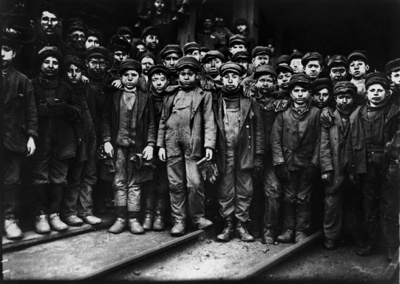
Young students can relate to this image since the age of these young boys is close to their own.  The title of the photo is “Breaker Boys”.   Lewis Hine used his photograph to change life for children all across the United States in 1910.   Breaker boys were employed in coal mines to separate the coal from slate.   Hine travelled the country taking images of child laborers.   Soonafter, a law was passed outlawing child labor.


The next image is the most famous of the four I’m featuring here.   Who hasn’t seen this haunting image of Florence Owens Thompson taken by Dorethea Lange in Oklahoma during the Great Depression in 1936?  It's called "Migrant Mother."


Photography is a powerful way to study history. Images of the past are signs of the particular times we are viewing. We can see how things looked, how people dressed, and how they wished to portray their present for future generations to see.


Historical images are great hooks to draw students in, and what better way to draw them in further than by teaching photography methods that seem to have gone by the wayside in many circles.


In today’s digital world anyone can snap an image and manipulate any way they wish and in doing so they can call themselves a photographer. Mr. Smith states, “I have a pro version of Photoshop CS4 now, and I can take a DSLR color photo and make and make it look like an old fine art black and white print from 60s. I can burn and dodge the photo just like Ansel Adams except it is digital and not like taking your hands to block out the light when the print is being exposed to the negative like Adams did.”


I have to agree.


Where is the knowledge….the craft, and does it suffer at the hands of technology?


Signs of the time, indeed.

Monday, May 02, 2011

Change in an Instant!

Without a question…..without a doubt history and time are inexplicably intertwined. You can’t have one without the other. During my 49 years riding around on this planet there have been events that serve as turning points in my life – meetings, births, marriages, deaths, reunions, actions that show strength and truthfulness and those that scream weakness and betrayal. Yes, we all have those moments in life….during our time here……embedded in each of our personal histories.

Collectively, historical events have their impact as well. We all have those, “Where were you?” moments such as JFK’s assassination, the Apollo Moon Landing, the Challenger Explosion, the Oklahoma Bombing, and of course…….the tragedy of September 11th, a date that needs no year to identify it because it was that terrible, that horrible, that defining in the psyche of each and every American who experienced it.

Last night was another one of those defining moments in our collective history. While it can be argued the death of Osama bin Laden is actually the closing act to the tragedy of September 11th it is yet another of those events which define our lives.

September 11th changed our lives in so many ways all in an instant just as last night changed it as well. Some of the changes are short term such as the elation, the relief, and the renewed anger as we remember what his policies and philosophy led others to do in the name of religion….of all things. Other changes will be long term. It would be interesting to be a fly on the wall fifty or even one hundred years from now to see how September 11th and the death of bin Laden is treated in history classrooms.

Will the whole series of events be taught in a entire instructional unit lasting several days? Then again, it might just become a mere mention before launching into an even more important event….though now we can’t even fathom that. The worse thing that could happen is if future historians and educators decide the whole thing was much ado about nothing.

I doubt that will happen since these events did occur during the age of technology and instant news, and not just news of the collective kind but personal news. We all have Facebook pages, blogs, pictures on line, the ability to interact with newspapers and other columns leaving our comments to express our thoughts and feelings.

Yes, within the last decade our lives have been changed in an instant. Last night’s news made of all of us recall those events of September 11th – where we were, what we were doing and how we came to be where we were last night.

Over the last few years I’ve re-posted my September 11th story because it’s that important personally for me to remember. I’m re-posting it again below, and I ask you to remember and reflect how you came to where you were at when you heard the news last night……

However, this time I will use the young’s man real first name because he finally got the chance to read my recollection of that tragic day not too long ago, and gave me permission to use it.

September 11, 2001 began like any other September school day; however, it was abnormally quiet since Tyler’s seat was uncharacteristically empty. He had not missed a day of school since we had started around the first of August.


Tyler was my assigned rambunctious, outspoken, almost uncontrollable young man for the year. There is always at least one. He was a handsome ten year old who adored baseball, adored going to church, and was very in touch with his feelings. While his brain usually moved ahead of his feet by about ten steps he never intentionally meant to interrupt me for the five thousandth time in one class period, never meant to cause me frustration, and he never meant to get on my nerves. Tyler simply had no clue that a one-to-one ongoing conversation between a teacher and himself was not the proper procedure in a classroom with 24 other students.


He blurted out constantly attempting to finish my sentences, anticipate my questions, and interrupted his classmates every time the notion slapped him in the head. He also had a problem many young men do…..he couldn’t sit still. His parents had long since solved the energy problem by making sure Tyler was signed up for every sport that came along. Unfortunately we don’t run bases in my classroom.


After the second week of getting used to Tyler’s energy level he and I conferenced and we worked out a management plan for mysanity. He and I developed hand signals so that he would know when I had had my limit of interruptions. He honestly didn’t realize what he was doing. Sometimes kids have to be taught social limits regarding space and conversation limits. We worked out a plan where Tyler could stand at his seat every so often to ease any discomfort as he sat. I arranged for his seat to be towards the back of the group so he wouldn’t interfere with another student. Tyler seemed grateful for the strategies as he commented, “Gee, maybe this will work. Lord knows you were ready to strangle me yesterday.”


Tyler was right. So on that September morning his seat screamed at me in the quiet as the class proceeded through their morning work.


We were about to transition into Social Studies when Tyler suddenly burst through the door out of breath speaking as fast and as loud as he possibly could. “Oh my gosh, Mrs. Cooper, a plane crashed in New York City and the whole place is on fire.”


It was very confusing to say the least. I mean where had he suddenly come from? The classroom had gone from very orderly and quiet to some town crier bursting through the door screaming New York City was on fire. My mind was attempting to process all of this. Where had Tyler been? Why was he just now coming to me? What had he been doing? What is this about a plane?


Huh?

I grabbed Tyler by the shoulders. “Darlin’, what are you talking about?”


Tyler was still trying to speak between deep breaths. “I don’t…..know. The man…..said a plane……had crashed…….in New York.”


“What man?” I quizzed.


“The man…..on the radio,” Tyler gulped.


The room was totally disrupted by now with students watching my question and answer session with Tyler their heads bobbing back and forth like they were watching a tennis match.


“Back up, Tyler,” I lobbed, “Where have you been?”


Tyler fired back, “The dentist. By the way, Dr. C. says hello.” Dr. C. is a local dentist and I had taught his son a couple of years before. He was always sending my students back to school with a “Hey, how ya’ doing?” message.

I countered impatiently with, “Yes, yes, hey to Dr. C.” I waved my hand to the air. “Tyler, tell me what’s going on?”


I was getting exasperated. The rhythm of my class had been disrupted, precious instructional minutes were being lost, and I still didn’t know what was going on.


Finally, Tyler served up, “On the way over here from Dr. C’s office the guy on the radio said the World Tower or something has been hit by a plane.”


“The World Trade Center, is that what you mean?” I struck back.


“Yeah, I think so.”


I walked over to the television, hit the on button and switched the channel to CNN……the only twenty-four hour news channel our school could get at the time. The image hit me like a ton of bricks.


“Oh my gosh, Tyler. You’re right.” I said as I backed up from the screen. The room got very still and we listened to the announcer. It was still early enough that both towers were still standing. The announcer was still getting information in his earpiece so he could explain what was going on.


I offhandedly began telling students that many years before a small plane had hit the Empire State Building and the same thing had probably happened again. I told them that, but I wasn’t so sure.


I stepped into the hallway and got the attention of my teaching partner. I lovely woman who was still trying to figure this Southern gal out considering she grew up in New York. Her eyes immediately filled up with tears as she pulled her door behind her and mouthed the words, “Those bastards!” to me.


“What do you mean?” I asked.


“I guarantee you this is the same group who tried to take the towers down before.” We exchanged a few more words before she stepped back in her room to turn on her television as Tyler came to my classroom door.


“Mrs. Cooper,” he said. “The tower just fell.”

“Don’t be silly,” I told him as I reentered my room. A few of the girls had heard me and were agreeing with Tyler.


I looked at the screen and there was nothing there but one tower and smoke. It simply did not register with me the building were gone. The announcer was speaking about planes, large planes had done this. My mind screamed. Jetliners, how could two jetliners hit the towers on the same day?


Another student asked, “Mrs. Cooper, what’s the pentagram?”


A bossy little girl shot back at him, “Pentagon, pentagon.”


I didn’t take my eyes from the television as I said, “Ummm, it’s a building in Washington D.C. where all the branches of the armed forces have their offices including the Secretary of Defense. Why?”


“The guy on television said a plane crashed into it. It’s on fire too.”


I closed my eyes. I could not deny something was going on. We had to be under attack, but from who? I wanted to curl up into a ball and cry. I wanted to get my purse and go get my kids. I wanted my husband. I wanted my mother and father. I couldn’t. I was the teacher. I was the adult in charge. I couldn’t let them see me upset. I had to turn off the television and get on with our day.

I walked over to the set at the same time my vice principal came into my room. She smiled and motioned to the television and said, “Turn it off.”


“I know,” I said. “I was about to.” We both knew this wasn’t the same thing as our first walk on the Moon or MLK’s funeral. Our students didn’t need to see anymore unfolding events. Luckily they didn’t see any bodies falling from the sky and they had not yet begun to show footage of the plane flying into the tower and the resulting explosion. It was bad enough they witnessed the fall of the building.


Some of the children, being children, went right back to what they were doing. Tyler walked over to me and said, “Mrs. Cooper, we need to pray for those people. There are people who died this morning. It’s so sad.”


“Yes, Tyler. It’s so sad. Tyler, you know I can’t ask you to pray.”


“I know, but I don’t think you’ll stop me. Will you?”


“No, I won’t. Do what you need to do.”


Tyler walked around the room to every student saying, “C’mon guys. We need to pray for those people. Let’s hold hands and get in a circle.”


Every boy and girl stood up, formed a circle and grabbed each other’s hands. No one argued about holding a girls hand or a boy’s hand. Boys didn’t balk at holding each other’s hands. They just did it. Once they were all were in place each one turned and looked my way as if to say, “C’mon!” I was sitting alone at a student’s desk confused and needing information so terribly. At this point all I knew was someone had an undetermined number of American planes, some were missing, some had crashed horribly, and my husband who works in the air freight industry had his office very near the Atlanta airport.


As the kids looked at me two students broke ranks and opened up a place for me. They just stood there looking at me. I just sat there looking at them. Finally, I got up and joined them in their prayer circle. I looked across the circle to Tyler and nodded at him. He began his very heartfelt, innocent prayer for the people in the buildings, the people in the planes, the people on the ground, our president and other government leaders and as he ended each child went around the circle and said something squeezing the next person’s hand as they were through. Finally, the prayers ended up at Tyler again and he finalized the prayer.


I don’t remember what we did that day. I don’t remember what I taught, or if I taught. An hour later the exodus started. Child after child was called for check-out until I only had three or four left.


Finally, the last student was on a bus and I was on my way home. Hubby had contacted me earlier in the afternoon to tell me he was ok and had gone to get both our kids. They were all at home waiting for me.


The ride home was so eerie. The message boards over the normally backed-up Atlanta interstates flashed the words NATIONAL EMERGENCY. The most surreal thing was there was no traffic on the streets or in the sky. The skies around Atlanta’s busy airport are always filled with planes. You can always look up and find at least one in any direction you gaze. Not that afternoon. It was so quiet. It was four p.m. before I really knew what had happened and saw the same footage that everyone else had seen over and over all afternoon.


I learned many things that day. I learned that my country was as vulnerable as any other. I learned that your life can change direction in one single instant. I learned that citizens can put politics aside and come together in one voice when they realize they have a common enemy. I learned the frantic fear of wondering where your family is and realized we would need an emergency game plan. I learned that people hate me just because I was born an American.


The most important thing I learned, however, was from a ten year old young man and his fellow classmates who did what they felt in their hearts and lived up to their convictions no matter the consequence.

Thursday, April 28, 2011

What's Your Royal Title?

Well, the Royal Wedding is almost upon us. Many of us wish we could be on the guest list to have one of the treasured seats in the congregation, but unfortunately, we don’t have the right kind of name – one containing a royal title.

Since it is the time for all the wedding hoopla to take place I decided to have some fun with my Facebook status by posting the following – “What is the name of your Royal Wedding Guest name? Start with Lord or Lady…Your first name is the first name of your grandparents….Surname is the name of your first pet….The name of the street you grew up on with “of”.”

Who knew I had such important friends? They came up with names like Lord Everett Pretzel of Viceroy, Lady Lilby Piper of Preakness, Lord Wilbur Smokey of Welcome Hill, Lady Elizabeth Pepe of Pullen, Lady Annie Bucky of Chapel Hill, Lady Sarah Tinkerbell of Valencia and last but not least Lord Charlie Hotdog of Windridge.

The made up names are rather comical, aren’t they?

However, real royal titles can be a little strange also and some are downright funny.

Take King Niall of the Nine Hostages, for example. You don’t know about him? He’s the one who kidnapped Saint Patrick.

Sir William Douglas the Hardy at Scone also known as Black Douglas fought alongside William Wallace.

The Marquess of Bute was create in 1796 and the title is still in use today by a British racecar driver. Dumfries House serves as their family seat.

Then , of course, we have the more familiar Earl of Sandwich. While he didn’t invent the sandwich the food is attributed to him. Seems he liked the gaming tables so much he would have servants bring him some meat between two slices of bread to eat. Hmmmm…..I wonder if he hung out with the Earl of Mayo or the Earl of Munster.

….and what about Baron Strange? Hmmm…..that’s just strange.

The Earl of Inchcape is a title that was created in 1929 for a shipping magnate, and one of the Earls of Jellico commanded the Grand Fleet at the Battle of Jutland.

Earl Nugent brings to mind Wango Tango Cat Scratchin' Ted.... and The Earl of Rocksavage sounds like a wrestler with the WWF, but it’s actually the courtesy title for the heir of the Marchess of Cholmondeley which is pronounced “Chumley”. Doesn’t that name make you think of Chumlee from the History Channel’s Pawn Stars.

What about the Earl of Camperdown as in “Did you take the camper down after our NASCAR weekend at Rockingham?”

The Duke of Atholl makes me think of “The Focker’s” series of movies for some reason.

Thankfully the title Earl of Wigtown was surrendered in 1372 because……well, seriously…..Wigtown????

And finally…..the Earl of Lovelace….when I mentioned this title to my husband he asked, “Is he kin to ‘Duke’ Throat?”

After this I doubt I will ever be invited to any royal parties.

Oh well…..

Many congrats to the Happy Couple!

Sunday, April 03, 2011

An Interview With ElementaryHistoryTeacher

Occasionally a former student or a young friend will contact me and want to interview me about my writing. Recently a young friend had an assignment to complete and during the process of answering his questions I decided I would share the answers here.


1. What stirred your ambition to be a writer, specifically non-fiction?

I always enjoyed writing essays, research reports, and term papers in school. I know that is very unusual, but the truth is the truth. I don’t write non-fiction the way most folks do. I have to infuse something of myself – my thoughts, my feelings, my emotions – into the piece. Many of my postings and articles contain bits and pieces from my personal life or real situations that have happened in the classroom. Relating a bunch of facts to people can be boring. Using facts and making a parallel to something personal seems to draw others in because the process enables them to open their own doors and make connections to the content.

I was fortunate to have a wonderful teacher by the name of Cleo Hudson at Woodward Academy in College Park, Georgia. While in her class I wrote all sorts of things including fiction. I still have all of my assignments and have looked at them from time to time. Let’s just say I have a formula that is comfortable for me now, and I’m smart enough to stick to it. Fiction is so foreign to me it would be like a right handed person trying to hold a fork with their left hand. Mrs. Hudson was very encouraging, however, and one piece of advice she gave me holds true now……write what you know.

2. Even though you write non-fiction, have you ever written fiction?

I wrote a terrible story of fiction in high school about a very wealthy family. The plot involved a drug overdose, and Mrs. Hudson had me conduct all sorts of research regarding drug interactions. I had to learn how to write exchanges during conversations in such a way the reader could keep up. Mrs. Hudson’s lessons have paid off sometimes at History Is Elementary when I have included a conversation between students and myself.

3. Have you ever sent any work to a publisher? If so, whom?

I sent a couple of short stories to a few magazines. It was required in the class I was taking, and I received the expected rejection notices. I still have them somewhere in a scrapbook.

I’m currently 75 percent complete with a book titled, 1620 Days: My Walk through an American Classroom regarding the nine years I taught fourth and fifth grades. Each chapter parallels a historical focus along with some sort of situation in my classroom. The book also hits on educational reform issues. The content is very similar to my postings at History Is Elementary.

I plan to publish the book myself first unless a publisher knocks on my door. Do you know one? :)

4. Even if you haven't sent anything to a publisher, surely someone has reviewed your work? How do you handle negative criticism?


My work is reviewed all the time online by readers who post comments. My post Oh, I love to Tell the Story is a good example regarding reader comments.

Recently my Patch column received a negative comment. Someone accused me of whitewashing history. Here is the link….you can see how I handed it.

I agonize most over historical accuracy. Do I have my facts straight? Are they clear to the reader? I have to have my facts straight or someone will let me know. When I’m wrong I admit it. I try to thank everyone for their comments, but there are many history bullies out there who like to throw their knowledge around and post a comment just to see their own writing online. Still, I love the blog process because you can have a conversation with so many people across the country and the world. As a teacher it helped me to see my issues in the classroom were the similar to other teachers.

5. How has being a writer affected aspects of your life, particularly social, spiritual, and familial?

Apparently when I’m in top form I can put a word or two together. I praise God for that gift, and I try to improve upon it when I can.

I find that people are usually interested to discover I’m a writer/educator even if history is not their thing. It’s a great conversation starter.

I believe my family is used to seeing stacks of research materials and things to do around my chair. They realize it is just something Mom has to do, and they like the fact that every now and then I include them in a particular piece, but only in a positive way.

6. Are you a writer who sets personal deadlines, or is your work "done when it's done?"

I’m terrible at deadlines. I let other things get in my way, and I don’t consistently work at it like a job. I know what I should be doing, but I don’t do it. My book should be finished, but it’s been a challenging year for my personal life. I’m paid to write my column for the Douglasville Patch page. So far, I’ve met every deadline, but I agonize over every submission.

I enjoy writing for my blogs because I’m in control. I can publish when I wish. I can write what I want when I want. I feel I have more creativity because I write when something moves me to write and update the site.

7. Is there anything that helps you concentrate on your work and get past writer's block (I.E. music, some idiosyncrasy, etc.)?

Since I stick mainly to history topics I do find that if I stay immersed in history publications online and off I stay motivated. Sometimes when I don’t like the way a piece is going I step away from it for a bit. I rest and read it with fresh eyes. Amazingly, I can see a conversation thread on Facebook or a friend’s link to something and that will inspire me in some way. My most recent piece at the history blog titled A Message to Garcia started with a friend’s posting on Facebook.

8. Who are you biggest inspirations and literary influences?

Mark Twain is a favorite and the historian, Shelby Foote. Winston Groom is a favorite. My best loved local writer is Ferrol Sams. I used to read his book Christmas Gift! aloud to my fifth graders. It’s a wonderful look at life in Georgia during the Depression…..and you can’t be an Atlanta gal without appreciating the work of Ludlow Porch, Lewis Grizzard, and Celestine Sibley.

9. Not every writer has a big break like J.K. Rowling or Christopher Paolini, and every writer at some point cannot make a living simply off writing alone. How do you compensate for this?

I take freelance assignments when I can. This summer I wrote a lesson plan for this website, and I am having such fun learning all about Douglasville history with my Patch column, Every Now and Then. I have a few advertisements on my blogs, but I’m far from supporting myself. I have a great family that lets me take a seat at the table, and my husband owns his own business. I admire anyone who can manage to make writing their sole income source.

10. I know from personal experience that every writer wants to give up at some point. What keeps you going?

Rabid determination is the only way I know how to describe it. I have had all sorts of challenges since I started History Is Elementary and Georgia on My Mind.

My mother passed away after a very lengthy illness, I had two major surgeries five months apart, a long recovery, and other issues that have challenged my love of writing. I think I keep going because I denied it for so long. It wasn’t until 2006 that I picked up my pen and started writing seriously. I simply feel the need to do it, and as an educator I feel I can reach a much broader audience online.