Monday, May 30, 2011

Memorial Day and My 800th Post....

I find it appropriate that this post is my 800th posting for History Is Elementary.

Memorial Day is one of my favorite holidays, so it makes sense I’m writing about it again for post number 800. I knew the milestone post was coming up. I had thought about what I would write. I had even asked friends on Facebook what I should write about, and they came up with several interesting ideas. Then I realized Memorial Day was rapidly approaching…..and I couldn’t go without saying something.

What does Memorial Day mean to you? Cookouts, picnics, trips to the beach, perhaps a sale at the mall, time off from work, a cold beer or two, the Indianapolis 500, a slab of ribs on the grill……

Don’t get me wrong. I don’t have a problem with any of those things, but I wouldn’t be the ElementaryHistoryTeacher that I am if I didn’t point out what the original intent behind Memorial Day is.


Yes! These sweet young ladies, two of which I have the pleasure of knowing, have the right idea. Hannah and Claire are the daughters of a couple who are great friends of mine.  Paula and Scott felt it was important to teach their daughters the true meaning and intent of Memorial Day. Their family along with several other people decorated the graves at Marietta National Cemetery where there will be a ceremony today at noon.


I applaud them heartily!

Yes, Memorial Day is the official day to recognize men and women who have died while serving our country in the military.

Originally, Memorial Day morphed from a day that became popular soon after the end of the Civil War that was known as Decoration Day. Not only was it a day of remembrance, but it also served as a day for reconciliation as the North and South tried to heal.

The war dead was remembered by decorating their graves with flowers. On the very first Decoration Day, General James Garfield, future President of the United States, made a speech at Arlington National Cemetery where 5,000 people had gathered to decorate more than 20,000 Union and Confederate graves.

As there are with most things there are a few cities and/or groups who vie for the credit regarding who began the custom of decorating the graves of soldiers…..in the end it only matters that it’s done, right?

Over the years Decoration Day began to include soldiers from other wars and officially the day become Memorial Day when President Lyndon B. Johnson declared the last Monday in May as an official holiday in 1966.

Here are a few more pictures depicting Decoration Day events.


And of course looking back on other Memorial Day postings here at History Is Elementary…..This post is from 2009 and discusses heroes and this post is from 2008 when I was fortunate enough to spend Memorial Day at Arlington National Cemetery.


Whatever you do today......take a few minutes to remember those brave men and women who answered the call gave their lives in the cause of freedom.

Saturday, May 07, 2011

Signs of the Times

I found out this morning in a roundabout way the high school I graduated from will be hiring an art teacher for grades 4, 5, and 6 for the fall. The teacher will be employed full-time and will teach darkroom photography and printmaking to elementary classes.
Yes, you read that right.


Students in upper elementary grades will be learning darkroom photography and printmaking.


First of all, I don’t have to tell you the economic climate of the United States over the last couple of years hasn’t exactly been agreeable to many in the teaching profession. Education has experienced delays with contracts, budge cutbacks, and programs have been pared down or cut out all together. Teachers have been required to take furlough days and in many instances positions have been deleted totally.


Art and music have been hit especially hard in public school systems. Unfortunately, they always seem to be the first programs to go when there are money issues.


I doubt there are very few public schools today teaching darkroom photography and printmaking to any class let alone a class of young children, and of course, one of the main reasons Woodward Academy can afford this “extra” for students is Woodward is one of the top private schools in the Atlanta area.


Still….


What a terrific opportunity to teach what may be a dying art. Bob Smith, a local photographer in my neck of the woods states, “This is interesting …I guess it’s great to expose them to the way [photography] used to be done, but in ten years, they may have to buy the chemicals themselves to do the developing. I wonder what types of film will still be sold in ten years. You have to go to professional photography shops……just to buy old 120 film that went in every camera since World War II…and they have to wait on the manufacturer to produce the next allotment.”


Think about the implications for teaching history by having a darkroom photography and printmaking class. Even our youngest students are familiar with digital cameras. Many are very savvy with the Internet, camera phones and Photoshop. They know modern photography, but by teaching older methods students can learn about the methods of Mathew Brady whose Civil War images still get history students involved directly in the war.


Students can view this image….a street scene by Nicephore Niepce, one of the earliest photographic images from 1826. The method used for this print is called Heliogrgraphy, which means ‘sun writing’. The process took eight hours of exposure time…..notice the light is on BOTH sides of the street.


This image is an iconic one showing the damage from the San Francisco Earthquake in April, 1906 by Arnold Genthe. 

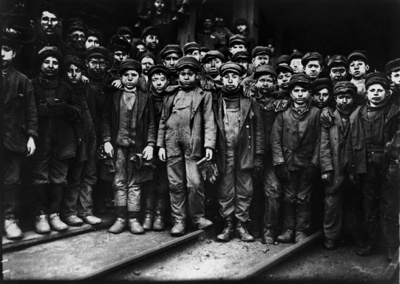
Young students can relate to this image since the age of these young boys is close to their own.  The title of the photo is “Breaker Boys”.   Lewis Hine used his photograph to change life for children all across the United States in 1910.   Breaker boys were employed in coal mines to separate the coal from slate.   Hine travelled the country taking images of child laborers.   Soonafter, a law was passed outlawing child labor.


The next image is the most famous of the four I’m featuring here.   Who hasn’t seen this haunting image of Florence Owens Thompson taken by Dorethea Lange in Oklahoma during the Great Depression in 1936?  It's called "Migrant Mother."


Photography is a powerful way to study history. Images of the past are signs of the particular times we are viewing. We can see how things looked, how people dressed, and how they wished to portray their present for future generations to see.


Historical images are great hooks to draw students in, and what better way to draw them in further than by teaching photography methods that seem to have gone by the wayside in many circles.


In today’s digital world anyone can snap an image and manipulate any way they wish and in doing so they can call themselves a photographer. Mr. Smith states, “I have a pro version of Photoshop CS4 now, and I can take a DSLR color photo and make and make it look like an old fine art black and white print from 60s. I can burn and dodge the photo just like Ansel Adams except it is digital and not like taking your hands to block out the light when the print is being exposed to the negative like Adams did.”


I have to agree.


Where is the knowledge….the craft, and does it suffer at the hands of technology?


Signs of the time, indeed.

Monday, May 02, 2011

Change in an Instant!

Without a question…..without a doubt history and time are inexplicably intertwined. You can’t have one without the other. During my 49 years riding around on this planet there have been events that serve as turning points in my life – meetings, births, marriages, deaths, reunions, actions that show strength and truthfulness and those that scream weakness and betrayal. Yes, we all have those moments in life….during our time here……embedded in each of our personal histories.

Collectively, historical events have their impact as well. We all have those, “Where were you?” moments such as JFK’s assassination, the Apollo Moon Landing, the Challenger Explosion, the Oklahoma Bombing, and of course…….the tragedy of September 11th, a date that needs no year to identify it because it was that terrible, that horrible, that defining in the psyche of each and every American who experienced it.

Last night was another one of those defining moments in our collective history. While it can be argued the death of Osama bin Laden is actually the closing act to the tragedy of September 11th it is yet another of those events which define our lives.

September 11th changed our lives in so many ways all in an instant just as last night changed it as well. Some of the changes are short term such as the elation, the relief, and the renewed anger as we remember what his policies and philosophy led others to do in the name of religion….of all things. Other changes will be long term. It would be interesting to be a fly on the wall fifty or even one hundred years from now to see how September 11th and the death of bin Laden is treated in history classrooms.

Will the whole series of events be taught in a entire instructional unit lasting several days? Then again, it might just become a mere mention before launching into an even more important event….though now we can’t even fathom that. The worse thing that could happen is if future historians and educators decide the whole thing was much ado about nothing.

I doubt that will happen since these events did occur during the age of technology and instant news, and not just news of the collective kind but personal news. We all have Facebook pages, blogs, pictures on line, the ability to interact with newspapers and other columns leaving our comments to express our thoughts and feelings.

Yes, within the last decade our lives have been changed in an instant. Last night’s news made of all of us recall those events of September 11th – where we were, what we were doing and how we came to be where we were last night.

Over the last few years I’ve re-posted my September 11th story because it’s that important personally for me to remember. I’m re-posting it again below, and I ask you to remember and reflect how you came to where you were at when you heard the news last night……

However, this time I will use the young’s man real first name because he finally got the chance to read my recollection of that tragic day not too long ago, and gave me permission to use it.

September 11, 2001 began like any other September school day; however, it was abnormally quiet since Tyler’s seat was uncharacteristically empty. He had not missed a day of school since we had started around the first of August.


Tyler was my assigned rambunctious, outspoken, almost uncontrollable young man for the year. There is always at least one. He was a handsome ten year old who adored baseball, adored going to church, and was very in touch with his feelings. While his brain usually moved ahead of his feet by about ten steps he never intentionally meant to interrupt me for the five thousandth time in one class period, never meant to cause me frustration, and he never meant to get on my nerves. Tyler simply had no clue that a one-to-one ongoing conversation between a teacher and himself was not the proper procedure in a classroom with 24 other students.


He blurted out constantly attempting to finish my sentences, anticipate my questions, and interrupted his classmates every time the notion slapped him in the head. He also had a problem many young men do…..he couldn’t sit still. His parents had long since solved the energy problem by making sure Tyler was signed up for every sport that came along. Unfortunately we don’t run bases in my classroom.


After the second week of getting used to Tyler’s energy level he and I conferenced and we worked out a management plan for mysanity. He and I developed hand signals so that he would know when I had had my limit of interruptions. He honestly didn’t realize what he was doing. Sometimes kids have to be taught social limits regarding space and conversation limits. We worked out a plan where Tyler could stand at his seat every so often to ease any discomfort as he sat. I arranged for his seat to be towards the back of the group so he wouldn’t interfere with another student. Tyler seemed grateful for the strategies as he commented, “Gee, maybe this will work. Lord knows you were ready to strangle me yesterday.”


Tyler was right. So on that September morning his seat screamed at me in the quiet as the class proceeded through their morning work.


We were about to transition into Social Studies when Tyler suddenly burst through the door out of breath speaking as fast and as loud as he possibly could. “Oh my gosh, Mrs. Cooper, a plane crashed in New York City and the whole place is on fire.”


It was very confusing to say the least. I mean where had he suddenly come from? The classroom had gone from very orderly and quiet to some town crier bursting through the door screaming New York City was on fire. My mind was attempting to process all of this. Where had Tyler been? Why was he just now coming to me? What had he been doing? What is this about a plane?


Huh?

I grabbed Tyler by the shoulders. “Darlin’, what are you talking about?”


Tyler was still trying to speak between deep breaths. “I don’t…..know. The man…..said a plane……had crashed…….in New York.”


“What man?” I quizzed.


“The man…..on the radio,” Tyler gulped.


The room was totally disrupted by now with students watching my question and answer session with Tyler their heads bobbing back and forth like they were watching a tennis match.


“Back up, Tyler,” I lobbed, “Where have you been?”


Tyler fired back, “The dentist. By the way, Dr. C. says hello.” Dr. C. is a local dentist and I had taught his son a couple of years before. He was always sending my students back to school with a “Hey, how ya’ doing?” message.

I countered impatiently with, “Yes, yes, hey to Dr. C.” I waved my hand to the air. “Tyler, tell me what’s going on?”


I was getting exasperated. The rhythm of my class had been disrupted, precious instructional minutes were being lost, and I still didn’t know what was going on.


Finally, Tyler served up, “On the way over here from Dr. C’s office the guy on the radio said the World Tower or something has been hit by a plane.”


“The World Trade Center, is that what you mean?” I struck back.


“Yeah, I think so.”


I walked over to the television, hit the on button and switched the channel to CNN……the only twenty-four hour news channel our school could get at the time. The image hit me like a ton of bricks.


“Oh my gosh, Tyler. You’re right.” I said as I backed up from the screen. The room got very still and we listened to the announcer. It was still early enough that both towers were still standing. The announcer was still getting information in his earpiece so he could explain what was going on.


I offhandedly began telling students that many years before a small plane had hit the Empire State Building and the same thing had probably happened again. I told them that, but I wasn’t so sure.


I stepped into the hallway and got the attention of my teaching partner. I lovely woman who was still trying to figure this Southern gal out considering she grew up in New York. Her eyes immediately filled up with tears as she pulled her door behind her and mouthed the words, “Those bastards!” to me.


“What do you mean?” I asked.


“I guarantee you this is the same group who tried to take the towers down before.” We exchanged a few more words before she stepped back in her room to turn on her television as Tyler came to my classroom door.


“Mrs. Cooper,” he said. “The tower just fell.”

“Don’t be silly,” I told him as I reentered my room. A few of the girls had heard me and were agreeing with Tyler.


I looked at the screen and there was nothing there but one tower and smoke. It simply did not register with me the building were gone. The announcer was speaking about planes, large planes had done this. My mind screamed. Jetliners, how could two jetliners hit the towers on the same day?


Another student asked, “Mrs. Cooper, what’s the pentagram?”


A bossy little girl shot back at him, “Pentagon, pentagon.”


I didn’t take my eyes from the television as I said, “Ummm, it’s a building in Washington D.C. where all the branches of the armed forces have their offices including the Secretary of Defense. Why?”


“The guy on television said a plane crashed into it. It’s on fire too.”


I closed my eyes. I could not deny something was going on. We had to be under attack, but from who? I wanted to curl up into a ball and cry. I wanted to get my purse and go get my kids. I wanted my husband. I wanted my mother and father. I couldn’t. I was the teacher. I was the adult in charge. I couldn’t let them see me upset. I had to turn off the television and get on with our day.

I walked over to the set at the same time my vice principal came into my room. She smiled and motioned to the television and said, “Turn it off.”


“I know,” I said. “I was about to.” We both knew this wasn’t the same thing as our first walk on the Moon or MLK’s funeral. Our students didn’t need to see anymore unfolding events. Luckily they didn’t see any bodies falling from the sky and they had not yet begun to show footage of the plane flying into the tower and the resulting explosion. It was bad enough they witnessed the fall of the building.


Some of the children, being children, went right back to what they were doing. Tyler walked over to me and said, “Mrs. Cooper, we need to pray for those people. There are people who died this morning. It’s so sad.”


“Yes, Tyler. It’s so sad. Tyler, you know I can’t ask you to pray.”


“I know, but I don’t think you’ll stop me. Will you?”


“No, I won’t. Do what you need to do.”


Tyler walked around the room to every student saying, “C’mon guys. We need to pray for those people. Let’s hold hands and get in a circle.”


Every boy and girl stood up, formed a circle and grabbed each other’s hands. No one argued about holding a girls hand or a boy’s hand. Boys didn’t balk at holding each other’s hands. They just did it. Once they were all were in place each one turned and looked my way as if to say, “C’mon!” I was sitting alone at a student’s desk confused and needing information so terribly. At this point all I knew was someone had an undetermined number of American planes, some were missing, some had crashed horribly, and my husband who works in the air freight industry had his office very near the Atlanta airport.


As the kids looked at me two students broke ranks and opened up a place for me. They just stood there looking at me. I just sat there looking at them. Finally, I got up and joined them in their prayer circle. I looked across the circle to Tyler and nodded at him. He began his very heartfelt, innocent prayer for the people in the buildings, the people in the planes, the people on the ground, our president and other government leaders and as he ended each child went around the circle and said something squeezing the next person’s hand as they were through. Finally, the prayers ended up at Tyler again and he finalized the prayer.


I don’t remember what we did that day. I don’t remember what I taught, or if I taught. An hour later the exodus started. Child after child was called for check-out until I only had three or four left.


Finally, the last student was on a bus and I was on my way home. Hubby had contacted me earlier in the afternoon to tell me he was ok and had gone to get both our kids. They were all at home waiting for me.


The ride home was so eerie. The message boards over the normally backed-up Atlanta interstates flashed the words NATIONAL EMERGENCY. The most surreal thing was there was no traffic on the streets or in the sky. The skies around Atlanta’s busy airport are always filled with planes. You can always look up and find at least one in any direction you gaze. Not that afternoon. It was so quiet. It was four p.m. before I really knew what had happened and saw the same footage that everyone else had seen over and over all afternoon.


I learned many things that day. I learned that my country was as vulnerable as any other. I learned that your life can change direction in one single instant. I learned that citizens can put politics aside and come together in one voice when they realize they have a common enemy. I learned the frantic fear of wondering where your family is and realized we would need an emergency game plan. I learned that people hate me just because I was born an American.


The most important thing I learned, however, was from a ten year old young man and his fellow classmates who did what they felt in their hearts and lived up to their convictions no matter the consequence.

Thursday, April 28, 2011

What's Your Royal Title?

Well, the Royal Wedding is almost upon us. Many of us wish we could be on the guest list to have one of the treasured seats in the congregation, but unfortunately, we don’t have the right kind of name – one containing a royal title.

Since it is the time for all the wedding hoopla to take place I decided to have some fun with my Facebook status by posting the following – “What is the name of your Royal Wedding Guest name? Start with Lord or Lady…Your first name is the first name of your grandparents….Surname is the name of your first pet….The name of the street you grew up on with “of”.”

Who knew I had such important friends? They came up with names like Lord Everett Pretzel of Viceroy, Lady Lilby Piper of Preakness, Lord Wilbur Smokey of Welcome Hill, Lady Elizabeth Pepe of Pullen, Lady Annie Bucky of Chapel Hill, Lady Sarah Tinkerbell of Valencia and last but not least Lord Charlie Hotdog of Windridge.

The made up names are rather comical, aren’t they?

However, real royal titles can be a little strange also and some are downright funny.

Take King Niall of the Nine Hostages, for example. You don’t know about him? He’s the one who kidnapped Saint Patrick.

Sir William Douglas the Hardy at Scone also known as Black Douglas fought alongside William Wallace.

The Marquess of Bute was create in 1796 and the title is still in use today by a British racecar driver. Dumfries House serves as their family seat.

Then , of course, we have the more familiar Earl of Sandwich. While he didn’t invent the sandwich the food is attributed to him. Seems he liked the gaming tables so much he would have servants bring him some meat between two slices of bread to eat. Hmmmm…..I wonder if he hung out with the Earl of Mayo or the Earl of Munster.

….and what about Baron Strange? Hmmm…..that’s just strange.

The Earl of Inchcape is a title that was created in 1929 for a shipping magnate, and one of the Earls of Jellico commanded the Grand Fleet at the Battle of Jutland.

Earl Nugent brings to mind Wango Tango Cat Scratchin' Ted.... and The Earl of Rocksavage sounds like a wrestler with the WWF, but it’s actually the courtesy title for the heir of the Marchess of Cholmondeley which is pronounced “Chumley”. Doesn’t that name make you think of Chumlee from the History Channel’s Pawn Stars.

What about the Earl of Camperdown as in “Did you take the camper down after our NASCAR weekend at Rockingham?”

The Duke of Atholl makes me think of “The Focker’s” series of movies for some reason.

Thankfully the title Earl of Wigtown was surrendered in 1372 because……well, seriously…..Wigtown????

And finally…..the Earl of Lovelace….when I mentioned this title to my husband he asked, “Is he kin to ‘Duke’ Throat?”

After this I doubt I will ever be invited to any royal parties.

Oh well…..

Many congrats to the Happy Couple!

Sunday, April 03, 2011

An Interview With ElementaryHistoryTeacher

Occasionally a former student or a young friend will contact me and want to interview me about my writing. Recently a young friend had an assignment to complete and during the process of answering his questions I decided I would share the answers here.


1. What stirred your ambition to be a writer, specifically non-fiction?

I always enjoyed writing essays, research reports, and term papers in school. I know that is very unusual, but the truth is the truth. I don’t write non-fiction the way most folks do. I have to infuse something of myself – my thoughts, my feelings, my emotions – into the piece. Many of my postings and articles contain bits and pieces from my personal life or real situations that have happened in the classroom. Relating a bunch of facts to people can be boring. Using facts and making a parallel to something personal seems to draw others in because the process enables them to open their own doors and make connections to the content.

I was fortunate to have a wonderful teacher by the name of Cleo Hudson at Woodward Academy in College Park, Georgia. While in her class I wrote all sorts of things including fiction. I still have all of my assignments and have looked at them from time to time. Let’s just say I have a formula that is comfortable for me now, and I’m smart enough to stick to it. Fiction is so foreign to me it would be like a right handed person trying to hold a fork with their left hand. Mrs. Hudson was very encouraging, however, and one piece of advice she gave me holds true now……write what you know.

2. Even though you write non-fiction, have you ever written fiction?

I wrote a terrible story of fiction in high school about a very wealthy family. The plot involved a drug overdose, and Mrs. Hudson had me conduct all sorts of research regarding drug interactions. I had to learn how to write exchanges during conversations in such a way the reader could keep up. Mrs. Hudson’s lessons have paid off sometimes at History Is Elementary when I have included a conversation between students and myself.

3. Have you ever sent any work to a publisher? If so, whom?

I sent a couple of short stories to a few magazines. It was required in the class I was taking, and I received the expected rejection notices. I still have them somewhere in a scrapbook.

I’m currently 75 percent complete with a book titled, 1620 Days: My Walk through an American Classroom regarding the nine years I taught fourth and fifth grades. Each chapter parallels a historical focus along with some sort of situation in my classroom. The book also hits on educational reform issues. The content is very similar to my postings at History Is Elementary.

I plan to publish the book myself first unless a publisher knocks on my door. Do you know one? :)

4. Even if you haven't sent anything to a publisher, surely someone has reviewed your work? How do you handle negative criticism?


My work is reviewed all the time online by readers who post comments. My post Oh, I love to Tell the Story is a good example regarding reader comments.

Recently my Patch column received a negative comment. Someone accused me of whitewashing history. Here is the link….you can see how I handed it.

I agonize most over historical accuracy. Do I have my facts straight? Are they clear to the reader? I have to have my facts straight or someone will let me know. When I’m wrong I admit it. I try to thank everyone for their comments, but there are many history bullies out there who like to throw their knowledge around and post a comment just to see their own writing online. Still, I love the blog process because you can have a conversation with so many people across the country and the world. As a teacher it helped me to see my issues in the classroom were the similar to other teachers.

5. How has being a writer affected aspects of your life, particularly social, spiritual, and familial?

Apparently when I’m in top form I can put a word or two together. I praise God for that gift, and I try to improve upon it when I can.

I find that people are usually interested to discover I’m a writer/educator even if history is not their thing. It’s a great conversation starter.

I believe my family is used to seeing stacks of research materials and things to do around my chair. They realize it is just something Mom has to do, and they like the fact that every now and then I include them in a particular piece, but only in a positive way.

6. Are you a writer who sets personal deadlines, or is your work "done when it's done?"

I’m terrible at deadlines. I let other things get in my way, and I don’t consistently work at it like a job. I know what I should be doing, but I don’t do it. My book should be finished, but it’s been a challenging year for my personal life. I’m paid to write my column for the Douglasville Patch page. So far, I’ve met every deadline, but I agonize over every submission.

I enjoy writing for my blogs because I’m in control. I can publish when I wish. I can write what I want when I want. I feel I have more creativity because I write when something moves me to write and update the site.

7. Is there anything that helps you concentrate on your work and get past writer's block (I.E. music, some idiosyncrasy, etc.)?

Since I stick mainly to history topics I do find that if I stay immersed in history publications online and off I stay motivated. Sometimes when I don’t like the way a piece is going I step away from it for a bit. I rest and read it with fresh eyes. Amazingly, I can see a conversation thread on Facebook or a friend’s link to something and that will inspire me in some way. My most recent piece at the history blog titled A Message to Garcia started with a friend’s posting on Facebook.

8. Who are you biggest inspirations and literary influences?

Mark Twain is a favorite and the historian, Shelby Foote. Winston Groom is a favorite. My best loved local writer is Ferrol Sams. I used to read his book Christmas Gift! aloud to my fifth graders. It’s a wonderful look at life in Georgia during the Depression…..and you can’t be an Atlanta gal without appreciating the work of Ludlow Porch, Lewis Grizzard, and Celestine Sibley.

9. Not every writer has a big break like J.K. Rowling or Christopher Paolini, and every writer at some point cannot make a living simply off writing alone. How do you compensate for this?

I take freelance assignments when I can. This summer I wrote a lesson plan for this website, and I am having such fun learning all about Douglasville history with my Patch column, Every Now and Then. I have a few advertisements on my blogs, but I’m far from supporting myself. I have a great family that lets me take a seat at the table, and my husband owns his own business. I admire anyone who can manage to make writing their sole income source.

10. I know from personal experience that every writer wants to give up at some point. What keeps you going?

Rabid determination is the only way I know how to describe it. I have had all sorts of challenges since I started History Is Elementary and Georgia on My Mind.

My mother passed away after a very lengthy illness, I had two major surgeries five months apart, a long recovery, and other issues that have challenged my love of writing. I think I keep going because I denied it for so long. It wasn’t until 2006 that I picked up my pen and started writing seriously. I simply feel the need to do it, and as an educator I feel I can reach a much broader audience online.

Wednesday, March 30, 2011

A Message to Garcia

You reader, put this matter to a test: You are sitting now in your office--six clerks are within call. Summon any one and make this request: "Please look in the encyclopedia and make a brief memorandum for me concerning the life of Correggio."

Will the clerk say, "Yes, sir," and go do the task? On your life he will not. He will look at you out of a fishy eye and ask one or more of the following questions:

Who was he?

Which encyclopedia?

Where is the encyclopedia?

I was hired for that?

Don't you mean Bismarck?

What's the matter with Charlie doing it?

Is he dead?

Is there any hurry?

Sha'n't I bring you the book and let you look it up yourself?

What do you want to know for?

And I will lay you ten to one that after you have answered the questions and explained how to find the information, and why you want it, the clerk will go off and get one of the other clerks to help him to try to find [Correggio]--and then come back and tell you there is no such man. Of course, I may lose my bet, but according to the Law of Average I will not. Now, if you are wise, you will not bother to explain to your "assistant" that Correggio is indexed under Cs, not in the Ks, but you will smile very sweetly and say, "Never mind," and go look it up yourself.

Hmmm…..Integrity. Resourcefulness. Independent action.

They might as well be words from a dead language in today’s world.

However, the test situation posed above was not put forth recently but was asked on February 22, 1899. Yes, one hundred and twelve years ago it seems we had problems with folks not being able to carry out a mission. Apparently moral stupidity was rampant, and folks were unwilling to cheerfully catch hold and lift.

This situation was posed by Elbert Hubbard in a pamphlet he wrote titled, “A Letter to Garcia” in reaction to an observation his young son had made at the dinner table regarding the outcome of the Spanish American War. His son had remarked that the success the United States had experienced could all be boiled down to one man…..Andrew S. Rowan.

Never heard of him? I’m not surprised since most folks don’t know many details regarding the Spanish American War past the fact the USS Maine exploded in Havana’s harbor and one Theodore Roosevelt went up San Juan Hill.

Prior to the war the Cubans had attempted more than once to gain their independence from Spain. In May, 1898, the leader of the Cuban rebels, Garcia Y’iniguez Calixto, was hiding out in the jungles of Cuba. Once the United States became involved President McKinley knew it was imperative he get some sort of message to Garcia and knew that information was key regarding a successful U.S. operation there.

When the President asked, “Who can deliver a message to Garcia?” his advisors were quick to indicate Andrew S. Rowan was his man. This is certainly one situation where a president was advised correctly.

Later in his account of his mission Rowan wrote, “The President was anxious for information. He realized that success meant that the soldiers of the republic must co-operate with the insurgent forces of Cuba. He understood that it was essential to know how many Spanish troops there were on the island, their quality and condition, their morale, the character of their officers, especially those of the high command; the state of the roads in all seasons; the sanitary situation in both the Spanish and insurgent armies and the country in general; how well both sides were armed and what the Cuban forces would need in order to harass the enemy while American battalions were being mobilized; the topography of the country and many other important facts.”

Rowan was advised by his commanding officer, “Means will be found to identify you in Jamaica, where there is a Cuban junta. The rest depends on you……..After that, providing the United States declares war on Spain, further instructions will be based on cables received from you. Otherwise everything will be silence. You must plan and act for yourself. The task is yours and yours only. You must get a message to Garcia. Your train leaves at midnight. Good-bye and good luck!”

That was it. Those are the only instructions Rowan received. He did the rest on his own. His full account regarding his time in Cuba gathering information and delivering that all important letter to Garcia can be found here....just scroll down a bit.

Getting back to Hubbard he sat down after his dinner and wrote out a four page pamphlet titled, A Letter to Garcia” that within days would go viral in 1899 terms. Once it was published business people got hold of it and passed it along. Extra copies were ordered at twenty-five cents each. “A dozen, fifty, a hundred, a thousand, and yes, a hundred thousand. Then in half million lots until finally it was translated into nearly every language…..At one time during the 1920s more copies of “A Message to Garcia” were in print than any other publication except the Bible.”

The question, “Who can send a message to Garcia?” become synonymous with being resourceful and having integrity to do one’s job without dissolving into a puddle of helplessness. Hubbard stated later, “The hero is the man who does his work – who carries the Message to Garcia.”

I think the most powerful portion of Hubbard’s pamphlet is this……

THE WORLD BESTOWS ITS BIG PRIZES, both in money and honors, for but one thing, and that is Initiative. What is Initiative? I'll tell you. It is doing the right thing without being told. But next to doing the thing without being told is to do it when you are told once. That is to say, carry the Message to Garcia: those who can carry a message get high honors, but their pay is not always in proportion. Next there are those who never do a thing until they are told twice: such get no honors and small pay. Next, there are those who do the right thing only when Necessity kicks them from behind, and these get indifference instead of honors, and a pittance for pay. This kind spends most of its time polishing a bench with a hard luck story. Then, still lower down in the scale than this, we have the fellow who will not do the right thing even when someone goes along to show him how and stays to see that he does it: he is always out of a job, and receives the contempt he deserves, unless he happens to have a rich Pa, in which case Destiny patiently awaits around the corner with a stuffed club.

To which class do you belong?

Thursday, March 10, 2011

Chain...Chain....Chain..Chain of Fools

I walk over to my laptop and make a quick “click”. The sounds of Aretha Franklin fill the classroom….

Chain, chain, chain, chain, chain, chian
Chain, chain, chain, chain of fools
Five long years I thought you were my man
But I found out I'm just a link in your chain....
 found out I’m just a link in your chain….

Go ahead – click on the video and listen. I’ll wait.


I’m certain you are thinking I’ve lost it. Why is ElementaryHistoryTeacher playing this particular song for nine and ten year olds as the opening salvo to a lesson regarding an aspect of the American Revolution?

Don’t click off just yet. I have a connection.

Teaching history isn’t all about reading a lesson in a book or having a teacher tell a fascinating story for kids to take notes from.

Teaching history is all about making connections and visualizing the links – links in a chain of events that ebb and flow through history to the present day. In this particular exercise where I play the Queen of Soul’s famous song for my students I’m trying to allow them to own and claim the content and build some links of their own to the content.

I want them to listen to the song. I might even play it two or three times.

Okay, I might even play it a fourth time just for me.

I pop the lyrics up on my classroom screen and we read through them together. Some of my more talented students actually sing through them having already picked up the melody.

I pick up with the lyrics where I left off above….. (Read through them very carefully)

You got mw where you want me
I ain't nothing but your fool
You treated me mean oh you treated me cruel
Chain, chain, chain, chain of fools
Every chain has a wink link
I might be a weak child, but I'll give you strength
You told me to leave you alone
My father said come on home
My doctor said take it easy
Whole bunch of lovin is much too strong
I'm added to your chain, chain, chain
Chain, chain, chain, chain
Chain, chain of fools
One of these mornings the chain is gonna break
But up until then, yeah I'm gonna take all I can take
Chain, chain, chain, chain of fools

Students are sitting in small groups, so I proceed to tell them to take another look at the lyrics and discuss how the situation between the British and the American colonies is similar to the lyrics of the song.

Seriously…….think about it. I’ll wait. They don’t tell you in teacher education school, but most of good teaching is knowing when to hush and let the student’s think.

So?????

What did YOU come up with?

My students don’t disappoint me. They make some great connections between the contemporary lyrics and the plight of the American colonists.

Students volunteer the following:

*The British government had the colonies where they wanted them. Taxing them, but not allowing them any representation in Parliament.
*The colonist felt they were being treated mean and cruel. Students cited situations like the Intolerable Acts as proof.
*The colonists were a chain of fools. They were being taken advantage of and needed to stand up for themselves.
*The weak links in the chain were Tories.
*Everyone has an opinion regarding what should be done…….the Sons of Liberty, Committees of Correspondence, newpapers, the members of the Continental Congress.
*The chain is finally broken with Lexington and Concord.

Yes, this lesson is a great way to review. It’s also a great way to bring up new content tying into the chain theme.

Let me throw a few names out to you…..Peter Townsend, Sterling Iron Works, Captain Thomas Machin, Colonel Timothy Pickering.

Do they ring a bell?

What about New York, West Point, the Hudson River? Those are more familiar, aren’t they?

They all have something to do with one another. Early on during the American Revolution the Patriots were concerned about the security of the Hudson River and the military outpost at West Point. To keep the British from advancing up the Hudson they installed a chain across the river from Constitution Island over to the west bank of the river. It wasn’t the only chain, but it is remembered as The Great Chain. It was an ideal place in the river since a heavy S-curve existed there. Ships had to slow down because of the curves and it was the perfect location for artillery to shoot at enemy ships.

Peter Townsend was the owner of Stirling Iron Works, the company hired to build the chain. The Stirling name hails from William Alexander, Lord Stirling – the one-time owner of the land where the ironworks was located and a Major General in the Continental Army. Captain Thomas Machin and Colonel Timothy Pickering oversaw the project.

The whole thing weighed around 65 tons and stretched out to 600 yards. Each link in the chain was two feet in length and weighed 114 pounds.

To compensate for the changing current and tide pulleys, rollers, ropes, and mid-stream anchors were used in tandem with the chain. The chain was supported by huge logs. To avoid damage by ice the chain was removed each winter during the war and replaced each spring.

One point of interest about the chain regards Benedict Arnold who informed the British it was possible to break the chain because he had actually weakened it. Arnold escaped to the British when he realized the Patriots knew he had been an informer.

The picture below shows 13 links of the chain that are on display at Trophy Point, West Point. Yes, 13 links for the 13 colonies.


History tells us the British fleet never attempted to break the chain.


You can find out more about the chain and Peter Townsend at this link.

This post from The New York Times dated February, 1895 provides more detail regarding how the chain was installed.

Monday, February 21, 2011

Scattering Seeds

I visited my father a couple of weekends ago and walked over some of his property. Today, most of it is heavily wooded, but in the early days when my great grandfather and grandfather farmed for a living most of the land was covered in cultivated fields of some sort. My father left the land in the 50s to join the Army and later settled in Atlanta to raise my sister and me. He said he was done with farming, but……..

The land lured him back, and I’ve never known him to not have a tractor of some sort even when we lived in the suburbs. Eventually, he began to return to the farm on the weekends and helped his father with a huge garden. My father is a huge proponent of child labor, so my sister and I were schooled in the ways of plowing a field, scattering seeds, and my favorite farming activity…..picking up rocks. My grandmother and mother taught my sister and me the other side of farming – food preservation. You know…….canning and freezing.

During the work week Daddy would visit the local feed and seed place to gather up supplies for our weekend of farming. During those days since I pretty much took every step that Daddy took, I would go along. The feed and seed store was an interesting place…….hay was scattered about on the floor, there were interesting smells, at Easter there were always colored chicks and bunnies for sale, and there were always those racks of seed packets with the colorful pictures. While Daddy would conduct his business I would stand in front of the seed rack flipping through the packets looking at all of the colorful flowers and various vegetables that could be grown in our area. Occasionally, Daddy would allow me to purchase a packet or two of the precious seed……petunias or zinnias to plant in a bed along the side of our front porch.

So, I’ve been thinking which usually leads me to do a little investigating and I’ve come up with some interesting points that could infuse any course of study regarding the 1800s along the lines of agriculture, inventions, women’s rights and North-South relations during Civil War. The most important thing I discovered is it seems we have the Shakers to thank for those little seed packets.

Yes, that’s right. Those folks that followed the Shaker religion are more formally known as The United Society of Believers in Christ’s Second Appearing. They rejected sex and believed in social equality. In fact, instead of using the Seneca Falls Convention of 1848 and the work of Susan B. Anthony and Lucretia Mott as the starting point for women’s rights in the United States it would be more correct to examine Ann Lee who led the Shakers and came to the colonies as early as 1747. She is the prime reason the Shakers practiced equality.

Most people today equate the Shakers with their music and furniture. The furniture was plain and functional, and today it is highly sought by collectors. Their songs and dances were very important to Shaker worship services and are very unique. In fact, their frenzied movements during worship earned the sect the Shaker name.

The Shakers had an excellent work ethic and were fond of saying, “Do your work as though you had a thousand years to live and as if you were to die tomorrow.”

The Shakers invented many items, but are rarely given credit since they did not patent their inventions. The rotary harrow, circular saw, clothes pin, the wheel driven washing machine and flat broom can all be traced back to Shaker communities.

In 1802 Brother Jefferson White founded the seed business at the Enfield Shaker Community.

As early as 1816 they were the first ones to place seeds in packets. Before the seeds were placed in packets they sold them via wooden boxes which can still be found today in antique stores.


They were sold to stores and individual farmers via Shaker Seed Wagons. Most farmers wanted to purchase the seeds because the Shaker Seed Company had a great reputation for great business ethics and quality seeds and herbs. Plus….there was over 100 varieties.

The Hancock Shaker Community had at one time over 10 acres devoted to the cultivation of seeds and herbs. Eventually the business grew and the Shakers had to contract local farmers to grow seeds under the Shaker label.

Another curriculum area where the Shaker Seed Company can be discussed is the Civil War. The company was Northern business concern…..one that had a large customer base in the South. Once the Civil War began the seed business began to decline since most of the customers were in hostile territory and the product could no longer be delivered to customers. The seed company never could recover from significant southern debts. By the 1870s the Shaker Seed Company had been discontinued.

PBS has an excellent site for Ken Burn's Shaker series here.

Wednesday, February 02, 2011

Remembering Old Weather

I can remember how the painted wooden planks of our front porch felt on my bare feet during the hot and lazy days of July. I can remember the smell of the dirt in Pa Land’s garden after it had been churned up during a night of pelting rain. I can remember the delight of looking out my bedroom window and discovering a blanket of snow had fallen making even the ugliest parts of my yard beautiful. I can remember heading off to school on cool crisp mornings that gradually morphed into bitterly cold trips as October and November became December and January begging for coats, ear muffs and mittens. I can remember the beginning of Atlanta’s Great Ice Storm of 1973 – the clink, clink, clink of sleet as it began to coat every surface signaling we would be homebound for the next fifteen days or so.
Weather has an important role to play in our historical memory. It changes our picnic plans. Derails a lunch we might have planned with an old friend or hits us in the pocketbook. It does not matter if we are the farmer with a ruined crop or the grocery store customer having to pay a higher price for a scarce item.

Remember the Battle of the Bulge? What about the Challenger Explosion or the Dust Bowl? The outcomes of many important battles have been affected by weather as I recounted here. Hurricanes such as Katrina are remembered for their long-lasting effects on our lives. Television shows such as the Weather Channel’s When Weather Changed History and books like Laura Lee’s Blame It on the Rain (Harper, 2006) help us to see weather and history go hand in hand.

Yes, old weather data provides details to help us figure out why certain decisions were made, helps us to analyze various outcomes, and can help us make predictions regarding the future due to climate cycles.

The folks at OldWeather.org are doing what they can to fill in the gaps regarding the Earth’s observational weather record primarily for the years around World War I. The majority of the work is being done strictly by volunteers who are working from their own homes to pour over the scanned log books of over 250 Royal Navy ships. Even YOU can be a volunteer at OldWeather.org!

Each volunteer is assigned a ship and records the information from their home. They note the date, location or voyage, and the individual keeper’s weather records – wind direction and strength, cloud cover, and weather conditions. Barometric pressure is noted along with temperature observations, interesting events aboard ship and landmarks.

So why would this weather data be important?

This article from Science News states:

Some of the voyages are interesting to social sciences, too. The logbooks from the H.M.S. Beagle, which carried Charles Darwin around South America between 1831 and 1837, had careful weather observations…..and out of William [Edward] Parry’s three tries to reach the North Pole, he covered the most seas in 1819 – a surprisingly warm year in the Arctic…with very little floating ice.


The aim of the project is to predict how climate affects weather variability. But accumulating a massive bank of data won’t necessarily help weather stations make guesses about the weather more than 10 days in the future.

A person connected to the program is quoted saying, “It’s not possible to predict when it will start raining in Baltimore. But it is possible to predict how the chance of rain in Baltimore changes if there is a massive drought in California or a heat wave in New York City.”

Another long-term goal of the project is to mesh the data together in a user-friendly website where people could enter a date and location and find out what the weather was like for that day….

The blog for OldWeather.org provides further implications regarding how the project can impact historical information:

….quite a few people are getting interested in the sickness records in the logs, and their relationship to the well-known ‘spanish flu’ outbreak in 1918. Many of the logs contain a record of the ‘Number on Sick List’; we didn’t ask for this number to be recorded, but some people have decided to record it anyway, and so far the database has accumulated values from almost 10,000 log pages from 126 different ships.

The article goes on to state:

On September 2, 1918 the Spanish flu caught up with HMS Africa, and the cases mounted fast – reaching a peak with 476 people ill on the 9th. The Africa was a big ship, a King Edward VII-class battleship, but even so 476 people is nearly 2/3 of the crew; and it must have been a major challenge to keep her operational.

This project really excites me as a historian, writer, and educator. What a wonderful tool for reference and further analysis, and what a wonderful project a class could undertake! Younger classes could follow the actions of a volunteer as log pages are examined and digitized and make judgements based on the data. Older classes under the direction of their teacher could possibly volunteer and do the work themselves.

Bravo OldWeather.org!!!!

Sunday, January 23, 2011

Sunday This and That

I’ve been in a fog since Christmas. I know the New Year has come and gone. I know that I should have hit the ground running with resolutions, new schedules, and new habits, but the only thing I seem to have formed a habit with is meandering to and from one project to another.

Last week, while I was still trying to recover from being confined to quarters for an entire week while my beloved Atlanta dug out from the snow and ice I felt a little reprieve from the things I knew I must see to – the items I need to get to Goodwill, tax documents, receipts to enter, writing projects to work on and complete – but last week was different. Things were back to normal, and I was still wandering about bumping into thing after thing all needing more than a modicum of attention.

Then it hit me. January is always a foggy time for me. The let-down after the holidays, the starkness of the house after decorations have been put away, the damned cold cutting through me like a knife…..all of that and more just does me in.

I finally admitted to myself that I had failed once again to hit the ground running as the new year began, and I surrendered.

That’s when I decided to cut myself some slack and just get over myself.   I’d pick up steam this week and by the time February gets here I’ll hit the ground walking at a brisk pace.

One of my New Year resolutions had to do with regular blogging….getting back to it….at least three times a week. We will see. Here is post number one….a little mish-mash of this and that.

Well, I’m counting it as number one at any rate.

Have you found the site Rating Historical Fiction yet? The tagline over there states “Reviews of social studies resources by teachers and librarians to help identify the best books for students”. Recent book reviews include Fever, 1793 and The Watsons Go to Birmingham.

How many of you saw the media blast regarding Fed Up With School Lunch? You can find out more about Mrs. Q and her efforts here at her FAQ page.

I continually get these emails letting me know History Is Elementary has been included on one list or another…..Seriously, I do appreciate the links and these lists always alert me to other blogs I might have missed.  

History Is Elementary is listed 26 in Top 50 Blogs by Elementary Educators and in the list, 100 Seriously Cool Classroom Blogs for Teaching Ideas & Inspiration as well as Amazing Blogs for Elementary Educators.

Do you know about “Disunion”?   The New York Times is hosting the series in their online opinion section. “The series, which will have an open-ended run, tells the story of the Civil War using both historical perspectives and contemporary accounts. Rich in voices, themes, and appearance, the series makes use of maps, portraits, engravings, diaries, and timelines in its exploration of this important moment in American history. “

“The series is edited by George Kalogerakis and Clay Risen of The New York Times and will include weekly pieces written in the form of 1860-era blogs, along with several shorter posts on specific events, characters, and themes.”

Kevin Levin over at Civil War Memory has recently published a New York Times opinion piece regarding the recent black Confederate/4th grade history textbook controversy in Virginia.

You can access the piece following this link to Civil War Memory.  Make sure you read the comments at Kevin’s blog and at the New York Times site as well. Interesting stuff

And in case you missed it….

Here is a list of 25 Historic Technology Predictions from the past. Some of the entries might surprise you.

For example,

"In 1878 an Oxford professor by the name of Erasmus Wilson said, “When the Paris Exhibition [of 1878] closes, electric light will close with it and no more will be heard of it.” It’s also hard to believe in 1932 Albert Einstein said, “There is not the slightest indication that nuclear energy will ever be obtainable. It would mean that the atom would have to be shattered at will.”

Well now. How about that?

Head on over and read through several more predictions.

Have a happy Monday!!!!

Sunday, January 02, 2011

Be a Hero: Sink a U.S. Ship

The Spanish American War tends to be the event where the term yellow journalism arises, and in my opinion it is an appropriate spot to discuss the role of media regarding war and foreign policy . There is no smoking gun, but it can be argued the headline wars between Joseph Pulitzer’s New York World and William Randolph Hearst’s New York Journal helped to fan the flames of war. Both papers sensationalized news events such as the sinking of the American battleship Maine in Havana harbor in 1898. Even today after numerous investigations we still aren’t sure if the Maine exploded due to an accident on board or due to actions by the Spanish.

Both Pulitzer and Hearst told their readers the Spanish were responsible  even through there was no proof. They hyped the story to feed a public hungry for revenge though some argue folks outside of New York did not see the sensationalistic reports, therefore the papers really didn’t really cause the war. I agree somewhat……there were other things happening behind the scenes, but my focus here is the gentleman in the picture I’ve posted…..not the causes of the Spanish American War.

Whether the Spanish were at fault for the Maine explosion or not, war was declared, and Rear Admiral William T. Sampson arrived off Santiago on June 1, 1898 for what would be remembered as the largest naval engagement of the Spanish-American War. A standoff had been underway since May between the Americans and Spanish Admiral Pascual Cervera y Topete who had positioned himself and his squadron in Santiago Harbor. Rear Admiral Sampson ordered the collier USS Merrimac commanded by Lieut. Richmond Pearson Hobson (the handsome man in the picture I posted), to be sunk in order to block the harbor soon after he arrived on the scene. The crew of the Merrimac bravely attempted to carry out Sampson’s order under heavy Spanish fire which eventually disabled the Merrimac’s steering gear. The Merrimac sank mainly due to Spanish fire and unfortunately it didn’t exactly end up where Sampson ordered or Hobson intended. The Americans were eventually successful clearing the harbor, and the war continued on for approximately six months.   Rear Admiral Sampson and another officer had a major disagreement over who the credit should go to regarding the overall actions at Santiago Harbor. I wrote about that here.

Now at this point some of you might be saying to yourself…..wait a minute……don’t I remember something about a vessel named Merrimac involved in the Civil War? Something about the Monitor and the Merrimac? How could the USS Merrimac sink during the Spanish-American War if it had already been sunk during the Civil War?

The answer is simple. There have been six different vessels named Merrimac throughout our history. The Merrimac Hobson scuttled was the fourth such vessel to bear the name, and it is not related to the Merrimac of Civil War fame. THAT one belonging to the United States burned and the Confederates took her hull and the rebuilt ship was then known as CSS Virginia, but we tend to remember the battle as the Monitor and the Merrimac, don’t we?

Another note I’d like to insert here is you see two spellings for the ship Hobson commanded……Merrimac and Merrimack. All six United States vessels were named for the Merrimac River running through Massachusetts and New Hampshire, and for the most part both spellings are acceptable. No one is really sure when the “k” was omitted.

Getting back to Richmond Pearson Hobson…..He and his crew were taken prisoner by the Spanish and held for at least a month before being released during a prisoner exchange. Back in the states the crew of the Merrimac became national heroes. Newspapers ran with the story printing Hobson’s picture and created an enduring American hero. Every member of the Merrimac including Hobson was awarded Medals of Honor and Hobson set off on a cross country tour where he kissed the girls, spoke to crowds, and he even dined with President McKinley. He was so popular at the time he probably would have been People’s Sexiest Man Alive or Time’s Person of the Year.

Hobson became a US Congressman in 1933 and he became what is remembered today as the Father of Prohibition for his work after leaving Congress. He wrote three books on the effects of drug use, spoke on radio programs was founder of the International Narcotic Education Association and spoke extensively for the Anti-Saloon League as their highest paid speaker.

A full account of the Merrimac sinking can be found here.

An article written by Hobson for the New York Times regarding the ills of drugs he wrote in 1924 can be found here.

Wednesday, December 22, 2010

A Bo Type of Christmas

The White House theme this year for Christmas decorations is “Simple Gifts”….emphasizing what Mrs. Obama says are the simple things at Christmas time, such as music, children, friends, and family, and gifts made from nature.


However, the Obama’s dog, Bo, has his stamp all over Christmas at the White House this year. A larger-than-life version of the Obama family pet, made of 40,000 twisted black and white pipe cleaners, is one of the first things tourists and other guests will see when they stroll through the White House all decked out for the holidays.

Bo also features prominently in a 350-pound, white chocolate-covered gingerbread White House. A tiny version of the family dog made from almond paste sits on the edible grounds near of replica of Mrs. Obama’s fruit and vegetable garden.

Bo’s signature….of sorts….is even found on the official White House Christmas card seen below:


Notice everyone in the Obama family signed the card including Bo. His little paw print is seen along with everyone else’s.


The cover of the card features a picture of the White House taken by Pete Souza following a snow storm on February 3, 2010.


Past articles of mine regarding the White House Christmas greetings can be found here, here, here, and here, and I’m still looking for that original Wyeth painting that was used for the Nixon Christmas card from 1971.

Monday, December 20, 2010

A Honey of A Christmas

I love the premise behind the National Treasure movies where members of the Gates family feel compelled to solve a series of historical clues in order to find a treasure that will ultimately save the family reputation. Unfortunately, there are always a few bad men along the way and some of the clues and found artifacts end up painting the Gates family in a bad light. It must be difficult to have your family ridiculed and doubted because historians don’t believe your ancestor’s role in the American story. Luckily for the fictional Benjamin Gates he finds all the pieces of the historical puzzle and in the end he finds the treasure, saves a few lives, and even gets the girl.

Not so for the real-life family of John Honeyman, a spy for Washington and little known hero of the Battle of Trenton during Christmas, 1776. I’m not surprised if you have never heard of John Honeyman because most contemporary historians have relegated his story to the back burner and allowed the pot to simmer a bit because cold hard evidence is lacking.

I really can’t say I blame them because I like hard cold evidence, but the Honeyman tale, if it could be substantiated, makes for great history!

John Honeyman first came to the British colonies as a soldier for Great Britain in 1758 to fight in the French and Indian War. Having shared this war many times with my young students it’s very easy to allow them to be lulled into thinking the French and Indian War was fought only by colonists. They need to remember the war in the colonies were merely an offshoot of the Seven Years War in Europe. Honeyman is a great example to use with students to exhibit the French and Indian War was not only fought by colonist but British soldiers were sent to the colonies to assist them as well. Like many soldiers though at the time, Honeyman wasn’t exactly thrilled about having to fight. It’s also a great time to emphasize that men like George Washington also fought for the British during the conflict. Many British soldiers like Honeyman decided to stay in the colonies.

While serving in the British army Honeyman was noticed by Colonel James Wolfe and eventually served as his bodyguard. When Honeyman left the army he had his discharge papers as well as a letter from Wolfe confirming his position as bodyguard.

Fastforward a bit to 1776 and at some point so the story goes Honeyman meets up with General George Washington and the British paperwork Honeyman possesses is mentioned. Washington realizes the paperwork will be helpful to allow Honeyman access to British camps and Honeyman is asked to pose as a Tory to gather intelligence for the Patriots.

The first instance regarding John Honeyman’s involvement in the Battle of Trenton was published in 1873 in an article titled 'An Unwritten Account of a Spy of Washington' in Our Home magazine. The story was written by Judge John van Dyke, a grandson of John Honeyman, using oral accounts told to him by his Aunt Jane, the daughter of John Honeyman.

The article states Honeyman did pose as a Tory in Griggstown and Trenton and apparently he was so believable in the role, he made many Patriot neighbors mad at him to the point they would attack his house. The only thing that saved the family was the fact John Honeyman had a letter of protection from General George Washington. The letter identified Honeyman as a Tory, but also requested safety for the family. The British trusted Honeyman so much that he was given the freedom to walk about the British garrison at Trenton.

The story continues that just prior to the Battle of Trenton Honeyman was captured by the Patriots…..part of his plan….and he gave up his information he had gathered to Washington and his men. When a fire broke out close to where he was being held Honeyman escaped and made his way back to Trenton where he advised Colonel Johann Rall the Patriots wouldn’t attack even if they wanted to. They were demoralized and did not have the necessary equipment for an attack.

Honeyman knew better……his information was part of a great ruse since Washington was planning to attack during the Christmas holiday.

It was easy for George Washington to make the decision to attack on Christmas. While some Americans did celebrate the holiday by December, 1776, it was overlooked by many Patriots as they considered it a celebration for the British. While Christmas held more significance in 1776 than it did during the mid to late 1600s it wasn’t held in such high regard as it is today. Washington knew the British would celebrate, but knew the Hessians camped at Trenton would celebrate heartily with food, drink, and games as was the German custom. It would be the perfect time for a Patriot attack.

Washington planned Christmas surprise included taking 2400 men across the Delaware River in order to attack the Hessians camped at Trenton. One thousand enemy soldiers were taken prisoner within an hour, and the much needed victory spurred the Patriots on.

So, did John Honeyman really serve as Washington’s spy? There is no hard evidence even though many historians in the past have referred to him. Everything boils down to family lore and the Honeyman family have never produced the letter from George Washington giving the family protection. However, many in support of the story argue that Honeyman never left the colonies for Nova Scotia as most Tories did, and he was able to purchase three tracts of land following the American Revolution when most could not afford anything. Was this payment for his service?

This American Heritage article seems to support the Honeyman service while this article from the Central Intelligence Agency site does a fantastic job of negating the whole thing.

You can be the judge, but it is still a fascinating story either way.

I’ve written about Trenton and the crossing Washington and his men undertook before. You can find my articles here and here.