Blogthings has a quiz to find out which U.S. president you are most like. Go on over and find out for yourself. I did, however, I’m a bit concerned……
Go on over to American Presidents and see who I’m most like.

Saturday, January 13, 2007

Friday, January 12, 2007
Wearing Mother's Jewelry

This post was updated with new information on Saturday morning.
I keep several little reminders of my past on my desk at school. I have three small clay bowls I made in elementary school that at one time or another I presented to my mother for Mother’s Day or her birthday. One of the bowls stayed on a table in our living room for years with a small dried flower arrangement in it. On a picture stand I have a small picture I drew when I was a child that was glued to a piece of plyboard and then covered with a clear glaze. I have a mold of my tiny hand made in second grade painted shimmery gold. I remember my teacher, Mrs. Smith, telling us to make sure we had signed our names to the bottom so that they would be true works of art. Today when my students explore my room at the beginning of the year they oogle my relics and ask, “Did you really make this when you were little?” I point to my handprint and proudly tell them, “Yes, and if you don’t believe me look at the name on the bottom.”
In my home I have a coffee table that Mom and Dad had in their very first house. The table is featured in just about every picture taken of my family room growing up. My son has already claimed the table and, he swears he will keep it safe and pass it along when the time comes. Today the “s” in permanent marker is still on one end of the table where I wondered what would happen IF……I have some of Mom’s jewelry. Mostly the pieces are very simple costume-type items, but they are pieces I remember rummaging through her drawer and then trying them on for size. Now I can wear them and no one tells me I can’t, but the joy of wearing Mom’s jewelry is bittersweet because thre tradeoff is simply too empty to imagine. Isn’t that the way with mothers and daughters? When you finally get to wear the “big girl” jewelry you are surprised to find out the one person you want to see you wear it isn’t there to help you enjoy it.
My focus for this week’s Wordless Wednesday is the tiara pictured here. It is known as the “King George III Fringe Tiara”. Sometimes it is referred to as the “Fringe Tiara”.
This week’s painting is indeed titled The First of May and shows Prince Albert and Queen Victoria holding Prince Arthur who would one day be the Duke of Connaught. Prince Arthur’s godfather, the Duke of Wellington, is presenting him with a jewel-studded gold box. Notice the tiara Queen Victoria is wearing. It is the same one pictured in this post.
This tiara was actually made as a necklace in 1830 from diamonds once belonging to King George III, the British king during the French and Indian War and American Revolution my students are now exploring. The tiara can be worn as a collar type necklace or once mounted on a thin wire it can be worn as a tiara. It is reported that Queen Victoria first wore the tiara to the opera in 1837, and of course, she wore it as Winterhalter painted the image I used for this week’s Wordless Wednesday. Upon Queen Victoria’s death the tiara was willed to the Crown along with several other pieces of jewelry to be worn by all future Queens.
While I did not find any evidence of Queen Alexandra, Queen Victoria’s daughter-in-law, wearing the tiara I located a photograph from the wedding of the future King George V and Mary of Teck showing the daughter of King Edward VII and Queen Alexandra, Princess Louise, wearing the tiara as a necklace. The photograph can be seen here . Once the page loads scroll down past a photo of Queen Alexandra, her mother, Princess Louise and the individual pictures of Queen Alexandra and her mother, the Queen of Denmark. In the individual picture of Princess Louise the fringe tiara is seen around her neck. There is a note next to the photo that states that it was a wedding gift to her from her parents. I am doubting this. It may have been loaned to her for the occaision since it was included in items Queen Victoria willed to the Crown. Queen Mary would be the next to wear it after Queen Alexandra. Leslie Field’s excellent book, The Queen’s Jewels, traces the line of this tiara very well and does not mention it was given to Princess Louise. While I searched and searched for an image of Queen Mary wearing the tiara the only picture I have ever seen is in Leslie Field’s book.
In 1937, Queen Mary passed the tiara along to her daughter-in-law Queen Elizabeth. Here is a picture of her wearing the tiara.

In 1947, Queen Elizabeth loaned the tiara to her daughter Princess Elizabeth to wear as her “something borrowed” at her wedding to Prince Phillip. There is a famous story about how the tiara wire broke as the Princess was dressing for the wedding. The court jeweller was standing by in case of any emergency and immediately took the tiara along with serveral court policemen to a sideroom to fix the tiara.

In 1973, Queen Elizabeth was then known as the Queen Mother. She loaned the fringe tiara to her grandaughter, Princess Anne, for her marriage to Captain Mark Phillips.

Every family has items that seem to flow from one generation to another. If we look at family pictures closely enough we can identify items that have stood the test of time. Royal families are no different.
Thursday, January 11, 2007
Thursday 13, Version 9: Lesser Known American Patriots
 |
1.John Dickinson 2. James Wilson 3. Dr. Joseph Warren 4. Richard Henry Lee 5. Benjamin Rush 6. William Prescott 7. Henry Knox 8. John Jay 9. Francis Lightfoot Lee 10. Edmund Randolph 11. Lachlan McIntosh 12. Mercy Otis Warren 13. Crispus Attucks Follow the links to learn more about these important Americans who helped our great nation gain indepdence! Links to other Thursday Thirteens!1. (leave your link in comments, I’ll add you here!) |
The purpose of the meme is to get to know everyone who participates a little bit better every Thursday. Visiting fellow Thirteeners is encouraged! If you participate, leave the link to your Thirteen in others comments. It’s easy, and fun! Be sure to update your Thirteen with links that are left for you, as well! I will link to everyone who participates and leaves a link to their 13 things. Trackbacks, pings, comment links accepted!
View More Thursday Thirteen Participants
Wednesday, January 10, 2007
The Education Carnival Is Up!

The 101st Carnival of Education is up over at I Thought a Think. No, there’s not a 101 posts, but it does look very interesting, and there is one cute picture of a dalmation.
Tuesday, January 09, 2007
Wordless Wednesday Week 7

You might be able to name the painting, the artist, and the subjects, but I don't think anyone will know the direction I'll head this week.
Please read this regarding a past image. I need your help.
Laying a Foundation in Forty Minutes Flat!

My students have been discovering the French and Indian War as our introduction to the American Revolution. If you are uncertain as to why we are studying a war to study a war, well, that’s because the aftermath of the French and Indian War was one of the sparks that caused the shot heard around the world.
I began our discussion this week as I do every unit. I passed out study guides that contain the state standards Georgia students are required to meet, text pages, test and quiz dates, unit vocabulary, and key questions. Students read the state standards and underlined the verbs after I reminded them that the standards are the things they should be able to do concerning the American Revolution. In this way I have set the bar for expectations. Students realize at some point I will want them to explain and describe the causes of the American Revolution including how the French and Indian War played a role in the birth of our nation…a perfect opportunity for writing across the curriculum, but that will come later.
Our first foray in the content was with a line graph that indicates population in the Thirteen Colonies from 1710 to 1750. I asked students to remind me the steps they should take when reading a line graph and, I asked them to take a minute or two and answer five multiple choice questions printed below the graph. As they worked I walked the room to view their answers. My quick assessment concerned me a bit as many students did not answer the first question correctly regarding the purpose of a line graph. The proper response was “A line graph shows changes over time.” Several students chose the answer historical events. As we went over the answers I allowed students to correct their papers and took advantage of the teachable moment regarding the purpose of a line graph including reminders that obvious answers aren’t always the correct one, and if they use a line graph in science they can’t possibly be used for historical events only.
We continued analyzing the graph which shows a steady but moderate increase in population until the year 1730. Beginning that year until 1750 there was a marked increase in the population of the colonies. We discussed the effects of more and more people in the colonies in relation to our own suburb of Atlanta which is growing by leaps and bounds. I asked students, “What do you parents say about all this growth?” One young man responded, “We gotta get out of here!” Time passes, but people stay more or less the same.
I drew a quick outline of present-day America and hurriedly created some upside down V’s to represent the Appalachian Mountains. I question students on the points I’ve been driving home all year. Where did the colonists first settle? (along the coast) What is the area called in behind the initial settlements called? (backcountry or frontier) What happened to the Native Americans who lived in the areas where colonist settled? (treaties were made, broken, and the Native Americans were continually pushed west) By 1750, did the Native Americans like the British or dislike them? (I think that answer is obvious. One young man said, “Well, duh!”)
I drew a line down the map and ask students, “What is this?” Many correctly state the line is the Mississippi River. I sketched in another line flowing into the Mississippi and identified it for students as the Ohio River. I used a different color marker to shade in the area known as the Ohio River Valley. I asked students, “What do we know about the French? Who can remind us about their role in America?”
Through a series questions and discussion we identify the French had intricate trade networks with the Natives who lived in the Ohio River Valley. We compared and contrasted the British goals in North America compared to the French. The British colonist brought their families to the New World and set up towns, churches, and schools. The French came over in much more limited numbers and rarely brought whole families. The Ohio River Valley was the stomping ground of French fur traders who desired profit more than settlements.
At this point I put all of the information on the table and asked students to digest it. I reminded them, “Ok, our line graph tells us the population in the colonies begins to increase in great numbers after 1730. The French can’t seem to get people here to settle, but have a great trade network going on in the Ohio River Valley. What do we think about that?”
The hardest part of being a teacher, who loves to share her passion, is to shut up long enough to allow students to discover the answers on their own. It’s hard, but I wait, and wait, and wait some more. At one point I rephrase my question. “You own a farm outside of Philadelphia. Gradually the town has gotten closer and closer to your property. You are no longer in the country. What do you want to do?”
Forty minutes later after we have had one lost tooth, five sign-outs to the restroom, two intercom interuptions, and one graceful trip over a bookbag strap we finally got to crux of the lesson. Gradually the population of the colonies increased. Colonists wanted additional land to settle on and began looking towards the Ohio River Valley which the French already claimed.
The foundation is now set. Now we begin on the walls.
Sunday, January 07, 2007
An Internet Challenge...Your Help Is Needed

So, I’m wondering…..I’m wondering how powerful the Internet can be. I’m wondering if it’s possible through the power of the Internet to locate the whereabouts of a historic painting that could be worth well over a million dollars. I’m wondering if the power of blogging and emails could locate a painting that has not been documented or seen since 1976.
This all started when I was attempting to come up with an idea for a post at American Presidents. I try to post there at least every eight to ten days. As I was looking through the official White House site I stumbled upon the official White House Christmas card and an idea for a post was born. I posted Have You Received Your White House Christmas Card? While I was looking at different cards I came across the Nixon card for 1971 and was simply awestruck by it.
The image for the 1971 cards was different. It was a colonial design showing what appreared to be George Washington with a White House under construction. I’d never seen a painting like it, so I quickly researched it and decided to post the image as my Wordless Wednesday and asked commenters to guess about the picture. Then I would later post about the image and how it was used for an official Christmas card. You can see my postings here where I explain more about this unique painting.
Firefly over at Bioluminescence left a comment that really intrigued me. She found an article from the year 2,000 which explained how the White House and others were attempting to locate the original painting for this image.
It all started in 1930 when the Pennsylvania Railroad, the largest company in the United States until World War I, commissioned the artist, N.C. Wyeth, to complete a series of images for a poster series titled “Building the Nation”. There were supposed to be twelve images but only four were ever known to be completed. Pennsylvania Railroad later became Penn Central and in 1976 was taken over by Conrail.
The White House would love to know the whereabouts of the painting as it is a rare image of George Washington with a scaffolded White House. Wyeth is the only known artist to have painted the White House under construction. Estimates state the painting could be worth well over $1 million dollars.
Posters of the image do exist, however, the original painting the posters were taken from has been lost. The last time the painting was documented was in an Appendix dated 1976 for the Pennsylvania Railroad listing items that were to be turned over to Conrail. The painting was listed as having minor surface damage.
Perhaps someone took the painting home, not realizing what they had, or perhaps it was given as a present at a retirement dinner. While some believe the painting is gone I don’t think so. It’s in an office closet underneath things someone thinks is a bunch of junk. It’s under someone’s bed with all of “Granddad’s stuff” he had when he worked for the railroad. Maybe it’s hanging unceremoniously in someone’s attic.
I need your help to get the word out. Copy this post and put it in an email and send to as many people as you can and ask them to do the same. Place a post on your blog or website. Perhaps one of your readers knows someone who worked for Pennsylvania Railroad or Conrail and knows several other people who did as well. Wouldn’t it be fantastic to tell people you helped to locate a painting that had historical significance plus it was worth over $1 million dollars?
Will YOU join in with this national scavenger hunt?
Information can be obtained through this blog and emails can be sent to historyiselementary@yahoo.com. I am preparing an email to send to everyone I know. If you would like me to send you a copy of the email so that you can simply forward it without reinventing the wheel please contact me and I will be happy to send it to you.
Friday, January 05, 2007
I Like Ike! (No, Not That One...the Other One)

For nearly a half century Irwin H. Hoover was an extremely important man. He had a large amount of power, and knew where the secrets were buried for eight different presidential administrations of the United States. Imagine the conversations he overhead not just from the President, but every Congressman and every diplomat that entered the White House.
Hoover went to the White House in 1891 at the request of the Edison Company. His task was to assist in the wiring of the White House for electric lights. This was a very new and untested invention at the time and President Harrison and his wife, like many Americans at the time, were extremely afraid of the effects of having electric lights in their home. It is said the Harrisons were so afraid they didn’t even want to turn the lights on and off. Hoover was asked to stick around to make the transition to electric lights easier. He stuck around for forty-two years.
President McKinley appointed Hoover as Chief Usher where he was in charge of making the White House a home for the First Family, oversaw the many items that make the White House a museum of American History, and oversaw all of the official and ceremonial events of the White House. Today, the Chief Usher keeps track of a large budget, chooses the Christmas tree for the Blue Room, and is usually the one seen holding an umbrella for the President as he leaves or arrives at the White House.
Ike Hoover was described as being tall, immaculate, and dignified. Time Magazine for March 4, 1929 described Hoover as “crisply grey of hair, vigorous of demeanor, it is he who inspects all callers, who engineers all receptions, arranges the First Lady's teas, sends the White House motor hither and yon.”
At some point one source states he was offered $50,000 to tell his stories. He turned the offer down stating, “When I pass out everything goes with me.” Apparently though at some point he changed his mind and did write his memoirs. He didn’t exactly do a “tell all” book, but did leave a wonderful primary source for studies of the administrations he served.
Through Hoover’s eyes we see many of the personalities of the Presidents he served and their families.
Hoover described William McKinley as “[someone who] had a passion for cigars and was perhaps the most intense smoker of all the presidents during my life. One never saw him without a cigar in his mouth except at meals or when asleep.”
There have been many things written about the riproaring White House when it was invaded by Theodore Roosevelt and his horde of children. Hoover advised, “Something indeed was wrong when there were not two or more guest for [lunch].” Hoover went on to explain it was impossible to get an accurate count. “The place was really a transient bordinghouse, and how everyone got enough to eat was the wonder of the household.”
In his daily diary of events written on White House paper seen here you can see that Wilson’s inauguration was just another day at the office for Hoover. In his memoir Hoover titles the chapter, “Taft out---Wilson in: a typical inauguration day.”
When a stroke paralyzed Wilson’s left side and left him incompetent. “The President lay stretched out in the large Lincoln bed. He looked as if dead. There was no sign of life. His face bore a long cut above the temple from which the signs of blood were still evident…He was just gone as far as anyone could judge from appearances.”
In an online article titled Fakery In American Journalism by Thomas Fleming we truly can understand how grave Wilson’s situation had become though while Americans were not told about the condition of the President. Fleming uses this quotation from Hoover’s memoir to describe Wilson, “that intellectually he had shrunk from a giant to a pygmy.”
Upon the election of Franklin D. Roosevelt Hoover observed, “Republicans dropped out of sight overnight.” Those who were left seemed to have changed into Democrats.”
It was FDR who had the sad duty in 1933 to send telegrams to the widows of Presidents Harrison, Cleveland, Roosevelt, Wilson, Taft, Coolidge, and Hoover to inform them of Ike Hoover’s passing. He simply left the White House one afternoon after a day of work and had a heart attack and died at the age of sixty-two. When FDR spoke of Ike Hoover he said, “It was Ike who met me at the door when I came to make the White House my home. It was good to receive his welcome and during those months to have his help and devotion in official and family life…The nation, too, has lost a true and faithful servant, who, during every administration since that of President Harrison, has given his best to his government.”
A fellow blogger at The Boiled Egg of Infinity, stated in his post titled Sudden Rush of Widening Horizons that Hoover had the fortune of developing a unique perspective over the many years he served in the White House. He compares Hoover’s memoir to a blog and contends “if Mr. Hoover were alive today, a blog would be the ideal format for him.”
I believe he might be right.
Ike Hoover’s picture was part of of a Wordless Wednesday post seen here. Teachergirl has the distinction of correctly advising the identify of Mr. Hoover. Way to go!
Thursday, January 04, 2007
Go Visit A Brand NEW Carnival
 Well, not only have I birthed a new blog, Georgia On My Mind, I have also birthed a carnival…..The Carnival of Georgia Bloggers. You can find the first edition of the Georgia Carnival here.
It doesn’t matter if you are from Georgia or not…..Go on over and meet a few of the fantastic writers my state has to offer. They just may become a few of your new favorites.
Wednesday, January 03, 2007
Thursday 13, Version 8: American Revolution Trivia
 |
1. Who won the first battle of the War of Independence? The Massachusetts Militiamen won the Battle of Lexington and Concord when they forced the British to retreat from Concord back to Boston. The British were trying to confiscate colonial arms from a depot at Concord. The battle, which took place on the night of April 18-19, 1775, was the first military encounter of the American Revolution (1775-83) 2.On what hill did the Battle of Bunker Hill take place? It took place not on Bunker Hill but on Breed's Hill, on June 17, 1775. The opposing forces were supposed to engage on Bunker Hill, but for unknown reasons the soldiers dug in on the smaller sight, about 2,000 feet away. To straighten things out for visitors, Breed's Hill was later renamed Bunker Hill. 3.What did John Hancock (1737-93) do to earn his place as president of the Continental Congress? His most distinctive contribution to the rebel cause was the money. Hancock was a merchant who had inherited a fortune from a smuggler uncle. He used his wealth to help finance the revolution. He is best remembered now for his flamboyant signature on the Declaration of Independence in 1776. After the war, Hancock became governor of Massachusetts. 4. How many grievances against the king were named in the Declaration of Independence? The document cited 27 separate grievances against the king of Great Britain, George III. These grievances included refusing his assent to "wholesom" laws, making judges dependent on "his will alone," and bringing in foreign mercenaries to wage war on the colonies in a way "totally unworthy the head of a civilized nation." 5. Was Paul Revere of British decent? The Revolutionary War patriot (1735-1818) was only 50 percent British. Revere's father was French silversmith Apollos Rivoire, a Huguenot (Portestant) refugee from the persecution by the Catholic authorities in france. Revere's mother, Deborah Hitchbourn, was of English descent. 6. How cold was it at Valley Forge? Overall, the winter was fairly mild in 1777-78 when George Washington and his Continental Army were encamped at this site 22 miles northwest of Philadelphia. There was heavy snow and freezing weather in Christmas week but a thaw in January. What made conditions miserable was lack of adquate food, clothing, and shelter due to negligence and mismanagement by the Continental Congress and the commissary department. It is estimated that 2,500 of 10,000 soldiers died of disease and exposure during this period. 7. Who was Marie Joseph Paul Yves Roch Gilbert du Motier? He was the French nobleman better known to history as the Marquis de Lafayette (1757-1834). In 1777, at the age of 19, Lafayette came to America to volunteer in the Revolutionary War. Idealistic and adventurous, he was appointed a major-general and helped to secure military assistance from France. 8. Long Island, White Plains, Bennington, Monmouth, and Cowpens are all battles of the American Revolution. Which battles from this list did the Americans win? The Americans won the battles at Bennington and Cowpens. 9. Who was Molly Pitcher? She was Mary McCauley Hays, (1754-1832), heroine of the American Revolution. She entered her nickname during the Battle of Monmouth in 1778, when she fetched water for her husband and his gun crew. After her husband suffered a wound, she took over for him, helping the gun crew do its job. Afget the war, she was given a yearly pension of $40 by the Pennsylvania Assembly. 10. How many countries did the British fight during the American War of Independence? By 1780, the British were fighting not only to the United States and its ally France, but also Spain, the Netherlands, and the ruler of Mysore in India. The conflicts were not all related to American independence, but they did keep the British busy on many fronts, aiding the U.S. cause. 11. What became of British general Charles Cornwallis (1738-1805)? In the U.S., Cornwallis's main claim to fame was his surrender to the Americans and French at Yorktown, Virginia, on October 19, 1781, a turning point that effectively ended the war. But Cornwallis's career of enforcing British imperial rule was far from over. He went on to become Governor General of India (1786-94, 1805) and viceroy of Ireland (1798-1801). 12. Who were the American diplomats who negotiated the treaty that ended the Revolutionry War? Benjamin Franklin, John Adams, and John Jay negotiated for the United States. The Treaty of Paris, ending the war and recognizing American independence, was signed on February 3, 1783. 13. Who was the last surviving signer of the Declaration of Independence? Charles Caroll of Carrollton, Maryland. Born in 1737, he was 95 years old when he died in 1832. These questions and answers have not been totally verified for accuracy by EHT. There were taken directly from the book Questions From American History, The New York Public Library Book of Answers by Melinda Corey and George Ochoa Links to other Thursday Thirteens!1. (leave your link in comments, I’ll add you here!) |
The purpose of the meme is to get to know everyone who participates a little bit better every Thursday. Visiting fellow Thirteeners is encouraged! If you participate, leave the link to your Thirteen in others comments. It’s easy, and fun! Be sure to update your Thirteen with links that are left for you, as well! I will link to everyone who participates and leaves a link to their 13 things. Trackbacks, pings, comment links accepted!
View More Thursday Thirteen Participants
Tuesday, January 02, 2007
Wordless Wednesday Week 6

Who is this very important man?
Look for my explanation post this Friday regarding this image.
Last week's explanation can be found here.
Another image can be found at Georgia On My Mind.
It's two for one!
Monday, January 01, 2007
Happy New Year

I AM THE NEW YEAR
I am the New Year.
I am an unspoiled page in your book of time.
I am your next chance at the art of living.
I am your opportunity to practice what you have learned about life during the last twelve months.
All that you sought and didn't find is hidden in me,Waiting, for you to search it out with more determination and passion.
All that you dreamed but didn't dare to do,all the faith that you claimed but did not have --
These slumber lightly, waiting to be awakened by the touch of a strong purpose.
I am your opportunity.
-- Author Unknown
Saturday, December 30, 2006
President Ford's Tree

We’ve heard about President Ford’s integrity. His stellar athletic career has been discussed, his Congressional record, and the fact that he served as President and Vice-President without having one single American vote him into office.
We’ve heard numerous discussions regarding his pardon of President Nixon and debated if President Ford made the correct decision. The effect the pardon had on Ford’s subsequent election loss to President Carter has been discussed ad nauseum.
I’ve neither heard nor read anything within the last few days that discuss an event that is known, but is rarely dealt with in the realm of historical “Monday morning quarterbacking”. I’m a little mystified by it. For a couple of days during August, 1976 our nation stood toe-to-toe with an enemy who had attacked two of our soldiers without provocation resulting in President Ford staring down the gunbarrel of World War III erupting in his face,
….and it was all over a tree.
If you are a regular reader of History Is Elementary you know by now you will need to click over to American Presidents,where I have been given a wonderful opportunity to post about presidents, for the rest of this story.
We’ve heard numerous discussions regarding his pardon of President Nixon and debated if President Ford made the correct decision. The effect the pardon had on Ford’s subsequent election loss to President Carter has been discussed ad nauseum.
I’ve neither heard nor read anything within the last few days that discuss an event that is known, but is rarely dealt with in the realm of historical “Monday morning quarterbacking”. I’m a little mystified by it. For a couple of days during August, 1976 our nation stood toe-to-toe with an enemy who had attacked two of our soldiers without provocation resulting in President Ford staring down the gunbarrel of World War III erupting in his face,
….and it was all over a tree.
If you are a regular reader of History Is Elementary you know by now you will need to click over to American Presidents,where I have been given a wonderful opportunity to post about presidents, for the rest of this story.
Friday, December 29, 2006
History Is Elementary Has Given Birth!

The New Year is a time of reflection, goal setting, and new beginnings. While I'm working on the reflecting and goal setting I have already had a new beginning of sorts.
History Is Elementary has given birth to a four post (so far) baby blog called Georgia On My Mind. So far in the TTLB ecosystem my baby blog is lower than an insignificant microbe.
I've felt the need for some time for a blog such as Georgia On My Mind simply because Georgia history is so interesting and our current events are worthy of making note of. Georgia is a vast state full of interesting characters, marvelous land formations, and lots of political action.
I've been ferreting out and reading several Georgia blogs of late and I have seen some really great ones. Currently I'm trying to gather up as many Georgia blogs as I can and link to them so they are all listed on one webpage. I also am forging ahead with a blog carnival for Georgia bloggers. Even though many folks are off line this week I've still planned the first blog carnival to be up on Friday, January 5th. Both of my children ate solid food, walked and talked early, so I see no need in waiting with my baby blog. We'll have a carnival even if the only post is mine.:)
It's hard work birthing a new blog so forgive links that don't work and spotty posting over the next few days. If you know a Georgia blogger please contact them and send them my way. Georgia On My Mind is listed on my blogger profile now so you can use that link or you can click here.
Thursday, December 28, 2006
The Carnival of Education: The 99th Version

Darren over at Right On the Left Coast is hosting the 99th Carnival of Education.
It's amazing how time flies.
Hurry on over and find out what is going on in the world of education before the cotton candy gets all gummy.
Wednesday, December 27, 2006
Thursday 13 Version 7: Top Influential Americans
 |
Taken directly from the Atlantic Monthly site: 1. Abraham Lincoln-He saved the Union, freed the slaves, and presided over America’s second founding 2. George Washington-He made the United States possible---not only by defeating a king, but by declining to become one himself. 3. Thomas Jefferson-The author if the five most important words in American history: “All men are created equal.” 4. Franklin Delano Roosevelt-He said, “The only thing we have to fear is fear itself,” and then he proved it. 5. Alexander Hamilton-Soldier, banker, and political scientist, he set in motion an agrarian nation’s transformation into an industrial power. 6. Benjamin Franklin-The founder-of-all-trades----scientists, printer, writer, diplomat, inventor, and more; like his country, he contained multitudes. 7. John Marshall-the defining chief justice, he established the Supreme Court as the equal of the other two federal branches. 8. Martin Luther King, Jr.-His dream of racial equality is still elusive, but no one did more to make it real 9. Thomas Edison-It wasn’t just the lightbulb; the Wizard of Menlo Park was the most prolific inventor in American history. 10. Woodrow Wilson-He made the world safe for U.S. inverventionism, if not for democracy. 11. John D. Rockefeller-The man behind Standard Oil set the mold for our tycoons---first by making money, then by giving it away 12. Ulysses S. Grant-He was a poor president, but he was the general Lincoln needed; he also wrote the greatest political memoir in American history 13. James Madison-He fathered the Constituition and wrote the Bill of Rights. American Presidents has created a mini-list from the Atlantic list compiling just the presidents on the list. It can be seen here. The most amazing find at the Atlantic site is the list of links to articles written by some of the famous Americans on the list. These writings were actually published in Atlantic Magazine. They include a ballad written by Abraham Lincoln, a letter written by Harry Truman which gives his justification for dropping the bomb on Hiroshima, a nuanced portrait of Churchill by Eleanor Roosevelt, an essay authored by W.E.B. Dubois urging members of his race to achieve “self-respect” and “self-realization”, and an essay written by J. Robert Oppenheimer, inventor of the atomic bomb in which he encourages Americans to take responsibility for the world’s fate. These writings and many more can be found at the Atlantic site here. Links to other Thursday Thirteens!1. (leave your link in comments, I’ll add you here!) |
The purpose of the meme is to get to know everyone who participates a little bit better every Thursday. Visiting fellow Thirteeners is encouraged! If you participate, leave the link to your Thirteen in others comments. It’s easy, and fun! Be sure to update your Thirteen with links that are left for you, as well! I will link to everyone who participates and leaves a link to their 13 things. Trackbacks, pings, comment links accepted!
View More Thursday Thirteen Participants
Lady Liberty and Her Boys

It is amazing to me that it took right at 146 years for this great nation of ours to create a permanent home for our judicial branch of government. The building’s cornerstone was finally put in place in 1932. At that time Chief Justice Charles Evans Hughes said, “The Republic endures, and this is a symbol of its faith.” I believe it one of the most beautiful symbols of our proud Republic.
We have President turned Chief Justice, William Howard Taft, to thank for the construction of the magnificent Supreme Court building in Washington D.C. He was instrumental in seeing that Congress authorized the construction.
This week’s Wordless Wednesday is the image from the western pediment.
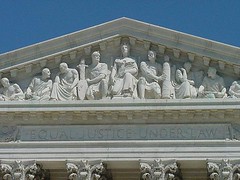
Thank you for all the wonderful participation in this week’s offering. Angelo was the first to indicate that one of the figures is Lady Liberty. Hootin'Anni correctly identified the location as Washington D.C. while once again A.M. Whittaker was dead on. Teachergirl made a valiant effort in guessing some of the figures are Moses, Confucious, and Solon. She was speaking correctly but they are on the eastern pediment….not the image I posted. Moses, Confucious, and Solon are all three on the eastern pediment to represent the three great Eastern civilizations from which U.S. law was derived. I find it interesting that the tablets Moses holds are empty.
Getting back to the image I posted...
Robert Aitken was given the job of sculptor for the western pediment. He worked in the shed seen below as he carved the figures.
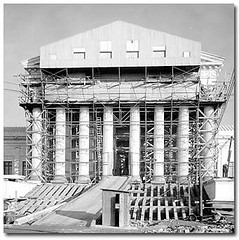
Aitken placed Liberty on her throne in the middle guarded by Order and Authority. Aitken later described Liberty as “looking confidently into the future with the scales of justice across her lap.”
On either side of Order and Authority are three figures which depict Council and Research.
Aitken modeled these figures after several prominent figures in law or after persons who had a hand in the creation in the Supreme Court Building to include on the far left Chief Justice Taft as a young boy at Yale. He represents Research Present. Look at the image below and examine Taft's reclining figure. To his immediate left can be seen a crown which one Supreme Court website states is the English crown. Taft is also looking towards a Pope's miter and a Bishop's crosier. Second from the left is Secretary of State Elihu Root who introduced Taft’s bill to create Washington’s Fine Arts Commission. He is one of the two figures representing Council. The figure seen third from the left is the building architect, Cass Gilbert.
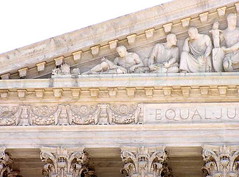
On the far right is John Marshall, Chief Justice from 1801-1835 representing Research Past. The figure second from the right is the sculptor himself, Robert Aitken, while the third figure from the right is Chief Justice Hughes who succeeded Taft. Hughes is the second figure representing Council and was also chairman of the building commission.
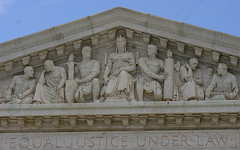
Finally, here is one of my most favorite pictures. The columns are soaring up towards the wonderful coffered ceiling.
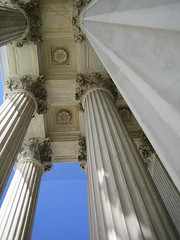
The Supreme Court building is simply that....SUPREME!
The Death of a President

My son came in last night and told my husband and me about President Ford passing away. I was totally unaware even though I had been on the Internet all evening doing this and that. He was 93, our oldest living president, and he had been ill for sometime. He passed away at his home in Rancho Mirage, California.yesterday.
Though I was born during the Kennedy administration, was a toddler during Johnson, and remember most of the end of Nixon’s presidency, President Ford was the president I most remember as a young person. In October I wrote this piece for him that appeared at here at History Is Elementary and at American Presidents.
He was a very interesting and honest man. We will be learning many more things about him over the coming days. One of the most interesting facts about our 38th president is he served as president and vice president but was never elected by the people.
President Bush’s official statement regarding Ford’s death can be seen here, and the Ford Presidental Library site can be found here.
Tuesday, December 26, 2006
Wordless Wednesday Five

Wordless Wednesday is up a little early this week due to the holidays.
Who is involved in this cast of characters?
Update: Thanks for all of the great participation with this week's image. You can view my explanation here. Come back and play next week.
Sunday, December 24, 2006

Subscribe to:
Posts (Atom)