Thursday, January 04, 2007

Go Visit A Brand NEW Carnival

Well, not only have I birthed a new blog, Georgia On My Mind, I have also birthed a carnival…..The Carnival of Georgia Bloggers. You can find the first edition of the Georgia Carnival here.

It doesn’t matter if you are from Georgia or not…..Go on over and meet a few of the fantastic writers my state has to offer. They just may become a few of your new favorites.

Wednesday, January 03, 2007

Thursday 13, Version 8: American Revolution Trivia


Thirteen Questions and Answers About the American Revolution


1. Who won the first battle of the War of Independence?
The Massachusetts Militiamen won the Battle of Lexington and Concord when they forced the British to retreat from Concord back to Boston. The British were trying to confiscate colonial arms from a depot at Concord. The battle, which took place on the night of April 18-19, 1775, was the first military encounter of the American Revolution (1775-83)

2.On what hill did the Battle of Bunker Hill take place?
It took place not on Bunker Hill but on Breed's Hill, on June 17, 1775. The opposing forces were supposed to engage on Bunker Hill, but for unknown reasons the soldiers dug in on the smaller sight, about 2,000 feet away. To straighten things out for visitors, Breed's Hill was later renamed Bunker Hill.


3.What did John Hancock (1737-93) do to earn his place as president of the Continental Congress?
His most distinctive contribution to the rebel cause was the money. Hancock was a merchant who had inherited a fortune from a smuggler uncle. He used his wealth to help finance the revolution. He is best remembered now for his flamboyant signature on the Declaration of Independence in 1776. After the war, Hancock became governor of Massachusetts.

4. How many grievances against the king were named in the Declaration of Independence?
The document cited 27 separate grievances against the king of Great Britain, George III. These grievances included refusing his assent to "wholesom" laws, making judges dependent on "his will alone," and bringing in foreign mercenaries to wage war on the colonies in a way "totally unworthy the head of a civilized nation."

5. Was Paul Revere of British decent?
The Revolutionary War patriot (1735-1818) was only 50 percent British. Revere's father was French silversmith Apollos Rivoire, a Huguenot (Portestant) refugee from the persecution by the Catholic authorities in france. Revere's mother, Deborah Hitchbourn, was of English descent.

6. How cold was it at Valley Forge?
Overall, the winter was fairly mild in 1777-78 when George Washington and his Continental Army were encamped at this site 22 miles northwest of Philadelphia. There was heavy snow and freezing weather in Christmas week but a thaw in January. What made conditions miserable was lack of adquate food, clothing, and shelter due to negligence and mismanagement by the Continental Congress and the commissary department. It is estimated that 2,500 of 10,000 soldiers died of disease and exposure during this period.

7. Who was Marie Joseph Paul Yves Roch Gilbert du Motier?
He was the French nobleman better known to history as the Marquis de Lafayette (1757-1834). In 1777, at the age of 19, Lafayette came to America to volunteer in the Revolutionary War. Idealistic and adventurous, he was appointed a major-general and helped to secure military assistance from France.

8. Long Island, White Plains, Bennington, Monmouth, and Cowpens are all battles of the American Revolution. Which battles from this list did the Americans win?
The Americans won the battles at Bennington and Cowpens.

9. Who was Molly Pitcher?
She was Mary McCauley Hays, (1754-1832), heroine of the American Revolution. She entered her nickname during the Battle of Monmouth in 1778, when she fetched water for her husband and his gun crew. After her husband suffered a wound, she took over for him, helping the gun crew do its job. Afget the war, she was given a yearly pension of $40 by the Pennsylvania Assembly.

10. How many countries did the British fight during the American War of Independence?
By 1780, the British were fighting not only to the United States and its ally France, but also Spain, the Netherlands, and the ruler of Mysore in India. The conflicts were not all related to American independence, but they did keep the British busy on many fronts, aiding the U.S. cause.

11. What became of British general Charles Cornwallis (1738-1805)?
In the U.S., Cornwallis's main claim to fame was his surrender to the Americans and French at Yorktown, Virginia, on October 19, 1781, a turning point that effectively ended the war. But Cornwallis's career of enforcing British imperial rule was far from over. He went on to become Governor General of India (1786-94, 1805) and viceroy of Ireland (1798-1801).

12. Who were the American diplomats who negotiated the treaty that ended the Revolutionry War?
Benjamin Franklin, John Adams, and John Jay negotiated for the United States. The Treaty of Paris, ending the war and recognizing American independence, was signed on February 3, 1783.

13. Who was the last surviving signer of the Declaration of Independence?
Charles Caroll of Carrollton, Maryland. Born in 1737, he was 95 years old when he died in 1832.

These questions and answers have not been totally verified for accuracy by EHT. There were taken directly from the book Questions From American History, The New York Public Library Book of Answers by Melinda Corey and George Ochoa

Links to other Thursday Thirteens!1. (leave your link in comments, I’ll add you here!)

Get the Thursday Thirteen code here!

The purpose of the meme is to get to know everyone who participates a little bit better every Thursday. Visiting fellow Thirteeners is encouraged! If you participate, leave the link to your Thirteen in others comments. It’s easy, and fun! Be sure to update your Thirteen with links that are left for you, as well! I will link to everyone who participates and leaves a link to their 13 things. Trackbacks, pings, comment links accepted!

Tuesday, January 02, 2007

Wordless Wednesday Week 6


Who is this very important man?
Look for my explanation post this Friday regarding this image.
Last week's explanation can be found here.
Another image can be found at Georgia On My Mind.
It's two for one!

Monday, January 01, 2007

Happy New Year


I AM THE NEW YEAR

I am the New Year.

I am an unspoiled page in your book of time.

I am your next chance at the art of living.

I am your opportunity to practice what you have learned about life during the last twelve months.

All that you sought and didn't find is hidden in me,Waiting, for you to search it out with more determination and passion.

All that you dreamed but didn't dare to do,all the faith that you claimed but did not have --

These slumber lightly, waiting to be awakened by the touch of a strong purpose.

I am your opportunity.

-- Author Unknown

Saturday, December 30, 2006

President Ford's Tree


We’ve heard about President Ford’s integrity. His stellar athletic career has been discussed, his Congressional record, and the fact that he served as President and Vice-President without having one single American vote him into office.

We’ve heard numerous discussions regarding his pardon of President Nixon and debated if President Ford made the correct decision. The effect the pardon had on Ford’s subsequent election loss to President Carter has been discussed ad nauseum.

I’ve neither heard nor read anything within the last few days that discuss an event that is known, but is rarely dealt with in the realm of historical “Monday morning quarterbacking”. I’m a little mystified by it. For a couple of days during August, 1976 our nation stood toe-to-toe with an enemy who had attacked two of our soldiers without provocation resulting in President Ford staring down the gunbarrel of World War III erupting in his face,

….and it was all over a tree.

If you are a regular reader of History Is Elementary you know by now you will need to click over to American Presidents,where I have been given a wonderful opportunity to post about presidents, for the rest of this story.

Friday, December 29, 2006

History Is Elementary Has Given Birth!


The New Year is a time of reflection, goal setting, and new beginnings. While I'm working on the reflecting and goal setting I have already had a new beginning of sorts.

History Is Elementary has given birth to a four post (so far) baby blog called Georgia On My Mind. So far in the TTLB ecosystem my baby blog is lower than an insignificant microbe.

I've felt the need for some time for a blog such as Georgia On My Mind simply because Georgia history is so interesting and our current events are worthy of making note of. Georgia is a vast state full of interesting characters, marvelous land formations, and lots of political action.

I've been ferreting out and reading several Georgia blogs of late and I have seen some really great ones. Currently I'm trying to gather up as many Georgia blogs as I can and link to them so they are all listed on one webpage. I also am forging ahead with a blog carnival for Georgia bloggers. Even though many folks are off line this week I've still planned the first blog carnival to be up on Friday, January 5th. Both of my children ate solid food, walked and talked early, so I see no need in waiting with my baby blog. We'll have a carnival even if the only post is mine.:)

It's hard work birthing a new blog so forgive links that don't work and spotty posting over the next few days. If you know a Georgia blogger please contact them and send them my way. Georgia On My Mind is listed on my blogger profile now so you can use that link or you can click here.

Thursday, December 28, 2006

The Carnival of Education: The 99th Version


Darren over at Right On the Left Coast is hosting the 99th Carnival of Education.
It's amazing how time flies.
Hurry on over and find out what is going on in the world of education before the cotton candy gets all gummy.

Wednesday, December 27, 2006

Thursday 13 Version 7: Top Influential Americans

Thirteen Things about The Top Thirteen Influential Americans
Atlantic Magazine has published the 100 most influential Americans compiled by ten eminent historians. Here are the top 13 for your viewing pleasure. The entire list can be seen here. While there might be some people who could be added here and there, I was pleased with the list overall. The authors covered all aspects of American life from politics, business, education, science, and religion.

Taken directly from the Atlantic Monthly site:

1. Abraham Lincoln-He saved the Union, freed the slaves, and presided over America’s second founding
2. George Washington-He made the United States possible---not only by defeating a king, but by declining to become one himself.
3. Thomas Jefferson-The author if the five most important words in American history: “All men are created equal.”
4. Franklin Delano Roosevelt-He said, “The only thing we have to fear is fear itself,” and then he proved it.
5. Alexander Hamilton-Soldier, banker, and political scientist, he set in motion an agrarian nation’s transformation into an industrial power.
6. Benjamin Franklin-The founder-of-all-trades----scientists, printer, writer, diplomat, inventor, and more; like his country, he contained multitudes.
7. John Marshall-the defining chief justice, he established the Supreme Court as the equal of the other two federal branches.
8. Martin Luther King, Jr.-His dream of racial equality is still elusive, but no one did more to make it real
9. Thomas Edison-It wasn’t just the lightbulb; the Wizard of Menlo Park was the most prolific inventor in American history.
10. Woodrow Wilson-He made the world safe for U.S. inverventionism, if not for democracy.
11. John D. Rockefeller-The man behind Standard Oil set the mold for our tycoons---first by making money, then by giving it away
12. Ulysses S. Grant-He was a poor president, but he was the general Lincoln needed; he also wrote the greatest political memoir in American history
13. James Madison-He fathered the Constituition and wrote the Bill of Rights.

American Presidents has created a mini-list from the Atlantic list compiling just the presidents on the list. It can be seen here. The most amazing find at the Atlantic site is the list of links to articles written by some of the famous Americans on the list. These writings were actually published in Atlantic Magazine. They include a ballad written by Abraham Lincoln, a letter written by Harry Truman which gives his justification for dropping the bomb on Hiroshima, a nuanced portrait of Churchill by Eleanor Roosevelt, an essay authored by W.E.B. Dubois urging members of his race to achieve “self-respect” and “self-realization”, and an essay written by J. Robert Oppenheimer, inventor of the atomic bomb in which he encourages Americans to take responsibility for the world’s fate. These writings and many more can be found at the Atlantic site here.
Links to other Thursday Thirteens!1. (leave your link in comments, I’ll add you here!)
Get the Thursday Thirteen code here!

The purpose of the meme is to get to know everyone who participates a little bit better every Thursday. Visiting fellow Thirteeners is encouraged! If you participate, leave the link to your Thirteen in others comments. It’s easy, and fun! Be sure to update your Thirteen with links that are left for you, as well! I will link to everyone who participates and leaves a link to their 13 things. Trackbacks, pings, comment links accepted!


Lady Liberty and Her Boys


It is amazing to me that it took right at 146 years for this great nation of ours to create a permanent home for our judicial branch of government. The building’s cornerstone was finally put in place in 1932. At that time Chief Justice Charles Evans Hughes said, “The Republic endures, and this is a symbol of its faith.” I believe it one of the most beautiful symbols of our proud Republic.

We have President turned Chief Justice, William Howard Taft, to thank for the construction of the magnificent Supreme Court building in Washington D.C. He was instrumental in seeing that Congress authorized the construction.

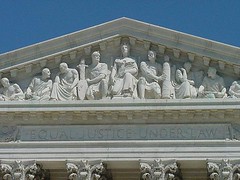
This week’s Wordless Wednesday is the image from the western pediment.

west pediment

Thank you for all the wonderful participation in this week’s offering. Angelo was the first to indicate that one of the figures is Lady Liberty. Hootin'Anni correctly identified the location as Washington D.C. while once again A.M. Whittaker was dead on. Teachergirl made a valiant effort in guessing some of the figures are Moses, Confucious, and Solon. She was speaking correctly but they are on the eastern pediment….not the image I posted. Moses, Confucious, and Solon are all three on the eastern pediment to represent the three great Eastern civilizations from which U.S. law was derived. I find it interesting that the tablets Moses holds are empty.

Getting back to the image I posted...

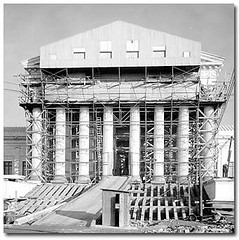
Robert Aitken was given the job of sculptor for the western pediment. He worked in the shed seen below as he carved the figures.

supreme court under construction

Aitken placed Liberty on her throne in the middle guarded by Order and Authority. Aitken later described Liberty as “looking confidently into the future with the scales of justice across her lap.”

On either side of Order and Authority are three figures which depict Council and Research.

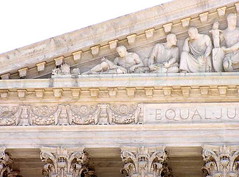
Aitken modeled these figures after several prominent figures in law or after persons who had a hand in the creation in the Supreme Court Building to include on the far left Chief Justice Taft as a young boy at Yale. He represents Research Present. Look at the image below and examine Taft's reclining figure. To his immediate left can be seen a crown which one Supreme Court website states is the English crown. Taft is also looking towards a Pope's miter and a Bishop's crosier. Second from the left is Secretary of State Elihu Root who introduced Taft’s bill to create Washington’s Fine Arts Commission. He is one of the two figures representing Council. The figure seen third from the left is the building architect, Cass Gilbert.

Left Side of West Pediment


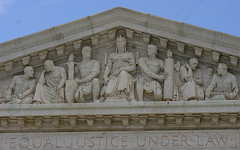
On the far right is John Marshall, Chief Justice from 1801-1835 representing Research Past. The figure second from the right is the sculptor himself, Robert Aitken, while the third figure from the right is Chief Justice Hughes who succeeded Taft. Hughes is the second figure representing Council and was also chairman of the building commission.

west pediment

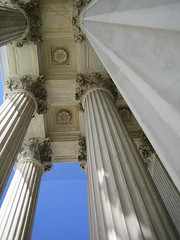
Finally, here is one of my most favorite pictures. The columns are soaring up towards the wonderful coffered ceiling.

supreme court columns

The Supreme Court building is simply that....SUPREME!

The Death of a President


My son came in last night and told my husband and me about President Ford passing away. I was totally unaware even though I had been on the Internet all evening doing this and that. He was 93, our oldest living president, and he had been ill for sometime. He passed away at his home in Rancho Mirage, California.yesterday.

Though I was born during the Kennedy administration, was a toddler during Johnson, and remember most of the end of Nixon’s presidency, President Ford was the president I most remember as a young person. In October I wrote this piece for him that appeared at here at History Is Elementary and at American Presidents.

He was a very interesting and honest man. We will be learning many more things about him over the coming days. One of the most interesting facts about our 38th president is he served as president and vice president but was never elected by the people.

President Bush’s official statement regarding Ford’s death can be seen here, and the Ford Presidental Library site can be found here.

Tuesday, December 26, 2006

Wordless Wednesday Five


Wordless Wednesday is up a little early this week due to the holidays.
Who is involved in this cast of characters?
Update: Thanks for all of the great participation with this week's image. You can view my explanation here. Come back and play next week.

Sunday, December 24, 2006

Merry Christmas!


See....knowing latitude and longitude is something you might need later!

Friday, December 22, 2006

A Very Needed Surprise!


In light of my low-key Christmas I discussed earlier I received a very needed surprise yesterday. When I wasn’t looking History Is Elementary was added to the top 100 education blogs by the Online Education Database. Many of my blogging friends are there and many new finds (to me) are there as well. Looks like I have plenty of sites to visit. I’m sure many of the unfamiliar will become fast friends in the days ahead. I’m honored to be included and emailed the staff at OED to thank them.

Here are some blogs I’m already familiar with…….A big congrats to them!

Moving at the Speed of Creativity
Eduwonk
This Week in Education
D-Ed Reckoning
Education in Texas
Jenny D.
Are We Doing Anything Today?
Christopher D. Sessums Blog
NYC Educator


Here are three that I look at often, but have been too overwhelmed with items on my “to-do” list to link to them:

The Stingy Scholar
2 Cents Worth
Education Intelligence Agency

Enjoy perusing this lengthy list of sites in the on-line community for education!

I'm Not Trying to be the Grinch...Really


There is no Christmas tree at my house this year. There is no baking, there is no caroling, there is no deck the halls, or fa-la-la. I have been home all week until today….no shopping, no lunches out, no nothing. Well, some writing was done here on my diversion from housework and lesson planning. I did do a bit of shopping today, but only because it has gotten to be the last possible minute and even the Grinch had a heart in the end.

My family has been very supportive of my decision to not unpack Christmas and drag it about the house. It’s just not in me. The sheer thought of having to make Christmas is simply too overwhelming this year. I think I’ve finally reached the apex of my grieving and folks simply need to let me be. No more fending and fighting it off…..I need to wallow and flop about in it. I need to be messy with it and let it ooze from my pores.

When my father-in-law reacted with surprise and shock as we discussed our “no tree” Christmas I joked and told him I was attempting to revive the custom of mourning which of course, used to dictate what some could and couldn’t do for up to a year or more. No, I’m not going to do anything to that extreme, but I need a quiet Christmas.

If you are new to this blog then you may be unaware that my mother passed away after a very lengthy illness on July 15th. I posted about her here, here, here, and here. Many of you went out of your way to console me and believe me I was touched. This blog has saved my sanity more times than I can count. The week following Thanksgiving Dear Sister lost her mother-in-law. Can you imagine….loosing your mother and your mother-in-law within four months of each other? I guess you could say Dear Sister’s mother-in-law’s funeral sent my grief to the top of a pot ready to be skimmed. I’m attempting to skim as fast as I can but sometimes…..

I write to cope…Dear Sister makes the loveliest mongrammed purses you’d ever want to see (a picture will be forthcoming soon) and works practically 24/7 as her coping mechanism. Dear brother-in-law is just beginning the process.

Once again this past week a reader, a fellow educator, contacted me and wanted to send something my way. I had no idea what she wanted to send me. Here is what my wonderful colleage, my fellow blogosphere citizen, my lovely friend, Butterfly Angel, sent to me:

Dear EHT,
I remembered that you suffered the loss of your mother and I wanted you to know that I hadn’t forgotten. The attachment was given to me when my dad passed away two years ago, December 19th. He had Parkinson’s disease. I understand what you are or might be going through at this time of year. I am thankful that we have ‘met’ and it is a joy to know that the Internet can be used for good. God works in mysterious ways and I am glad He brought us together.

Butterfly Angel, thank you for your gift, and I agree…the Internet can be used for good.
If you know someone who has lost a loved one and might be having a difficult time this year please forward this poem to them.

My First Christmas in Heaven

I see the countless Christmas trees around the world below
With tiny lights, like heaven’s stars reflecting on the snow.
The sight is so spectacular please wipe away the tears
For I am spending Christmas with Jesus Christ this year.
I hear the many songs that people hold so dear
But the sound can’t compare with the Christmas choir up here.
I have no words to tell you the joy their voices bring,
For it is beyond description to hear the angels sing.
I know how much you miss me; I see your tortured heart
But I am not so far away, we really aren’t apart.
So rejoice for me my loved ones, you know I hold you dear
And be glad I’m spending Christmas with Jesus Christ this year.
I sent you each a special gift from my heavenly home above.
I sent you each a memory of my all undying love.
After all, love is a gift more precious than ingots made of gold,
For I can’t count the blessings or love he has for you.
So have a merry Christmas and wipe away that tear.
Remember I am spending Christmas with Jesus Christ this year

(Author unknown)

Thursday, December 21, 2006

Weblog Awards 2006: It Was Simply Lovely to be Nominated

Years ago I was simply enamoured over the Academy Awards…who wore what designer, who said what, etc. I always wondered what the stars really thought as they said, “Oh, it’s ok I didn’t win…really. It was such an honor to be placed among the other nominees.”

Right…sure….I always felt that deep inside they were probably tearing their awards program into tiny, tiny pieces and would throw themselves dramatically across their fur covered beds dissolving into a puddle of tears once they reached for the safety of home.

I may not ever think that way again because, honestly, I am honored to be among the six blogs who were eligible for votes in the education category for the Weblog Awards. Overall, there were forty-nine nominated blogs that were considered. Wow! Out of forty-nine History Is Elementary placed in the top six. I’d say we are all winners (even many of those that weren’t nominated), but of course congrats goes out to Michael Berube, Ivy Gate, and Spunky Homeschool.

All of the six blogs in the education category were vastly different. Perhaps the folks at the Weblog Awards would consider breaking up the category of education a bit as it is a very broad area. I found this post by Mr. Person at Text Savvy endearing and an appropriate inquiry. I also appreciate the sentiments of Mr. McNamar at The Daily Grind.

It was such a shame that there were instances of inappropriate voting as seen here and here from the Weblog Award message boards.

Looking over the message boards it seems that several panties were in a bunch but no matter. This is not the biggest problem the world is facing today, and the whole thing is meant to be FUN.

So…here it goes…my loser speech….Thank you to everyone at the Weblog Awards and to the person who nominated me. Thank you to each and every person who clicked through to check me out and for each of you who supported me with a vote or votes. It was such an honor to be included with my fellow nominees. I hope some of you newbie readers stick around because History Is Elementary will begin its second year of historical and educational ramblings in January. My goal is to continue to share with you, teach you, learn from you, and continue to prove history IS elementary!

A Painting With a Dual Purpose


Post Update: Firefly has uncovered a very interesting article regarding the whereabouts of the original painting for this week's Wordless Wednesday. I have emailed appropriate curators at the White House and the museums mentioned in the article and hope to hear back from them soon. This is getting interesting....Please read the entire post and make sure you view the comments as well.

Congrats to A.M. Whittaker and Firefly who placed the proper information in the comments section first.

The painting I featured in this week’s Wordless Wednesday seen here was created by American artist, N.C. Wyeth. It was first commissioned in 1930 for the Pennsylvania Railroad where it was used as a patriotic poster. Unfortunately I was unable to discover if any of the poster images survive or where the original painting is today. I have emailed the Wyeth homeplace and studio to see what they can tell me.

The painting does depict President Washington and White House architect, James Hoban inspecting the uncompleted White House in 1798. The site of the White House was chosen by Washington and city planner, Pierre L’Enfant, which we recognize today as 1600 Pennsylvania Avenue. Though Washington never lived in the mansion he did oversee the construction. Wikipedia advises Mr. Hoban resided on the grounds of the White House during construction with his wife, ten children, and nine slaves in a red brick house.

The second purpose for Wyeth’s image came about in 1971, some twenty-six years after Wyeth’s tragic death in a train crossing accident. President Nixon along with his wife, Pat, choose Wyeth’s image for their official White House Christmas Card.

As I researched White House Christmas Cards for my recent post at American Presidents I was struck by the 1971 card and how different the image was compared to other cards. I loved the big, billowy clouds and just the overall painting style made me pause and take notice. Compare this image to other N.C. Wyeth images seen here and here. He had quite a career doing illustrations for children's book and magazines such as Scribners.

Tanya Nichols over at Crafty Girls mentioned in the comments she would come back and print the picture out for her children. This is a great idea. Children need to view art as something to interpret and every painting has more than one meaning.

Inferencing is one of the reading skills I struggle with every year to teach my fourth graders. All of you who commented on my Wordless Wednesday this week did just that…..even if you did it comically….you were inferencing and it is a powerful tool for learning. There is a fantastic N.C. Wyeth painting called The Giant here. It is a great learning tool for kids to experience the “whole” picture. Sometimes you can set your printer to black and white or outline and print a famous painting out for kids to color. They love this.

You can learn more about N.C. Wyeth here.

I'm pleased that some of you seem to be enjoying this little diversion. I had thought about chucking the whole thing, but it would seem it is serving a learning purpose....for ALL of us. :)

Wednesday, December 20, 2006

Thursday 13-Version 6: Things I'd Like Santa to Deliver

1. A place for everything and everything in its place and that everything that needed doing was DONE

2. More room in my classroom

3. More room in my house

4. More room in my chair when I sit in it

5. A sweet Bulldog puppy that my lazy Hemingway cat would NOT eat

6. Several books on various political and historical topics

7. Extra time to read the books on various political and historical topics

8. A full time cook and laundress for my long suffering family

9. An assistant to do my clerical work in the classroom

10. A three-stone diamond ring from Dear Hubby

11. A book deal….it doesn’t matter what kind of book…any deal will do

12. A brand new Jaguar----Champagne colored

13. One more lucid conversation with my mother

Wordless Wednesday....Sort of....What Can You Tell Me About This?

Telling me the painting is set in Washington D.C. and the year is 1798 won't cut it.:)

Update: Shhhhhh! I know this is Wordless Wednesday, but the Education Carnival is in town. Hurry on over to The Median Sib before the lines get too long.

Update 12-20-06: The explanation for this week's Wordless Wednesday is posted here.

Tuesday, December 19, 2006

Is History Important? A Reprise


Polski3 has reviewed an article concerning the large numbers of higher learning centers that are no longer requiring any history for graduation.

As Dorothy Parker would say, “What fresh hell is this?”

Go read the rest of Polki3’s post here (Aren’t we glad he’s back to blogging!?) His observations regarding less emphasis on history at the elementary and middle levels is correct from what I can see, and my main comment to the source of this silliness is BALDERDASH!

I agree with Polski3 that we all need to make our voices heard. As NCLB is up for reauthorization we should make a plea to Congress to make sure Social Studies and Science are added to the requirements of the No Child Left Behind legislation.

One of Polski3’s commenters mentioned Richard Dreyfuss, the actor, who gave “dire predictions” in a recent interview regarding the teaching of Civics. This issue took a particular turn over at Dennis Fermoyle’s blog From the Trenches of Public Ed. Where he garnered a whopping 29 comments regarding teaching the Constitution and what some perceive as a lack of teaching in the area of Civics. You can see his post here.

So, is history important? I asked this question last January on my seventh day of blogging. I’m running it here again as I think it’s appropriate to do in light of recent events.

One reason why history is important it that the past has value to our society. Thousands of people throughout history have gone to great lengths to record history through newspapers, diaries, journals, saved letters, family Bibles, and oral traditions. It is believed that Aborigines of Australia actually managed to hang onto their history for 40,000 years by word of mouth.

History is the narrative of mankind. It provides answers as to how people lived as well as provide for us the roots to certain ideas concerning laws, customs, and political ideas. Have you ever wondered where the rude gesture of pointing your middle finger at people you are annoyed at came from? One origin story states it reportedly began at the Battle of Agincourt where the French demanded the surrender of the English longbow men. The French demand was very simple. The bowmen had to surrender immediately or upon capture they would have their middle fingers cut off. This finger was sacred to the men since it was the finger used in firing the longbow. The English response to the French demands was to raise their middle finger and raise their hands high in the air in unison for the French to view. This enraged the French who attacked immediately but were promptly obliterated by the plucky English. Think about their bravery the next time you are tempted to raise that finger.

The age-old adage, “you can’t know where you are going unless you know where you have been” is actually very true. A true scholar of history realizes history does repeat itself. This repetition has importance in society. It teaches the value of certain social changes and governmental policies. Ideas that were presented in the 1960s can be found in the writings of William Godwin in the 1790s. The Ancient Greeks redistributed wealth which was clearly repeated during the Communist regimes. It didn’t work for the Greeks and it certainly did not work for Communist Russia.Though the Greeks had strange ideas about wealth they were firm believers that history was something that people could learn from.

I began my love affair with history as an elementary student who read each and every biography my media center possessed. I was fascinated with the famous people I was learning about since they had a childhood like me and I was intrigued at the twists and turns their life took on their journey to achieve their goals. I remember particularly the biography I read about Woodrow Wilson. He held my interest because he was born in my home state of Georgia. He provided a character education lesson because he showed great tenacity as he never gave up even after several failed businesses that resulted in a bankruptcy. History provides a wealth of material to teach character education, both positive and negative.

History teaches a wide range of material. It isn’t simply a litany of dead people, places, and dates. I am amazed all the time as I discover links to science curriculum and the arts in the units I teach. You can’t teach United States regions without mentioning that each region has its own ecosystem made up of specific food chains, climates, and physical features. A study of history clearly shows man’s love of the arts and it cannot be denied that once a civilization was able to maintain a steady food supply their creative ideas flowed whether on rock walls, papyrus, or cedar bark. These links provide relevance for students. It assists them to take small chunks of history squares and weave them into a knowledge quilt.The links that students can discover between history, science, and the arts provides a well constructed framework that bond national and regional past events. This allows for comparisons with contemporary events to provide context for understanding. The American Revolution was basically our first national event. The powers that be in my home state of Georgia like for students to learn the significance of historical events as they relate to our state. Before we get into Georgia’s participation in the Revolution I have introduced the events leading to the war up to the Battle of Bunker Hill. When they realize we are going to talk about Georgia’s participation they get real excited and quickly get really upset. They are very disappointed to learn that Georgia fell very early in the war to the British. They learn that we have some war heroes but the majority of colonists in Georgia were Tories. Georgia was not the hotbed of revolution that Massachusetts or Virginia was. We then embark on a mission to understand why Georgia was not heavily involved in the independence movement.

History when presented properly lends itself to critical analysis. Even young students are capable of reviewing a series of primary and secondary resources and independently determine what happened during an event and why. This independence is a goal we have for all students throughout all disciplines of education. History is a perfect curriculum tool to practice analysis, generalizing, and inference. In fact, the Bradley Commission Report on History in the Schools (1988) states, “…history is the only avenue we have to reach an understanding of ourselves and our society. Without such understanding the two foremost aims of American education will not be achieved---the preparation of all our people for private lives of personal integrity and fulfillment, and their preparation for public life as democratic citizens.

"The question I pose in the title is a no brainer to someone like me. You see, I am one of those people who can be totally consumed by large twenty pound history tomes. I love the intrigue, story-twists, coincidences, and repetition of themes involved in history. I’ll read the history of anything. The history of butter, word histories, Mandarin Chinese, buttermilk, famous cats in history, the history of knitting, obscure African tribal histories, and yes…..American history.I strongly identify with a character in the Kingsley Amis novel, Lucky Jim, who works in the history department of a fictitious English university when he answers the department telephone by stating, “History speaking!” We are all history every minute of every day. We participate in the history of our families, we add to the history of the corporations and businesses we serve each day at work, and we participate in history as we vote, compose a letter to our congressman or a newspaper editor or attend a demonstration or memorial.

Recently I was looking at a website attached to the University of Utah where a history professor was reporting that he had asked one of his history classes of two hundred students, “Why is history important?” A student spoke up and honestly answered very matter of factly, “It’s not important. It’s about dead people, not about me.” The professor stood his ground during a deafening round of applause from the other students and countered, “Well, I see dead people. I hear dead people and ……so will you!”

Is learning history important? You bet it is!

If you agree with me and think history is important contact your Congressman and encourage him or her to include Social Studies and Science in the requirements of the No Child Left Behind Act.

Monday, December 18, 2006

Have You Received Your Christmas Card From the White House?


This is an image from the official White House Christmas greeting sent by President Johnson and Lady Bird in 1967.
Apparently there are a few people upset about this year's official greeting.
Click on over to my newest posting at American Presidents to learn more about this White House tradition.