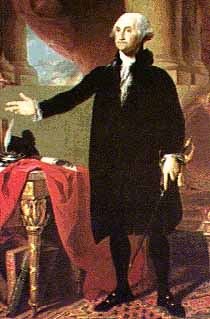
When I was younger we didn’t have a day to celebrate all U.S. Presidents. Instead we split the day in two and recognized Abraham Lincoln and George Washington since their birthdays were both in February…..so, I’m linking to two past articles. The first involves Lincoln and the Emancipation Proclamation. This article originally appeared at History Is Elementary as well as American Presidents Blog in 2008. You can view it here.
Monday, February 20, 2012
President's Day, 2012
When I was younger we didn’t have a day to celebrate all U.S. Presidents. Instead we split the day in two and recognized Abraham Lincoln and George Washington since their birthdays were both in February…..so, I’m linking to two past articles. The first involves Lincoln and the Emancipation Proclamation. This article originally appeared at History Is Elementary as well as American Presidents Blog in 2008. You can view it here.
Tuesday, January 24, 2012
A Christian Nation? Be Careful What You Preach
Wednesday, December 14, 2011
The President's Overdue Library Books
Monday, February 16, 2009
Framing History Correctly
In a post of mine over at American Presidents Blog titled Monroe Crossing the Delaware I go into great detail regarding how I use Emanuel Leutze’s painting Washington Crossing the Delaware in my classroom. I’ve posted about the painting again over at APB. It seems the Metropolitan Museum of Art discovered a photo that depicted the painting in a special frame Leutze ordered specifically for the painting.
Per a web article I read over the weekend Leutze’s frame bore sheields at each corner and was topped with an eagle crest and a ribbon that marked lines from George Washington’s eulogy: “First in War, First in Peace, and First in the Hearts of his Countrymen.”
You can read the rest of my post here, and see the Matthew Brady image that got the reframing started.
Monday, January 14, 2008
Lobbing Discussion Bombs
Teachers are forever throwing discussion bombs out into the middle of the classroom floor hoping to ignite some type of viable conversation to help students connect to prior knowledge, connect to new knowledge, and create even more questions for future lessons.So, one day last year found me sitting on my classroom stool waiting for conversations to stop, papers to stop rustling, and 3-ring binders to stop their incessant clicking. I finally lobbed my discussion bomb. I direct students, “Tell me about a time your mother embarrassed you.” Instantly every hand in the room goes up including my own.
Parental embarrassment of any kind seems to be the great equalizer in a very diverse group of people including my young students. For the next several minutes I’m regaled with tales of mothers who like to show baby pictures (especially the naked type) to friends and family, mom’s who go out in public with curlers in their hair, and mom’s who laugh or talk too loud. In my own case my mother was notorious for taking up with virtual strangers in waiting rooms and grocery store lines, and in the course of five minutes she would be telling them all sorts of personal and private things about my sister and I while we looked on in horrified fashion.
I’m a huge embarrassment to my own children at times. I even know what it is I do to elicit the eyerolling and the exasperated exclamations of “Oh, Mother!”, but I can’t help myself. Perhaps it all stems from some type of hormone that is present during pregnancy and never goes away. At any rate it would seem that if there are children mothers who embarrass them are never far away.
Now I don’t merely bring up embarrassing mother stories just for the heck of it. I usually do it as an introduction to a read aloud I use in my classroom by Jean Fritz titled George Washington's Mother
To find out more about my wordless image from last week and more about the relationship between George Washington and his mother head over to American Presidents.
Thursday, December 27, 2007
As Promised....A Few Sources
Yesterday I wrote about academic controversy and how it can be used in the classroom. I promised a list of various sources and you can find it below.A few things need to be clarified about this list, however. I would never use the online sources I provide here by merely printing them off “as is” and hand them to students. I would not use blog entries as classroom resources nor would I direct students to websites unless they were of the scholarly type such as online journal articles or sites belonging to the National Parks Service. I’ve used information from many of these sources but have repackaged them to fit the needs of students.
When preparing an academic controversy type lesson for students it is very important to provide information from both sides of an issue. This should not be an activity where the instructor is attempting to guide all students to one particular point of view. The point is for students to examine and analyze the information presented in order to come up with their own opinions and to be able to state those opinions in a clear and logical manner.
Sources to consult when using Washington’s Prayer at Valley Forge in the classroom:
1. Supporters of the story regarding Washington’s prayer at Valley Forge use the following eyewitness testimony of Isaac Potts, a Quaker and a Loyalist which was given to Rev. Nathaniel Randolph Snowden. Snowden later recorded the event in his diary: " I was riding with Mr. Potts near to the Valley Forge where the army lay during the war of ye Revolution, when Mr. Potts said, 'Do you see that woods & that plain? There laid the army of Washington. It was a most distressing time of ye war, and all were for giving up the Ship but that great and good man. In that woods (pointing to a close in view) I heard a plaintive sound as of a man at prayer. I tied my horse to a sapling & went quietly into the woods. To my astonishment I saw the great George Washington on his knees alone, with his sword on one side and his cocked hat on the other. He was at Prayer to the God of the Armies, beseeching to interpose with his Divine aid, as it was ye Crisis & the cause of the country, of humanity & of the world. Such a prayer I never heard from the lips of man. I left him alone praying. I went home & told my wife. We never thought a man could be a soldier & a Christian, but if there is one in the world, it is Washington. We thought it was the cause of God & America could prevail.' (source)
Snowden’s diary entry is a good example for students to use when determining reliability of a source and when determining the type of source such as a primary document or secondary source. In the past I’ve used activities where one student tells a short account of an event to another student out of the hearing of the rest of the class. The second student then goes to his/her desk and writes down what they were told. The second second student then visits a third and reads his/her account to a third student who in turn writes down what he/she heard in order to read it to a fourth student. This process continues until all students have been told and have written down the account ending with the first student who writes down the last account. Then we compare the original story to the the final account. Students are amazed at what has been left out and what has been embellished in the account.
2. This site supports Pott's story and also includes the fact that he supervised the grinding and delivery of the grain which Washington had requested that local farmers provide for the army. I have not seen this mentioned in a scholarly account.
3. This site mentions Potts and his home... that some state Washington used as his headquarters while at Valley Forge (the image I present with this post). However, the editors of the Washington Papers at the Library of Congress state bluntly that "no evidence" exists in his records to document the claim, insisting that the association "appears to rest largely upon tradition" and the "recollection of aged individuals." As the marker text suggests, prior to the arrival of the Americans, a British raiding party had destroyed several buildings at Valley Forge. There could not have been too many inhabitable residences from which the commander in chief could select his headquarters. The general's expense accounts indicate that he left his tent on Christmas Day 1777 to establish more permanent quarters at the home of Deborah Hewes, a widow. Isaac Potts himself was not then present at the Forge, living instead at nearby Pottsgrove. Records from the period also suggest that William Dewees, who had married into the Potts family, was actually considered the owner and operator of Valley Forge during the wartime period. (source)
The National Parks Service site currently states the Potts home was Washington’s headquarters.
4. Chapter 13 from A History of the Life and Death, Virtues and Exploits of General George Washington by Mason Locke Weems better known as Parson Weems. It is Parson Weems who has the honor of spreading the cherry tree myth as well and the account of the prayer at Valley Forge.
5.Arnold Friberg, the artist who completed the painting of Washington in prayer, explains in his own words the reasons why he completed the painting and the research he conducted in the process. From the site Friberg states The well known American legend is without documentation. But from Washington's own words there can be no doubt of his deep and humble dependence upon whom he chose to call "that all wise and powerful Being on whom alone our success depends.
6. A stained glass image of Washington in prayer
7. Over at Boston, 1775 J.L. Bell provides information regarding the story that Washington saw an angel at Valley Forge.
8. Washington's Prayer Journal---taken from a book published in 1919 called George Washington, the Christian which is a collection of prayers that supposedly Washington compiled and used. When a California teacher used the prayer journal along with other documents in his fifth grade classroom there were complaints, the items were eventually banned, and the teacher filed a lawsuit which was eventually settled. The prayer journal itself is highly suspect. (check out Liz’s links marked “Library of Congress and George Washington’s Papers)
9. Did Washington Pray at Valley Forge?---an article from Coral Ridge ministries which mentions Paul Boller, a historian and noted presidential expert, who discounts the story. The article also mentions five people who gave account of the event. Jared Sparks, an early Washingtion biographer, is also mentioned.
10. Taking the Measure of Washington....Once More---an online article by Michael J. Lombardi at the Journal of Colonial Williamsburg Foundation. This article examines the painstaking efforts historians go to to make sure we are getting an accurate and not romanticized picture of Washington.
11.Information regarding a book by Michael and Jana Novak titled Washington’s God: Religion, Liberty, and the Father of our Country
12.Ushistory.org provides an account written by Gilbert Starling Jones from The Picket Post, published by the Valley Forge Historical Society (April, 1945, No. 9)
13.The National Parks Service site for Valley Forge provides An account of the conditions at Valley Forge, and at this parks service site we are told the Potts home was Washington’s headquarters while this article advises where all of Washington’s officers slept.
14.Wayne Bodie’s Valley Forge Winter: Civilians and Soldiers in War
15. From the National Valley Forge Park site----an article titled New Interpretations at Valley Forge states subsequent research among primary source materials revealed very few seferences to soldiers being buried at Valley Forge, but many references to the need to dispose of the remains of butchered cattle and dead horses….Says park historian Joseph Lee Boyle, "No substantiated human graves have ever been found in the park," which is a significant shift in interpretation from what was being written at the turn of the century
16.American Heritage Magazine---reviews the book American Creation
17. In an online interview John Ferling author of Almost a Miracle: An American Victory in the War of Independence
I would also suggest that if you are interested in further resources please refer to my original post and take a look at the comments section where many great opinions and ideas were put forth and The Tour Marm and Ed over at Millard Fillmore's Bathtub provided some additional sources/links as well.
Wednesday, December 26, 2007
Controversy...It's a Good Thing!
Controversy…our very world is full of it! It only takes a few clicks in the blogosphere to become embroiled in one controvery or another and everyday it seems we are heaping on more and more controversy involving subjects from religion to politics and from education issues to social ones like teen pregnancy or abortion. Historians have their fair share of controversies as well---the atomic bombing of Hiroshima and Nagasaki, the Crusades, the causes and effects of any war---and because there are no definitive black or white answers due to individual analysis and conjecture many issues remain controversial until more evidence is located that cannot be refuted in any way.Think about it for a minute…you see something in a blog, newspaper, or book that goes against the grain, your ire is up and you want to voice your own opinion in response. Many of you would rely on your own prior knowledge and a large number of you would dig a little deeper to verify some of the things you disagreed with in the original article….just to make sure, you know. In the process your horizons are broadened just a bit with some of your prior knowledge being confirmed and some of it being thoroughly debunked. You, my good friend, have learned something in the process.
I’m not one that really wants to get embroiled in a controversy and at first glance I might balk at the idea of actually planning for one in the classroom! Who needs the hassle, right?
In his book Creative Controversy---Intellectual Challenge in the Classroom
Dr. Johnson advises academic controversy exists when one person’s ideas, information, conclusions, theories, and opinions are incompatible with those of another party, and both parties have to reach an agreement. However, in today’s world where many believe controversial issues have no gray areas but are either white or black we see no concessions or even a hint of an admission that with some issues we simply don’t have enough information to have an exact answer.
Last week’s wordlesss image was a portion of a painting by Arnold Friberg called VaThe Prayer at Valley Forge (1975). An earlier engraving of Washington’s Prayer by Henry Brueckner also exists. Friberg explains in his own words the reasons why he completed the painting and the research he conducted in the process. From the site Friberg states The well known American legend is without documentation. But from Washington's own words there can be no doubt of his deep and humble dependence upon whom he chose to call "that all wise and powerful Being on whom alone our success depends."
I decided to use the painting of Washington praying due to the very controversies surrounding it (if you haven’t already this would be a good time to check out the comments made regarding my mystery image here):
*A man, George Washington, is praying. Some believe it is wrong to show public school students an image of someone in prayer. I’ve read where this painting has been banned from public buildings including schools, but I have no specific locations.
*There is a strong religious message as you view the painting that sends the separation of chuch and state crowd into a tizzy.
*Washington in prayer?!? Some believe Washington was Christian while others argue he was a Deist and not a Christian.
*The backstory behind the painting is suspect and many historians argue that it is nothing more than an American myth.
I strongly feel there is nothing illegal or irresponsible by showing students the painting by Mr. Friberg. As many of my commentors suggested this image can be used to teach about Valley Forge, American myths, the evaluation of historical sources, and can even lead to a discussion on the exact wording of the Constititution regarding freedom of religion and as Polski3 stated Jefferson’s own opinion regarding the separation of church and state.
Everyone had really great ideas concerning how to use the painting. Following Dr. David Johnson’s ideas on academic controversy, however, I have in the past shown the painting to students and discussed its background. After carefully pairing students together I have provided them with several bits of information concerning the various controversies surrounding the painting that I mentioned above. The trick with a lesson surrounding academic controversy is to allow the students to explore the information, evidence, and points of view and allow them to arrive at solutions on their own.
Each team receives information based on only one point of view. They must digest the information and understand the point of view so that they can relate the position to their partner. After both sides have been presented the partners trade information and the process begins again resulting in each partner presenting the alternative point of view. Many students state it is very interesting to see how differently their partner can interpret the same information.
Following the second set of presentations the partners work together to analyze both sets of information and they attempt to discover which point of view seems the most plausible. Finally, students synthesize their new knowledge by arriving at a concensus that each student must word on his or her own in writing to turn in. Sometimes the concensus my students have arrived at is simply agreeing to disagree while others disagree greatly with one point of view but certainly understand where it came from.
I have found these types of activities motivate my most reluctant students and also begin to help them understand how to listen to a different point of view that can affect their lives inside and outside of the classroom.
Our hot-button issues in history, science, religion, politics, education, and our social and cultural lives aren’t going away anytime soon. What concerns me is it doesn’t seem that any of the sides to an issue are willing to concede even an inch of ground to move on. Unfortunately some controversies are not white or black. They are very gray, and allowing students an opportunity to mix points of view in order to see the gray is a very powerful thing to do---not necessarily to teach tolerance or to teach compromise at all costs, but to teach students what it is to have an intelligent informed dialogue regarding controversial subjects and to understand with some issues we might never have a meeting of the minds.
Tomorrow I will post a list of various online sources that can be used to formulate materials for students to view when Friburg’s painting is used in an academic controversy lesson.
UPDATE: My source list is now published here
Monday, October 08, 2007
Washington Slept Here
You know the old saying, “Washington slept here”, don’t you?So many places over the years have tried to cash in on the George Washington name that if he actually slept in all of the places people claim it’s a wonder we won the Revolution.
However, I’m not referring to George Washington in my title. Instead my subject matter is Washington Irving, the American author and one time U.S. ambassador to Spain. Just like his namesake it seems he has a plaque as proof he slept somewhere as well....
Last week’s wordless image was correctly identified by Grift Drift. The structure was indeed the magnificient Alhambra Palace in Spain. Washington Irving was the connecting factor between the Alhambra and our own history and literature. Irving actually resided in the Alhambra for a time while he was doing research for some of his writing including a book about Columbus. Many history scholars point to Irving’s work concerning Columbus as the basis for the very incorrect idea that the first voyage of Columbus was an attempt to prove the Earth was round. Irving is also one of the original sources for the whole "so help me God" issue I’ve written about before.
You can find out more about Washington Irving and his home named Sunnyside if you wish.
Though it may not always fit with the school system’s prescribed flow of content I generally preview American folklore with students during the second half of October using my Language Arts class to introduce Social Studies topics to students.
Halloween is the perfect time to lose ourselves in the stories of Rip Van Winkle and The Legend of Sleepy Hollow by Washington Irving.
Irving traveled greatly and it would seem he was most inspired to write about America when he was away from it for long periods of time.
Once when I wrote the term "romantic history" on the board I heard giggles, twitters, and rustlings throughout the room. I smiled and said, “Ok, what’s got everyone excited?”
One young lady volunteered, “Well, what’s so kissy-kissy about history?”
“Who said we’re going to talk about kissy-kissy?” I responded. I ended my remark by making loud kissy noises with my mouth. Several young men responded with choruses of “Ugh!” and “Gross, man!”
“Ok, first of all we are not talking about the history of love but a treatment of history.”
The boy in the front row raised his hand. “Treatment? You mean like a doctor?”
“No, I’m not speaking about a medical treatment. Ok, folks. Let’s back up a bit and let’s put our historian hats on,” I say as I mimick placing a hat on my head.
We enter a discussion regarding point of view and how we can all experience the same event but would remember it differently. We discuss the explorers and their point of view in constrast with the point of view of Native Americans. I explain to students that try as we might people who record history do not always provide all sides of an issue, and sometimes certain historians slant their treatment of history a certain way on purpose. They are not necessarily attempting to pull the wool over our eyes. Most of the time the treatment of history depends on social issues and views at the time the history was written. However, Irving’s writing helped to provide America with romantic history….a treatment that blends fiction and fact. He also borrowed ideas from European culture to arrive at something totally American.
The website HudsonValley.org states:
If there is one person in our history that more than anyone else shaped our memories and created our legends, it’s Washington Irving. America’s first successful fiction author, Irving through his writing created the myths and legends that day form the base of our literary history. Rip Van Winkle and The Legend of Sleepy Hollow are universally known to children as they grow up in our culture helping to forge the commonality we all enjoy. And in his Knickerbocker history Irving chronicled the birth of our nation, a fictitious chronicle indeed but a chronicle whose artificial facts and details to this day help shape our beliefs and our ideas of our country.
Young students simply adore the PBS series Wishbone. Part 1 of Halloween Hound: The Legend of the Creepy Collars can be found here with links to the parts of the episode.
Here is a link to an online text version of The Legend of Sleepy Hollow
Sunday, November 12, 2006
So Help Me God this 'So Help Me God' Thing Won't Go Away

One of the first posts that I published on this site that gained some notice was George, We Hardly Knew Ye. In the post I relate several myths and non-myths regarding our first president. A myth that has apparently gained mythological proportions is whether or not our first president said the words ‘so help me God’ at the end of the oath.
The saga continued as I was contacted by a reader named Casandra. Further information prompted me to post So Help Me God and nearly a month later Mythbusting 'So Help Me God'.
The great Mr. Bell over at Boston, 1775 (I love his site!) also has had some interest in this issue as well as others who participated in a discussion group at H-net.org. You can see Mr. Bell’s post here and follow his link to the discussion group.
As I previously posted back in the spring my class emailed the Library of Congress regarding their research on this issue. Very little information was obtained from the LOC which was sort of surprising. Recently I obtained a digital copy of an email from Dr. Juretta Jordan Heckscher, an official with the Library of Congress, to the aforementioned discussion group. Here it is:
To H-OIEAHC
Re: Presidential oath "so help me God" This is in reply to Barbara Clark Smith's very interesting inquiry aboutSmithsonian NMAH curators' attempts to find out when and by whom the phrase "sohelp me, God" was added the presidential oath of office prescribed by the Constitution. Reference specialists on the Library of Congress's Digital Reference Team have done some research on this topic. In particular, my colleague Kenneth Drexler reports the following information: "The question was whether or not there is primary-source evidence thatWashington said 'so help me, God' in 1789. The short answer is that I could find no evidence that he did. [Also,] according to a Washington Post article from [January 20,] 2001,'Whether Washington actually added "So help me God" to the oath is not supported by any eyewitness accounts, according to Philander D. Chase, editor of the Papers of George Washington project at the University of Virginia. "He may have said those words," Chase said.' During my research I did obtain a copy of a letter by Tobias Lear to GeorgeAugustine Washington dated May 3, 1789 in which he described the inauguration. I got the letter from Duke University. The letter makes no mention of 'so help me, God.'"
Recently a source advised me concerning an inaugural exhibit at the Mt. Vernon Estate and Gardens. George Washington’s oath of office is printed in front of the inaugural exhibit and it notes ‘So help me God’ appended to Washington’s oath. Another card with an asterisk in smaller sized print read, “Scholars debate whether Washington added these final words to the oath as set forth by the Constitution. Most modern-day Presidents include these words and think they are following in Washington’s footsteps.” My source has it on pretty good authority that someone high up in the organization insisted on the vagueness of the wording instead of correctly noting there is no proof. This same person also decided to keep the myth intact that George Washington turned down a chance to be king as well.
I guess some myths are just too hard to let go.
I believe after looking at various sources that have been provided to me I feel fairly secure in the knowledge that there is to date no proof George Washington uttered the words ‘So Help Me God.’ We can safely chalk the issue up on the myth side of the tally board…..for now that is……history has a habit of coming back and biting us in the fanny as new things are found. I won’t hold my breath, and I’m certainly not going to keep looking for a needle in haystack.
Perhaps this can be my final word on the matter.
Should I take an oath to that effect?
Thursday, May 18, 2006
Mythbusting 'So Help Me God'

My email to the Library of Congress read as follows:
Our students have been researching various presidents over the last few days. We have found several different Internet sites regarding the inauguration of George Washington and the words "so help me God". Many people have quoted the Library of Congress as their source for stating that GW did add those words to the end of his oath of office. What is the definitive answer to this question? We have found other Internet postings and sites that report there are no primary sources that state GW stated "so help me God". Thanks for your help.
Librarian Number 3 of the American Memory Team responded:
I am afraid there is no definitive answer to that question. Some testify that he did, others are silent.
As one student said, “Well, that was a lot of help!”
The conception of this email exchange began with this post where I was challenged by a reader to contact the Library of Congress. I believe that Casandra was hoping the Library of Congress would provide me with some of the sources they have provided to others in the past, but they didn’t. It would seem Casandra and I were unaware that there have been large amounts of research going on in recent months by folks on a mission. I am certain that I am not the only person to contact the Library of Congress in recent months with a similar question. I guess they finally wised up and decided to avoid the whole thing.
Within the last few days there have been new additions to the Internet regarding George Washington, the presidential oath of office, and those four little words--- ‘so help me God’. The first posting can be seen seen here with an additional one here. The first post by Matthew Goldstein appears to be a carefully researched inventory of sources along with information advising if the source can be verified or not. Here’s a taste:
One of the first claims that any president added those words to the oath are found in a book published in the 1856 (The Republican court; or, American Society in the Days of Washington, by Rufus Wilmot Griswold ), and in several books to follow, such as Washington Irving’s Life of George Washington (1857), Centennial Anniversary of Washington’s Inauguration (1892), and The History of the Centennial Celebration of the Inauguration of George Washington (1892).
Those books, and others, mention various eye witnesses to the recitation of the presidential oath: Robert Livingston, Samuel Allyne Otis (1st Secretary of the Senate), Roger Sherman, Richard Henry Lee (a friend of George Washington), Alexander Hamilton, General Henry Knox, General Arthur St. Clair, Baron Steuben, John Adams, George Clinton (Governor of NY), Philip Schuyler, John Jay, Ebenezer Hazard, and Samuel Osgood, for example; all of them died before 1830.
The claims that George Washington added that phrase all appear to be repetitions of the dubious second hand contents of a single book about George Washington’s 1789 inaugural that was published 67 years after the fact. The claims that all subsequent presidents used that phrase is clearly false. It was appended rarely starting in 1881 into the early 20th century and then was appended most or all of the time in the late 20th century.
The second site, nonbeliever.org, also gives a list of sources that state Washington added the words ‘so help me God’:
The oath of office for United States president, as specified in Article II the constitution, does not include the phrase "so help me God." Contrary to the Architect of the Capital description of President Washington's Inaugural, the National Endowment for the Humanities grades 3-5 lesson, the Joint Congressional Committee on Inaugural Ceremonies, Donald R. Kennon, Chief Historian, United States Capitol Historical Society, and Dr. Marvin Kranz of the Library of Congress among others, there appears to be no reliably corroborated contemporary evidence that any president voluntarily appended those words to the oath of office until Chester A Arthur's 1881 inauguration Perley's reminiscences of sixty years in the national metropolis Poore, Benjamin Perley, 1820-1887. Philadelphia: Hubbard, c1886. Pages 428-429. Both the New York Times (page 5) and the Washington Post of September 23, 1881 report that Chester Arthur appended those words to the oath of office.
So why are these two researchers working so hard to prove ‘so help me God’ was not uttered by George Washington? Are they constitutional purists? Are they simply interested in getting history right? Are they consumed with the fact that the National Endowment for the Humanities might have a myth stated as fact on one of their lesson plans? Are they anti-God? Ah, elementaryhistoryteacher might be getting warmer. Matthew Goldstein states:
The falsification of history regarding "So help me God" being appended to the presidential oaths thus qualifies as one more example of a creeping establishment of monotheism along with the better known examples of the annual day of prayer, the new national motto, the printing of the new national motto on all currency, and the revised pledge of allegiance. [What Mr. Goldstein is referring to concerning the “revised pledge to the flag” is the words ‘under God’ which was not in the original version.]
Me thinks that an argument before the Federal District Court in Sacramento on May 19th may have everything to do with the information I have stumbled across. Remember Michael Newdow? He’s the Dad who doesn’t like his daughter reciting the pledge to the flag each morning at school because of the words ‘under God’. See an article regarding the upcoming court date here. The subject of Newdow’s argument before the court this time are the words ‘in God we trust’, our national motto.
Many Americans react very negatively to Mr. Newdow and folks like the two researchers I refer to. Doug Powers is a good example of what is out there.
Newdow states he is not an Atheist activist but whether he wants to be or not he attracts many people who feel disenfranchised by the mere mention of God on our money, in our pledge, or presidential oath.
Do I see their point? Yes, if I attempt to be fair, I do see the point of view of someone who does not believe in God or of someone who believes in a strict separation of church and state. The Constitution does not give us either/or scenarios. However, myths can become entrenched into the psyche of the minds of citizenry to the point that they are hard to eradicate.
Sunday, April 30, 2006
So Help Me God

Today is the anniversary of the inauguration of George Washington as our first president. It has been two hundred and seventeen years since that event and folks are still attempting to find out what really happened.
What’s the big deal? Why does it matter? Well, for some folks it’s a matter of four little words…’so help me God’.
In a past post, I lamented that I often run across educators who innocently buy into historical myths either by accident or ignorance. At the end of that particular post involving George Washington I listed additional information and labeled the list “non-myths” (at least until proven otherwise).
A drop-in reader, Cassandra, emailed me with an observation from the other side of the fence. She said, “Please help students realize that the burden of proof is upon those who are making the statement, and not the other way around.” I agree…especially if we don’t want to continue teaching history myths. However, as a teacher in the classroom every day I cannot investigate every single piece of historical information to make sure there are primary sources to back it up. Sometimes we just have to trust the researcher, the textbook authors, and the teacher resource creator. However, as a classroom teacher I do have a responsibility to strive to remain current in my subject matter and not simply teach the text.
There is still quite a debate regarding George Washington and the words that he has been reported to have added to the end of his oath of office-----‘so help me God’. According to my e-mailer many different researchers have not been able to locate a bona fide primary resource to verify George Washington uttered the words “SHMG”.
My e-mailer urges me to have my students write or e-mail the Library of Congress and have the library provide us with information regarding the primary sources used to determine the notion that George Washington uttered the words in question.
This might prove to be an interesting activity. As an educator I want to make sure that I teach truths and provide as many possibilities to examine primary sources. So…I’m planning on crafting an inquiry to the Library of Congress. I doubt I involve my current group of students because other academic demands are taking up much of our time. I also feel that much of this information in its original form is too complex for nine year olds. I would much rather get my hands on the sources and put them in a more presentable form so that they can comprehend what they are looking at.
Here’s a except from Cassandra’s email to me:
On January 20, 2001 the Washington Post carried an article with the title, "Thundering On The Metroliner With George Washington's Inaugural Bible." The article explained how the same Bible that had been used at George Washington's Presidential Inauguration of April, 30 1789 was being transported from New York City to Washington D.C. for use at President-elect George W. Bush's Inauguration.
The article also described how after the Bible had "arrived on the balcony [of Federal Hall], Washington ... repeated the oath of office 'in a loud, firm voice,' [and] according to one account. 'He then added, 'So help me God,' and bent forward to kiss the Bible.'"The article continued, "[New York State Chancellor Robert R.] Livingston shouted, 'Long live George Washington, president of the United States!' and everyone went nuts. (Whether Washington actually added "So help me God" to the oath is not supported by any eyewitness accounts, according to Philander D. Chase, editor of the Papers of George Washington project at the University of Virginia. 'He may have said those words,' Chase said. After the swearing-in, Washington went inside to read his -- and the new country's -- first inaugural address in the Senate chamber."
Nobody onboard the Metroliner, at that moment, said, "Hold on, stop the train!" They should have, because Philander D. Chase had just made an historic statement that flat out challenged what educators and historians over the last 145 years have come to presume as a matter of fact.
The "account" alluded to by Philander Chase is attributed to the well-known author, Washington Irving, which never came to light until 1854. The main problem with Washington Irving's report is that Irving was six years old at the time of the inauguration, and when the inaugural scene is described it is just as if a ubiquitous author was narrating the story while standing on the second-story balcony of Federal Hall, when we know he wasn't.
Since the time of its first telling, Washington Irving's polished version of how George Washington supposedly added the words, "so help me God" to his oath of office has been repeated over and over again. It was revitalized during the 1889 Centennial Commemoration of George Washington's Inauguration, and then again in 1957 it was most notably repeated by the Nobel Prize winning historian, Douglas Southall Freeman.
Trying to overcome the idea that George Washington added the words, "So help me God," to his constitutionally prescribed presidential oath is going to require an abundant level of patience. However, if the reader takes the opportunity to visit the new Donald W. Reynolds Museum and Education Center the Mount Vernon Estate and Gardens, which is planned to open on Oct. 27, 2006, with its life-size diorama vignette showing a re-enactment of George Washington taking his presidential oath, then the visitor will be able to experience a firsthand account of George Washington taking his Inaugural Oath of Office. This way, one person at a time, we might be able to de-"mythize" at least one moment of history.
Yours truly,
Cassandra
So here’s your turn to weigh in if you have any pertinent information. I’d love to hear from you, and as soon as I get a response from the Library of Congress I will post away….so help me God!
Sunday, March 05, 2006
George, We Hardly Knew Ye!
At a conference that I recently attended I overhead two teachers talking. They were discussing a lesson for American History. I inferred they were lower elementary teachers since some of the activities they discussed usually take place in first and second grades.It was very hard to not wedge myself into their conversation. They were discussing one of our foremost American heroes…George Washington. There are many false stories out there surrounding the man that is remembered as being first in war, first in peace, and first in the hearts of our countrymen, and these two educators had bought into all of them. Yikes!
I guess the reason why their ignorance struck such a cord with me is I began the French and Indian War earlier this week as an introduction to the American Revolution. For my purposes it is not necessary to cover the entire French and Indian War. I hit the causes and the results which is kind of sad because there are several interesting tidbits concerning this time period. I would introduce more information, but we do tend to be a bit “standards” anal these days, and time is my enemy. I do feel, however, that if we teach social studies we should take the time to de “myth”isize history.
One of the first things I do is I ask the students to tell me things about George Washington. Our jot list includes: he’s on the dollar bill, he’s on the quarter, he never told a lie, he cut down a cherry tree, he had wooden teeth, he could throw a silver dollar across a river, he wore a wig, and he was our first president. I tell the kids that unfortunately history is full of myths that get handed down from generation to generation and people believe them for so long it is as if they are fact. I take a marker and draw a line through all of the myths leaving only the money facts and the first president fact on our list. They are shocked. “But my mom said….”, “But my teacher said…”
Anytime we de “myth”isize history in my classroom I make sure students realize the reasons behind the myths. We talk about revisionists (like Disney), we discuss how new information is discovered, and we discuss the motives behind changing history to leave out groups of people. I make sure students realize no one is trying to pull the wool over their eyes, especially their parents and former teachers. I certainly don’t want to break a bond of trust within the family.
I share the following with students….
George Washington’s family (on both sides) had been in the colonies for at least 2 generations. He considered himself a Virginian, however, his loyalties were with the King of Britain. He was British. He was a soldier in the British army. I tell the kids to close their gaping mouths and think for a minute. I remind students that we are talking about a time period before the United States. We look at our map again. I remind them that everyone who lived in the 13 colonies were not citizens of the United States but were citizens of British colonies and were loyal to the King.
This is very powerful for nine year olds to grasp. They hear George Washington and automatically think United States. I make sure in my lesson I remind them that George is British several times while we tackle the myths they have learned.
Teeth-GW did not have wooden teeth. He did have false teeth but they made from various materials------cows teeth, human teeth, and ivory. One dependable source stated he had a set of teeth that were lead and weighed as much as three pounds. These false teeth would have had springs to allow him to open and close his mouth. These would have been very uncomfortable which explains why GW is not seen with a toothy grin in any of his pictures.
A great throw-It is routinely shared with schoolchildren that George Washington once threw a silver dollar across the Potomac River. That would have been impossible since the Potomac is very wide and silver dollars would not have existed at the time the story takes place. Later Washington’s step-grandson theorized that there had been a mix-up in the story. He verified Washington had thrown a piece of slate across the Rappahannock River where he lived at Ferry Farm, his childhood home. The Rappahannock’s banks are much closer together than the Potomac’s.
Expert with an ax-You know, I saw this myth debunked a few years ago in Weekly Reader…why is it still hanging around? Mason Weems, an early biographer of Washington’s, made this story up to promote GW’s honesty. Family members have verified through the decades that the whole story is bunk.
Weird Powdered Hair-Many historians, including those that work at Mount Vernon, have verified GW did not wear a wig. He hated them. He powdered his own red/brown hair and braided it down the back to comply with the style.
Here are some non-myths (at least until they are proven otherwise):
*GW was the only president to be elected unanimously
*GW was a slave owner with 300 plus souls under his control.
*GW used slave laws to his advantage. He took his favorite cook, a male slave named Hercules, to Pennsylvania to prepare his meals. At the time Pennsylvania had a law that slaves within the colony would be free after residing in the colony for six months. GW always sent Hercules home before the end of the six month period. Eventually Hercules ran away and GW never found him.
*Upon his death GW’s will ordered his slaves freed, and he ordered that funds be set aside to help the elderly and to educate the young.
*GW, like Thomas Jefferson, is now rumored to have fathered a slave child of his own. However, many people dispute this and state that more than likely GW was unable to father children. He may have had TB earlier in his life and this may have caused him to be sterile. Some state that a Washington probably fathered the child in question, but not
George Washington.
*GW didn’t lack for children. He fathered his step-children and grandchildren. He and Martha also took in several children belonging to friends or family at various times. GW even took in the Marquis de Lafayette’s son during the French Revolution.
*The hemp plant was grown at Mount Vernon so some folks like to think GW knew something about pot. I think the plant was more than likely used for rope.
*We can thank GW for the Bible being part of the presidential inauguration ceremony and the words “So help me God” which he added himself.
*Upon her husband’s death Martha Washington burned all of her and her husband’s correspondence---only two or three letters survive.
*GW’s horses had their teeth brushed each morning. Was he planning on using them in a new set of dentures?
*It is a wonder he ever made it to serve as our first president. As a young man he suffered malaria, smallpox, pleurisy, dysentery, a near drowning in an icy river, shot at and missed by an Indian standing less than 50’ away, and had two horses shot out from underneath him
*GW survived a close call with a duel with a man named Payne---problems ended when GW offered his hand as a sign of apology and friendship*GW turned down a salary from Congress and insisted that he be paid only for his expenses. His salary would have been $500. By accepting an expense only arrangement during the 8 years of war GW was owed $447,220
Some might argue that it doesn't hurt the American public to believe their first president had superhuman throwing strength and never told a lie but we also need to understand our leaders are mortal men and women. They have the same fears, bad habits, and mortality that we do. Their greatness comes in the manner they overcome their shortcomings, the honing of their skills in leadership and delegation of duties, and their desire and constant effort at doing the right thing all the time.
.gif)