Thursday, December 14, 2006

Trumbull's Battle of Bunker Hill

Thanks to everyone who participated in my little game for Wordless Wednesday. Those of you who guessed an American Revolution battle were correct, and those of you who mentioned Bunker Hill were even more correct.

The title of this painting is The Death of General Warren at the Battle of Bunker Hill by John Trumbull. A larger version of the painting can be seen here.

One unique aspect of this painting is the artist witnessed the battle from Roxbury where he was under the command of General Joseph Spencer of the First Connecticut Regiment. Trumbull used sketches he made of the spot at a later time, and many of the likenesses are very acurate since Trumbull obtained other portraits of many of the battle participants to be accurate.

After the shots were fired that were heard around the world at Lexington and Concord the British marched back to Boston…not an easy thing to do with wool uniforms and over sixty pounds of equipment to lug around…not to mention the Rebels hiding behind trees taking pot shots at them.

The next major engagement came when Rebel soldiers postioned themselves on the ridges up above Boston. The British decided to attack and Bunker Hill became a well known American battle. The funny thing is there is a little “bunk” in Bunker Hill because once the fighting began most of the battle took place on Breed’s Hill.

In my classroom I generally begin the Battle of Bunker Hill by writing the following on my white board, “Don’t shoot until…..” I ask students to write down what I have on the board plus I tell them to complete the statement. Of course some of the responses are quiet comical. Don’t shoot until you’ve loaded the gun. Don’t shoot until I get out of the way. My personal favorite is don’t shoot until you’ve got a good shot. Generally though over half to three-fourths of my wee ones know the phrase, “Don’t shoot until you see the whites of their eyes.” And those that didn’t remember it suddenly recall it once it’s mentioned.

We have short discussion about what “whites of an eye” are, and we pair up and measure out how close someone has to be to really see the whites of an eye. We also discuss why so many of us know that statement yet we really don’t know where it comes from. I tell students that after our discussion of Bunker Hill is complete they will always remember where the statement came from. Many people are given credit with giving the order to the Rebel force. Israel Putnam is given the nod most of the time. The Americans did not have the stores of ammunition the British did. Every shot counted. By waiting until the last possible moment the Americans could as one young man recalled “[mow the British] down like pieces of grass”.

Look at the painting. Notice how the grouping froms a V-shape around the fallen man. Of course, the man on the ground is none other than General Warren. Some sources state, however, his rank of Major General was not in effect at the time of the battle. In fact he he fought as an individual in this battle as he refused command. Warren was actually a doctor and was very active in the Sons of Liberty and the Committee of Correspondence. It was Warren who sent Dawes and Revere on their famous midnight ride.

In Trumbull’s own words he explains the painting, “[It] represents the moment when (the Americans having expended their ammunition) the British troops became completely successful and masters of the field. At this last moment of the action, General Warren was killed by a musket ball through the head. The principal group represents him expiring, a soldier on his knees supports him, and with one hand wards of the bayonet of a British grenadier,…Colonel Small…is represented seizing the musket of the grenadier, to prevent the fatal blow, …Near this side of the painting is seen General Putnam, reluctantly ordering the retreat of these brave men; …Behind Colonel Small is seen Major Pitcairn, of the British marines, mortally wounded, and falling in the arms of his son,…Under the heel of Colonel Small lies the dead body of Colonel Abercrombie. General Howe, who commanded the British troops, and General Clinton,…are seen behind the principal group.”

If you look over to the extreme right of the painting you see Lt. Grovesnor (with the hat and sword) and behind him we see Peter Salem. You can see his image much better in the larger image (see link above). Peter Salem was a former slave who was given credit for shooting British Marine Major John Pitcairn, the man mentioned above who died in his son’s arms.

The British won this battle but paid a dear price. They had over 200 dead and over 800 wounded to the Americans 140 dead and 271 wounded. These numbers vary sometimes depending on the sources, but the British suffered heavy losses. Once the Americans ran out of ammunition many fought hand-to-hand even using their teeth when necessary.

The British knew immediately they had underestimated the Rebels and began to realize they would need more soldiers in the colonies including mercenaries.

It is most amazing to realize that Trumbull had lost the sight in one eye at an early age. Based on that information alone his early paintings are astounding. I find it just as amazing Trumbull could have painted one of the American victories, but painted our first significant loss. In doing this he documented the struggle and the determination of those involved. His snapshot of Bunker Hill has become our national memory of the event. We are fortunate that he was actually involved in the struggle. In a letter to Thomas Jefferson dated June 11, 1789 Trumbull stated, “Some superiority also arose from my having borne personally a humble part in the great events I was to describe. No one lives with me possessing this advantage, and no one can come after me to divide the honor or truth and authenticity, however easily I may hereafter be exceeded in elegance.”

More information about Bunker Hill can be found here

A great resource is Patriots, a middle to high school level novel about the battle. It’s illustrated, has a glossary at the end, and also has a free teacher guide. You can find the book at Battle of Bunker Hill.

The Good and Bad...A Week Before Christmas Break

The Bad…..they’re dropping like flies. Some sort of stomach ailment is traveling around giving bad tummies, fevers, and headaches. I wrote so many passes to the office this morning I was afraid somebody would think I was trying to empty my room. I’ve been on the fringes of the travelin’ crud myself, but since it’s a near impossibility to secure a sub I’m trudging on……

The Good…presents! So far I’ve amassed lots of sweet homemade cards, hugs, a mini-snowglobe and bear figurine from the dollar store, raspberry vanilla and cherry blossom products from Bath and Body Works, a bag of fruit, and a nice watch. One gift was particularly unusual…..I received a battery operated pencil sharpener in the shape of a monster. You put your pencil in his mouth to sharpen it. When you’re done he burps. The young man that gave it to me said, “I gave it to you because you have a good sense of humor.” Another student spoke up and said, “Yeah, you’d get it….you’d think it was funny.” I did get it. I did think it was funny. What my gift giver didn’t realize is the best gift he gave me was telling me he thinks I have a good sense of humor. My students understand me. After the thirtieth burp, however, I don’t know if my sense of humor will still be intact.

The Bad…tempers are short. Kids who have tolerated each other suddenly have had enough and are telling each other off right and left. This leads to shoving desks, shoving chairs and shoving each other. Name calling is high on the activity list, and being in a state of constant alert for everyone’s safety is a little exhausting.

The Good…I have earned a new reputation among students, especially the boys, as a tolerable linebacker. Earlier this week one of my young men became a bit too aggressive during a friendly game of football. He didn’t like the way a play had gone and pushed another boy rather hard two or three times. I began walking towards them telling the first boy to stop several times. The boy being pushed puts his hands up and backed away, but the pusher kept after him. I basically ended up tackling the pusher from behind and held him in a restraint hold to get him to calm down. Once things calmed down one of the boys hollered, “Nice tackle, Elementaryhistoryteacher! Ya wanna play?” The news must have gotten around because several students in other grades mentioned hearing about my “tackle”. I won’t hold my breath….I don’t think the Atlanta Falcons will be calling anytime soon.

The Bad…coordinating a pizza order for 100 students for our non-party, movie watching event on Friday, sweating out the delivery of our presents we ordered for students on-line, end of term paperwork, grading, coordinating exams when students are absent from school more than they are in, and adding the extra load of completing 96 certificates for students throughout the entire school who had exemplary behavior during September, October, and November. These were awarded at our PTSO meeting Tuesday night. They took me three days to complete. How do I get roped into these things?

The Good…Our reading teachers have determined our fourth grade has risen an entire level in reading scores since the beginning of the year. Approximately 90 of 100 fourth graders have 10 Accelerated Reader points or more. This is fantastic since none of our students had 10 points during the first term…..our reading teachers pushed the program, motivated the kids, and they surpassed our wildest dreams. In 9 weeks many of my homeroom students have amassed 20, 30, and even 40 points. Most important of all we have noticed that fluency is increasing and comprehension is improving. What a Christmas present!

The two highest students are in my homeroom. One has 69 points while the other has 70. These points for students represent many minutes of independent reading. Today we recognized the top three in each homeroom with pizza. It was nice to have this small group for a special lunch in one the classrooms with us to acknowledge their hard work. Here is a couple of pictures of our top students.

ARParty1

The young man on the left is my "pencil sharpener guy".

ARparty

S0….it’s finally here. The final day before break, and I haven’t even started my shopping yet.

The Carnival of Education---Edition 97 is up over at the Education Wonks. Go see the best and brightest in the edublogosphere!

Wednesday, December 13, 2006

13 Reasons to Vote For This Blog in the Weblog Awards

First of all forgive the self-promotion....Second I realize I am woefully behind in the voting. A little old teacher's site like mine simply can't compete against a powerhouse professor's site, but still it's fun to see how many votes I've gotten and I'm honored to receive each and every one of them. They are a huge validation for what I do here and I appreciate them so much.

Vote for me because....

1. You never know what you’ll find when you visit…interesting stories about presidents, a glimpse into my classroom, or a personal reflection

2. I work really, really hard on this site

3. I am passionate about what I do whether it’s my teaching or writing

4. Not only do I educate my students, but I educate each and every visitor who sticks around long enough

5. I support my fellow bloggers with comments, links, and virtual high-fives and hugs

6. This is is the only excitement I have in my poor, mundane academic life.....:)

7. A blog award will legitimize my efforts in the eyes of my neglected family

8. Because history really is elementary!

9. My students will think it’s really cool if I win, and we will have a great reason to have punch and cookies in the classroom.

10. The Weblog winner button will look really great on my sidebar

11. You enjoy reading about my quirky Southern family

12.Because I might soon tire of this fal-de-ral without encouragement and Dear Sister will be very cross……ok, that may be a little too dramatic.

13. As a Social Studies teacher it is my duty to remind you to vote……if not for me, vote for someone!

BUT if you want to vote for me follow this link!

Wordless Wednesday: Week 3

This is a representation of a very famous battle. Can you tell me the name of the battle and something unusual about it?

Thanks for stopping by…an explanation of the image will be up by Friday!

I’m a finalist for weblog award in the category of education. Please vote for me here

UPDATE: Thanks for the Wordless Wednesday comments. You can see an explanation of the painting and leave more comments here.

Sunday, December 10, 2006

Ummmm.....I Believe Your Myths and Traditions Are Showing


I hadn’t planned on writing about this issue until I had the fourth person mention it to me. It was at that point I decided I couldn’t remain silent any longer. Now at the outset let me remind you that I have made it no secret here that I am a Christian, and I am fairly conservative. I believe in many American traditions and love our heritage of liberty laden documents like the Declaration of Independence and the United States Constitution.
However, the comments made in my presence this past week by several people reinforced to me what I already know. What many Americans think are fact and law are sometimes at best only tradition and myth. Now there’s nothing really wrong with this. Every culture needs its traditions and myths, but when tradition and myth intrude on the legal rights of others then tradition and myth can be a dangerous thing. So what started this discourse? Last week Dennis Prager, talk show host, author and on-line columnist, published this column seen here, and the next day his follow up can be seen here regarding the brand new Congressman from Minnesota, Keith Ellison.

This week I heard from American citizens that it was a law that all members of Congress must swear an oath on the Christian Bible. I heard someone say only Christians should be members of Congress because the United States is a Christian nation. I heard someone say, when confronted with the truth about the legalities, that law doesn’t matter and that if a member of Congress doesn’t want to swear to the Christian God by placing his hand on a Christian Bible then he shouldn’t be allowed to serve the people who elected him.

How Puritan! How close-minded! So, is this what we have made of ourselves with tradition and myth? Is it “our” way or the highway?

In the early days before the thirteen colonies were even completely organized a man by the name of Roger Williams dissented from the Puritan way of life. He spoke out and stated he thought the Puritan tradition of allowing religion to dictate government policy and procedures wrong. He felt the treatment of Native Americans was wrong. He was banished from the Puritan colony and eventually founded a settlement at Providence where a government was set up that clearly seperated church and state and called for equal rights for all who lived there.

Thomas Hooker, a pastor, was a Puritan dissenter as well. He disputed Puritan views that stated only those of the Puritan version of faith could vote within the colony. Hooker felt any man should have the right to vote, and after banishment went on to found the colony of Connecticut. The Fundamental Orders, Connecticut’s plan of government, is thought to be the world’s first constitution of its kind. All men were given the right to participate in government.

I review these situations in our history because they are important. The ideas that these two people took with them as they were banished from the Puritan way of life became some of the most important aspects of the government of the United States….freedom of religion, seperation of church and state, and the right to comment and dissent.

Poor Mr. Prager, though. He has been cussed out, villified, and has been threatened. We need to remember he has a right to express his opinion and there is a way to disagree without name calling and threats. I admire Mr. Prager and have enjoyed listening to him in the past. I will probably listen to him in the future, but I feel strongly he is wrong in this case simply because the Constitution does not support his views.

The oath of office that members of Congress recite is not written specifically in the Constitution. The only oath of office that is prescribed word-for-word is the oath for president. Members of the first Congress in 1789 took it upon themselves to create an oath as one of their first acts as a lawmaking body. The oath, a mere fourteen words, said, “I do solemnly swear (or affirm) that I will support the Constitution of the United States of America.”

Why so short? Why so simple? The answer is simple…..The Constitution states members of Congress and other officials “shall be bound by Oath or Affirmation to support this Constitution.” That’s it. This oath was changed a bit during the Civil War over time as members of Congress were concerned a traitor might take a seat in Congress. The added text came to be known as the Test Oath as it was a test of loyalty. Eventually members of Congress had to recite this revised oath as well as sign a copy. Even when the test oath text was removed, in 1884, it became a tradition for members of Congress to sign their name in a book that is filled with names of people who have served in Congress and have taken the oath. Mr. Ellison and other new members of Congress will be signing that book very soon.

In Prager’s first column he states, “When all elected officials take their oaths of office with their hands on the very same book, they all affirm that some unifying value system underlies American civilization.” Huh? I don’t get it. First of all they don’t’ and haven’t in the past said the oath with their hand on the same book. Second, they don’t state they will support a value system. They only state they will uphold the Constition as they serve “we the people”. The Constitution is not a value system…..it is a plan for our government….it details how the government will operate.

Mr. Prager states many Jews, non-believers, Mormans, etc. have placed their hands on a Bible, but he doesn’t give any specific names of people. I am wary of blanket statements, and quiet frankly I’d be suspect of any person who placed their hand on the Bible when it isn’t their sacred text. To force someone or intimidate them to do that is an act no better than the early explorers who slashed the throats of Native Americans simply because they wouldn’t pray to God and convert from their wicked ways.

Many say, and I can agree, the whole thing is a moot point anyway. All new members stand together in a group, raise their hands, and repeat words that have been part of an oath crafted by the First Congress in 1789. There are no hands placed on any book of any kind. Later during the photo-op there is an opportunity for a new member of Congress to be surrounded by friends, family, and the book of their choice if the mood strikes.

Prager goes on, however, and says, “So why are we allowing Keith Ellison to do what no other member of Congress has ever done----choose his most revered book for this oath?” Gee, maybe because that’s the tradition……others have done this with no problem. Case in point……Debbie Wasserman Schultz of Florida refused the Christian Bible when she was sworn in as a U.S. Representative. A Hebrew Bible could not immediately be found, but one was eventually borrowed from another representative.

Eugene Volokh, in a National Review article seen here takes issue with Prager’s statement, “for all of American history, Jews elected to public office have taken their oath on the Bible, even though they do not believe in the New Testament.” Volokh continues, “…it is clear [Prager] is wrong. Linda Lingle, Governor of Hawaii, took the oath of office on a Torah in 2001….[and] Madeleine Kunin, a Jewish immigrant and Governor of Vermont [used family owned prayer books].” (Mr. Volokh also explores the mutliculturalism aspect of Mr. Prager’s argument in the last link given as well).

Prager continues, “…I nor tens of millions of other Americans will watch in silence as the Bible is replaced with another religious text for the first time since George Washington brought a Bible to his swearing-in.” First of George Washington was being sworn as the president of the United States. This is the only office that the Constitution specifically calls for and prescribes an oath of office. I have researched and have been provided with a waterfall of information regarding Washington and his oath of office and my sources explain to me that the Bible Washington used was not one he brought. It was an after thought and one had to be procured.

In fact, there have been presidents who were sworn with no Bible at all such as Theodore Roosevelt. Rutherford B. Hayes had no Bible at his private ceremony. He only pulled it out for the public. Franklin Pierce did not swear but used the affirmation choice, as did Herbert Hoover, a Quaker. Lyndon Johnson was sworn in for his first term using only a missal, a book containing the prayers and rites used by a priest in celebrating Mass.

In the follow up column Prager states, “Clearly, many Americans, including some conservatives and libertarians, have no problem with the idea that for the first time in American history, a person elected to Congress has rejected the Bible for another religious text when taking his oath of office.” In another statement he says, “America is interested in only one book, the Bible.”

I’m sorry….I must have missed the memo that made Christianity the official religion of the nation. What about the Constitution’s provision that states “no religious test shall ever be required as qualification to any office or public trust under the United States….” It would seem that the framers of the Constitution solved this issue a long time ago. The Constitution goes on to state, “The Senators and Representatives…[and other state and federal officials] shall be bound by oath or affirmation, to support this Constitution, but no religious test shall ever be required.”

In the second column Prager states, “My belief that the Bible should be present at any oath (or affirmation) of office has nothing whatsoever to do with the religion of the office holder.” This really scares me. Is this what we are about? I don’t care what religion you are. I don’t care if you don’t worship this way. Swear to my book, my way, or it’s the highway. Mr. Prager says the solultion is very simple….Mr. Ellison should bring both books, the Bible and the Koran, to the ceremony. In this way he will be sending the “right” message. In fact I believe that is really what is at the crux of Mr. Prager’s shorts being in a tangled knot….

Mr. Prager seems to think since he will have already been sworn in Mr. Ellison will bring his Koran to make a point to the American people. He says, “…the use of the Koran has absolutely nothing to do with taking an oath on the book he holds sacred. It is used entirely to send a message to the American people. So all the arguments that he must be able to swear on the book he holds sacred are moot. He will have already been sworn in.” If this is the case then all of the books members bring to the photo-op are moot and are simply “messages” being sent to the American people. I disagree with the whole “message” reasoning, however, when have we ever denied free speech? If Mr. Ellisons’ message can’t be delivered then no one’s message should be delivered.

I tell my nine year old students everyday they have a responsibility to themselves to not believe everything they see, hear, and read until they have have checked things out themselves and have used the facts to arrive at their own conclusions. It is easy to make blanket statements, it is easy to allow tradition and myth to cloud our collective national conscience, and it is easy to sit back and allow things to happen. This situation has probably educated many, many people who were under wrong impressions. This situation has probably opened the door for some to reconsider their thoughts and opinions. This situation shows that our country is indeed a wonder place where all are invited to participate in government, and all are free to worship in any manner they choose.

BTW...I’m a finalist for a Weblog Award. Vote for me here. Thanks!

Saturday, December 09, 2006

Was It the Arrostook War? The Lumberjack's War? The Caroline Affair? The Pork and Beans War? Or Was It the Northeastern Boundary Dispute?


It is possible the United States could ever be used as a staging area for a non-American attack on one of our neighbors? Would Americans allow their sacred ground to be used in order to topple a neighboring government?

Our government uses the land and strategic locations of other nations all the time. We have military bases in many other countries all over the globe.

I guess the question is have other countries, organizations, or groups had military bases here in the United States? The answer is a surprising YES.

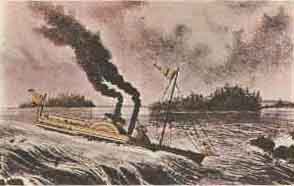
My wordless Wednesday image is reposted here. Look at the image very carefully. You see a large vessel going over a waterfall. Here’s a hint….the waterfall is Niagra Falls. Are you wondering about the long title to this post? All of those events have something to do with the picture.

Let’s go back to the years 1838 and 1839 and the presidency of Martin Van Buren. During his watch relations with Britain deteriorated to a very dismal state. One reason had to do with the Panic of 1837 where…..well, that’s another story for another time. I want to concentrate on the historical engraving and the Panic of 1837 can be a side cause to this ship going over Niagra Falls, but I’ll stick to the basics for now.

Part of this story also goes all the way back to 1783 and the Treaty of Paris which ended the American Revolution. Part of the treaty determined the boundary between the newly independent United States and Canada. The main problem area was between the Canadian province of New Brunswick and the territory of Maine which in 1783 was part of Massachusetts. Maine became a state in 1820 and settlers began staking claims even though the British claimed many of the same lands especially those in the Aroostook River valley. In fact, many of the new settlers were actually British who decided to cross the border to claim new lands….land Britain was claiming anyway. Many of the British were lumberjacks who spent part of the year on the Canadian side of the border and the other part of the year on the American side. Because many of land claims were so far away from the authorities many land claims went unfiled and ownership often overlapped.

There was another reason the British weren’t too happy with us during this time as well. Canadian rebels hoping to begin a republic had attacked their home country from bases established in the United States during a time in history Canadians remember as the Upper Canadian Rebellion.

Here is where I will defer to Wikkipedia as they give as good an explanation as any other I’ve seen:

A band of Canadian rebels, led by William Lyon Mackenzie, seeking a more democractic Canada, had been forced to flee to the United Strates after leading the failed Upper Canada Rebellion in Upper Canada (now Ontario). They took refuge on Navy Island on the Canadian side of the Niagra River, which seperates the two countries (between Ontario and New York) and declared themselves the Republic of Canada…

American sympathizers supplied them with money, provisions, and arms via the steamboat SS Caroline. On December 29, Canadian loyalist Colonel Sir Allan MacNab and Captain Andrew Drew of the Royal Navy commanding a party of milita, crossed the international boundary and seized the Caroline, towed her into the current, set her afire, and cast her adrift over Niagara Falls, after killing one American named Amos Durfee in the process. [His body was later exhibit in front of a recruiting tavern in Buffalo, New York.] It was falsely reported that dozens of America were killed as they were trapped on board; in fact the ship had been abandoned before being set adrift. Public opinion across the United States was outraged against the British. President Martin Van Buren protested strongly to London, but was ignored.

On May 29, 1838, American forces retaliated by burning a British steamer SS Sir Robert Peel while it was in US waters. The tensions were ultimately settled by the Webster-Ashburton Treaty. President Martin Van Buren sent General Winfield Scott to prevent further American incursions into Canada. Later that year, Irish-Canadian rebel Benjamin Lett murdered a loyalist captain who had been involved in the incident. As part of the Webster-Ashburton Treaty of 1842, the affair was settled by an expression of regret on the part of Britain that there had not been an immediate explanation and apology for the occurrence.

This incident has been used to establish the principle of “anticipatory selfdefense” in international politics, which holds that it may be justified only in cases in which the “necessity of that self-defence is instant, overwhelming, and leaving no choice of means, and no moment for deliberation.”

Look for next week's Wordless Wednesday History Mystery. Will you be able to guess what it is?

Thursday, December 07, 2006

The 2006 Weblog AwardsElementaryhistoryteacher is turning cartwheels…ok, those of you that know me personally know that I am physically unable to do this. It’s a long story for another time involving two dogs, and one narrow flight of stairs that resulted in a surgical steel rod, nine screws, and two pins installed into my ankle. But IF I could….

I’m turning cartwheels in my mind’s eye though.

I’m so very proud! I am a finalist for a 2006 Weblog Award in the category of education.

Take a spin around my blog and if you think I’m worthy please vote for me here. You are allowed to vote once each day through December 15th.

I’m so happy to be nominated and your vote is much appreciated.

Thursday Thirteen 4: Remembering Pearl Harbor


December 7th….per FDR a day that will live in infamy. He was so correct.

Today, sixty-five years later we are still remembering the horrendous attack at Pearl Harbor.

My Thursday Thirteen is dedicated to the many men and women who died, were injured, or experienced this shattering event on the day that formalized our participation in World War II.

Thirteen Facts about December 7, 1941…the Attack on Pearl Harbor

1. One source states the attack involved 300 Japanese planes. Bombers first attacked the airfield at Ford Island at 7:55 a.m. This prompted the dispatch, “Air raid---Pearl Harbor---this is no drill.”

2.More than 2400 servicemen and civilians were killed. 55 Japanese airmen were killed and one was taken prisoner.

3.19 ships were sunk or destroyed---

4. 188 planes were destroyed----155 planes were damaged. The Japanese had 29 planes destroyed and 4 of their mini-subs were sunk.

5.American intelligence had the knowledge we would more than likely be attacked, but they thought it would be somewhere in Asia.

6.Frank Knox, the Secretary of the Navy at the time, said, “No matter what, the U.S. Navy is not going to be caught napping.”

7.A series of errors kept the forces at Pearl Harbor from being warned of the impending attack.

8.Every member of Congress voted to declare war against Japan except for one. She was Jeannette Rankin of Montana.

9.The war declaration ended a long period of isolationism in the United States.

10.The attack on Pearl Harbor was not the only place Japanese forces attacked that day. The British lost the HMS Prince of Wales and Repulse

11. The Arizona is still submerged under the waters of Pearl Harbor and continues to be a memorial to the many men entombed there.

12. The damage at Pearl Harbor was devastating that day, however, vital oil tank farms, the Navy Yard and machine shops were not destroyed. The submarine base, a power base, and the Headquarters Building where the intelligence unit was located were left intact.

13. The Navy Yard and machine shops were key in getting six ships---Nevada, West Virginia, Tennessee, Maryland, California, and Pennsylvania----repaired and returned to service. The Oklahoma was initially capsized, was righted, but was never returned to service.

Wednesday, December 06, 2006

The Education Carnival-Edition 96

Welcome to the 96th Carnival of Education! I’m honored to host this edition and have enjoyed the experience. Since this was my first time to host I decided I would keep my presentation fairly simple. Perhaps I’ll get a little more elaborate the next time. Submissions are arranged acccording to curriculum and topic area in no particular ranking order.

There is something here for everyone so enjoy as the midway is now open…..

Social Studies

Henry Cate of Why Homeschool fame has found an interesting way to study political campaigns over the last fifty years. In this post titled Great Resource for Learning History he discusses this websource all educators would be proud to have on their “favorites”.

I’m offering up a mysterious picture here in my ongoing series of Wordless Wednesdays. I post a historical image of some type and you can try to guess what you think it is. I will post an explantion of the image by Friday of each week.

Digitalnative advises while The Atlantic magazine decided to list the Top 100 most influential figures in American history, they forgot to provide any details. So, this Digital Native decided to bring the list into the 21st Century. Here, you'll find a list of the Top 100 with a link to Wikipedia. It’s Beginning to Look A Lot Like…..

Darren at Right on the Left Coast wants us to take a look at calendar. Go on….you won’t be disappointed. You can see it in his post titled School Calendar

Students Do and Say the Darndest Things

NYC Educator states, “Smart kids can trick you and get away with murder, however I think old age and treachery always overcomes youth and enthusiasm (in the end).”
Intriguing, huh? Find out what he’s talking about in his post titled Four Girls.

Carol, The Median Sib, has a whole different spin on the story that goes “In 1492 Columbus sailed the ocean blue….” Now, what were the names of those ships again? Find out here.

This section probably should be corrected to say students and “parents” do and say the darndest things……Ms. Cornelius shares a story regarding expulsion for students who planned a fight at school titled Maybe the Principal Didn't Say "I REALLY Mean It"

Testing, Narrowing the Achievement Gap, and Meeting AYP

What would you do if 2007 was looming ahead and you still had not received your 2006 test scores? Alexander Russo from This Week in Education offers More Testing SNAFU Stories. Receiving them in May or the following January the results are the same…..backflips and high-fives or wailing and gnashing of teeth!

Alvaro at Sharp Brains provides Student Achievement Gap, Stress, and Self-Regulation and you can give your brain a work out and illuminate how your brain works at the same time with A Well-Deserved Break: Top 10 Brain Teasers

Guest blogger, Alan Bonsteel, M.D. at Edspresso discusses closing the achievement gap in his post titled Closing In on Closing the Black/White Educational Achievement Gap. He wonders if the Holy Grail has been obtained.

AYP, AYP, AYP, AYP…..is this some strange motivation cheer? I think not! Those three little letters either cause your administrators to rub their hands together with glee, or they become whip cracking authors of memos instituting policy change after policy change in attempt to fix whatever it is that’s broke. Absences are such an important part of making AYP, but an policy for truant students is only as good as the courts in your district. If they aren’t willing to do what’s necessary to get students to school it’s hopeless. In an excellent post entitled My Letter to Staff IB who authors Three Standard Deviations to the Left questions how students manage to pass even thought they aren’t in class.

Matt Johnston of Going to the Mat fame provides Wizard of Oz Diplomas which also takes a look at passing students along for the sake of passing them along.

Perhaps we could achieve some of the goals of NCLB if ALL of our students had the buildings they deserved. Ed at AFT has posted Build It Up at NCLB: Let's Get It Right. Go find out the sad state of conditions for some teachers and students as well as view the AFT report “Building Minds and Minding Buildings”.

Dan McDowell has posted My Castle over at A History Teacher. He furthers the conversation regarding building conditions and gives us a personal glimpse of HIS castle including a picture.

Self-Improvement

As a part-time Language Arts teacher I find it interesting to see how others advise writers. Lucas McDonnell provides a short article on how to become a better writer through using what you already know titled Write What You Already Know: 7 Effective Tips for Writers

With the New Year fast approaching you can’t help but begin thinking about resolutions. A little reflection and self-improvement goes along way. Steven Aitchison doesn’t mince words as he discusses Self-Discipline, Willpower, and Motivation at his blog titled Change Your Thoughts.

Educational Philosophy

Who said, “Except our own thoughts, there is nothing absolutely in our power”? Brad Hoge of HUNblog clues us in on who said it plus gives us some random thoughts regarding Kant on Constructivism.

Tammy over at Life Without School provides her philosphy of homeschooling in Zen and the Art of Homeschooling.

The Bluedorns discuss The Trivium Pursuit in a post titled Classical Q and A

Do you know who John Taylor Gatto is? John at Pick the Brain clues us in with his post A Teacher's Essay on the Public Education System.

Professional Issues

Every wonder why we have so few male teachers? Strausser over at A Teacher's Perspective states he has the answer. He verbalized his viewpoints recently in an interview for a magazine article. I hope he let’s all of us know soon which magazine we need to pick up! His post titled Shortage of Male Teachers provides us with a great preview of his responses.

In this post titled True Mr. NcNamar of The Daily Grind states he wants to give parents exactly what they want. After examining his proposal I’m all for it. Where do I go to sign the petition?

David Parker teaches college just up the road from me and now he’s joined the blogosphere. His blog titled Another History Blog is just a few days old. He gives some great insight into teacher evaluations with his post titled Beauty In the Classroom. Go welcome this new blogger!

This edition of the Education Carnival has two views regarding an educator’s autonomy regarding choosing curriculum sources we use with students.

What makes a resource appropriate or inappropriate for student use? Who makes that decision? What control do we as educators have? Matt Cheney at The Quarterly Conversation gives us his point of view in his post titled appropriately What Is Appropriate?

I don’t know about you…but blogging helps me think through an issue especially when I’m upset about something. Apparently I’m not alone. In her post titled Justification Aquiram of Teaching in the Twenty-First Century fame continues a discussion from an earlier post involving a recent situtuation where her choice to use a particular novel study with her students was questioned.

Now here’s a choice in curriculum I’m not so sure about….In his post titled The School of Chaos our esteemed EdWonk advises about the curriculum at the Brooklyn Free School.

“Bald-faced charter school hostility” is how Ryan Boots describes the attitude of one public school coach towards charters in general. Click on over and read Refusing to Play Charter Schools at Edspresso.

What is is an education carnival without a post or two from Mamacita at Scheiss Weekly? In her heartfelt post titled The Text Message I Expected But Didn't Want she gives a wonderful tribute to a friend and teacher. On a lighter note Mamacita explains just how much she loves her job in Then and Now: My Working Life

Like Mamacita, Dr. Homeslice is also in mourning for someone he admired. He has changed the background color of his blog to indicate he is Mourning Mooney . Click on over and discover who Dr. Homeslice admired so much.

Strategies to Help Students Succeed

Russ Egan over at The Student Help Forum offers us practical advice to any student writing a science report in his post How to Write Up a Science Report for High School

Do you know what problem posing is? Last year my team at school had a wonder in-service (yes, some are beneficial) on this very issue. Mister Teacher has posted a fine example of what problem posing is. Go take a look at what his students provided when they posed a few problems in his post Houston, We Have a Word Problem. I just love that title!

It’s never too late to learn as Me-Ander provides a great ABC lesson for her Seniors in a post titled Teaching the ABCs

Ms. SuperScience states a simple reason why some students fail in her post titled You know it's going to be a long day when...

Graduate School and Online Education

Through her own online education experience The Science Goddess examines the effect online courses may have on public education in her post Brick and Mortar Dinosaurs . She includes some interesting facts and number regarding this growing trend.

Mr. Lawrence was surprised when he encountered some major “tudes” as well as Whining In Graduate School. It would appear he had a quick refresher course in negative reinforcement.

Have you wondered which schools are The 25 Best Colleges for Nerds? Check out Online University Lowdown.

David E. discusses immigrants and jobs heading overseas in his post titled Immigrants Taking Jobs? Jobs Are Going Overseas.

Well, we began with Social Studies and we’ll end with it too……

Constitutional Issues

The Supreme Court entertained arguments on Monday regarding the Seattle and Louisville busing cases. Joanne Jacobs weighs in with her post Who Goes Where.

Didn't Tinker v. Des Moines Settle This? That’s what Greg is asking over at Rhymes With Right in his post regarding free speech and what students may wear and what they can’t wear. Go state YOUR opinion.

There you have it….the 96th Education Carnival. Thanks for visiting History Is Elementary and all of our worthy participants.

Next Week's Midway: The Carnival comes home to The Education Wonks. The deadline for submissions is: 8:00 PM (Eastern) 5:00 PM (Pacific) Tuesday, December 12. Submissions may be sent to: owlshome [at] earthlink [dot] net . Contributers may also use Blog Carnival's handy submission form: here.

The Midway should open Wednesday morning.

See the Education Carnival archives here.

Wordless Wednesday: Week 2

Sunday, December 03, 2006

Calling All Educators and Education Supporters!


The 96th Carnival of Education will be posted here on Wednesday, December 6, 2006. I'm honored to be your hostess.

Come one, come all……nominate those great posts by sending them to me at historyiselementary [at] yahoo [dot] com

If all goes well the midway will be open for your reading pleasure Wednesday morning since I will try very hard to post before I retire Tuesday evening.

Please get those posts in by midnight eastern standard time on Tuesday, December 5th.

Saturday, December 02, 2006

Martin Van Buren: He's So K-E-W-L


As technology races ahead in order to make our lives easier we are forever realizing there are trade-offs for a less complicated life. While email makes it possible to directly contact most anyone we must also put up with infuriating and at times comical email spam that fills our inboxes with ads for viagra, tales of lost Iraqi gold, or an invitation to join in on Nigerian banking intrigues. Desktop computers have led to working at home, instant publishing, and numerous ways to organize our lives. On the flipside desktop computers have opened up a portal to a den of inequity of pornography, gambling, and thievery which penetrates our humble homes and has a huge effect on business productivity. Cell phones had aided us enormously regarding safety and instant contactibility. The downside….instant contactibility. They are a curse and a God-send at the same time.

One of the problems we are seing more and more in education are the increased use of cell phones among our students at all grade levels during the school day. There are reports even parents do not hold sacrosanct instruction time and ring up their child when the whim strikes. Cell phones can be used to contact one another between classes, in class, and after school. Text messages can be used without the phone being detected at all. There are reports that cell phones at school have been used to bully other students, as cheating aids, and serve as disruption during instructional time. Text messaging has a language all its own. Short-cuts, half-spellings, and abbreviations abound. Now we are finding text messaging style is infiltrating our language arts classes, and there is a real concern text messaging will interfere with formal writing skills.

Just look at how the beauty of written prose can be changed through text message speak. Taken from Wikipedia look at this “translation” of William Shakespeare’s A Midsummer Night’s Dream:

If we shadowes ave ofendd. Thnk bt ths & al is mnded. That u ave but slumer’d ere; whiL thse visNs did appr; & this wk & idel theme; no mre yEldN bt a dream. Gentles, do nt reprehNd; if u pardon we wil mend; & I am honst Puck;

While we can decypher and “get through it” something is lost.

Interestingly enough abbreviated language is nothing new. How many times a day do you use the abreviation OK? We tell people we are OK when they ask how we are. We exclaim “OK!” when students finally seem to “get it”. We use OK at the end of question where we want some type of affirmation. Don’t bang on that desk again, OK? Complete the assignment and turn it into my box, OK?

So just how does the abbreviation for OK fit into a post regarding a past president and relate to text speak in the twenty-first century?

Stay with me while I connect the dots, OK?

Go on over to dot number one at American Presidents for the remainder of this post.

Friday, December 01, 2006

As Seen on My Computer Screen This Week...Items That Are Notable and Quotable (Version 2.0)


It already seems like my time off for Thanksgiving was days and days ago. My things to do list just keeps getting longer and longer and I feel like I’m constantly juggling a passel of cats and every one of them has their claws out.

At any rate while I have been foisting felines I’ve managed to run across some interesting things out and about and thought I’d share them.

I’m one of those third row Baptists….I don’t feel like I’m getting the message quite right if I’m not sitting in “my” seat. I hate change. I just don’t adjust well at all. That’s why I’m concerned about a new plan for new dollar coins. Not only will they feature Nixon ( I don’t really object to this…) and various other presidents they will be hiding “In God We Trust”. Yikes! Jet in Columbus over at Blogcritics offers this article New Dollar Coin Hides "In God We Trust" and Will Feature Nixon and Others. I Thought it would make a great topic for American Presidents, but Michael beat me to it with his take on the whole matter here. Jennie W., who also blogs at American Presidents, chimes in with a comment. What do you think? Do we need another coin?

Remember Wayne and Garth and their “NO WAY!”, “WAY!” banter? The Reflective Teacher previews a neat (can you tell I’m a child of the 70’s?) quiz type game students can partipate in online in a post titled Learning Can Be Fun and Exciting...Way or No Way. It takes “No Way!” and “Way” to a whole new level. Follow the link and have fun!

Dropping Knowledge looks extremely interesting. Information at the site states “Ask, answer, and discuss questions, download media, and use the searchable database to find social topics that matter most to you”. Some of the questions currently being discussed are “What is God’s religion?” and “Can the Internet and television be harnessed?” We all have opinions….maybe it’s time we go drop some of our knowledge at Dropping Knowledge!

If you are interested in using blogs in the classroom and anything else that has to do with technology check out EduBlog Insights

Topics From 192 Countries is a group blog. Every member of the group is from a different country. Unfortunately, they already have someone from the United States blogging for them, but your country may not be taken just yet. This blog has potential for lesson ideas, reading comprehension lessons, as well as geography. I’d peruse the site though before allowing students free reign.

Finally, in the immortal words of Rocky the Squirrel, “Here’s something I hope you’ll really like…..” I recently read a thought provoking post over at Open Up My Head and See What's On My Mind. Here’s a portion of what was written there:

“Too often in life we lay waiting, longingly gazing at our futures without ever really truly embracing them. We desperately cling to the hope of a journey---of an adventure. What we fail to realize as we do this is that the adventure has already begun; the adventure continues on with or without our consent.”

So true…so true! That wonderful wording really struck home to me.

I’m tired of my adventure continuing without me even realizing it.

I need to stop juggling those damn cats!

Mary Turner Sargent


I’ve joined several bloggers out and about who participate in Wordless Wednesdays. My first post was yesterday and can be found here.

I’ll continue posting a historical image on Wednesdays and will follow up with an explanation regarding the historical significance of the image by Friday.

This week’s image is a famous paining by John Singleton Copley of Mary Turner Sargent. A much larger and clearer image of the portrait can be found here. The painting was completed shortly after Mrs. Sargent’s marriage to Daniel Sargent of Boston who hailed from a very wealthy family of merchants and ship owners. Daniel Sargent was a Federalist and served in the Massachusetts legislature for a time and as a state senator. He was also a first captain in the Boston Light Infantry.

Mrs. Sargent was born in Salem, Massachusetts, where many of America’s first millionaires lived. She was born in what is now the House of the Seven Gables made famous by Nathaniel Hawthorne’s 1851 novel by the same name. Per the House of Seven Gables website no papers of [Mrs. Sargent’s] have been found, but the recent discovery of the letter books kept by her niece, Judith Sargent Murray, are revealing important information. In these letter books---in which Judith made copies of her correspondence to family and friends---the letters to or about Mary describe her as a woman of integrity, selflessness, and compassion.

Can you imagine sitting six hours at time for fifteen or sixteen times in order to have a painting completed? There is some evidence that this is exactly what Mrs. Sargent did per one of her sons.

Click on over and examine the larger version of the painting. What do you see?

Many of my commenters yesterday mentioned Mary Sargent’s very long neck. It does look rather strange, but in the larger image you see that she clearly has something tied around her neck. Even with that knowledge her neck is still long. Perhaps she appears to be quite tall and straight because of her undergarments. During this time period women of wealth were taught from a young age about posture. Of course, they wore whale boned corsets so they had no choice at standing up straight. They also had no choice at breathing as well!

We can see from Mrs. Sargent’s posture and placement of her hands that she was a wealthy, refined lady of social standing. Copley used copies of backgrounds from English paintings as well as the positioning of the subject and objects within the painting to give them an English feeling. In the larger version you can see that there is actually cascading water to the left of the painting. One of Mary Sargent’s hands is in the water and you can see she is holding a shell. Remember the famous painting called The Birth of Venus by Botticelli seen here.The shell Mrs. Sargent holds points to Venus who is a symbol of love and beauty while the water represents purity.

Copley may have been chosen to paint Mary Sargent’s image because he had quite a list of clients on both sides of the Atlantic and was well known in wealthy circles. Copley was very skilled at recreating the trappings of wealth in his paintings such as the clothing, the furniture, and of course the lace. Look at Mary Sargent’s arms. Even on-line the lace looks like you could reach out and touch it.

Mary Sargent eventually lost her life to water on the brain. One of her sons was Henry Sargent who became famous for his portraits while another son, Lucius Manlius Sargent was a writer and historian. I knew there was a reason why I was drawn to this family….

At the outbreak of war between the colonies and England, Copley had a decision to make. Should he see the war out in the colonies or the “mother country”? Either way he would alienate half of his customer base. After he was encouraged to study painting in London at the Royal Academy Copley chose to return to England. He never returned to the colonies, but we are left with little treasures like the painting of Mary Turner Sargent.

Thursday, November 30, 2006

Two Carnivals Involving History....I'm In Heaven

The midway over at the 44th History Carnival looks very full. I can't wait to dive in. It can be found here hosted by David Tiley at Barista.

Are you into ancient and medieval history? Check out Carnivalesque hosted by Even in a Little Thing here.

I've been doing some research into ancient African history and find it very interesting. The average person is aware of particular histories such as American, British, European, World.......but African history can be a mystery to some. I believe part of the problem stems from the fact that much of the history was oral and once imperialism reared its ugly head much of African history was lost or rewritten.

There's a whole other blog post in this ramblin'.....at any rate, go visit these carnivals.

You can never have enough history!

Wednesday, November 29, 2006

Thursday Thirteen: Week 3...Things I Remember


Thirteen Things I Remember.....Do you remember them as well?

1. The arches at McDonalds used to be part of the building style. They went through the building.
2. Scooby Doo without Scrappy Doo and guest stars such as Sonny and Cher
3. Record players and pieces of furnture that were referred to as “the Hi-Fi”
4. Televisions that were encased in huge cabinets.
5. Women wearing aprons
6. Little girls wearing crinolines…slips with layer upon layer of tulle that scratched your “hiney” when you sat down not to mention the panties with 50 layers of ruffles, the “big girl” tights that never stayed up, frilly, frilly white ankle socks AND shiny black patent maryjanes
7. Krystal (Whitecastle) burgers costing 17 cents a piece and the décor was shiny silver ala 1950’s diner…..the lettering on their cups and bags was in black with a splash of purple (it’s strange what you can remember…)
8. the Sears store on Gordon Road in SW Atlanta near the Dunkin Doughnuts had a large Winnie-the-Pooh display in the children’s department. It included a large tree. I always wanted to climb up the tree and visit with “Pooh” and Christopher Robin
9. when lunches at school were ONE choice only. You ate what you were given or starved….Most ate and amazingly no rights were violated at all
10. a time before middle schools. I went to school through seventh grade in the same building before switching over to the high school.
11. I remember Blue Laws…..everything including grocery stores closed on Sunday.
12. when teachers were RESPECTED and had AUTHORITY
13. when the once-a-year test was given over three consecutive days instead of interrupting instructional time for 14

Wordless Wednesday: Week 1

Update: An explantion to this week's Wordless Wednesday can be found here.

Carnival of Education: Week 95


The textbook edition of the Carnival of Education is up at A History Teacher. Dan has done a wonderful job hosting. Go on over and catch up with friends and meet a few new ones.

Next week’s carnival will be here at History Is Elementary! Submissions can be sent to historyiselementary [at] yahoo [dot] com. Make sure your entry is in before midnight on Tuesday, December 5th.

Now all I have to do is come up with a creative way to present everything.

No, no, I’m not nervous……:)

Sunday, November 26, 2006

It's Good to Be the King...er...Queen


Sometimes all you need is something very simple to move content along and to motivate students to think critically as any historian would do.

Prior to our Thanksgiving vacation my students were examining the Pilgrim colony at Plymouth and the later Puritan colony at Boston. Before that we managed to get Jamestown settled and coerced gold hungry men to work so they could eat real food ala John Smith.

It was at the point after we had taken a good hard look at initial French colonization that we turned to the Dutch. We discussed the purchase of Manhattan Island, the diversity of New Amsterdam, and the intolerance of people like Peter Stuyvesant.

It was at this point that I drew a blank outline of present-day United States on the board and turned to the class, “We’ve been talking about early colonization in North America. What are some of the colonies we’ve mentioned?”

Hands go up all over the class. I call on one young man. He answers, “Plymouth?”

“Are you asking me or telling me?” I counter.

He smiles and quickly states, “I’m telling you.”

“Great, then come on up and make a dot where Plymouth would be.”

The next dot to go up is for Jamestown.

Hands have continued to flap and wave during this exchange so while our first dot is going up on the map I call on another student.

A young lady wearing furry, mukluk type boots responds, “Roanoke!” in a loud, clear voice.

Another student agrees with her by saying, “Yeah, the Lost Colony.”

One of my arm flappers interjects more forcibly than he needs to, “But, it wasn’t a successful colony. It shouldn’t go up on the map.”

Other children argue it should be on the map. One student even says it should be on the map because it really is a place today. At any rate mukluk girl finally gets the marker and she makes her dot.

I refocus our energies by asking, “What about the Dutch colonies?”

We quickly get a dot up for New Amsterdam. I continue questioning students by asking, “Why would European monarchies allow colonization? What was in it for them?”

Various students summarize that colonies formed because the monarches granted permission through charters, and money was invested in companies like the Virginia Company in return for stock. Students advise that monarchs wanted colonies because it would give them power and prestige. My nine year olds don’t use the word prestige. I believe their wording was, “It would make them look good, it would make them look important, and others would like them.”

Finally I ask students to look at the map we had fashioned together on the board. I ask them to look at the map through the eyes of a king…..the king of England. “Look at your map. Look closely. Analyze it. What do you notice?”

We begin the answer dance where I’m peppered with various responses that are a mix of wild guesses and thoughtful attempts. I take refuge for a minute by sitting on my back table and swing my legs back and forth. I keep telling students to think, think, and think some more. I remind them to think like a king.

Finally, a revelation. One young lady observes, “The English colonies are divided.”

Someone agrees, “Yeah, the Dutch colony seperates the English colonies.”

“So. So what?” I respond, “Why is that a big deal?” We embark on a short discussion why it’s not a good idea to have territory split by a potential enemy.

I call on one particular young man who doesn’t appear to be involved with the rest of the class. Basically his head is below his desk and is actually inside his bookbag.

I approach his desk and rap on it. He sits up rather quickly. “Ummm, Uninvolved Student, what would you do if you were the King of England?”

Uninvolved sits up straight and for a moment looks like a deer caught in headlights. He looks around the room for a minutes and then he states, “Well…….if I was the king I would get rid of what’s in my way. I’d get rid of the Dutch.” He springs back to his original position....head in bookbag.

I stand there dumbfounded.

I guess some students can listen even when their heads are in a bookbag.

UPDATE: Make sure you check out the comments. One reader, Linda, asked a very good question concerning St. Augustine and Santa Fe----both established settlements during the same time period. I've posted my response in the comments section.

Dragging Things Out


I guess we are the only family in the United States actually smoking a turkey today. You’d think we’re tired of turkey after Thanksgiving, but Hubby Dear received a dandy bird from a client and well…..we have to eat, you know. We usually drag holidays out as long as we can.

Sometimes dragging something out is great and other times well….sometimes things can go on too long. Cinderella over at World of Royalty linked to two newspaper stories regarding the American Mohegan tribe and a request to meet with monarch of Britan dating back to the 1730s. Read the whole story story here and here.

This is most interesting. Everytime I visit Cinderella I find something wonderful.

A Mixed Post: Presidential Tag Clouds, Ease History, and Bad History


This is SO WAY COOL! I’m so excited about it in a geeky kind of way. Dave over at Patahistory has linked to something called presidential speech tag clouds. You can link directly to his post here and read about it. You can link the tag clouds directly by clicking here. Once you are at the tag cloud site notice the button directly under George Bush’s name. Click on it and you will find it can move back to the left. As it travels left notice the tag clouds….they zoom back in time through all of the presidents.

This has many possibilities for research and classroom use. Have students compare and contrast tag clouds. When is terrorism first mentioned? Which president mentions war? Is there a president who doesn’t discuss the economy? Another possible activity could be to have students compare the tag clouds to actual events during a particular president’s administration.

Feel free to comment and post any additional ideas you can think of.

Ease History is a great find. Just where have I been? The website states Ease History is a rich online environment that supports the teaching and learning of history. It contains video clips regarding historical events and core values. It also includes campaign ads from 1952 through 2004. Go and explore to see how you can use this in the classroom!

The Carnival of Bad History is up over at Philobiblon. Not sure what bad history is?

Now is great time to find out.

Saturday, November 25, 2006

Damn Good Dog!


I just love UGA, the University of Georgia mascot. I love him even more when we beat Georgia Tech in the annual rivalry game.

In case you aren't aware UGA is tussling with the mascot of the Georgia Tech Yellow Jackets. He won!

Damn fine game!

Friday, November 24, 2006

November Remembrance, Part One

Is it possible to love someone through another’s memory? To love and admire someone you never met, someone you will never be able to meet, someone who at the moment of their passing caused an incredible upheaval of grief and gouged an enormous chasm of longing for things that can never be, someone who a large number of people still speak of with reverence, awe, and thankfulness?

I believe it is possible.

I know it is possible.

I know it because I participate in this kind of love and admiration everyday for two vastly different Americans who left this Earth almost a year to the day from one another. My admiration for these two inviduals stems from my mother who shared her memories of them with me during my formative years where they became entertwined and linked indelibly in the murkiness where actual memory and grafted memories blend.

NovemberRemembrance

I was six months old on Saturday, November 24, 1962. Naturally I have no real memories of this day. What I know comes from Sister Dear who was six at the time. We had just celebrated Thanksgiving the previous Thursday. More than likely my parents had driven my sister and I to their shared hometown to visit with my Dad’s folks and then my Mom’s. Little did anyone know it would be the last time my Mom saw her mother alive. Sister Dear recollects the phone ringing that Saturday afternoon and nothing ever being the same again. She tells me now that Mother began wailing and flung herself across her bed. Sister Dear remembers simply standing and staring at Mother as she became a grieving, heaving mass of pain. When she remembers that moment she sees a collage of images of mother mixed with the piney hardwood floor of our hallway, the old radio that had been mothers as a teen now used as a phone table in the hallway, and how time seemed to stand still. Sister Dear was watching Mother’s agony as she had been told her mother had been found dead of a heart attack at the age of 62.

It was sudden. It was cruel. It was not what anyone would have expected. In writing that my Mother has left behind she states Nanny was tall and slender with broad shoulders. She had beautiful skin and dark, thick, course hair. She was a great cook and seamstress----most of the clothes my mother wore were handmade by my grandmother. She was always a cheerful person---smiling, laughing, and always hid any problems she might have---plus she always wanted to do something to help people who were less fortunate than herself.

Sister Dear speaks of our “Nanny” by describing her simply as FUN. She remembers having great times with Nanny. In every picture I have ever seen of my grandmother she is wearing a June Cleaver type dress…..shirtwaist, short sleeves, and full skirt. Sister Dear tells that Nanny would place her in the hem of her skirt and swing her back and forth. That had to be fun. Sister Dear tells of waking on warm mornings and gazing up on the wall where a picture hung of a little boy and a little girl. They were about to cross a bridge and an angel was hovering at their shoulders. She has told me this picture actually scared her. We were told as children that the boy and girl were on their way to Heaven. I remember the framed print too…….it scared me as well. Sister Dear has told me she would lie in bed the longest time and try NOT to feel sorry for the kids, but it was hard. As an adult I now understand the significance of that print. My grandmother had bore tragedy upon tragedy as young woman. Her first husband had been shot to death in front of her, and she had lost three children….one to sickness, one got ahold of some medicine that had been left out, and a baby boy had been born dead. The print that scared my sister and I so probably gave comfort to our grandmother and might have been the reason it hung in the spare bedroom.

Once up Sister Dear would walk into the front room and find a big bowl of blueberries on the floor between the screen door and door jam. She’d sit on the gritty floor and munch away. It always seemed, Sister Dear says, that Nanny would just know she was up and awake. She’d turn from her chores in the garden and give a hearty good mornin’ wave, and Sister Dear's day of fun would begin by building a playhouse out of tongue and groove planks and a cardtable Nanny would provide for her. I’ve always been told Nanny loved working with plants and apparently she could get anything to grow anywhere. Sister Dear remembers Nanny always smelled deliciously of outside, sunshine, and fresh turned earth. Things could be done at Nanny’s house that could not be done at home. Nanny always allowed Sister Dear to make mud pies on the porch not with water, but with real honest to goodness buttermilk.

Sister Dear remembers Daddy holding her as they stood in front of the casket set up in the front room of my grandparent’s home, and she remembers the funeral which took place at the one room wooden church with the obligatory outhouse in the back plopped in the piney woods where three generations of my mother’s family scratched the dirt. The land for the church had at one time been part of the family farm, but my great grandfather had donated it to the church folk. Nanny was laid to rest in dirt that was home to her. Sister Dear remembers a long service, our distraught mother who we now know had been given something to keep her calm and quiet, and the long row of our grandfather’s half-sisters who were actually more in line with our mother’s age than our grandfather’s. Each dear aunt took her turn holding Sister Dear in her lap….first Dee, then Blanche, then Claudine, then Nelle, and Elizabeth and then back to Nelle, then Claudine, then Blanche, and then Dee where the whole process started over again.

Mother grieved. Years later Mother spoke of grieving hard. She often said the knowledge that she had to take care of Sister Dear and I got her through, but there were days she didn’t know if she could make it. Our grandfather grieved hard as well. Sister Dear remembers his home being fun. I remember it as dark and dusty shrine much like the Haversham bedroom in Great Expectations. Many things were left exactly like they were the day Nanny left us even down to her pin cushion which always hung on a nail in the hallway with the pins in it just like they were the last time Nanny used it. As I grew older it remained hanging on its nail fading in color with the dust eventually caking over it until it was practically rotten.

The remainder of this post can be found at American Presidents Blog here.

Thursday, November 23, 2006

Happy Thanksgiving!


DON'T FORGET TO KISS THE COOK.......

Thursday Thirteen 2, Thanksgiving Myths

Thirteen Things about THANKSGIVING MYTHS

1. The Pilgrims celebrated the first Thanksgiving. There is much debate where the Pilgrims held a harvest celebration or a time of thanksgiving. They did not refer to their three day feast as Thanksgiving as we refer to it. This feast did not become a yearly event, and it was not until the 1800s that Americans began to think about a regular Thanksgiving celebration.

2. Since it was a harvest celebration God was left out. The Pilgrims were a very religious group. To think they didn’t pray or include God in their celebration would be denying who they were.

3. Pilgrims……Puritans, they were all the same. The Pilgrims were Seperatists who disagreed with the Church of England. They preferred to leave England and settled in Holland before sailing for “Northern Virginia”……..actually present-day Massachusetts. The Puritans came over later and began settling in the area of present-day Boston.

4. Pilgrims wore dark clothing and per many of the paintings and school pageants where the feast is portrayed Native Americans wore feather headresses. In probate records from the time period we find inhabitants of Plymouth owned cloaks of red and clothing of various hues. The large buckles we are so fond of using to recreate Pilgrim clothing did not come into use until the late 1600s. Wampanoags would not have worn headresses in the manner of Plains Indians. They also did not live in teepees.

5. The Pilgrims were the only group to have a time of thanksgiving. Records indicate many different European groups in North America had times of thanksgiving including the Spanish in present-day Texas and in St. Augustine during the 1500s. The settlers at Berkeley Plantation, Virginia also make a claim of having an earlier thanksgiving celebration. Ultimately various Native Americans of North America must have the distinction of a harvest celebration and/or time of thanksgiving as they had done so for thousands of years as part of their culture.

6. They ate turkey. While we are certain through various records of the time they ate deer we are not certain about turkey. Records indicate fowl was served, but historians continue to debate the turkey issue. It is certain that many of the dishes we consider traditional today were not served at the Pilgrim’s feast.

7. The Pilgrims lived in log cabins. Many of the images that have been created over the years show Pilgrims living in log type cabins. This is incorrect. For many months the Pilgrims continued to use The Mayflower as a home. Slowly, wooden, clapboard building were fashioned to house the Pilgrims and their possessions.

8. The Pilgrims prepared the food and invited the Wampanoags. Like any pot-luck everyone participated. The Pilgrims would have prepared some of the food and Massasoit, along with 90 of his braves brought several deer.

9. After three days of feasting there must have been tons of dishes to wash. My students are usually delighted to find out that the early Pilgrims would have had no plates and there wasn’t a single fork at Plymoth Plantation. They ate with their hands.

10. The term “Pilgrims” was not in use until the 1870s. William Bradford states “They knew they were Pilgrims.” in his Of Plimoth Plantation. He was there. He should know.

11. William Bradford issued a Thanksgiving Proclamation in 1623. Jeremy D. Bangs gives a great debunking to this misconception here.

12. The Pilgrims were grave robbers. Written first-hand accounts of people who were there indicate they found graves, examined them, but left things intact. They did find buried corn and carried some of it away with them.

13. Celebrating Thanksgiving is a slap in the face to Native Americans and should not be done. True, after Massasoit died things began to get increasingly tense between the Wampanoags and all European settlers in the area including the Pilgrims. King Philip’s War is proof of that. Perhaps we could look at Thanksgiving as the time that once was…..the time when there was a promise of doing things in a more congenial manner. Thanksgiving should not be looked upon as a celebration of domination or a time of mourning……it serves as an important lesson that Europeans and Native Americans were not always at odds. They could cooperate and live together. There are lessons to be learned from the breakdown of relations.


Links to other Thursday Thirteens!1. (leave your link in comments, I’ll add you here!)

Get the Thursday Thirteen code here!

The purpose of the meme is to get to know everyone who participates a little bit better every Thursday. Visiting fellow Thirteeners is encouraged! If you participate, leave the link to your Thirteen in others comments. It’s easy, and fun! Be sure to update your Thirteen with links that are left for you, as well! I will link to everyone who participates and leaves a link to their 13 things. Trackbacks, pings, comment links accepted!


Wednesday, November 22, 2006

What's All the Hubbub, Bub? All I Want Is Turkey, Family, and a Little Football

Tomorrow is Thursday and folks who participate in the Thursday Thirteen meme will be posting their list for the week. I posted my first list last week. I decided to join the meme because it looked interesting and I thought it might be a great way to attract people to this site who are not involved in education. I decided that I could incorporate history and educational issues into my list each week.

Since tomorrow is Thanksgiving I thought a list of Thanksgiving myths or misconceptions would be appropriate. Wow, there is quite a debate going on out there, and a multitude of misinformation exisits even on the debunking sites.

The first thing I did was google “Thanksgiving myths”. After I had gone through the first couple of pages of hits my head was actually reeling. There is a large amount of information, misinformation, and spin…..not to mention a large amount of copycats.

One website attempts to take on all comers and actually attempts to use primary sources to support his thoughts. Imagine that! Jeremy Bangs, a former curator at Plymouth Plantation, has posted an excellent posting which wades through many of the myth webpages zipping around the Internet. You can see his three-page work here.

Mr. Bangs states:

Surveying more than two hundred websites that “correct” our assumptions about Thanksgiving, it’s possible to sort them into groups and themes, especially since Internet sites often parrot each other. Very few present anything like the myths that most claim to combat. Almost all the corrections are themselves incorrect or banal. With heavy self-importance and pathetic political posturing, they demonstrate quite unsurprisingly that what was once taught in grade school lacked scope, subtlety, and minority insight.

One could go on. Someone should go on. To respond to all the assorted internet nonsense about Thanksgiving it is necessary to go on and on.

He then refers you to the site I have linked to above.

History News Network has some great articles up under the heading “Thanksgiving” but they appear to be a repeat since many of the comments are dated 2002 and 2003. An item under “Breaking News” caught my eye.

In an Associated Press article titled Teachers Emphasize the Indians reprinted here there is a discussion regarding how many elementary teachers are abandoning the romanticized version of Thanksgiving and settling for the more realistic version. The article discusses a teacher who attempts to get students to realize Europeans came and took possession of lands without any thought that they might already belong to someone else.

“I think that is very sad,” said Janice Shaw Crouse, a former college dean and public high school teacher and now a spokewoman for Concerned Women for America, a conservative organization. In criticisim of the teacher detailed in the article Ms. Crouse states, “He is teaching his students to hate their country. That is a very distorted view of history, a distorted view of Thanksgiving.”

Personally, I think Ms. Crouse is wrong. There is a place in our classrooms for the realistic as well as the romanticized versions of history including Thanksgiving. My students realize that when Columbus landed in the Carribbean and claimed the land in the name of the Queen of Spain it wasn’t his to claim. Does the fact that my students understand Plymoth Plantation was once a Patuxet village and the Pilgrims simply took it over mean they will hate their country? I think not. I think the knowledge helps them to understand their country better.

That being said I firmly believe a great responsibility lies with the classroom teacher to help students bridge the gap between realism and romanticism. We should provide enough background to students so they see the context of the time period. I explain to students that we are constantly uncovering new information that can be documented about historical events. Many things I learned in school has since been updated. Many things they learn today will more than likely be updated as more investigation is made.

Rick Shenkman, editor at History News Network weighs in here with Top 10 Myths About Thanksgiving.

Timothy Walch tries his hand with Thanksgiving Myths here. He states:

So what do most Americans believe happened on that first Thanksgiving Day? Most still cling to what they learned in elementary school. The Pilgrims sat down with Indians for a big meal of turkey, cornbread, cranberries and pumpkin pie. The Pilgrims dressed in black, and the Indians wore feathers and colorful beads. In fact, many Americans today still recall if they were "pilgrims" or "Indians" in their school pageants.

It's a charming story, but it's a myth. To be sure, it's a powerful one -- one that will be repeated many times this November. The fact that it's so pervasive is evidence that American myths have long lives.

So it's a good thing that Americans today are not tested on the history of that first Thanksgiving, because few of us would earn a passing grade. It seems that the historical evidence of Thanksgiving is not as compelling as the myths that cloud our memories. It's too bad that childhood images of Pilgrims and Indians aren't based on historical facts.

Here is the part of Walch’s essay that really hit home for me:

And yet there's a legacy about this holiday that threads its way from past to the present and defies both myth and historical evidence. That legacy is generosity. To be sure, Americans today may not be as religious as the Pilgrims, but most Americans do share their plenty with their family and friends on this special day. It's a holiday that brings all Americans, no matter their creed or disposition, together. And that's something worthy of our thanks.

Does it matter what they served, who served it, what they wore? I agree with Mr.Walch. We need to remember for one brief shining moment Native Americans and Europeans, though they may have been wary of one another, sat down and broke bread. They shared a meal, they interacted, they tried to understand each other. It would be a shame not to share this fact with students as well.

We can all argue, quote, and requote, until kingdom come but one thing is for sure. Just like in any historical investigation we need to look at the artifacts and the written sources. If you can’t verify it then it is simply conjecture. I’m going to post my list of 13 myths tomorrow. Anyone who wants to quibble is welcome to do so, but come armed with primary source documentation from the various writings of Willam Bradford or other involved people of the time.