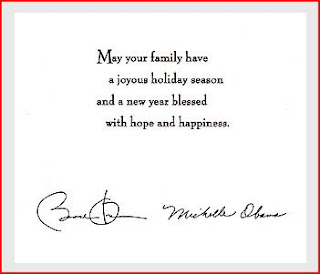
As my regular readers know I contribute articles to American Presidents Blog and for that reason I became interested in researching and writing about the yearly White House Christmas card that have been sent out by each president since the 1950s when it became an official practice of each administration.
So, last month I once again began my search for the first card of the Obama administration. It’s been difficult to say the least, and I’ve found a little art mystery as well that has really challenged my research abilities.
First off….even several days into December the only image I could find was the a picture of the inside of the card showing the sentiment and signatures. I’ve posted it below.
It truly astounds me that a painting has been so grossly misidentified.
Past articles of mine regarding the White House Christmas greetings can be found here, here, here, and I’m still looking for that original Wyeth painting that was used for the Nixon Christmas card from 1971. It’s also a mystery…..
1. While I was roaming around Biltmore over New Years I became enthralled with the ornamentation found everywhere along the 780-foot façade. I love to take close-up pictures of architectural details, and Biltmore provides me with all sorts of delights.
2. One of the things that Mr. Elementaryhistoryteacher and I focused on were the many gargoyles on the house. The word ‘gargoyles’ is derived from an old French word gargouille, meaning throat. The English words gargle, gurgle, and gargoyle are derived from gargouille.
3. Some believe that gargoyles – sometimes called grotesques – are inspired by the skeletal remains of prehistoric dinosaurs and other fossils. Originally a gargoyle was considered a waterspout, directing water away from a building.
Yes, I agree.....the figure below seems rather proud of his ummmm.....attributes.
4. Technically an architect calls a waterspout on a building a gargoyle. It a stone carving does not carry water and has a face that resembles a creature, it is technically called a grotesque.
5. Many people believe that gargoyles were created by medieval architects and stone carvers to ward off evil in an imperfect world.
6. The creatures - gargoyles, grotesques, and chimeras - that decorate the façade of Biltmore House are fantastic, frightful, and fanciful. They lurk in virtually every nook and cranny from parapets, upper balconies and slither from the groins of the ornately arched windows.
7. Why are they there? Richard Morris Hunt, the architect of Biltmore, took cues from the French renaissance and Gothic styles….The influence is evident in the proliferation of curious creatures that embellish it; gargoyles have been fixtures on the cathedrals, public buildings and grand homes of Europe for centuries.
8. The masons of the Middle Ages expanded on this theme by introducing non-functional decorative elements depicting animals and humans in a grotesque (and often humorous) style, or letting their imaginations run wild with chimeras: mythical beasts that combined elements from various creatures. The gryphon, which has the body of a lion and the head and wings of an eagle, is a well-known example.
9. The monsters that adorn Biltmore House were actually dreamed up by Mr. Hunt’s architectural team.
10. Plaster prototypes of each individual statue were provided to the project’s master stone carvers, who had been imported from major cities such as New York and Chicago.
11. Working in a tent city set up for the construction crew on the estate’s esplanade, the carvers defined the basic contours of the Indian limestone sculptures on the ground, and they finessed the detail in place on the façade.
12. The home’s minor grotesques give us a glimpse of the individual style of the anonymous makers.
13. Major works, such as the two fearsome sentinels that overlook the main entrance, were executed to the architect’s specifications…..
Vocabulary is key when teaching any subject from Math (integer….diameter….cotangent ) to Science (antimatter…circuit…velocity) from Language Arts (compound sentence…simile…alliteration) to Social Studies ( amendment…capital resources…inalienable). If students are unable to master and manipulate the subject’s vernacular they will encounter difficulty reading various texts, understanding their notes, and once April rolls around the student might not be able to understand the questions on the all important state mandated test.
Vocabulary acts as the foundation for each instructional unit. In fact, Marzano contends in his book Building Academic Vocabulary (2005), “…students in the 50th percentile in terms of ability to comprehend the subject matter taught in school, with no direct vocabulary instruction, scores in the 50th percentile ranking. The same student after specific content-area terms have been taught in a specific way, raises his/her comprehension ability to the 83rd percentile.”
Yes, specific content-area vocabulary instruction IS very important.
Once students begin to study the English colonies the vocabulary list takes on a who’s who of colonial founders and governors along with words like indigo, indentured, and apprentice, but tucked away within the list is a great word……the word artisan.
An artisan is someone who works with his or her hands to create a product. Prior to the Industrial Revolution artisans produced goods using creative thinking and took great pride in the products they produced. If they didn’t…well, their customer base would suffer, and they wouldn’t be very successful. Knowing the customer’s needs and keeping them happy with quality work was very important.
In fact, the work of the blacksmith was bespoken meaning he only worked at the request of others.
One type of colonial artisan I like to spotlight for students is the blacksmith, and the why behind my choice is very simple. Of all the craftsmen that came to the New World the blacksmith was the most important. In fact, other types of craftsmen couldn’t have done the things they did without the help of a blacksmith.
A blacksmith forges and shapes iron with an anvil and hammer.
This article explains how the blacksmith makes the anvil sing an ancient hammer language. ”It’s a 50-part language that’s tapped out on the anvil….It’s the first thing an apprentice learns, because it’s the language that the master uses to converse with the strikers (helpers). The anvil makes a different sound depending upon where the hammer strikes. The apprentice knows where to hit the metal on the anvil based upon the “song” the master plays.”
Not only is there a special language within the singing of the blacksmith’s hammer the color of the heated metal also has a language of its own. Since early blacksmiths had no thermometer to gauge the temperature of the heated metal they learned how to judge the color. The color provides the information they need to determine when the metal is ready to twist and turn. This is the main reason most blacksmith shops are dimly lit so that the blacksmith can see the fired metal.
Hmmmm….it would seem that the blacksmith has his own content-area vocabulary….language that involves two of his five senses including observation and hearing.
Over the New Year’s holiday I got the chance to see a true blacksmith in action at the Horseshoe Bend area of the Biltmore Estate. Doc W. Cudd, Jr. (seen in my pictures with this article) gave an excellent demonstration in his smithy shop, found in the property’s 1902 horse barn, that enthralled a crowd of young and old alike. He explained that over the last 450 years there has always been at least one blacksmith in his family.
From this article I discovered that Doc Cudd received his first anvil at age 9, and began apprenticing under his dad and great uncle at age 10. After progressing to journeyman, he passed an intense test—just one portion took 18 hours—and became a blacksmith in 1995.
The article continues…."When people come see me at the barn, I always want them to feel like they're sitting on my front porch," he says. His rapport with guests is evident—he has a collection of 150 pictures that guests have sent him commemorating their River Bend Barn visit."
As I entered the smithy shop it was a tight fit as folks had stopped in and decided to stay awhile to listen to the demonstration. It is clear to this teacher that Mr. Cudd loves his profession and not only is he a master blacksmith, but he’s a master teacher as well. Passion is the true ingredient for any teacher …..and it is so very evident with Mr. Cudd.
Mr. Cudd puts the capital "A" in the word Artisan.
I witnessed Mr. Cudd creating one of his signature key rings….a key ring that is sold in the barn’s gift shop…..at the end of his demonstration he presented it and held it aloft so we could all see it.
and yes, Mr. Elementaryhistoryteacher just had to have one.
We might just have to "throw-down" over who gets to carry it.
Resources:
The poem, The Village Blacksmith by Henry Wadsworth Longfellow can be found here
A video created in 1893 titled “Blacksmith Scene” can be found here. It was first kinetoscope shown in public exhibition and was created through the Thomas Edison Laboratory. The Library of Congress selected this video clip for preservation by the National Film Registry for being “culturally, historically, or aesthetically significant.”
A great little sample chapter regarding content-area vocabulary instruction can be found here, and a slide-show featuring Marzano’s findings regarding vocabulary instruction can be seen here
When I was high school there was this girl a couple of years older than me who wore pink every chance she got. We were required to wear school uniforms, but had the choice of adding jewelry and scarves in order to feed the need to be unique and different.
I threw my identity out for others to see by using an antique men’s collar bar to pin various handkerchiefs to the lapel of my “required” navy blazer. I alternated between a handkerchief my mother had brought back from a trip to the Caribbean and one that belonged to my great grandmother I had found languishing in a drawer at my grandfather’s.
But this acquaintance of mine absolutely adored pink…..she accessorized with all things pink that she could get away with and constantly announced to anyone, much like Shelby Eatenton in the movie Steel Magnolias, that “pink was her signature color.”
Unfortunately my friend and even the character of Shelby Eatenton can’t exactly corner the market on credit regarding the signature pink line because a former First Lady has that honor.
Mamie Eisenhower.
Find out more about Mamie’s signature color and her impact on Christmas at the White House in my post at American Presidents Blog
Around my house the Great Awakening is when Dear Daughter is roused each school day morning. We yell…we cajole…we holler something akin to the Rebel Yell.
Nothing meets us but dead silence.
We bang the wall.
Finally and faintly we hear, “I’m up!”
Of course, that’s not the end of it – we will have to repeat the exercise at least four times for her to be truly up, and I’m never at ease until I see she has finally made her way down the steps.
It is a cross we bear as parents of a teenager, I guess……among many other crosses.
In history the Great Awakening refers to periods of great religious revival in our nation. The approximate years for the first Great Awakening occurred from the 1730s to the 1760s, and the movement mainly consisted of changes regarding how pastors approached the delivery of their sermons moving from a heavy dose of theology to more of an appeal to the emotions and practical application.
While it is easy to discuss the attacks on religion today we need to remember that by the end of the 1700s many church leaders knew their hold over Americans was weakening mainly due to the growth of scientific knowledge and nationalism.
The Second Great Awakening occurred from the 1790s to the 1840s after church leaders had mobilized and organized so to speak…..
While the second movement spread to various areas north, south, east and west it began in Kentucky of all places in the middle of frontier farmers, and spread rapidly mainly through the use of circuit preachers who traveled from town to town and sometimes from house to house.
The main denominations in the movement tended to be Methodists, Baptists, and Presbyterians. Church leaders held camp meetings that went on for several days promoting the message that individuals must include God into their daily lives and rejected the Calvinistic idea that only a chosen few were predestined for salvation. Church leaders preached all could attain grace through faith and faith alone.
Charles Grandison Finney, a Presbyterian minister, was one of the better known leaders of the Second Great Awakening. He is remembered as the father of Modern Revivalism. He freely admitted to using emotion to reach people and compared his methods to politicians and salespeople.
Most of Finney’s messages were delivered along the Erie Canal in upstate New York and other cities in the Northeast. He believed people could be made perfect by striving for high morals. Finney’s preaching style was very innovative for the times. He allowed women to pray openly at meetings that included mixed genders. He employed the “anxious seat” which was a place for people to receive prayer when they were under conviction of becoming a Christian.
Finney’s sermons and prayers often publically censured people by name. He denounced slavery. He also became a major naysayer of the Freemasons after he resigned the organization in 1824.
He served as the president of Oberlin College in Ohio, the first US college to admit women and African Americans.
In most history textbooks today very little is said about either Great Awakening movements. Some texts devote a small section briefly describing the movements and then rapidly move on to other things.
Why?
The only plausible reason I can think of is the movement involves religion….often a touchy subject for any public school classroom, but I’m of the opinion that educators are failing their students when they merely touch on….basically gloss over… certain aspects of the American story merely because it involves religion.
Both movements had a huge impact on American religious history in that the Baptist and Methodist denominations took a more dominant role in American society.
The initial Great Awakening movement played a key role in the American Revolution by providing an arena for democratic concepts to be shared freely and openly.
The second movement took advantage of westward expansion and zeroed in on reform in many areas of American society –abolition, temperance, prison reform, care for the handicapped and mentally ill, and women’s rights – and argued that God’s plan included those reforms. Personal piety was favored over religious education and theology.
Getting back to Dear Daughter and the monumental efforts it takes on the part of her father and I to wake her….it always amazes me that on the days that she has to be up early…say 5 or 5:30 to attend a wrestling match where she keeps score and does other administrative things she gets up on her own with absolutely no problem at all.
Hmmmm….the difference?
Well, she is a teenage girl, and there is a boyfriend…a boyfriend who just happens to be on the wrestling team.
Perhaps Charles Grandison Finney and the other Great Awakening ministers DID understand the people and their needs.
Give them what they want….give them what they need much along the lines of politicians or salespeople and by appealing to their emotions.
But, at some point it would seem that the basics of faith suffered at the hands of the ministers of the Great Awakening…. just as Dear Daughter’s sense of responsibility could suffer if her father and I didn’t hold her accountable for every day of the week instead of just when the situation is appealing to her.
Well, I’m waiting….I know they have been placed in the mail but haven’t seen an image of this year’s White House Christmas card…..yet. I know I won’t be getting one from the Obamas, but many people will be finding a card from the White House in their mailbox this week.
For the last three years I’ve mentioned the card here at History is Elementary and published an image at American Presidents.
While we are waiting for this year’s card to arrive here are some links to past postings regarding the White House Christmas card:
History is jam packed with moments…..moments great and small. For someone like me they are all equally intriguing….all equally important though some actually get a little more play in the classroom than others.
If I had to ask you about your top ten list for events in American History more than likely we would all have varying lists with a little overlap.
I’m sure that most of you would include events from the Pilgrims landing at Plymouth Rock, the Boston Massacre, or even Dr. King’s “I Have a Dream” speech.
My events would be a little more obscure (for some)….Shay’s Rebellion, the inception of The Manhattan Project, the Election of 1800, the March on Washington Movement (1941-1947), or the Battle of Fallen Timbers.
I’ve looked through their list and there are many gems there. Some that rose to the top for me include:
World War II: The Lost Color Archives: One of the most devastating wars in the history of mankind, this five part series contains many lost images of the war presented in color. There are images of many turning points in the war and even images of Hitler himself.
The Declaration of Independence: The birthing document of the United States was signed on July 4, 1776. Mel Gibson, Michael Douglas, Whoopi Goldberg, and others recite it word for word. Gettysburg Address: Abraham Lincoln gave this speech at the Soldiers’ National Cemetery in Pennsylvania on November 19, 1863, at the height of the Civil War. Actor Jeff Daniels reads it over a slideshow of historical images
First Moon Landing: The Russians beat the Americans to space, but Neil Armstrong played a pivotal role in history when he set foot on the moon in 1969. This short video is actual footage of the moon landing, including the historic line.
Go on…..go take a look and find something to occupy your time in a fashion that will inspire you and remind you that we do live in a great nation with a great and long history.
Dig down deep into that creaky file cabinet in your mind and pull out the folder labeled “Vikings” and name a few of the more famous ones for me.
I’ll wait.
No, not the football team. There should be another folder there for the OTHER Vikings. You know, the Norsemen who were explorers, warriors, merchants, and pirates.
There you go. That’s it. Wow, that folder hasn’t seen the light of day in…..well, just blow the dust off it and open it up.
Canute (Knut or Cnut) Sweynsson….better known as Canute the Great….King of England, etc.
Those are usually the top three names I get. Most of the time folks just give me Erik and Leif.
What about Thorfinn Karlsefni?
Yep, you are so very right. Who in the heck is Thorfinn Karlsefni?
Well….here goes….
1. Thorfinn was a Norse merchant who followed Leif Ericsson’s route seven years later.…around 1010 AD…to North America.
2. While on a trading trip to Greenland Thorfinn met and married Gudrid Thorbjarnardottir, the widow of Erik the Red’s son, Thorvald. (Believe me, I’m glad I don’t have to type these names every day.)
3. Snorri, the son of Thorfinn and his wife is thought to be the first European baby born in North American.
4. The location of Snorri’s birth it thought to be Buzzards Bay, Massachusetts. Other locations given include Long Island Sound, the Bay of Fundy, or L'Anse aux Meadows
5. Three years after arriving in North America, Thorfinn and his men abandoned the settlement they created and went to Greenland first…..then Norway and finally settled in Iceland, his childhood home.
6 Why was the North American settlement abandoned? Perhaps distance was the key. Some scholars theorize that Vinland was to the Vikings like India was to Alexander the Great…..it was beyond the Viking’s ability to impose their will. Others argue that climate change was the culprit.
7. You can find a statue of Thorfinn Karlsefni in Philadelphia, Pennsylvania....pictured here with my post.
8. Thorfinn grew up in Iceland and can count Aud the Deepminded, a queen from the British Isles and Ugarval, King of Ireland in his lineage though I have found no verifiable reference to Ugarval.
9. Archeology supports the long-held theory that it was Thorfinn who began the tradition of telling the Viking sagas that were passed down from generation to generation.
10. Sagas recount for most of our knowledge regarding Viking history, but it is important to remember we must separate Viking fantasy from Viking fact. Archeology lends credence to the sagas. Sagas that include Thorfinn explain he left North America after a clash with Native Americans.
11. One of the sagas tells the story of Freydis and Thorvald…a married couple that accompanied Thorfinn and his wife to the New World. When attacked by Native Americans the saga states that the Viking men ran off leaving a pregnant Freydis to scream after them, “Why do you flee from such pitiful wretches, brave men like you? If I had weapons, I am sure I could fight better than any of you.” At this point Freydid picks up a sword and exposes her breast to indicate she is a woman and frightens off her attackers. There are other versions of this particular saga…..
12.Once he settled in Iceland the records indicate Thorfinn never returned to North America.
13. Archeologist discovered a turf mansion believed to belong to Thorfinn in Iceland.
An online article regarding Thorfinn and the archaeology that proves some of the sagas concerning him can be found at Smithsonian Magazine online.
Other bloggers participate in Thursday Thirteen. You can learn more about the meme or find links to other participants here
Halloween night Mr. EHT and I received a phone call that every parent dreads…one from a stranger identifying himself as an EMT.
My mind worked furiously to comprehend what he was saying, but all I wanted to say was, “Surely sir, you have the wrong number.” He just kept rattling off information ---he was with my daughter, there had been an accident, he and his wife ( a nurse) had been driving by, he assured me they would stay by Dear Daughter’s side until she was in the ambulance.
Ambulance??????
I finally got the words out…..”Is she….is she ok?”
The voice on the other end of the phone said, “Yes, she’s complaining (hmmmm…….complaining….that’s good, I thought) of back and neck pain, and they have her on a backboard to stabilize her until they can see what is causing her pain.
After arriving at the hospital, Mr. EHT and I discovered barring any findings from the x-rays, Dear Daughter was just very scared and hurting from the slam of the airbag deploying and the strain against the seatbelt.
Dear Daughter’s Youth Minister had at arrived at the hospital about the same time her father and I had walked in. We left him in a near empty waiting room to see our daughter. Fifteen minutes later I returned to the waiting room to advise Pastor Danny how Dear Daughter was doing and to see if he wanted to go back to see her.
I was taken aback. The empty room, in that very short span of fifteen minutes had filled up with various members of our church and several teens. The room was full. We were overwhelmed with the support we had. Most stayed until Dear Daughter went home later that night.
Friends and family…..they certainly come in handy in the time of a crisis, don’t they?
Since that night I’ve continued to think about the support that was freely given to my family and as I tend to do I began to put a historical spin on the whole episode. My thoughts zeroed in on Thomas Jefferson and his daughters. He certainly knew what it was like to depend on friends and family during moments of crisis and upheaval.
Head on over to American Presidents to see where I’m heading with all of this……..here
The letter pictured at the beginning of this post was written by Mary Jefferson to Thomas Jefferson.
When I was growing up my dad had a constant supply of gravel around our house because he was always using one of his tractors to move the gravel around to fill up potholes that would form on the many gravel drives around the lumberyard. From time to time my friends and I would climb the huge pile of white and grey granite stones and proclaim ourselves kings and queens of the world. That is, until we got knocked off our perch and onto our keisters. To this day I have scars and divets in my shins, knees and elbows from my rather abrupt ousters from being a world ruler.
From time to time I need a diversion in the classroom…maybe I don’t feel particularly well, perhaps the weather is really crummy, or it could be that a certain student is pushing my button a little too often. Then again, maybe I’m just simply not in the mood to teach that next lesson in my American Revolution unit or World War II, or I simply can’t face explaining how the Korean War has never really ended. Yes, believe it or not Elementaryhistoryteacher gets a bit worn mid-way through a unit...sometimes.
Then again….it could be the students need a diversion. You begin class and look out to find those glazed over looks that beg for a diversion. Perhaps it’s a really sunny day after a string of really nasty weather days, maybe there was a really nasty fight down the hall and it riled everyone up, and then again perhaps students need a diversion because……because diversions are…they are….
… the stuff of life!
Diversions make the mundane bearable.
So…..one of my little pleasures that serve as a diversionary lesson begins where I ring my little bell to signal class has begun and then on the whiteboard at the front of the board I write: Remain quiet. We are going to suspend our present study and detour down another road. Today’s lesson involves folks who wanted to take over the world, but first we are going to watch a little video and enjoy some music.
I show some song lyrics on the overhead and begin the video…..
Yep, from the mid-eighties the song is Everybody Wants to Rule the World from the band Tears For Fears. The audio is particularly good on this video, so turn it up and enjoy!
Here are the lyrics:
Welcome to your life…There’s no turning back…Even while we sleep…We will find you…Acting on your best behavior…Turn your back on Mother Nature.
Everybody wants to rule the world.
It’s my own design…It’s my own remorse…Help me to decide…Help me make the most of freedom and pleasure…nothing ever lasts forever.
Everybody wants to rule the world.
There’s a room where the light won’t find you…Holding hands while the walls come tumbling down…When they do I’ll be right behind you.
So glad we’ve almost made it….So sad they had to face it.
Everybody wants to rule the world.
I can’t stand this indecision…Married with a lack of vision
Everybody wants to rule the world.
Say that you’ll never, never, never, never need it….One headline why believe it?
Everybody wants to rule the world.
All for freedom and for pleasure….Nothing ever lasts forever.
Everybody wants to rule the world.
I ask students what they think the song is about and how it might fit into a study of history. I then inform them that when asked about the song, Curt Smith, the band’s lead vocalist, stated, “The concept is quite serious – it’s about everybody wanting power, about warfare and the misery it causes.”
Then we switch gears a little and we discuss a cartoon from the WB Television Network called Pinky and the Brain. You can find all sorts of video clips from the series at this YouTube link. Pinky and the Brain are two rats who have been altered genetically and reside in a laboratory. Pinky is good-natured but feebleminded while the Brain is self-centered and scheming. Each episode begins with the following dialogue:
Pinky: “So Brain, what do you want to do tonight?”
Brain: “The same thing we do every night, Pinky – try to take over the world!”
Added to the mix in each episode and each new plan for world domination are parodies of classic novels and popular movies.
I share with students that the show was actually inspired by an actual conversation between two men who had previously worked on Mighty Morphin Power Rangers and the popular Ren and Stimpy series. They wondered like we all have what it would be like to take over the world. We then launch into a discussion about world domination. Why would someone want to control the world? What would the pros and cons be? Would it take a particular type of individual to actually pull off such a feat?
At this point I present a list to students including some of the following: Napoleon, Ghengkis Khan, Caesar, Hitler, Alexander the Great, and a few others. Hopefully, you have recognized these names as men who sought to take over the world…..or at least the world that was known to them at the time.
Based on our prior discussion regarding what motivates someone to seek world domination I ask students to choose one name and do a little in-class research using my encyclopedias and the vast array of Kids Discover magazines I’ve been collecting over the years. Each issue is centered around one topic…..The Constitution….Ancient Rome….Gengkis Khan, etc. They are geared for younger students age 7-12, and I haven’t found a student yet that doesn’t like them.
Students complete some research on their own and then I ask them to gather in small groups based on the person they chose. I ask them to share with each other what they have discovered and analyze the information in order to conclude what motivated the person to want to take over the world and why they failed. Finally, each student meets with another student who researched a different person. They share with each other what they have discovered and keep meeting with a different student until they have heard about each man on our research list.
Diversion ARE the stuff of life and sometimes they are very, very necessary.
My secret doesn’t exactly fit the image many have of me….the quiet unassuming married school marm who in the past has lugged home not just one but two large bags each night filled to capacity with papers to grade, materials to review and to plan lessons with, paperwork to complete, and an assortment of other effects that teachers just seem to accumulate.
Teachers just have that image...always doing the right thing, always saying the right thing, always being where they are expected to be, but I have this desire…
If I could….if the timing was right…..if I had the funds….if my health was better…..if I didn’t have so many obligations…if ….if….if….if….if…
IF
I
actually
had
the
nerve
I would run away.
Yes, you read that right.
ElementaryHistoryTeacher would love to run away.
The reason? Well, to travel, of course. I want to see and experience the world.
I want to see the Great Pyramid, the Great Wall of China, and see “the running of the bulls” in Pamplona, Spain.
I want to climb the Rockies, ride through the Alps, and see Mount Kilimanjaro.
I want to take a mud bath in China, take a cooking class in Thailand, and go on a safari in Tanzania, Africa.
I want to sleep in a Bedouin tent, belly dance in Istanbul, and explore the Greek and Roman ruins.
I want to watch the sunrise over the Grand Canyon, trace the route of Lewis and Clark, and actually lay on the stones where the Mayans performed their rituals.
I want to read a book in some quaint bookstore in England, I want to sip coffee sitting in a sidewalk café in Paris, and I want to lay in the sun topless like all the office girls do during their lunch hour in Malaga, Spain.
I want to ride the Orient Express across Europe, ride a lodge boat down the Amazon River and experience Victoria Falls via the Devil's Pool .
I want to see where Martin Luther nailed the 95 Theses on the door in Wittenberg, stand in St. Peter’s Square, and most importantly walk the path of Jesus through the Holy Land.
I want to skinny dip along the beaches of the Cook Islands….in particular one of the most beautiful places there…. Aitutaki Island.
Watch the video and you will see what I mean….
How did you like the music? Did you recognize it? It’s the theme to one of my most favorite travel shows.
You see, as much as I would like to visit all of the places mentioned above and do the things I listed the likelihood of any of them coming true at this point is next to nothing. I’m not looking for sympathy here….just being realistic. I might get to some of those things, but the reality of just running away and experiencing the world is unrealistic for me at this point for many reasons.
Therefore, I have to satisfy my desire vicariously.
I’m not usually a big fan of most travel shows, but Globe Trekker on PBS is one way that I can cure my wanderlust. The guides on the show travel the way I would like to. They explore the authentic culture of every region they visit yet they still hit on the important historical sites as well. Ian Wright, one my most favorite guides on the show states he enjoys “living cheap and getting dirty” on his travels, and I have to say a little of that would be interesting. Justine Shapiro, another host on the show, states, “The way to connect with other distinct cultures is to go with an open heart and spend time with the locals.” That would be part of my schtick if I was able to just …..GO.
In fact….the guides on the show are one of the reasons why I like it so much. There are several of them and they rotate through the episodes. They all have interesting backgrounds and bring their own little spin to the show. For example, Megan McCormick is a former English teacher in Japan. Zay Harding grew up in Hawaii and became interested in world cultures through the Boy Scouts, and Holly Morris is a print and media journalist with Adventure Divas.
From time to time I’ve used clips found at YouTube or the show’s main site in the classroom. These do need to be previewed for inappropriate content, but so many of the clips have value when teaching geography, world cultures or history. Most of the episodes can be searched by location. Often I’ve used them for independent study and allowed students to just pick something and run with it the way their heart takes them.
Sometimes THAT is when the best learning takes place.
The main website for Globe Trekker can be found here . Enjoy!
There are so many interesting points to bring up when discussing the War of 1812 – the writing of the Star Spangled Banner, the tornado that actually killed more British during the Washington D.C. invasion than bullets, General Andrew Jackson’s successful attempt to unite the people of New Orleans for its defense, Dolly Madison’s quick action to save the Gilbert Stuart painting of President George Washington – and the list goes on.
It’s sad really that so few Americans know about this time in American history, but I believe our first performance on the world stage defending American shores is worthy of our scrutiny, and teaches valuable lessons for all of us.
Coming home from our annual “It’s Fall, Ya’ll!” trip to Perdido Key on Alabama’s Gulfcoast I noticed an exit sign along the expressway. It read “Fort Deposit”.
“Fort Deposit,” I thought, “ Hmmmm….there has to be a story behind a place with a name like that.”
My research tells me that the town of Fort Deposit, Alabama dates back to 1813 and began as Fort Deposite or Fort of Deposit set up by General Ferdinand Claiborne under orders from General Andrew Jackson to set up a location for ammunitions supply. The location of the fort was important. The bluff it sits on the highest point between Montgomery and New Orleans. It was also located along the Jackson Military Road which linked other military camps in the area. So……what ‘s the big deal? During the War of 1812 Jackson needed an ammunitions supply depot, and Claiborne set it up.
It’s just another little factoid in the war with the British, right?
Oh, c’mon…..you know there’s more to the story.
In 1813, Alabama was not yet a state and was considered to be part of the Mississippi Territory. While there were white settlers living in the area there were members of the Creek Indian Nation living there as well and in greater numbers.
The Creek War which arose out of a civil war within the Creek Nation is considered to be part of the War of 1812 by many historians (myself included) because the British supported the Red Sticks….the faction of Creeks who wanted their nation to return to traditional ways. The United States on the other hand supported the Creek National Council which supported trade and cooperation with the United States.
The clash within the Creek Nation began soon after the New Madrid Earthquake in 1811. Many of the Creeks who supported the Red Sticks interpreted the Earth’s movements as a sign….a sign that the Creek Nation should return to traditional ways and leave white culture alone.
By 1813, interference from the Spanish and the English pushed the Americans into the Civil War. White settlers in the immediate area were not threatened until a group of whites attacked a Red Stick supply train close to Burnt Corn Creek in July, 1813.
In retaliation the Creeks marched on Fort Mims in August, 1813 where they massacred men, women, and children. Depending on the source used anywhere from 250-550 settlers were murdered. The folks at the Fort Mim’s site explain that the saying, “the good Lord willing, and the Creeks don’t rise” came about following the massacre…..and you thought that saying had something to with water and flooding, didn’t you?
Militias in Georgia, Tennessee, and the Mississippi Territory formed ranks and marched to the Fort Deposit area.
Fort Deposit served as a base of operations for Claiborne and his men during the Battle of Holy Ground in December, 1813. Holy Ground was the settlement founded by Josiah Francis, a Creek prophet and one of the leaders of the Red Sticks. Holy Ground was located along the banks of the Alabama River. Ceremonies had been performed at Holy Ground to establish a barrier the Creeks believed would destroy any white men who invaded the settlement. One of the most exciting moments of the battle occurred when William Weatherford, a Red Stick warrior and leader (also the son of a white man and a Creek woman), attempted to find a place along the high river bank to escape from the advancing Americans. The story goes Weatherford spurred his horse forward and leaped to the river below.
You can find out more about Fort Deposit here and learn about some fossil remains here.
I’ve been at the beach…again…for the last couple of days, so it’s more than appropriate to share a repeat of an earlier post written on this very same beach three years ago this month…..
Mr. EHT and I were up and out very early this morning enjoying yet another sunrise on MY beach.
It is not lost on me how things change….and how they remain the same.
Somehow or another I tend to trip down the path of Latin around the time of year students examine Ancient Indians . Since so many of our references to time refer to B.C. I launch into a discussion regarding our system of time reference.
B.C. and A.D.
We learn about the Julian and Gregorian calendars and discuss the entire Before Christ (B.C.) or Before the Common Era (B.C.E.) thing.
We learn that the Anno Domini dating system came to be mainly to figure out the dates for the Christian Eastern observance by a monk fondly remembered as Dennis the Little or Dennis the Short. The name was devised not because he was short in stature but because he was of the most humble sort. Until he devised the Anno Domini system the consular dating system relating to the various Consuls of Rome had been used. Our friend Dennis didn’t like the fact that folks were having to use the name of a particular nasty emperor (Diocletian) to refer to certain years.
I also share a list of interesting Latin phrases with students. Some actually become part of our classroom vernacular over the remainder of the year, and I have given extra credit to students who have discovered more phrases on their own or who memorize some of the longer phrases.
Here is a list of 13 Latin phrases I keep in my bag of tricks:
1. a mari usque ad mare – from sea to sea…. ask students why Canada would have this as their national motto
2. ab imo pectore – from the bottom of my heart
3. acta non verba – actions not words…..this one comes in handy as we work on building our character
4. ad valorem – by the value
5. ad sum – here! present!.....I think you can understand how this phrase becomes part of our classroom lexicon
6. casus belli – event of war….the incident that is used as the cause of war. I refer back to this one often as the year progresses.
7. corruptissima re publica plurimae leges - When the republic is at its most corrupt the laws are most numerous
8. e pluribus unum – from many comes one…..this one is referred to more than once in my classroom since it is found on the Great Seal of the United States
9. legem terrae – the law of the land
10. Libertas Justitia Veritas – liberty, justice, truth
11. manus manum lavat – one hand washes the other
12. pater patriae – father of the nation
13. per curiam – ‘through the senate” legal term meaning by the court
I used number 7 as my Facebook status this week and it prompted a friend to share with me the phrase “Pro Aris Et Focis”. Scott advised it translates to “For our alters and our hearths”. You may recognize it as “For God and country….”
Today is Thursday and even though the main Thursday 13 site is no more (for now) a few folks still carry on. You can find other 13 lists by clicking here.
Out of all the historical content I have shared with students over the years the content that I find most satisfying to share with them is the information and activities I present regarding how our government came to be and how it works.
As citizens we are all about our rights….in fact, these days it seems we all overdose a little about what government should be doing for us. We often forget that an important aspect of being a citizen of the United States involves not just having a laundry list of rights….that list includes responsibilities as well.
YES! There are things that WE….we the people are supposed to do in order for our government to work right.
One of our primary responsibilities as a citizen is not just to know our rights, but to know how our government works….not how we think it works, not how politicians tell us it works, not how the media wants us to perceive how it works, but really KNOW how it works.
A few years ago I was required to not only teach a few social studies classes I was also slated to teach two science classes. It was a change of pace, and I really ended up enjoying overseeing units regarding sound, small machines, and space. I infused each unit with lots of hands-on opportunities including plenty of chances for movement. One of the lessons that I loved the most was where students actually took the job of a planet or other heavenly body and formed a human universe. Anyone visiting our back parking lot that day would have seen total chaos as a group of students whirled around another student in the middle of the group as he moved his arms to mimic radiating the light of the sun out towards Earth and beyond. Every planet-person revolved around the sun and every planet had a moon or moons revolving around it as well while some students observed the action. Then of course, we had fruit basket turn over as some students came out of the mix to observe or changed jobs to get a different perspective.
We created a parallel universe….a model….so students could experience a little part of it.
My handy on-line dictionary tells me that the word parallel can mean anything having the same direction, course, nature, or tendency….it can be something identical or similar in nature.
I have come to find that parallels in content delivery are key to provide those hands-on opportunities that students need to experience content and to develop a true grasp of the concepts we are attempting to teach.
So, I’ve often thought how wonderful it would be if I could develop a parallel-type government project to help students grasp American government, but how to do it? How to manage it?… and basically as the adult in the room…..how to control it?
Well, great things come to those who wait. I’ve come across a wonderful little book titled Parallel.
Parallel.
Of course, I’m looking for a parallel activity, so what else would it be????
Parallel is a book written by an author from my neck of the woods by the name of RaeMichael. It is a book of fiction regarding a group of college students who are handed an extra credit project by their political science professor.
The group decides to set up a parallel government of the United States using the U.S. Constitution as their guide. Imagine that!
As the project….named the “New” United States of America….begins the first order of business for “Congress” is to pass a resolution to Reaffirm the Superiority of the Constitution requiring all laws and resolutions must be reconciled with the U.S. Constitution prior to consideration. Other actions of the “New” United States of America include holding politicians accountable for the promises they make, and campaign reform and the lobby process are also addressed.
I’m excited about the book because I can see the value of using it with upper elementary, middle, and high school students to interject another source into a teaching unit for government. I can see myself using the fictional book as a read aloud to serve as a springboard to ask students to set up a similar experiment…..allowing students to set up their own living, breathing, working “new” American government. Parallel provides opportunities for analysis and great pro/con discussions regarding such innovations in government as banning all lawyers from political service….yes, I know….a highly controversial subject.
The preview blurb on the back of the book advises the parallel government project was meant to be small….a small manageable version…[it] seemed the right thing to do. But what they didn’t understand was, government is never small nor manageable, and is often not the right thing to do. Rightly so….government is meant to do some things while it is also meant to stay out of other areas. This book takes an honest look at all aspects of government, and I recommend it highly.
You can visit the author’s website and purchase the book here.
One of the things that continually have the bees in my bonnet buzzing is the issue of clothing and students.
No, this is NOT the post where I opine about the serious lack of clothing in American classrooms nor is it the post where I profess to be astounded concerning the large amount of cleavage I see at the local high school. I’m not even going to write about how most school hallways resemble a plumber’s convention due to the amount of rear ends that wink at me.
My point this time is the emphasis children place on particular brands of clothing – Abercrombie, Pacific Sun, American Eagle, Hollister….
Now, I’m not just picking on students. I’m guilty of liking certain brands of clothing as well – Ralph Lauren, Talbots, Liz Claiborne , and Jones New York to name a few.
However, the difference is while I like certain brands of clothing I don’t alienate folks if they don’t wear the same thing as I do….I don’t call them names…..I don’t belittle them publically. Wear what you personally want to wear…..I do.
Unfortunately, students can and do alienate each other, call each other names, and belittle them publically.
This type of activity can undermine our number one purpose….learning.
Every few days I invite a student to join me for lunch…I don’t do this alphabetically because it would be too predictable, but I do make sure that every student is invited each nine weeks. I ask the student to get his or her tray and join me back in the classroom. We talk about all sorts of things. I ask the student about his or her life at home, likes, dislikes. We often discuss television shows including cartoons.
This provides an opportunity for me to build relationships with students…..students that are my problem kids…..kids that are the stand-out stars….and kids that I might not ever even know they were in the room unless I invited them to lunch.
Occasionally during these lunch dates a student will let me know if he or she is having issues with other students. This is usually when I find out I’m having a major clothing issue….a clothing bias can cause enough of a disruption to hinder the learning process.
This is when our normal studies come to a screeching halt, and we take a side road through fashion in history. We might research the fashions of the time period we are studying or, I might choose a short story I can read aloud to student and then ask them to illustrate what they think the characters in the story might be wearing depending on the clues given in the story. Students have to analyze the possible time period and the character’s actions to come up with a plausible costume. These activities also get students to discussing clothing choices and how they make and DON’T make a man.
From time to time one of the activites I use involves the Presidents of the United States. Some of their clothing choices were interesting, and speaking of labels……one label that is often repeated is the Brooks Brothers label. Follow this link to my newest posting at American Presidents titled All the President's Clothes... where I discuss how the Brooks Brothers label has been involved with the executive office since the early 19th century.
On this day in 1787 the United States Constitution was signed, however it was not until 2004 that an official observance was recognized by Congress. Prior to 2004 the day was celebrated as Citizenship Day.
The law which officially recognizes today as Constitution Day provides that any U.S. public school receiving federal funds must set aside a portion of classroom instruction specifically for teaching the history of the Constitution.
Here are some fun facts regarding the Constitution:
1. The U.S. Constitution Center advises our Constitution is the shortest and the oldest Constitution in the world.
2. The Constitution located at the National Archives in Washington D.C. was hand written by Jacob Shallus. He was an assistant clerk to the Pennsylvania General Assembly and was paid $30 for his touble.
3. Our Constitution was NOT the first plan of government for the United States. The Articles of Confederation failed miserably and necessitated the meeting of the Constitutional Convention to form a new plan.
4. Most people refer to the influence of John Locke when discussing the formation of our Constitution, but Monesquieu’s influence should not be overlooked. He discussed the need for balanced forces pushing against each other referencing Polybius, a 2nd century BC philosopher who discussed checks and balances.
5. Over 10,000 constitutional amendments have been introduced in Congress since 1789….only 27 have actually gone through the entire amendment process.
The U.S. Constitution is one of my most favorite topics to teach about….Since 2006, I’ve written about it several times here at History is Elementary. You can see those postings here.
Sadly most American classrooms don’t mention gold in relation to North American history until the 1840s are discussed ….you know the drill….American River, John Sutter, Forty-Niners, San Francisco.
Three American History books aimed at fourth and fifth grade and two books for high school I have at my disposal all tell the tale of the discovery of gold in California along with the large numbers of people who headed to the region to get rich.
Students examine how the gold-miner wannabees reached California. In some classrooms the situation is used to teach a bit of economics regarding the law of supply and demand and of course, Levi Strauss is always brought up regarding his contribution to the blue jean industry. Other points are also brought up. For example, the Gold Rush in California caused discrimination since so many ethnic groups ended up living close together, yet it also increased the population to the point California became a state in 1850.
The California Gold Rush a valid point in American history that should be taught. I have no problem with it per se, but what about other gold rushes?
What about other great finds of gold other than the one that occurred at Sutter’s Mill?
Poor little Conrad Reed is often shortchanged in the credit department regarding history, and I’m really not sure why. I’m mean afterall….one of the ways we interest kids in history is by pointing out that kids make history just as often as adults….and little twelve year old Conrad made history in the best way possible.
One day in 1799, while walking along the creek bed on his father’s farm in Cabarrus County, North Carolina little Conrad found a rather large rock….actually it was a nugget of gold, but no one realized it for three years while the nugget served as a door stop. At 17-pounds it was a rather large nugget, and once it was identified as gold, Conrad’s discovery ushered in the very first North American gold rush.
Yes, the very first gold rush was not in California….it was in the South.
Part of teaching the American Revolution, of course, involves introducing students to the use of Hessian soldiers by the British, but what we rarely tell students is sometimes the Hessians remained in the newly formed United States and contributed to American society in different ways. Conrad’s father, John Reed aka Johannes Reith (one suggested spelling), was one of those Hessians who stayed behind after the Patriots won independence. During the war Reed had actually abandoned his post outside of Savannah and never looked back.
While John Reed might have been an excellent farmer he was very uneducated in the gold department and allowed a jeweler to purchase the nugget for $3.50 (a whole week’s wages at that time) and only later discovered the nugget was actually worth $3,600.
Not wanting to be taken again Reed began mining gold on his property and soon after a slave by the name of Peter found a 28-pound nugget. At his death in 1845 John Reed died a very rich man.
You know it’s very easy to teach children about our known history – the collective history we, as Americans, share. There are certain members of our American family that we should recognize and know how they fit into the fabric of our American quilt….folks such as Thomas Jefferson, Jane Addams, or Dr. Martin Luther King, Jr.
But what about historical figures that aren’t so well known to everyone – everyday folks who do great things that don’t get into the history books?
A friend of mine sent me an email awhile back that sent me off on one of those searches I dearly love and with this search I hit pay dirt.
Do you know who Elizabeth Zimmermann is?
Well, if you knit or you know anyone who does then she is your girl.
Elizabeth Zimmermann, or EZ, as her devoted followers call her, is the undisputed knitting queen for the knitters of the world. EZ is famous for reintroducing German or continental knitting to people in the United States and Great Britain after it fell out of favor due to its association with Germany during World War II. She is also famous for many other knitting innovations.
My friend had read Mrs. Zimmermann’s book, The Opinionated Knitter, and a certain remark by the knitting guru gave her pause. Zimmermann states, “I am a full-blown U.S. citizen and achieved this honour during World War Two when I was – having married a citizen of Munich – actually German. (Generous people, the Americans.)” My friend was inquiring about Zimmermann’s citizenship status. You see, Zimmermann was actually born in Great Britain. She was a British citizen. So how on earth did she become a citizen of Germany and then of the United States????? My friend stated, “She seems to say that marrying a German automatically granted her German citizenship, and then later U.S. citizenship. “
I have to admit my friend’s inquiry made me want to know the chain of citizenship for Mrs. Zimmermann and how it all went down especially during a time period when relations between Germany and Great Britain (along with her U.S. ally) were so strained. Yet Germans did immigrate….one of the most famous being Albert Einstein. It does seem like they just "eased" on into America.
I wrote back to friend after an initial search that I wasn’t really sure what EZ meant by being German….she was English and married a German. Perhaps she meant since she was married to a German she felt German as well. I really don’t know and haven’t discovered what their laws were at the time, but here is a paragraph from her obituary that was published in the New York Times. It does explain the situation a bit more….
Miss Lloyd-Jones [aka Elizabeth Zimmermann] attended art schools in Lausanne, Switzerland, and Munich, where she sold sweaters of her own design to a local shop for pocket money. She also met Arnold Zimmermann, a brewer. He had to flee Hitler's Germany because an SS agent overheard him making a snide remark about Hitler. They married in England, immigrated to New York and moved several times before settling in Wisconsin. Upon discovering this I wrote to my friend, “I’m thinking they were able to get out prior to Hitler closing the borders. Many Germans did this and went to England or America. We weren’t yet involved that early in the war, so there wasn’t really an issue regarding allowing Germans into the country if they were fleeing Hitler. Later everyone was suspect of having Nazi ties and things were more difficult to become a citizen.
I have wondered what sort of “snide” remark Mr. Zimmermann made concerning Hitler. I would imagine things were a bit tense for the couple until they could make their way to Great Britain.
I also wondered about anti-German feelings as war was about to reach the United States.
This website states, “Anti-German feelings rose again during World War II, but they were not as powerful as they had been during the first World War. The loyalty of German Americans were not questioned as virulently. Dwight Eisenhower, a descendant of the Pennsylvania Dutch and future president of the United States, commanded U.S. troops in Europe. Two other German Americans, Admiral Chester Nimitz of the United States Navy and General Carl Spaatz of the Army Air Corps, were by Eisenhower’s side and played key roles in the struggle against Nazi Germany." But on the other hand, after we were involved in the war things changed drastically. Americans with German ties were actually placed in camps much like the Japanese were as this article and this article attest to. I have to wonder how the Zimmermann’s escaped this.
“He was born in a family of considerable culture and had a good German education in proper schools and the University. “He can carpenter, plumb, read, paint, write, brew beer, shoot, and fish.” Now, clue in on all of the things Mr. Zimmermann could do…..one in particular caught my eye. He could write.
Yes, Yes, he could.
You see, Arnold Zimmermann wrote children’s books
In the Lonely Lake/Der Einsame See Mr. Zimmermann not only wrote the text he also illustrated the work with pen and ink drawings, and he provided a wonderful nature study as well as a study of language as English and the German language are both experienced together on the book’s pages.
The Tale of Alain is a fascinating coming to America tale with a mouse as main charactercharacter. The book includes instructions for erecting a tipi; a glossary of nautical terms and complete instructions for knitting Alain’s striped sweater, courtesy of Elizabeth Zimmermann, [of course].
Both books can be purchased at Zimmermann’s company site……her daughter now runs Schoolhouse Press.
The books along with additional information can also be found here and here.
I think the books would make a terrific addition to a unit regarding World War II no matter the age of the students. The Zimmermann’s wartime experience would be one I wouldn’t mind analyzing a bit with students. Some situations I might pose to students would be:
After examining various German-American experiences during World War II regarding those who ended up in the camps, students could surmise reasons why the Zimmermann’s escaped the internment.
Students could read the books written by Arnold Zimmermann and learn more online about him and Elizabeth Zimmermann. They could then discuss how the Zimmermann’s seemed to adopt their new country, the United States, but they both seemed to want to keep their German culture alive.
Students could also research the stories of other Germans who fled Hitler and compare and contrast the various stories looking for common threads.
School starts in my district tomorrow, and every teacher I know has said the same thing. “Wow, that was a short summer!” Yep, I have to agree. It was a short summer, but like it or not the first day is here and by the end of next week summer will just be a hazy memory in our rear view mirrors.
Here are a few previous posts I’ve published here at History Is Elementary that deal with the nuts and bolts of getting ready for a new year…..things on my desk, various forms, and procedures, and one situation where I pulled a solution out of my a……out of thin air when I needed it most.